
lovethailand home >Northeastern Travel Attractions >Buri Ram Travel Attractions >Phutthaisong >Ban Yang > Wat Thep Rangsan
TL;DR: Wat Thep Rangsan is located at Ban Hua Saphan, Ban Yang Subdistrict, Phutthaisong District, Buri Ram Province, Thailand, open Daily, hours 08.00 – 17.00.
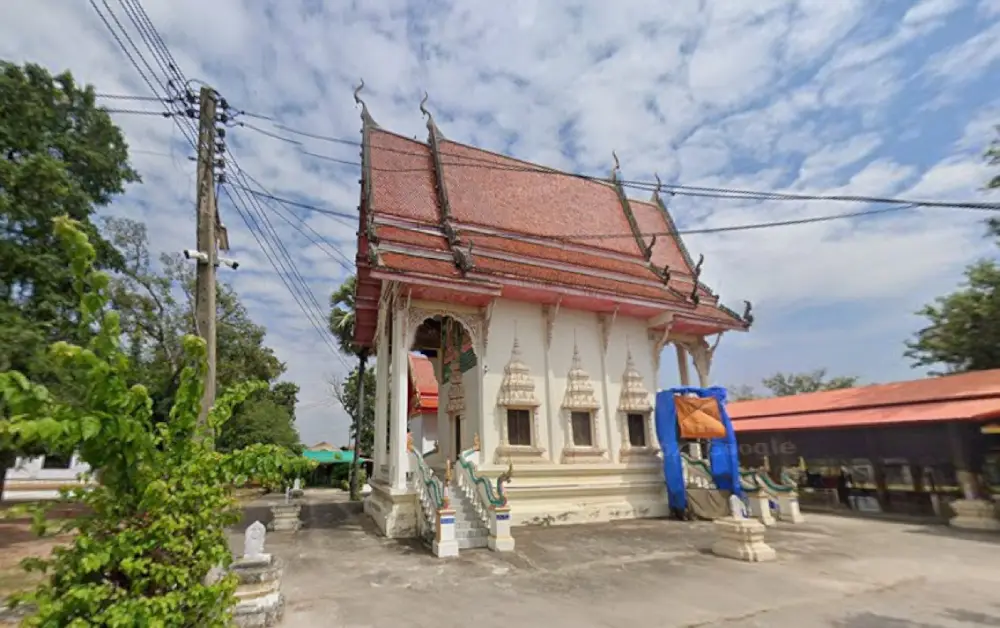
Wat Thep Rangsan
Open Days: Daily
Opening Hours: 08.00 – 17.00
Wat Thep Rangsan is located in Ban Hua Saphan, Ban Yang Subdistrict, Phutthaisong District, Buri Ram Province. It is an important community temple known for Luang Pho Khao, an old Buddha image made entirely of white lime plaster. The image was created around 1927 and has long been respected by the people of Ban Hua Saphan. For local villagers, Luang Pho Khao is not only a sacred Buddha image but also a spiritual center that connects the temple, the community, local faith, and the cultural life of Ban Yang Subdistrict.
Wat Thep Rangsan is a local Buddhist temple under the Mahanikaya order. It was established in 1915 and received its consecrated boundary in 1928. This makes it one of the long-standing temples in Phutthaisong District. The temple grounds cover about 8 rai, with an additional monastic land plot. Important temple structures include a sermon hall, monks’ residence, vihara, and multi-purpose pavilion. These buildings show that the temple has served not only as a place of worship but also as a community center for religious and social activities.
Luang Pho Khao is the spiritual heart of Wat Thep Rangsan. The image is made of white lime plaster, giving it a calm, pure, and simple appearance. Unlike highly decorated royal-style Buddha images, Luang Pho Khao reflects the faith and craftsmanship of a local community. Its value lies in its long connection with villagers, its role in daily worship, and its meaning as a sacred protector of Ban Hua Saphan.
The name Luang Pho Khao refers directly to the white appearance of the image. In Thai Buddhist culture, white often suggests purity, calmness, and mental clarity. When visitors come to pay respect, the image encourages them to slow down, calm the mind, and reflect on Buddhist values. This makes the experience of worship at Wat Thep Rangsan quiet, personal, and deeply connected with local devotion.
In the past, Luang Pho Khao served as the principal Buddha image in the old ordination hall. Over the years, the image became a witness to the religious life of the community. It has been present through ordinations, Kathin ceremonies, robe-offering events, merit-making days, Buddhist holy days, family prayers, and local acts of faith. Many people who visited the temple as children later returned with their own families, keeping the bond between the Buddha image and the community alive across generations.
The current abbot of Wat Thep Rangsan is Phra Khru Chotirot Koson Techapanyo. The temple has resident monks and continues to function as an active Buddhist temple. This is important because Wat Thep Rangsan is not a historical place separated from religious life. It remains a living temple where monks reside, villagers make merit, and local Buddhist ceremonies continue throughout the year.
Ban Hua Saphan is also well known for sericulture and silk weaving. The community has a strong reputation for mulberry cultivation, silkworm raising, silk reeling, dyeing, weaving, and silk product development. This makes the area around Wat Thep Rangsan culturally rich. A visitor can experience both Buddhist faith and local textile heritage in the same community. The temple and the silk village together reflect the deep relationship between religion, livelihood, family, and cultural identity in rural Isan.
The silk-learning community of Ban Hua Saphan includes several knowledge bases, such as mulberry cultivation and silkworm raising, silk reeling, silk weaving, dyeing, and product processing. These activities show that the village has preserved local craftsmanship and transmitted it to later generations. Wat Thep Rangsan stands within this cultural landscape, making it a meaningful stop for travelers who want to understand local life rather than visit only scenic or commercial attractions.
The people of Ban Hua Saphan respect Luang Pho Khao as a sacred image for blessings, safety, family well-being, and success in work. Worship at a community temple like this is often simple and sincere. Visitors may see local people making merit, offering flowers, lighting candles, or quietly praying. The atmosphere is not heavily commercialized. Its value lies in the continuing relationship between villagers and the sacred image that has watched over the community for many decades.
The temple buildings also reveal the development of Wat Thep Rangsan over time. The sermon hall was built in 1927 and has long served as a space for Dhamma talks, merit-making, community meetings, and religious gatherings. The monks’ residence supports monastic life, while the vihara and multi-purpose pavilion provide spaces for worship and community activities. These buildings show how a rural Thai temple functions as both a religious and social institution.
The sermon hall is especially important in a village temple. It is where people gather to listen to the Dhamma, join ceremonies, prepare community activities, and support temple events. Since Wat Thep Rangsan has had such a structure since the early twentieth century, the temple has clearly played a continuous role in the life of Ban Hua Saphan and Ban Yang Subdistrict.
Wat Thep Rangsan is also linked with local education. Ban Yang Subdistrict includes Wat Thep Rangsan School and Wat Thep Rangsan Child Development Center. This reflects a common role of Thai temples as places connected with learning and child development. In many communities, temples, schools, families, and local organizations work together. Wat Thep Rangsan therefore represents the broader social role of Buddhism in the community, not only its ritual role.
For travelers, Wat Thep Rangsan can be combined naturally with the Ban Hua Saphan silk community. A meaningful visit may begin with paying respect to Luang Pho Khao, then continue to learn about mulberry growing, silk reeling, dyeing, weaving, and local textile products. This kind of route helps visitors understand the community through both faith and craftsmanship. It is especially suitable for families, students, study groups, and cultural travelers.
The temple is also a practical stop in Phutthaisong District. From Buri Ram city, travel toward Phutthaisong District along National Highway 2226 for about 64 kilometers. After reaching Phutthaisong, continue along the Phutthaisong–Phayakkhaphum Phisai road, also used as the Phutthaisong bypass, for about 3 kilometers. The entrance to Wat Thep Rangsan is on the left. Turn left and continue for about 600 meters to reach the temple.
Wat Thep Rangsan is suitable for visitors interested in sacred local Buddha images, community temples, silk-culture routes, and the quieter side of Buri Ram’s Buddhist heritage. The temple is not defined by grandeur or luxury. Its strength lies in sincerity, continuity, and the faith of villagers who continue to honor Luang Pho Khao. For visitors seeking a genuine local temple experience, this is one of the meaningful places in Phutthaisong District.
A visit usually takes around 30 minutes to one hour. Visitors can pay respect to Luang Pho Khao, make merit, walk quietly around the temple grounds, and observe the local atmosphere. Those who want a deeper cultural experience should allow more time to visit the Ban Hua Saphan silk community or nearby cultural attractions in Phutthaisong.
Wat Hong, known for Phra Chao Yai, is one of the important nearby religious attractions. Phra Chao Yai is a respected old Buddha image at Wat Hong in Phutthaisong. Visiting both Luang Pho Khao at Wat Thep Rangsan and Phra Chao Yai at Wat Hong in the same trip allows travelers to see two important forms of local Buddhist devotion in the district.
Wat Manee Chan is another nearby temple that can be included in the same route. While Wat Thep Rangsan is known for Luang Pho Khao and community faith, Wat Manee Chan is known for its colored-glass decorated ordination hall. Together, the two temples show different cultural dimensions of Phutthaisong: sacred Buddha images, local art, community memory, and Buddhist devotion.
Visitors should dress respectfully when entering Wat Thep Rangsan. Shoulders and knees should be covered, shoes should be removed before entering sacred spaces, and voices should be kept low. Photography should be done respectfully, especially near Luang Pho Khao and around areas where monks or local worshippers are present. Because this is an active community temple, respectful conduct is essential.
Getting There from Buri Ram city is convenient by private car or rental car. Drive toward Phutthaisong District along National Highway 2226 for about 64 kilometers. At Phutthaisong, continue along the Phutthaisong–Phayakkhaphum Phisai road for about 3 kilometers. The temple entrance is on the left side of the road. Turn left and continue about 600 meters to Wat Thep Rangsan. Travelers without a private vehicle can first reach Phutthaisong town, then hire local transport to Ban Hua Saphan.
The best times to visit are morning and late afternoon. Morning visits are suitable for merit-making and quiet worship. Late afternoon is suitable for travelers who plan to visit the silk community or nearby sites during the day and end the route with a peaceful temple visit. If visiting during temple events or community activities, visitors should follow local guidance and respect the atmosphere of worship.
Restaurants, cafés, and local accommodations are available in Phutthaisong town and nearby subdistricts. Visitors can plan a meal before or after visiting the temple, then continue to nearby attractions such as Wat Hong, Wat Manee Chan, Bueng Sa Bua, Wat Pa Nong Bua Rong, Loeng Bo Water Park, Khlong Phang Chu, Dictionary Park, and Play La Ploen. Staying overnight in Phutthaisong makes it easier to explore the district without rushing.
For foreign travelers, Wat Thep Rangsan is a useful example of how Thai community temples function in real life. The temple connects a sacred Buddha image, monastic life, local education, child development, village ceremonies, and the silk-weaving culture of Ban Hua Saphan. It shows that Buddhism in Thailand is closely connected with daily life, local work, family memory, and the social structure of the village.
In summary, Wat Thep Rangsan is an important temple in Ban Hua Saphan, Ban Yang Subdistrict, Phutthaisong District, Buri Ram Province. It is best known for Luang Pho Khao, an old white lime-plaster Buddha image created around 1927. The temple was established in 1915, received its consecrated boundary in 1928, and remains active today with resident monks and community worship. Together with the silk culture of Ban Hua Saphan, Wat Thep Rangsan is a meaningful destination for visitors interested in sacred temples, local faith, and cultural travel in Phutthaisong.
| Name | Wat Thep Rangsan |
| Location | Ban Hua Saphan, Ban Yang Subdistrict, Phutthaisong District, Buri Ram Province, Thailand |
| Address | Ban Hua Saphan, Ban Yang Subdistrict, Phutthaisong District, Buri Ram 31120, Thailand |
| Highlights | Luang Pho Khao, an old white lime-plaster Buddha image highly respected by the people of Ban Hua Saphan |
| History | Wat Thep Rangsan was established in 1915 and received its consecrated boundary in 1928. Luang Pho Khao was created around 1927 and was formerly the principal Buddha image in the old ordination hall |
| Distinctive Features | A long-standing community temple with a sacred white Buddha image, important monastic structures, and a close connection with the Ban Hua Saphan silk-weaving community |
| Important Elements | Luang Pho Khao, sermon hall, vihara, monks’ residence, multi-purpose pavilion, worship area, and merit-making space |
| Luang Pho Khao | An old Buddha image made entirely of white lime plaster, created around 1927 and respected as a sacred image of Ban Hua Saphan community |
| Monastic Affiliation | Local Buddhist Temple, Mahanikaya Order |
| Temple Area | About 8 rai of temple land, with an additional monastic land plot |
| Important Structures | Sermon hall built in 1927, monks’ residence, vihara built in 1995, and multi-purpose pavilion for temple and community activities |
| Community Context | Ban Hua Saphan is known for mulberry cultivation, silkworm raising, silk reeling, silk weaving, dyeing, and silk product development |
| Abbot / Caretaker | Phra Khru Chotirot Koson Techapanyo |
| Resident Monks | 7 monks |
| Travel Information | From Buri Ram city, travel about 64 kilometers toward Phutthaisong District along National Highway 2226. From Phutthaisong, continue along the Phutthaisong–Phayakkhaphum Phisai road for about 3 kilometers, turn left at the temple entrance, and continue about 600 meters |
| Current Status | Open as an active local Buddhist temple and spiritual center of Ban Hua Saphan community |
| Open Days | Daily |
| Opening Hours | 08.00 – 17.00 |
| Facilities | Luang Pho Khao worship area, merit-making area, sermon hall, vihara, multi-purpose pavilion, temple courtyard, and parking area |
| Main Areas / Zones | Luang Pho Khao Worship Zone Sermon Hall Zone Vihara And Buddha Worship Zone Monks’ Residence Zone Multi-Purpose Pavilion Zone Temple Courtyard And Community Activity Zone Ban Hua Saphan Silk Community Connection Zone |
| Nearby Tourist Attractions | 1. Ban Hua Saphan Silk Tourism Community, about 1 km 2. Phra Chao Yai At Wat Hong / Wat Hong Buri Ram, about 4 km 3. Bueng Sa Bua, about 4 km 4. Wat Manee Chan, Ban Mafueng, about 5 km 5. Wat Pa Nong Bua Rong, about 14 km 6. Loeng Bo Water Park, Hai Sok Subdistrict, about 15 km 7. Khlong Phang Chu, Na Pho District, about 18 km 8. Dictionary Park, about 25 km 9. Play La Ploen, Khu Mueang District, about 35 km |
| Nearby Restaurants | 1. Growth Cafe’ Bistro & Bar, about 4 km, Tel. 096-168-7699 2. Bobby Bang Cafe Phutthaisong, about 4 km, Tel. 091-870-0587 3. Bypass Pub & Restaurant Phutthaisong, about 5 km, Tel. 081-877-8347 4. Hom Laeng Isan Food And Jim Jum Phutthaisong, about 5 km, Tel. 099-413-5396 5. Krua Baifern, Baifern Greenville, about 4 km, Tel. 091-870-0587 6. Baifern Phutthaisong, about 4 km, Tel. 044-655-434 |
| Nearby Accommodations | 1. Phufa Resort, about 2 km, Tel. 091-659-2466, 091-662-2646 2. Rachata Resort, about 5 km, Tel. 081-049-2045 3. Pho Fa Rung Resort, about 5 km, Tel. 089-424-0367 4. Prankamon Resort, about 9 km, Tel. 080-760-8833 5. Suan Palm Resort, about 10 km, Tel. 081-113-9806 6. Ban Suan Saen Suk Resort, about 6 km, Tel. 081-790-3041 |
Frequently Asked Questions (FAQ)
Q: Where is Wat Thep Rangsan located?
A: Wat Thep Rangsan is located in Ban Hua Saphan, Ban Yang Subdistrict, Phutthaisong District, Buri Ram Province, Thailand.
Q: What is Luang Pho Khao at Wat Thep Rangsan?
A: Luang Pho Khao is an old Buddha image made entirely of white lime plaster. It was created around 1927 and is highly respected by the people of Ban Hua Saphan.
Q: When was Wat Thep Rangsan established?
A: Wat Thep Rangsan was established in 1915 and received its consecrated boundary in 1928.
Q: Who is the abbot of Wat Thep Rangsan?
A: The abbot of Wat Thep Rangsan is Phra Khru Chotirot Koson Techapanyo.
Q: What are the opening hours of Wat Thep Rangsan?
A: Wat Thep Rangsan is open daily from 08.00 to 17.00.
Q: How is Wat Thep Rangsan connected with Ban Hua Saphan silk culture?
A: The temple is located in Ban Hua Saphan, a community known for mulberry cultivation, silkworm raising, silk reeling, dyeing, weaving, and silk product development.
Q: What attractions can be visited together with Wat Thep Rangsan?
A: Nearby attractions include Ban Hua Saphan Silk Tourism Community, Phra Chao Yai at Wat Hong, Bueng Sa Bua, Wat Manee Chan, Wat Pa Nong Bua Rong, Loeng Bo Water Park, Khlong Phang Chu, Dictionary Park, and Play La Ploen.
Q: How should visitors behave at Wat Thep Rangsan?
A: Visitors should dress respectfully, keep quiet, remove shoes in sacred areas, take photos respectfully, and treat the temple as an active spiritual center of Ban Hua Saphan community.
Mobile : 0986184933
 Mobile : 0986184933
 Category: ●Places of Worship
 Group: ●Temple
Last Update : 2 MonthAgo
 Last Update : 2 MonthAgo
 Click to Access the Navigation Map GPS
 Art, Culture and Heritage
 Historical Sites and Monuments(14)
 Landmarks and Memorials(2)
 Art, Craft Centres, Tradition(6)
 Museums(3)
 Educational Places
 Museum for Study(1)
Temple(74)
Museum for Study(1)
Temple(74)
 Other Sacred Sites(5)
 Suburban Living
 Village, Community(3)
 Nature and Wildlife
 National Parks and Marine Reserves(2)
 Mountain (Doi)(1)
 Dam, Reservoir, Lake(14)
 River, Canal(1)
 Bays and Beaches(1)
 Other natural attractions(2)
 Entertainment and Agricultural
 Animal camps and shows(1)
 Stadium(2)
 Farms, Parks and Ecotourism(2)
 Waterpark(1)


