
lovethailand home >Northeastern Travel Attractions >Buri Ram Travel Attractions >Phlap Pha Chai >Khok Khamin > Wat Khok Khamin
TL;DR: Wat Khok Khamin is located at Ban Khok Khamin, Khok Khamin Subdistrict, Phlapphla Chai District, Buri Ram 31250, open Daily, hours 08.00 – 17.00.

Wat Khok Khamin
Open Days: Daily
Opening Hours: 08.00 – 17.00
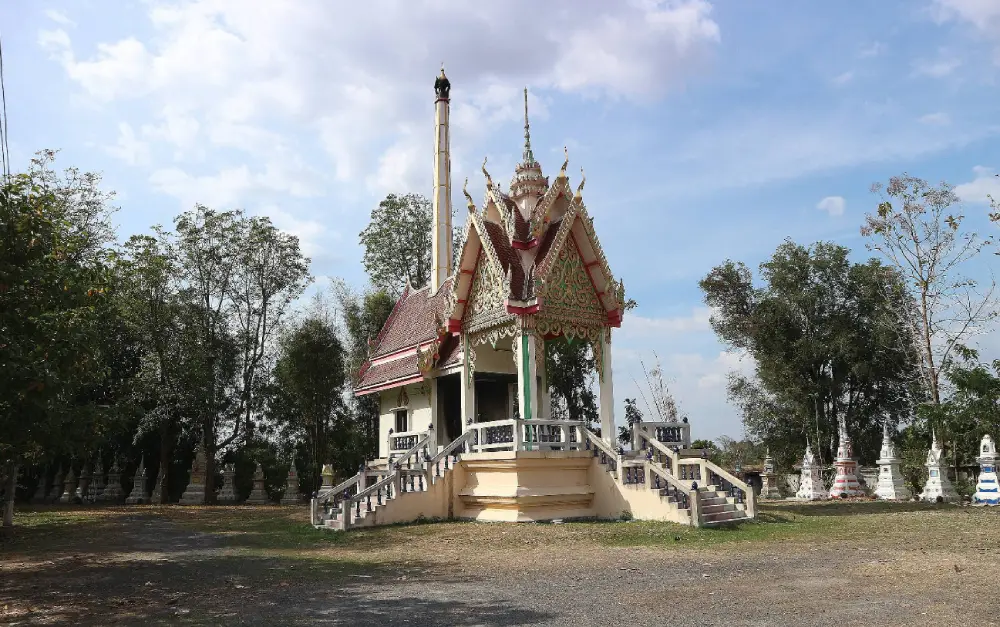
Wat Khok Khamin in Ban Khok Khamin, Khok Khamin Subdistrict, Phlapphla Chai District, Buri Ram Province, is an important community Buddhist temple and a local cultural site where ancient stone pillars are preserved. These stone pillars were discovered by villagers of Ban Khok Khamin and later kept at the temple so that local people could pay respect, worship, and learn from them. The temple is therefore more than a place for Buddhist ceremonies. It is also a community-based heritage space where faith, ancient objects, local memory, and the responsibility of the Khok Khamin local administration come together.
The most distinctive feature of Wat Khok Khamin is its role as the place where 5 ancient stone pillars are kept. These pillars are part of the cultural story of Phlapphla Chai District, whose local motto refers to the legend of stone pillars, Khmer Mahori music, fine silk weaving, and the Ta Tiaw waterway. For travelers, the temple offers a quiet but meaningful insight into how a rural community protects and interprets its own heritage. A visit here is not simply a temple stop; it is an opportunity to understand the cultural memory of Ban Khok Khamin and the wider Phlapphla Chai area.
Wat Khok Khamin is located in Moo 3, Ban Khok Khamin, Khok Khamin Subdistrict, Phlapphla Chai District, Buri Ram 31250. It is a community temple under the Mahanikaya order and was established in 1987. The temple stands within a quiet rural village environment where Buddhist practice and community life remain closely connected. Local people come here for merit-making, religious ceremonies, temple activities, and worship. At the same time, the temple serves as a place where the ancient stone pillars can be protected and made accessible for community learning.
For foreign travelers, Wat Khok Khamin is best understood as a local heritage temple rather than a major commercial attraction. Its value does not lie in large-scale architecture or tourist infrastructure. Instead, its importance comes from the way the villagers, monks, and local authorities have worked together to preserve ancient stone objects within a sacred community space. This makes the temple especially suitable for travelers interested in local history, community archaeology, rural Buddhist life, and cultural routes in southern Buri Ram.
The ancient stone pillars at Wat Khok Khamin were discovered by local villagers and later brought to the temple for safekeeping. Keeping them in a temple reflects a common pattern in Thai communities: sacred or historically meaningful objects are often entrusted to temples because temples are seen as safe, respected, and publicly accessible places. In this sense, Wat Khok Khamin functions both as a religious site and as a community guardian of local heritage.
The stone pillars are closely related to the broader “stone pillar legend” of Phlapphla Chai District. Local cultural information describes ancient stone pillars with carved Thep Phanom figures found in several areas, including Ban Mamang in Pa Chan Subdistrict, Ban Khok Ki in Sadao Subdistrict, and Wat Khok Khamin in Khok Khamin Subdistrict. Some of these pillars are now enshrined at Wat Phlapphla in Sadao Subdistrict, while 5 are kept at Wat Khok Khamin. This connection makes the temple one of the key places for understanding the stone pillar identity of Phlapphla Chai.
The phrase “stone pillar” in Phlapphla Chai is not merely a description of an old object. It has become part of the district’s cultural identity. It appears in local narratives, community traditions, district mottos, and even textile design. The stone pillar motif has inspired local silk patterns, showing how archaeological memory can be transformed into living culture. The pillars at Wat Khok Khamin therefore carry more than historical value; they are also part of local pride and cultural continuity.
The temple remains an active Buddhist community temple. It has 5 resident monks, and the current abbot is Phra Athikan Thoet Chakharo. This active monastic presence is important because the temple is not simply a storage place for ancient objects. It continues to serve the Buddhist life of the community through holy day ceremonies, merit-making, Kathin offerings, robe offerings, ordination-related activities, funerary rites, and village gatherings. The temple’s religious role and cultural role support each other.
The relationship between the temple, monks, villagers, and local administration gives Wat Khok Khamin several layers of meaning. Religiously, it is a Buddhist temple for worship and merit-making. Socially, it is a gathering place for the village. Culturally, it preserves ancient stone pillars. Educationally, it allows children, young people, and visitors to learn about local history from real objects in their own community. Seeing the temple through these layers helps visitors appreciate it more deeply than a quick sightseeing stop would allow.
Khok Khamin local administration has also been involved with the temple environment and community development. Local information refers to activities to improve the landscape of Wat Khok Khamin under the “Wat Pracharat Sang Suk” initiative, a temple-community cooperation model that promotes clean, orderly, and meaningful temple spaces. Such work helps the temple remain suitable both for religious use and for local cultural learning. It also shows that the preservation of heritage depends on practical community care, not only on historical interest.
The ancient stone pillars at Wat Khok Khamin should be treated as local heritage objects that require careful protection. Ancient objects cannot be replaced once damaged. If they are broken, moved without care, or handled improperly, both the physical object and the historical information it carries may be lost. The community’s decision to keep the pillars at the temple allows people to pay respect to them while also protecting them for future generations. This balance between worship and preservation is central to the temple’s value.
From a faith perspective, local people worship the pillars as sacred and auspicious objects. This reflects the way Thai communities often combine Buddhism, local belief, and respect for ancient things. The pillars are not treated merely as display objects. They are respected as part of the village’s spiritual and historical landscape. Visitors who come to see them should therefore approach with respect, understanding that these objects are meaningful to local people and not simply tourist curiosities.
The presence of the pillars inside the temple also creates a living learning environment. Children and young people in the community can see objects connected with their own local history without needing to travel to a large museum. This type of learning is valuable because it shows that history is not distant. It exists in the temple, in the village, and in the memories of elders. By preserving the pillars, the community preserves a bridge between past, present, and future.
Phlapphla Chai District has a rich cultural identity shaped by the legend of stone pillars, Khmer Mahori music, silk weaving, and the Ta Tiaw waterway. Wat Khok Khamin fits naturally into this cultural landscape. Travelers who visit the temple can extend their journey to other parts of the district, including Wat Phlapphla, sites related to ancient stone pillars, silk communities, Khmer music traditions, and natural attractions in nearby areas. This makes the temple a useful starting point for understanding the wider district.
Khmer Mahori music is another important cultural element of Phlapphla Chai. Although Wat Khok Khamin is best known for its stone pillars, the wider district is known for a combination of Thai-Khmer, Thai-Lao, and Thai-Suay cultural influences. Traditional music, silk weaving, local beliefs, and stone pillar legends all contribute to the identity of the area. A visit to Wat Khok Khamin can therefore open the way to a broader understanding of lower Isan culture in Buri Ram.
On ordinary days, Wat Khok Khamin offers a quiet and simple community temple atmosphere. Visitors can pay respect to the Buddha images, make merit, observe the ancient stone pillars, and take time to understand the rhythm of village life around the temple. During merit-making events or community activities, the temple becomes livelier as local people gather, prepare offerings, organize ceremonies, and meet one another. These scenes show that the temple’s value is found not only in its objects but also in the people who continue to use and care for the place.
Visitors who wish to photograph or study the stone pillars should do so respectfully. They should not touch, move, climb, scratch, or write on the pillars. These objects are both community heritage and sacred local items. Responsible behavior helps preserve them for future visitors and for the younger generations of Ban Khok Khamin. Cultural travel works best when travelers respect the meaning of the place for the people who live there.
Getting to Wat Khok Khamin is easiest by private car, motorcycle, or locally arranged transport. The temple is located in Khok Khamin Subdistrict, Phlapphla Chai District, where public transport is limited. From Phlapphla Chai town, travelers can use local roads toward Ban Khok Khamin. Those coming from Buri Ram city should plan their travel time carefully because the route includes district roads and rural sections. Starting in the morning is recommended for those who want to combine the temple with nearby attractions.
Getting There from Buri Ram city, travel toward Phlapphla Chai District and continue to Khok Khamin Subdistrict and Ban Khok Khamin. When using navigation apps, search for the full name Wat Khok Khamin, Khok Khamin Subdistrict, Phlapphla Chai District, Buri Ram, or use the location code Q6HP+P84. Since there are places with similar names elsewhere in Thailand, including the subdistrict and district in the search helps avoid confusion.
Visitors should allow at least 30 minutes to 1 hour for the temple, including time to pay respect, view the ancient stone pillars, and walk quietly around the temple grounds. Those who want to build a full-day cultural route can continue to Wat Phlapphla in Sadao Subdistrict, Prasat Chandum, the volcanic basalt columns of Buri Ram, Phanom Rung Historical Park, or Prasat Muang Tam. These places help connect local heritage, ancient architecture, and natural history in one travel route.
Wat Phlapphla is a particularly relevant nearby place for visitors interested in the stone pillar legend. Other ancient stone pillars are preserved there, making it a useful companion site to Wat Khok Khamin. Visiting both temples helps travelers understand that the stone pillar story is not limited to one village but belongs to a broader cultural landscape across Phlapphla Chai District.
Prasat Chandum adds another historical layer to the route. This ancient Khmer-related site reflects the presence of Khmer cultural influence in northeastern Thailand. If Wat Khok Khamin shows how a community preserves ancient pillars within a living temple, Prasat Chandum helps visitors see the architectural heritage of the wider region. Together, these places reveal the depth of Buri Ram’s local history beyond the most famous tourist landmarks.
The volcanic basalt columns of Buri Ram, located around Ban Khok Makha Ron in Sadao Subdistrict, offer a different but interesting comparison. The ancient pillars at Wat Khok Khamin are cultural objects, while the basalt columns are a geological formation. Visiting both places allows travelers to see two different meanings of “stone pillars” in Buri Ram: one shaped by human culture and belief, the other shaped by volcanic nature.
Food options around Phlapphla Chai include local restaurants and cafés. Nearby choices include Pha Rabiang Khiang Nam at Huai Tabaek Water Park in Khok Khamin Subdistrict, Khrua Dui Dui in Phlapphla Chai, Truthom in Chandum Subdistrict, Khrua Thiang Na Buffet 2 in the Sadao area, and Natee Cafe Buriram for those continuing toward broader travel routes. Planning food stops in advance is useful because the area is rural and restaurants may be spread out.
Accommodation options are available in Phlapphla Chai and nearby Prakhon Chai. In Phlapphla Chai, Huk Koon Resort and Orchid Homestay Buriram are practical options for travelers who want to stay near Wat Khok Khamin and Wat Phlapphla. Those who prefer more hotel choices can stay in Prakhon Chai, where Hotel de l’amour Buriram and other accommodations provide convenient access to Phanom Rung Historical Park, Prasat Muang Tam, and other major attractions in southern Buri Ram.
Before visiting, travelers should remember that Wat Khok Khamin is a community temple, not a large museum or commercial tourist attraction. Visitors should dress modestly, speak quietly, respect monks and villagers, and ask local people politely if they want to enter a specific area. This respectful attitude is especially important when viewing the ancient stone pillars, because they are meaningful objects for the community and should be treated with care.
The value of Wat Khok Khamin lies in the way it connects faith and local history. The ancient stone pillars give the temple a clear cultural dimension. The monks and villagers keep the temple alive as a religious space. The local administration supports the care of the temple environment. Visitors who come to pay respect and learn from the site help confirm that local heritage remains meaningful when people continue to value and protect it.
As a cultural travel destination, Wat Khok Khamin is a good example of a small community site that should not be overlooked. Places like this often preserve stories that do not appear in major tourist routes. A local temple may hold ancient objects, village legends, living memory, and a practical role in everyday community life. Visiting Wat Khok Khamin allows travelers to listen more closely to local voices and understand Buri Ram through its smaller, quieter cultural places.
Wat Khok Khamin is suitable for travelers who want to explore a deeper and quieter side of Buri Ram. Those interested in community history, ancient objects, local temples, lower Isan culture, silk traditions, Khmer-influenced culture, and the stone pillar legend of Phlapphla Chai will find the temple meaningful. The visit becomes more rewarding when travelers take time to understand the context, view the pillars respectfully, and recognize that every preserved local object carries meaning for the people of the area.
For these reasons, Wat Khok Khamin is more than the village temple of Ban Khok Khamin. It is a place of faith, a guardian of ancient stone pillars, and a cultural classroom for Phlapphla Chai District. The pillars discovered by villagers and preserved at the temple continue to remind visitors that community heritage survives when local people and respectful travelers help protect, understand, and pass it on to future generations.
| Name | Wat Khok Khamin |
| Location | Ban Khok Khamin, Khok Khamin Subdistrict, Phlapphla Chai District, Buri Ram 31250 |
| Address | Ban Khok Khamin, Moo 3, Khok Khamin Subdistrict, Phlapphla Chai District, Buri Ram Province, Thailand |
| Coordinates / Location Code | Q6HP+P84, Khok Khamin Subdistrict, Phlapphla Chai District, Buri Ram |
| Highlights | A community Buddhist temple preserving 5 ancient stone pillars discovered by villagers, open for worship and local heritage learning |
| History | Wat Khok Khamin was established in 1987 under the Mahanikaya order and became the local place where ancient stone pillars discovered by Ban Khok Khamin villagers are preserved |
| Name Origin | The temple is named after Ban Khok Khamin and Khok Khamin Subdistrict, the community where the temple stands and where the ancient stone pillars were found |
| Distinctive Features | A rural lower Isan community temple with religious, social, and heritage-preservation roles |
| Important Ancient Objects | 5 ancient stone pillars discovered by local villagers and kept at Wat Khok Khamin for worship and learning by future generations |
| Traditions / Rituals | Buddhist holy day merit-making, Kathin ceremony, robe offering, community merit-making activities, and respectful worship of the ancient stone pillars for auspiciousness |
| Travel Information | From Buri Ram city, travel toward Phlapphla Chai District, then continue to Khok Khamin Subdistrict and Ban Khok Khamin. Private car, motorcycle, or locally arranged transport is recommended. Search with the full temple name, subdistrict, and district to avoid confusion |
| Current Status | An active community Buddhist temple with resident monks and a place where the ancient stone pillars of Ban Khok Khamin are preserved |
| Open Days | Daily |
| Opening Hours | 08.00 – 17.00 |
| Facilities | Religious activity area, temple grounds, ancient stone pillar worship area, and community activity space |
| Main Areas / Zones | Buddhist worship area, religious activity area, ancient stone pillar preservation area, temple courtyard, and community activity area |
| Abbot / Caretaker | Phra Athikan Thoet Chakharo |
| Resident Monks | 5 monks |
| Local Administrative Contact | Khok Khamin Municipality, Tel. 044-666-300 |
| Nearby Tourist Attractions | 1. Wat Phlapphla, Sadao Subdistrict, about 13 km 2. Prasat Chandum, Chandum Subdistrict, about 14 km 3. Buri Ram Volcanic Basalt Columns, Ban Khok Makha Ron, Sadao Subdistrict, about 24 km 4. Phanom Rung Historical Park, about 43 km 5. Prasat Muang Tam, about 40 km |
| Nearby Restaurants | 1. Pha Rabiang Khiang Nam, Huai Tabaek Water Park, Phlapphla Chai, about 4 km, Tel. 094-904-6606, 063-763-6555 2. Khrua Dui Dui, Phlapphla Chai, about 9 km, Tel. 092-519-8064 3. Truthom, Chandum Subdistrict, about 14 km, Tel. 065-641-6897 4. Khrua Thiang Na Buffet 2, Sadao Area, Phlapphla Chai, about 15 km, Tel. 092-887-5041 5. Natee Cafe Buriram, about 25 km, Tel. 098-197-8004 |
| Nearby Accommodations | 1. Huk Koon Resort, Phlapphla Chai District, about 13 km, Tel. 063-762-8882, 082-923-6827 2. Orchid Homestay Buriram No.1, Sadao Subdistrict, about 16 km 3. Orchid Homestay Buriram No.2, Sadao Subdistrict, about 16 km 4. Stay Ban Posai with Pool, Prakhon Chai District, about 26 km 5. Hotel de l’amour Buriram, Prakhon Chai District, about 28 km, Tel. 044-651-555, 098-102-7809 |
Frequently Asked Questions (FAQ)
Q: Where is Wat Khok Khamin located?
A: Wat Khok Khamin is located in Ban Khok Khamin, Moo 3, Khok Khamin Subdistrict, Phlapphla Chai District, Buri Ram Province 31250.
Q: Why is Wat Khok Khamin important?
A: It is an important community temple and the place where 5 ancient stone pillars discovered by local villagers are preserved for worship and learning.
Q: What are the ancient stone pillars at Wat Khok Khamin used for?
A: They are preserved for public worship, auspicious devotion, and local heritage education for future generations.
Q: Who is the abbot of Wat Khok Khamin?
A: The abbot is Phra Athikan Thoet Chakharo, and the temple has 5 resident monks.
Q: What are the opening days and opening hours of Wat Khok Khamin?
A: The temple is open daily from 08.00 to 17.00. It is suitable for worship, merit-making, and respectful viewing of the ancient stone pillars.
Q: What nearby attractions can visitors combine with Wat Khok Khamin?
A: Visitors can combine the trip with Wat Phlapphla, Prasat Chandum, the Buri Ram volcanic basalt columns, Phanom Rung Historical Park, and Prasat Muang Tam.
Q: How can travelers get to Wat Khok Khamin?
A: From Buri Ram city, travel toward Phlapphla Chai District, then continue to Khok Khamin Subdistrict and Ban Khok Khamin. A private car, motorcycle, or locally arranged transport is recommended.
Q: How should visitors behave when viewing the ancient stone pillars?
A: Visitors should dress modestly, keep their voices low, avoid touching, moving, climbing, scratching, or writing on the pillars, and respect the temple and local community.
 Category: ●Places of Worship
 Group: ●Temple
Last Update : 3 MonthAgo
 Last Update : 3 MonthAgo
 Click to Access the Navigation Map GPS
 Art, Culture and Heritage
 Historical Sites and Monuments(14)
 Landmarks and Memorials(2)
 Art, Craft Centres, Tradition(6)
 Museums(3)
 Educational Places
 Museum for Study(1)
Temple(74)
Museum for Study(1)
Temple(74)
 Other Sacred Sites(5)
 Suburban Living
 Village, Community(3)
 Nature and Wildlife
 National Parks and Marine Reserves(2)
 Mountain (Doi)(1)
 Dam, Reservoir, Lake(14)
 River, Canal(1)
 Bays and Beaches(1)
 Other natural attractions(2)
 Entertainment and Agricultural
 Animal camps and shows(1)
 Stadium(2)
 Farms, Parks and Ecotourism(2)
 Waterpark(1)


