
lovethailand home >Northeastern Travel Attractions >Buri Ram Travel Attractions >Prakhon Chai >Ban Sai > Wat Pa Ban Paiboon
TL;DR: Wat Pa Ban Paiboon is located at Ban Paiboon, Moo 9, Ban Sai Subdistrict, Prakhon Chai District, Buri Ram Province, Thailand, open Daily, hours 08.00 – 17.00.

Wat Pa Ban Paiboon
Open Days: Daily
Opening Hours: 08.00 – 17.00
Wat Pa Ban Paiboon, also known as Wat Pa Paiboon, is located in Ban Paiboon, Moo 9, Ban Sai Subdistrict, Prakhon Chai District, Buri Ram Province. Established in 1959, the temple stands beside the Prakhon Chai–Buri Ram highway around kilometer 13. It is a meaningful forest temple for the local community, serving as a place for worship, merit-making, moral training, meditation, and quiet spiritual reflection. For travelers moving between Buri Ram city and Prakhon Chai, this temple offers a peaceful stop along the main route.
The origin of Wat Pa Ban Paiboon is closely tied to the faith of local villagers. Devoted residents donated approximately 16 rai of land to establish the temple. Later, a public forest area adjoining the temple, covering about 15 rai, was also placed under the temple’s care. This gave the temple a broad and naturally shaded setting, allowing it to preserve the atmosphere of a forest monastery while remaining conveniently accessible from the main road.
After the land was offered, villagers invited Luang Pu Suk Parisuttho to become the first abbot. The temple was named Wat Pa Ban Paiboon and affiliated with the Mahanikaya order. Luang Pu Suk played the foundational role in transforming the donated land and nearby forest into a Buddhist temple, a residence for monks, and a spiritual center for Ban Paiboon and neighboring communities.
The identity of Wat Pa Ban Paiboon is shaped by its forest-temple character. In Thailand, the term “wat pa” refers not only to a temple surrounded by trees, but also to a religious environment that supports calmness, simplicity, mindfulness, and meditation. Wat Pa Ban Paiboon represents this idea clearly. Although it is located beside a busy highway, the temple grounds retain a quiet and shaded atmosphere that helps visitors step away from the pace of travel and return to a more reflective state of mind.
Wat Pa Ban Paiboon also has an important educational and spiritual role. It has functioned as a moral and ethics training center, known locally as a Buddhist youth camp or “khai phutthabut.” It is also associated with the provincial meditation network as a designated meditation practice center in Buri Ram Province. These roles make the temple more than a place for ordinary merit-making. It is also a place where young people, local residents, and Buddhist practitioners learn discipline, morality, mindfulness, and the basic principles of Buddhist living.
The list of abbots shows the continuous development of the temple. Luang Pu Suk Parisuttho served from 1959 to 1991. Phra Ajarn Phongsakon Kalyanadhammo followed from 1991 to 2005. Phra Ajarn Narin Katapunno served as acting abbot from 2005 to 2008. Phra Ajarn Boontha Intapanyo cared for the temple and training center from 2005 to 2010. Since 2010, Phra Maha Luean Yasodharo has served as the current abbot.
Each period of leadership contributed to a different layer of the temple’s identity. Luang Pu Suk established the temple’s original foundation. Phra Ajarn Phongsakon helped expand the work of teaching and moral training. Phra Ajarn Boontha supported the training center during an important transitional period. Phra Maha Luean Yasodharo continues to guide the temple today as a place of worship, education, meditation, and community faith.
Phra Maha Luean Yasodharo is the current abbot of Wat Pa Ban Paiboon. His role includes looking after the temple, guiding monastic life, coordinating with lay supporters, and maintaining the temple’s mission as a center for Buddhist practice and moral education. The presence of an abbot with a strong teaching role helps the temple continue serving both local worshippers and those who come for meditation and Buddhist learning.
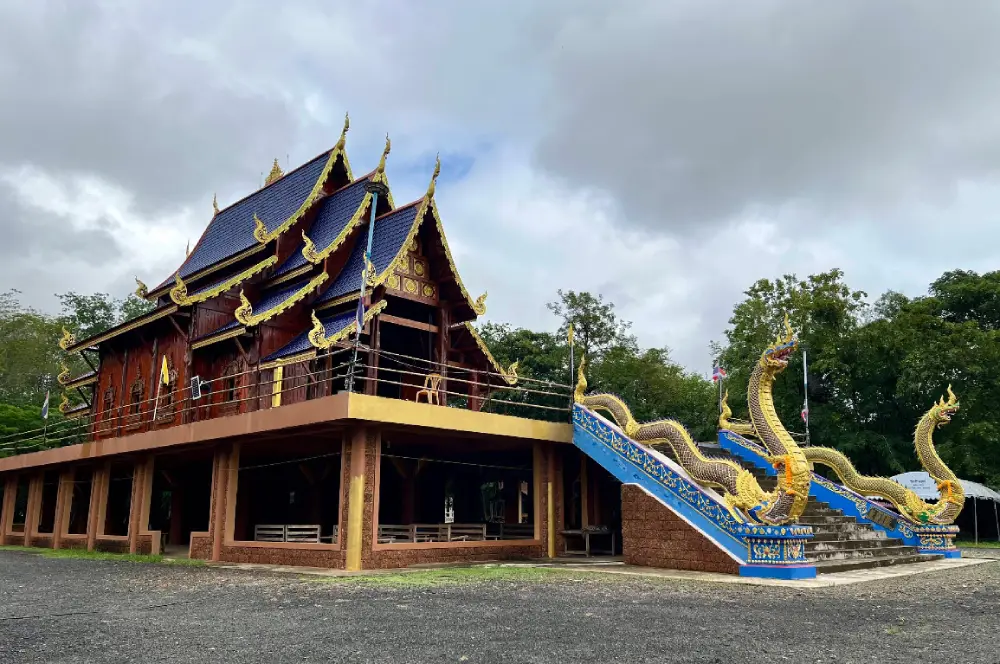
One of the most memorable features of the temple is its teakwood ordination hall. The wooden structure fits naturally with the forest-temple atmosphere and gives the temple a warm, calm, and traditional character. Inside the worship area, visitors can pay respect to the principal Buddha image. The combination of wood, forest shade, and sacred space makes the temple feel peaceful and grounded in nature.
The teakwood ordination hall has symbolic meaning. In a forest temple, religious architecture should support stillness rather than overwhelm the visitor. Wood helps create an atmosphere of gentleness and closeness to nature. At Wat Pa Ban Paiboon, the ordination hall therefore functions not only as a ritual building, but also as a space that encourages calmness, respect, and mindfulness.
The principal Buddha image is another important focus of devotion. Visitors usually begin by paying respect to the Buddha image, making merit, and taking a moment to calm the mind. For local Buddhists, this act is not only a ritual, but also a way to reconnect with goodness, gratitude, and inner balance. In the setting of Wat Pa Ban Paiboon, the worship experience feels especially quiet because of the surrounding forest atmosphere.
The temple’s role as a moral training center is especially important for the community. Buddhist youth camps teach children and young people about morality, discipline, respect, mindfulness, and living with responsibility. Such activities make the temple part of local education. It supports not only religious ceremonies but also the formation of good habits and ethical awareness among younger generations.
As a meditation-oriented temple, Wat Pa Ban Paiboon is suitable for visitors who want to experience the calm side of Thai Buddhism. Meditation practice in Thai forest temples often emphasizes simplicity, quiet observation, and awareness of the mind. The shaded temple grounds, forest areas, and simple atmosphere help create a setting where visitors can slow down and reflect, even during a short visit.
The location of the temple is practical. It lies along the route between Buri Ram city and Prakhon Chai District, making it easy to include in a cultural or spiritual itinerary. Travelers heading toward Prasat Muang Tam, Phanom Rung Historical Park, or the old temples of Prakhon Chai can stop at Wat Pa Ban Paiboon for worship and rest before continuing their journey.
Wat Pa Ban Paiboon is different from many old temples in Prakhon Chai town. Temples such as Wat Khon, Wat Pho, Wat Champa, Wat Chai Mongkhon, and Wat Ta Dan are known for their old community histories, sacred images, or historical buildings. Wat Pa Ban Paiboon is distinctive because of its forest-temple setting, its moral training work, its meditation role, and its peaceful roadside location between Buri Ram and Prakhon Chai.
Inside the temple, the main areas include the Buddha worship area, teakwood ordination hall, shaded forest area, moral training center, meditation area, monks’ residences, and community activity grounds. These areas allow the temple to serve several purposes at once: worship, meditation, education, monastic residence, and local religious events. This multi-functional character is common in meaningful Thai community temples.
Visitors should behave respectfully when entering Wat Pa Ban Paiboon. Shoulders and knees should be covered, shoes should be removed before entering sacred areas, and voices should be kept low. Because the temple is used for meditation and moral training, visitors should avoid loud behavior, disruptive photography, or actions that disturb monks, trainees, or local worshippers.
The best time to visit is in the morning or late afternoon. Morning visits are suitable for merit-making and quiet reflection, while late afternoon visits work well for travelers returning from Prakhon Chai or Phanom Rung. During temple training or meditation activities, visitors should be especially mindful of the quiet atmosphere and share the space respectfully with participants.
Getting There is convenient by private car, rental car, or local transport. From Prakhon Chai District, follow the Prakhon Chai–Buri Ram highway. The temple is located around kilometer 13 in Ban Paiboon, Ban Sai Subdistrict. From Buri Ram city, drive toward Prakhon Chai along the same main road. Travelers without a private car can take public transport between Buri Ram and Prakhon Chai, then hire local transport to the temple.
Wat Pa Ban Paiboon can be included in a full cultural route through southern Buri Ram. Travelers may stop at the temple before continuing to Nong Ra Sae San Lake Park, Wat Ta Dan, Wat Khon, Wat Pho, Wat Champa, Prasat Muang Tam, Kok Muang Hermitage, and Phanom Rung Historical Park. This route combines forest-temple practice, old community temples, local beliefs, and ancient Khmer heritage in one journey.
Food and accommodation options are mostly located in Prakhon Chai town and Buri Ram city. Travelers can plan a meal in Prakhon Chai before or after visiting the temple, then continue to historical attractions. Those who wish to explore Phanom Rung and Prasat Muang Tam at a slower pace may stay overnight in Prakhon Chai, while travelers who prefer a wider range of urban facilities may stay in Buri Ram city.
For foreign visitors, Wat Pa Ban Paiboon offers a useful introduction to the forest-temple side of Thai Buddhism. It shows that Thai temples are not only places for worshipping Buddha images, but also spaces for moral education, meditation, self-discipline, and community training. The temple’s forest atmosphere, training center, and long line of abbots reveal how Buddhism continues to support daily life at the local level.
Overall, Wat Pa Ban Paiboon is a meaningful temple for those interested in Buddhist practice, forest temples, community faith, and cultural travel in southern Buri Ram. Its history begins with villagers donating land in 1959, continues through the leadership of Luang Pu Suk Parisuttho and later abbots, and remains active today under Phra Maha Luean Yasodharo. Its shaded grounds, teakwood ordination hall, moral training center, and meditation role make it an important spiritual stop between Buri Ram city and Prakhon Chai.
| Name | Wat Pa Ban Paiboon / Wat Pa Paiboon |
| Location | Ban Paiboon, Moo 9, Ban Sai Subdistrict, Prakhon Chai District, Buri Ram Province, Thailand |
| Address | Moo 9, Ban Sai Subdistrict, Prakhon Chai District, Buri Ram 31140, Thailand |
| Road Location | Beside the Prakhon Chai–Buri Ram highway, around kilometer 13 |
| Highlights | A peaceful forest temple with shaded grounds, a teakwood ordination hall, a principal Buddha image, a moral training center, and a meditation-oriented atmosphere |
| History | Established in 1959 through the faith of local villagers who donated about 16 rai of land. An adjoining public forest area of about 15 rai was later placed under the temple’s care. Luang Pu Suk Parisuttho was invited as the first abbot |
| Monastic Affiliation | Mahanikaya |
| Temple Area | About 16 rai of donated temple land and about 15 rai of adjoining public forest area under temple care |
| Distinctive Features | Forest-temple setting, shaded grounds, teakwood ordination hall, principal Buddha image, moral and ethics training center, and provincial meditation practice role |
| Important Elements | Principal Buddha image, teakwood ordination hall, forest area, moral training center, meditation area, monks’ residences, and community activity grounds |
| Line of Abbots / Caretakers | 1. Luang Pu Suk Parisuttho, 1959 – 1991 2. Phra Ajarn Phongsakon Kalyanadhammo, 1991 – 2005 3. Phra Ajarn Narin Katapunno, Acting Abbot, 2005 – 2008 4. Phra Ajarn Boontha Intapanyo, Temple and Training Center Caretaker, 2005 – 2010 5. Phra Maha Luean Yasodharo, 2010 – Present |
| Abbot / Current Caretaker | Phra Maha Luean Yasodharo |
| Travel Information | Accessible by private car, rental car, or local transport. From Prakhon Chai, follow the Prakhon Chai–Buri Ram highway to around kilometer 13 in Ban Paiboon, Ban Sai Subdistrict. Travelers without a car can use public transport between Buri Ram and Prakhon Chai, then hire local transport |
| Current Status | Open as a forest temple, local Buddhist temple, moral training center, and meditation practice site |
| Open Days | Daily |
| Opening Hours | 08.00 – 17.00 |
| Facilities | Worship area, merit-making area, ordination hall, forest area, moral training center, meditation area, temple courtyard, and parking area |
| Main Areas / Zones | Buddha image and ordination hall zone Shaded forest zone Moral and ethics training center zone Meditation zone Monks’ residence zone Community activity courtyard |
| Main Contact Number | 098-509-3844 |
| Official Website / Official Page | Facebook: Wat Pa Paiboon |
| Nearby Tourist Attractions | 1. Nong Ra Sae San Lake Park, about 13 km 2. Wat Ta Dan, about 14 km 3. Wat Khon, about 15 km 4. Wat Pho, about 15 km 5. Wat Champa, about 16 km 6. Khao Kradong Forest Park, about 24 km, Tel. 081-470-1022 7. Prasat Muang Tam, about 30 km 8. Phanom Rung Historical Park, about 35 km |
| Nearby Restaurants | 1. Chai Rad Na, about 14 km, Tel. 091-336-0108 2. LuckyCafe, about 14 km, Tel. 094-025-7497 3. Panarin Roasted Duck Noodles Prakhonchai Angtia, about 15 km, Tel. 095-636-5497, 081-869-6175 4. Goody n’ Bakey, about 15 km, Tel. 094-297-8999 5. Jungle Cafe Prakhon Chai, about 16 km, Tel. 062-414-5461 6. Laang Wang Prakhon Chai, about 17 km, Tel. 084-605-4324 |
| Nearby Accommodations | 1. Hotel de l’amour Buriram, about 13 km, Tel. 044-651-555, 098-102-7809 2. Eireann Boutique Hotel, about 13 km, Tel. 044-666-199, 087-493-9919 3. Prakhonchai Resort Hotel, about 15 km, Tel. 044-671-288, 081-955-9089 4. Sohground Boutique Resort, about 17 km, Tel. 080-488-3183 5. New PKC Resort, about 14 km |
Frequently Asked Questions (FAQ)
Q: Where is Wat Pa Ban Paiboon located?
A: Wat Pa Ban Paiboon is located in Ban Paiboon, Moo 9, Ban Sai Subdistrict, Prakhon Chai District, Buri Ram Province, beside the Prakhon Chai–Buri Ram highway around kilometer 13.
Q: When was Wat Pa Ban Paiboon established?
A: Wat Pa Ban Paiboon was established in 1959 through the faith of local villagers who donated land for the temple and later placed an adjoining public forest area under the temple’s care.
Q: Who is the current abbot of Wat Pa Ban Paiboon?
A: The current abbot is Phra Maha Luean Yasodharo, who has served from 2010 to the present.
Q: What is the main highlight of Wat Pa Ban Paiboon?
A: The main highlights are its peaceful forest-temple atmosphere, teakwood ordination hall, principal Buddha image, moral training center, and meditation practice role.
Q: What are the opening hours of Wat Pa Ban Paiboon?
A: Wat Pa Ban Paiboon is open daily from 08.00 to 17.00.
Q: What attractions can be visited together with Wat Pa Ban Paiboon?
A: Nearby attractions include Nong Ra Sae San Lake Park, Wat Ta Dan, Wat Khon, Wat Pho, Wat Champa, Khao Kradong Forest Park, Prasat Muang Tam, and Phanom Rung Historical Park.
Q: What type of travelers should visit Wat Pa Ban Paiboon?
A: Wat Pa Ban Paiboon is suitable for travelers interested in forest temples, merit-making, meditation, Buddhist moral education, peaceful temple visits, and cultural routes between Buri Ram and Prakhon Chai.
Q: How should visitors behave at Wat Pa Ban Paiboon?
A: Visitors should dress respectfully, cover shoulders and knees, remove shoes in sacred areas, keep quiet in meditation zones, and behave respectfully toward monks and worshippers.
Mobile : 0985093844
 Mobile : 0985093844
 Category: ●Places of Worship
 Group: ●Temple
Last Update : 1 MonthAgo
 Last Update : 1 MonthAgo
 Click to Access the Navigation Map GPS
 Art, Culture and Heritage
 Historical Sites and Monuments(14)
 Landmarks and Memorials(2)
 Art, Craft Centres, Tradition(6)
 Museums(3)
 Educational Places
 Museum for Study(1)
Temple(74)
Museum for Study(1)
Temple(74)
 Other Sacred Sites(5)
 Suburban Living
 Village, Community(3)
 Nature and Wildlife
 National Parks and Marine Reserves(2)
 Mountain (Doi)(1)
 Dam, Reservoir, Lake(14)
 River, Canal(1)
 Bays and Beaches(1)
 Other natural attractions(2)
 Entertainment and Agricultural
 Animal camps and shows(1)
 Stadium(2)
 Farms, Parks and Ecotourism(2)
 Waterpark(1)


