
lovethailand home >Northeastern Travel Attractions >Buri Ram Travel Attractions >Prakhon Chai >Pang Ku > Wat Ban Pang Ku
TL;DR: Wat Ban Pang Ku is located at Pang Ku Subdistrict, Prakhon Chai District, Buri Ram Province, Thailand, open Daily, hours 08.00 – 17.00.
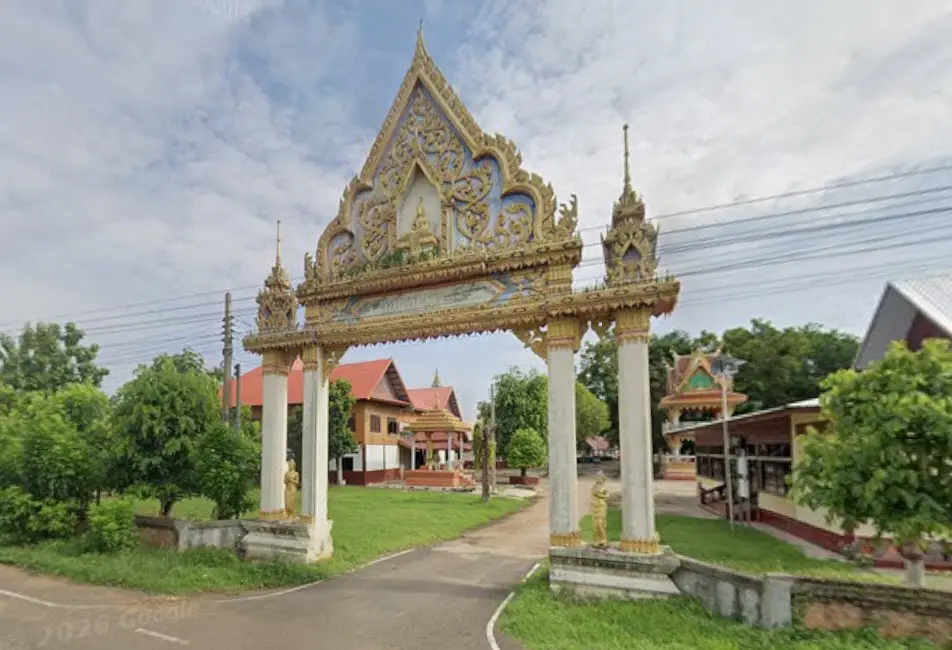
Wat Ban Pang Ku
Open Days: Daily
Opening Hours: 08.00 – 17.00
Wat Ban Pang Ku, also known as Wat Pang Ku, is located in Pang Ku Subdistrict, Prakhon Chai District, Buri Ram Province. It is a meaningful community temple known for its sacred Buddha image carved from golden ironwood, locally associated with takhian thong wood. This wooden Buddha image is larger than a human body and has a distinctive structure in which the base and the main Buddha figure are separated. The base is richly carved with symbolic Buddhist and local motifs, including Phra Thorani wringing her hair on the left side, a Buddha image in the Subduing Mara posture on the right side, Rahu swallowing the moon on the back, and a royal-attired Buddha image representing the power of spiritual aspiration. For the people of Ban Pang Ku, this image is not only an object of worship, but also a precious cultural treasure and a source of community pride.
Wat Ban Pang Ku is valuable because it preserves a rare example of local wooden Buddhist art. In Thailand, Buddha images are often made from bronze, stucco, sandstone, or laterite, while large wooden Buddha images require careful preservation over time. The presence of a large takhian thong wood Buddha image in this temple shows the depth of local devotion and the care with which the community has maintained this sacred object. The image reflects not only Buddhist faith, but also the craftsmanship, imagination, and cultural identity of the people of Pang Ku.
Takhian thong wood holds special meaning in Thai culture. It is valued for its strength, beauty, and durability, and it is also surrounded by local beliefs about sacred power. When such wood is carved into a Buddha image, the result becomes meaningful in both religious and artistic terms. The Buddha image at Wat Ban Pang Ku therefore carries multiple layers of value: it is a sacred object, a work of local craftsmanship, and a symbol of the community’s spiritual heritage.
The most striking feature of the Buddha image is its composition. The main figure is larger than a human body, creating a strong impression of presence and dignity. The separated base allows the carved details to be seen clearly. This base is not merely a support for the image. It functions as a visual narrative, carrying Buddhist stories and local symbols that deepen the meaning of the entire work.
On the left side of the base is the figure of Phra Thorani wringing her hair. In Buddhist tradition, this scene refers to the moment before the Buddha’s enlightenment, when the Earth Goddess bore witness to the Buddha’s accumulated merit. By including Phra Thorani on the base, the artisan connected the wooden Buddha image with the theme of spiritual victory and the power of accumulated virtue. This makes the image especially meaningful for devotees who come to pay respect and reflect on perseverance, merit, and faith.
On the right side of the base is a Buddha image in the Subduing Mara posture. This posture is one of the most important in Thai Buddhist art. It represents the Buddha’s victory over temptation, fear, and inner disturbance through spiritual perfection rather than physical force. The presence of this posture reinforces the message of inner strength and moral triumph, making the wooden Buddha image of Wat Ban Pang Ku especially powerful in its symbolic meaning.
The back of the base is carved with Rahu swallowing the moon, a motif that reflects Thai and regional cosmological beliefs. Rahu is often associated with eclipse, change, fate, and the shifting forces of the universe. Its appearance on a Buddhist object shows how local beliefs and Buddhist art can coexist within a single sacred image. At Wat Ban Pang Ku, this combination gives the Buddha image a distinctive local character that differs from more formal temple art.
The royal-attired Buddha image carved into the composition adds another important layer. In Thai Buddhist art, a royal-attired Buddha often represents supreme spiritual dignity, accumulated merit, and the majesty of enlightenment. Within the context of Wat Ban Pang Ku, this element expresses the idea of adhitthana parami, or the perfection of resolute aspiration. Together with the golden ironwood material and the surrounding symbolic carvings, it creates a powerful image of faith, beauty, and local identity.
Wat Ban Pang Ku is an active local Buddhist temple. The current abbot is Phra Sumet Sannyato, and monks continue to reside at the temple. This is important because the sacred wooden Buddha image remains part of a living religious environment. It is not displayed as a museum object separated from worship. Instead, it continues to be respected within the daily Buddhist life of the community through merit-making, prayer, temple activities, and local devotion.
For the people of Ban Pang Ku, the Buddha image is a source of collective pride. It represents the artistic and spiritual inheritance of the village. Community pride in such a sacred object is common in Thai local culture, where temples often preserve important images, relics, or objects that become closely tied to the identity of the village. At Wat Ban Pang Ku, the golden ironwood Buddha image gives the community a clear cultural landmark and a meaningful place of worship.
The Buddha image is also significant for those interested in folk art. It does not need to be understood only through formal royal art traditions. Instead, it should be appreciated as a work of local Buddhist creativity. The carving reflects how local artisans interpreted Buddhist stories, sacred symbols, and community beliefs through wood. This gives the image a unique character that is different from mass-produced temple objects or highly formalized religious art.
Visitors should take time to observe the image carefully. Begin with the overall size and posture, then look at the base and its carved details. The separated base makes it possible to read the image in layers. The Phra Thorani scene, the Subduing Mara posture, Rahu swallowing the moon, and the royal-attired Buddha each contribute to the meaning of the whole composition. This careful viewing allows visitors to appreciate the image as both a sacred object and a visual document of local Buddhist imagination.
Wat Ban Pang Ku is suitable for travelers interested in sacred temples, wooden Buddha images, local craftsmanship, community culture, and spiritual routes in southern Buri Ram. It is not a large commercial tourist attraction, but that is part of its value. The temple offers a quieter and more intimate experience of Thai Buddhist culture at the community level. Visitors can see how a sacred image continues to shape local identity and religious life.
Pang Ku Subdistrict belongs to Prakhon Chai District, one of the culturally rich areas of southern Buri Ram. The district is widely known for Prasat Muang Tam and Phanom Rung Historical Park, but its villages also preserve old temples and sacred local objects. Wat Ban Pang Ku adds an important dimension to a Prakhon Chai cultural route because it highlights living community faith rather than only ancient stone monuments.
When combined with other temples in Prakhon Chai, Wat Ban Pang Ku helps travelers understand the diversity of Buddhist heritage in the district. Wat Khon is known for its age and old ordination hall, Wat Pho for its long history near the market, Wat Champa for its monastic role, Wat Chai Mongkhon for its old wooden ordination hall, and Wat Ta Dan for local sacred beliefs. Wat Ban Pang Ku stands out because of its rare golden ironwood Buddha image and its strong connection with local craftsmanship.
Visitors who come to the temple should behave respectfully. Shoulders and knees should be covered, shoes should be removed before entering sacred areas, and voices should be kept low. Because the main Buddha image is a valued sacred wooden object, visitors should avoid touching the image or its carved base unless temple caretakers clearly allow it. Photography should be done respectfully and without disturbing monks or local worshippers.
The best time to visit Wat Ban Pang Ku is in the morning or late afternoon. These periods are more comfortable for walking around the temple grounds, especially in the warm climate of Buri Ram. Morning visits are suitable for merit-making and quiet prayer, while late afternoon visits work well for travelers returning from nearby attractions in Prakhon Chai District.
Getting There is convenient by private car, rental car, or local transport. From Buri Ram city, travel toward Prakhon Chai District, then continue to Pang Ku Subdistrict. Travelers without a private car can take public transport to Prakhon Chai town and then hire local transport to Wat Ban Pang Ku. The temple can be combined with other cultural attractions in Prakhon Chai, including Nong Ra Sae San Lake Park, Wat Ta Dan, Wat Khon, Wat Pho, Prasat Muang Tam, Kok Muang Hermitage, and Phanom Rung Historical Park.
A practical cultural route can begin at Wat Ban Pang Ku to pay respect to the golden ironwood Buddha image, then continue toward Prakhon Chai town for local temples and food. From there, travelers can continue to Prasat Muang Tam, Kok Muang Hermitage, and Phanom Rung Historical Park. This route shows the connection between community Buddhist faith, local wooden craftsmanship, old temples, and the ancient Khmer heritage of southern Isan.
Restaurants and accommodations are available in and around Prakhon Chai town. Travelers can find noodle shops, local restaurants, cafés, bakeries, boutique hotels, resorts, and small local accommodations within a practical driving distance from Wat Ban Pang Ku. This makes it possible to include the temple in either a half-day local route or a full-day cultural itinerary around Prakhon Chai.
For foreign visitors, Wat Ban Pang Ku is an excellent example of how Thai temples preserve more than architecture. They preserve sacred images, local stories, folk craftsmanship, and the emotional memory of a community. The golden ironwood Buddha image is a powerful expression of this role. It shows how Buddhist devotion can be carved into wood, protected by villagers, and passed from one generation to the next.
Wat Ban Pang Ku is therefore recommended for travelers who want to explore Prakhon Chai beyond the most famous attractions. The temple may be quiet, but it contains a rare and meaningful sacred object. Its wooden Buddha image, carved symbolic base, local artistic style, active monastic life, and strong community pride make it one of the distinctive cultural sites of Prakhon Chai District in Buri Ram Province.
| Name | Wat Ban Pang Ku / Wat Pang Ku |
| Location | Pang Ku Subdistrict, Prakhon Chai District, Buri Ram Province, Thailand |
| Address | Pang Ku Subdistrict, Prakhon Chai District, Buri Ram 31140, Thailand |
| Highlights | A sacred Buddha image carved from takhian thong wood, larger than a human body, with a separated base decorated with Phra Thorani, the Subduing Mara posture, Rahu swallowing the moon, and a royal-attired Buddha image |
| Distinctive Features | A community temple preserving a rare wooden Buddha image, local Buddhist craftsmanship, and the spiritual pride of Ban Pang Ku villagers |
| Important Elements | Golden ironwood Buddha image, Luang Pho Pang Ku, worship area, merit-making area, temple courtyard, and community religious activity areas |
| Important Buddha Image Details | The main image is carved from takhian thong wood and is larger than a human body. The base and image are separated. The left side of the base shows Phra Thorani wringing her hair, the right side shows a Buddha image in the Subduing Mara posture, the back shows Rahu swallowing the moon, and the composition includes a royal-attired Buddha image representing spiritual aspiration |
| Artistic Value | A local folk-style wooden carving that reflects Buddhist belief, regional craftsmanship, and the cultural identity of the Pang Ku community |
| Travel Information | Accessible by private car, rental car, or local transport from Buri Ram city to Prakhon Chai District, then onward to Pang Ku Subdistrict. Travelers without a car can take public transport to Prakhon Chai and hire local transport to the temple |
| Current Status | Open as an active local Buddhist temple |
| Open Days | Daily |
| Opening Hours | 08.00 – 17.00 |
| Facilities | Worship area, merit-making space, temple courtyard, and community religious activity areas |
| Main Areas / Zones | Golden ironwood Buddha image worship area, merit-making area, monks’ residence area, temple courtyard, and community ceremony area |
| Abbot / Caretaker | Phra Sumet Sannyato |
| Resident Monks | 5 monks |
| Nearby Tourist Attractions | 1. Nong Ra Sae San Lake Park, about 7 km 2. Wat Ta Dan, about 7 km 3. Wat Khon, about 8 km 4. Wat Pho, about 8 km 5. Wat Champa, about 9 km 6. Prasat Muang Tam, about 20 km 7. Kok Muang Hermitage, about 20 km 8. Phanom Rung Historical Park, about 25 km |
| Nearby Restaurants | 1. Chai Rad Na, about 7 km, Tel. 091-336-0108 2. Panarin Roasted Duck Noodles Prakhonchai Angtia, about 7 km, Tel. 095-636-5497, 081-869-6175 3. LuckyCafe, about 7 km, Tel. 094-025-7497 4. Goody n’ Bakey, about 8 km, Tel. 094-297-8999 5. Jungle Cafe Prakhon Chai, about 8 km, Tel. 062-414-5461 6. Laang Wang Prakhon Chai, about 9 km, Tel. 084-605-4324 |
| Nearby Accommodations | 1. New PKC Resort, about 6.1 km 2. Eireann Boutique Hotel, about 6.3 km, Tel. 044-666-199, 087-493-9919 3. Hotel de l’amour Buriram, about 7 km, Tel. 044-651-555, 098-102-7809 4. Prakhonchai Resort Hotel, about 8 km, Tel. 044-671-288 5. Sohground Boutique Resort, about 10 km, Tel. 080-488-3183 |
Frequently Asked Questions (FAQ)
Q: Where is Wat Ban Pang Ku located?
A: Wat Ban Pang Ku is located in Pang Ku Subdistrict, Prakhon Chai District, Buri Ram Province, Thailand.
Q: What is the main highlight of Wat Ban Pang Ku?
A: The main highlight is a sacred Buddha image carved from takhian thong wood, larger than a human body, with a richly carved symbolic base.
Q: Why is the wooden Buddha image at Wat Ban Pang Ku important?
A: It is important as a sacred object, a work of local folk craftsmanship, and a treasured cultural inheritance of the Ban Pang Ku community.
Q: Who is the abbot of Wat Ban Pang Ku?
A: The abbot of Wat Pang Ku is Phra Sumet Sannyato.
Q: What are the opening hours of Wat Ban Pang Ku?
A: Wat Ban Pang Ku is open daily from 08.00 to 17.00.
Q: What attractions can be visited together with Wat Ban Pang Ku?
A: Nearby attractions include Nong Ra Sae San Lake Park, Wat Ta Dan, Wat Khon, Wat Pho, Wat Champa, Prasat Muang Tam, Kok Muang Hermitage, and Phanom Rung Historical Park.
Q: What type of travelers should visit Wat Ban Pang Ku?
A: Wat Ban Pang Ku is suitable for travelers interested in sacred temples, wooden Buddha images, local craftsmanship, folk Buddhist art, community culture, and spiritual travel routes in Prakhon Chai.
Q: How should visitors behave when visiting Wat Ban Pang Ku?
A: Visitors should dress respectfully, cover shoulders and knees, remove shoes in sacred areas, keep quiet, avoid touching the wooden Buddha image or carved base, and take photos respectfully.
Fax : 043873480
 Fax : 043873480
 Category: ●Places of Worship
 Group: ●Temple
Last Update : 2 MonthAgo
 Last Update : 2 MonthAgo
 Click to Access the Navigation Map GPS
 Art, Culture and Heritage
 Historical Sites and Monuments(14)
 Landmarks and Memorials(2)
 Art, Craft Centres, Tradition(6)
 Museums(3)
 Educational Places
 Museum for Study(1)
Temple(74)
Museum for Study(1)
Temple(74)
 Other Sacred Sites(5)
 Suburban Living
 Village, Community(3)
 Nature and Wildlife
 National Parks and Marine Reserves(2)
 Mountain (Doi)(1)
 Dam, Reservoir, Lake(14)
 River, Canal(1)
 Bays and Beaches(1)
 Other natural attractions(2)
 Entertainment and Agricultural
 Animal camps and shows(1)
 Stadium(2)
 Farms, Parks and Ecotourism(2)
 Waterpark(1)


