
lovethailand home >Northeastern Travel Attractions >Buri Ram Travel Attractions >Prakhon Chai >Prakhon Chai > Wat Ta Dan
TL;DR: Wat Ta Dan is located at Near Nong Ra Sae San, Moo 9, Prakhon Chai Subdistrict, Prakhon Chai District, Buri Ram Province, Thailand, open Daily, hours 08.00 – 17.00.

Wat Ta Dan
Open Days: Daily
Opening Hours: 08.00 – 17.00
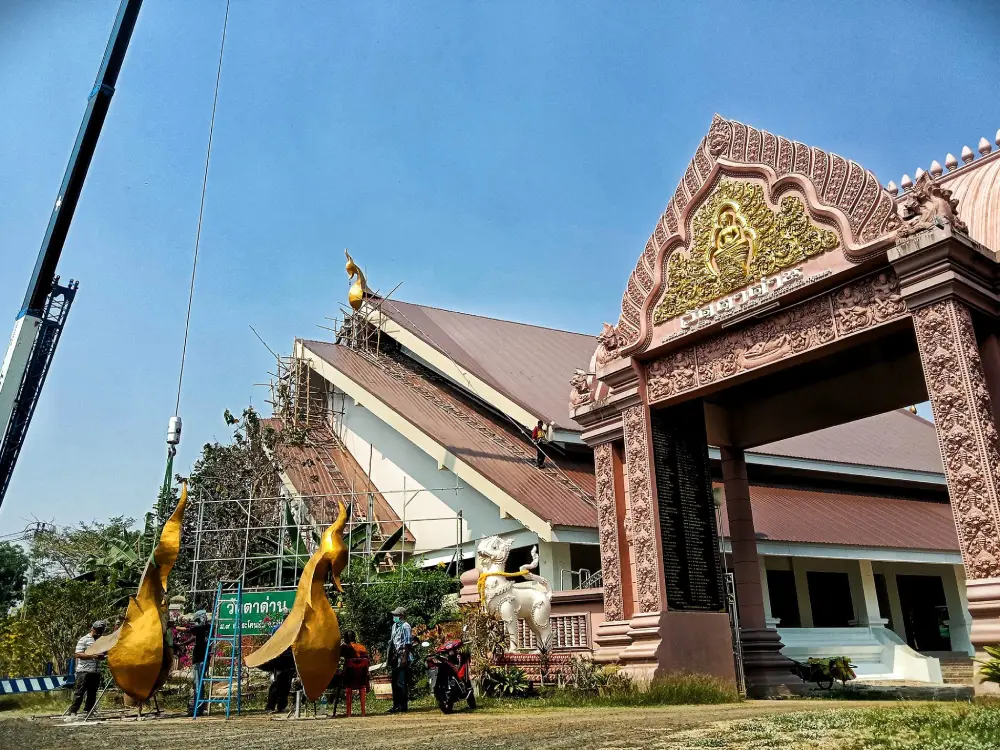
Wat Ta Dan, also known as Wat Ta Dan Wararam, is located near Nong Ra Sae San in Moo 9, Prakhon Chai Subdistrict, Prakhon Chai District, Buri Ram Province. It is an old community temple with deep local significance, especially for its ancient Buddha image and the long-standing belief that prayers here can bless couples with children. For travelers exploring southern Buri Ram, Wat Ta Dan offers a meaningful stop that connects Buddhist faith, local memory, and the cultural route toward Phanom Rung.
The temple stands in a landscape closely connected with Nong Ra Sae San and the route leading toward Khao Phanom Rung. Local tradition suggests that Wat Ta Dan may once have been associated with a frontier or gateway point on the way to Phanom Rung. Although this idea belongs to local memory and cultural interpretation, it gives the temple a distinctive identity. Wat Ta Dan is therefore not only a village temple, but also a place that helps visitors understand how local communities remember the historical routes of Prakhon Chai.
Prakhon Chai District is one of the most culturally layered areas of Buri Ram. It is known for ancient Khmer sanctuaries, old Buddhist temples, sacred ponds, community shrines, and routes that connect local settlements with Phanom Rung and Prasat Muang Tam. Wat Ta Dan belongs to this wider cultural landscape. A visit here allows travelers to see the living Buddhist side of Prakhon Chai, beyond the famous stone monuments that usually dominate travel itineraries.
The most important object of devotion at Wat Ta Dan is its old Buddha image. Local people have long regarded this Buddha image as sacred, especially for prayers related to having children. Couples and families who wish for a son or daughter come to pay respect, make a wish, and ask for blessings. This belief has made Wat Ta Dan a meaningful spiritual destination for those who seek hope, family continuity, and emotional strength through Buddhist faith.
One of the best-known local stories connected with the temple took place in 1993. The daughter of Ajarn Thong Maprachong had been married for 5 to 6 years but had not yet had a child. After hearing about the sacred reputation of the Buddha image at Wat Ta Dan, she came to pay respect and pray for a son or daughter to continue the family line. Later, she gave birth to twins, one boy and one girl. The event brought great joy to the family and became an important story of faith in the local community.
After the family’s wish was fulfilled, they returned to express their gratitude by supporting the construction of an ordination hall for the revered Buddha image. This act of devotion is highly meaningful in Thai Buddhist culture. When people receive encouragement, hope, or fulfillment through faith, they often return to make merit, build religious structures, or help support the temple. The ordination hall at Wat Ta Dan is therefore not only a building, but also a physical expression of gratitude and faith.
The belief in praying for children at Wat Ta Dan should be understood respectfully as a living local tradition. Visitors who come to pray should do so with sincerity, calmness, and proper conduct. In Thai Buddhist culture, asking for blessings is often accompanied by the intention to do good, keep moral discipline, make merit, and live with mindfulness. The spiritual value of the temple lies not only in the wish itself, but also in the hope and inner strength that faith gives to those who come here.
Wat Ta Dan also reflects the character of many community temples in southern Isan. It is connected with local water sources, village life, religious ceremonies, and community gatherings. The location near Nong Ra Sae San gives the temple a strong sense of place. In older rural communities, temples were often built near water, roads, and settlement areas, becoming natural centers of worship, rest, learning, and social activity.
The temple remains active in local religious life. It is used for merit-making, Buddhist ceremonies, community events, and temple fairs. Its official Facebook page also serves as a channel for temple news and religious activities. This shows that Wat Ta Dan is not an abandoned historical site, but a living temple where monks, laypeople, and local supporters continue to maintain Buddhist practice and community connection.
Wat Ta Dan is suitable for travelers interested in sacred temples, local beliefs, old Buddhist images, and the cultural routes of Prakhon Chai. It can be visited together with Nong Ra Sae San Lake Park, Wat Chai Mongkhon, Wat Khon, Wat Champa, Phra Phuttha Prakhon Chai Maha Ming Mongkhon, Prasat Muang Tam, Kok Muang Hermitage, and Phanom Rung Historical Park. This route combines living Buddhist faith with the ancient Khmer heritage of southern Buri Ram.
Visitors who come for spiritual reasons should begin by paying respect to the old Buddha image. They should keep the atmosphere quiet, make their prayer respectfully, and avoid treating the sacred space as a casual photo spot. If praying for family matters or children, visitors should do so with dignity and gratitude. A temple like Wat Ta Dan is meaningful because people come here with personal hopes, so the atmosphere should be treated with care.
The best time to visit Wat Ta Dan is in the morning or late afternoon. The weather in Prakhon Chai can be hot, especially during the dry season, and these times are more comfortable for walking around the temple grounds. Morning visits are suitable for merit-making and quiet prayer, while late afternoon visits work well for travelers returning from Prasat Muang Tam or Phanom Rung.
Visitors should dress respectfully when visiting Wat Ta Dan. Shoulders and knees should be covered, shoes should be removed before entering sacred areas, and voices should be kept low. Photography should be done with care, especially around worshippers, monks, and sacred objects. The temple is an active religious place, so respectful behavior is essential.
Getting There is convenient by private car, rental car, or hired local transport. From Buri Ram city, travel south toward Prakhon Chai District, then follow the Prakhon Chai–Khok Mueang Road toward Moo 9 near Nong Ra Sae San. Travelers without a private car can take public transport to Prakhon Chai and then hire local transport to reach the temple. The location can be combined with other cultural attractions in the district.
A practical day route can begin with Wat Ta Dan and nearby temples in Prakhon Chai town, followed by Phra Phuttha Prakhon Chai Maha Ming Mongkhon, Prasat Muang Tam, Kok Muang Hermitage, and Phanom Rung Historical Park. This route helps travelers understand how local Buddhist faith and ancient sacred monuments coexist in the cultural landscape of southern Buri Ram.
The area around Prakhon Chai has restaurants, cafés, hotels, resorts, and homestays that make travel convenient. Visitors can stop for food in town before or after visiting Wat Ta Dan, then continue toward the historical attractions outside the district center. For those who want to explore southern Buri Ram at a slower pace, staying in Prakhon Chai is a practical choice.
Wat Ta Dan is especially interesting because it shows how local belief can shape the identity of a temple. The story of the twins born after the prayer in 1993, followed by the construction of an ordination hall, shows how faith can turn into concrete support for Buddhism. In this sense, Wat Ta Dan is not simply a place where people ask for blessings. It is a place where fulfilled faith becomes merit-making and temple preservation.
For cultural travelers, Wat Ta Dan should be viewed as a site of living memory. Its value comes from the old Buddha image, the belief in blessings for children, the connection with Nong Ra Sae San, and the possible association with the route to Phanom Rung. These elements make the temple unique within Prakhon Chai. It may not be as monumental as Phanom Rung or Prasat Muang Tam, but it offers a deeply local and emotional understanding of Buddhist faith in Buri Ram.
Wat Ta Dan is therefore recommended for travelers who want to experience a sacred temple connected with family hopes, local history, and the cultural routes of southern Isan. A visit here gives insight into how Thai communities preserve faith through stories, offerings, temple construction, and regular religious activities. For those exploring Prakhon Chai, Wat Ta Dan adds an important spiritual dimension to the journey.
| Name | Wat Ta Dan / Wat Ta Dan Wararam |
| Location | Near Nong Ra Sae San, Moo 9, Prakhon Chai Subdistrict, Prakhon Chai District, Buri Ram Province, Thailand |
| Address | Moo 9, Prakhon Chai–Khok Mueang Road, Prakhon Chai Subdistrict, Prakhon Chai District, Buri Ram 31140, Thailand |
| Coordinates / Plus Code | J32C+5W5, Prakhon Chai, Buri Ram 31140, Thailand |
| Highlights | Old community temple near Nong Ra Sae San and the route to Phanom Rung, known for an ancient Buddha image associated with prayers for children |
| History | An old temple in Prakhon Chai with local stories linking it to the route toward Khao Phanom Rung and the idea of a former gateway or frontier temple |
| Distinctive Features | Ancient Buddha image, belief in prayers for children, ordination hall built from fulfilled faith, and a quiet local temple atmosphere near Nong Ra Sae San |
| Important Elements | Ancient Buddha image, worship area, ordination hall, meditation and activity hall, temple courtyard, and community merit-making areas |
| Main Belief | Many devotees come to pray for children. A well-known local story from 1993 tells of the daughter of Ajarn Thong Maprachong, who prayed here after years without children and later gave birth to twins |
| Travel Information | Accessible by private car, rental car, or local transport from Buri Ram city to Prakhon Chai District, then along the Prakhon Chai–Khok Mueang Road toward Moo 9 near Nong Ra Sae San |
| Current Status | Open as an active community Buddhist temple with religious activities promoted through its official Facebook page |
| Open Days | Daily |
| Opening Hours | 08.00 – 17.00 |
| Facilities | Worship area, merit-making space, ordination hall, meditation and activity hall, temple courtyard, and community religious activity areas |
| Main Areas / Zones | Ancient Buddha image worship area, ordination hall, meditation and activity hall, temple courtyard, and merit-making area |
| Abbot / Caretaker | Phra Khru Aphirak Satsanakit |
| Main Contact Number | 044-670-233, 081-874-5857 |
| Official Website / Official Page | Facebook: Wat Ta Dan, Prakhon Chai District, Buri Ram |
| Nearby Tourist Attractions | 1. Nong Ra Sae San Lake Park, about 1 km 2. Wat Chai Mongkhon, about 2 km 3. Wat Khon, about 3 km 4. Wat Champa, about 4 km 5. Phra Phuttha Prakhon Chai Maha Ming Mongkhon, about 10 km 6. Prasat Muang Tam, about 16 km 7. Kok Muang Hermitage, about 16 km 8. Phanom Rung Historical Park, about 21 km |
| Nearby Restaurants | 1. Chai Rad Na, about 3 km, Tel. 091-336-0108 2. Panarin Roasted Duck Noodles Prakhonchai Angtia, about 3 km, Tel. 095-636-5497, 081-869-6175 3. Jungle Cafe Prakhon Chai, about 4 km, Tel. 062-414-5461 4. Goody n’ Bakey, about 4 km, Tel. 094-297-8999 5. LuckyCafe, about 4 km, Tel. 094-025-7497 6. Laang Wang Prakhon Chai, about 5 km, Tel. 084-605-4324 |
| Nearby Accommodations | 1. Prakhon Chai Resort Hotel, about 3 km, Tel. 044-671-288, 081-955-9089 2. Hotel de l’amour Buriram, about 4 km, Tel. 044-651-555, 098-102-7809 3. Eireann Boutique Hotel, about 4 km, Tel. 044-666-199, 087-493-9919 4. Sohground Boutique Resort, about 5 km, Tel. 080-488-3183 5. Baan Khok Muang Homestay, about 16 km, Tel. 088-193-8840 |
Frequently Asked Questions (FAQ)
Q: Where is Wat Ta Dan located?
A: Wat Ta Dan is located near Nong Ra Sae San, Moo 9, Prakhon Chai Subdistrict, Prakhon Chai District, Buri Ram Province, Thailand.
Q: Why is Wat Ta Dan important?
A: Wat Ta Dan is an old temple in Prakhon Chai, known for its sacred ancient Buddha image and local stories connecting the temple with the route toward Phanom Rung.
Q: What is the Buddha image at Wat Ta Dan famous for?
A: Devotees believe the Buddha image is especially sacred for prayers related to having children.
Q: What is the 1993 story connected with Wat Ta Dan?
A: In 1993, the daughter of Ajarn Thong Maprachong prayed at Wat Ta Dan after several years without children. She later gave birth to twins, one boy and one girl, and the family supported the construction of an ordination hall in gratitude.
Q: What are the opening hours of Wat Ta Dan?
A: Wat Ta Dan is open daily from 08.00 to 17.00.
Q: What nearby attractions can be visited with Wat Ta Dan?
A: Nearby attractions include Nong Ra Sae San Lake Park, Wat Chai Mongkhon, Wat Khon, Wat Champa, Phra Phuttha Prakhon Chai Maha Ming Mongkhon, Prasat Muang Tam, Kok Muang Hermitage, and Phanom Rung Historical Park.
Q: What type of travelers should visit Wat Ta Dan?
A: Wat Ta Dan is suitable for travelers interested in sacred temples, old Buddhist images, local beliefs, prayers for children, Prakhon Chai history, and cultural routes toward Phanom Rung.
Q: What should visitors wear when visiting Wat Ta Dan?
A: Visitors should dress respectfully, cover shoulders and knees, remove shoes in sacred areas, keep quiet, and behave respectfully inside the temple grounds.
 Category: ●Places of Worship
 Group: ●Temple
Last Update : 3 MonthAgo
 Last Update : 3 MonthAgo
 Click to Access the Navigation Map GPS
 Art, Culture and Heritage
 Historical Sites and Monuments(14)
 Landmarks and Memorials(2)
 Art, Craft Centres, Tradition(6)
 Museums(3)
 Educational Places
 Museum for Study(1)
Temple(74)
Museum for Study(1)
Temple(74)
 Other Sacred Sites(5)
 Suburban Living
 Village, Community(3)
 Nature and Wildlife
 National Parks and Marine Reserves(2)
 Mountain (Doi)(1)
 Dam, Reservoir, Lake(14)
 River, Canal(1)
 Bays and Beaches(1)
 Other natural attractions(2)
 Entertainment and Agricultural
 Animal camps and shows(1)
 Stadium(2)
 Farms, Parks and Ecotourism(2)
 Waterpark(1)


