
lovethailand home >Northeastern Travel Attractions >Buri Ram Travel Attractions >Nang Rong >Nang Rong > Wat Nong Samet
TL;DR: Wat Nong Samet is located at Ban Nong Samet, Nang Rong Subdistrict, Nang Rong District, Buriram Province, Thailand, open Daily, hours 08.00 – 17.00.
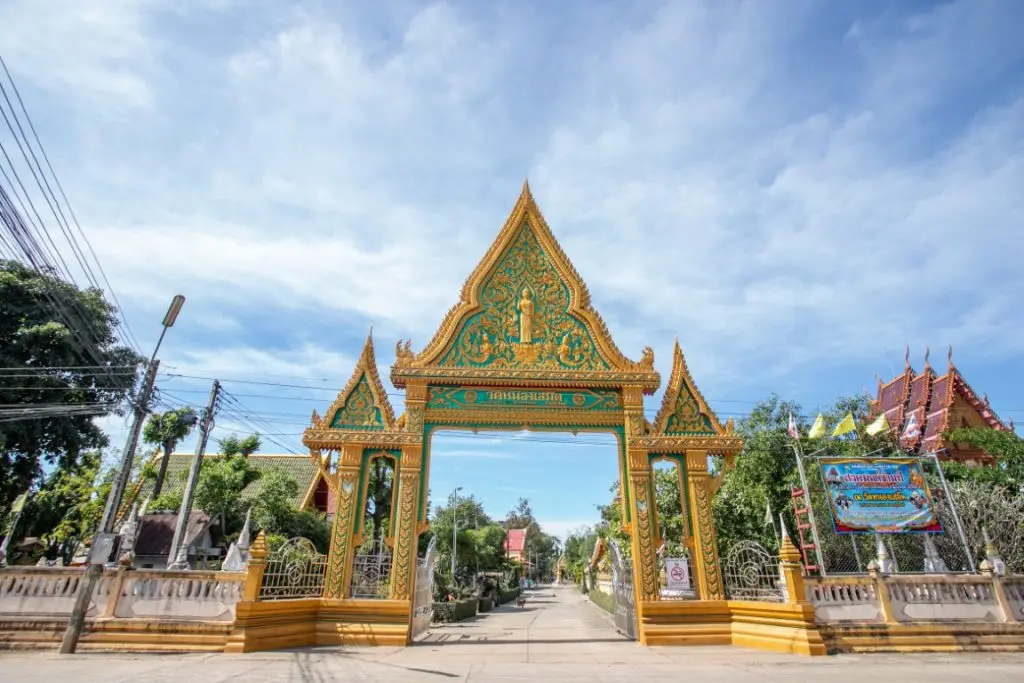
Wat Nong Samet
Open Days: Daily
Opening Hours: 08.00 – 17.00
Wat Nong Samet in Buriram Province is a community Buddhist temple located at No. 37, Ban Nong Samet, Nang Rong Subdistrict, Nang Rong District. The temple covers an area of 17 rai, 1 ngan, and 68 square wah and is known locally as a peaceful, clean, shaded, and well-maintained religious site. For foreign travelers who want to understand everyday Buddhist life in Nang Rong, Wat Nong Samet offers a meaningful look at a temple developed through local faith, community cooperation, and the leadership of monks and lay supporters.
The temple is not an ancient Ayutthaya-period site like some other temples in Nang Rong, but its importance comes from a different kind of history. Wat Nong Samet represents the development of a modern community temple created to serve the religious needs of local people. The land originally belonged to Mr. Kai Kosakul, a former excise officer of Nang Rong District, who donated it for the establishment of the temple in 1981. This act of donation became the foundation for the temple and allowed Ban Nong Samet and nearby communities to have their own Buddhist center.
The foundation of Wat Nong Samet shows how a Thai community temple can grow from collective faith. After the land was donated, the temple committee received the land on behalf of the community. The temple later received permission to build in 1983, with Mr. Phoem Chaichot as the applicant for permission. On September 16, 1985, it was officially permitted to become a temple under the name Wat Nong Samet, following the traditional name of the village where the temple stands. Later, on January 9, 2004, the temple received its royal grant of consecrated boundary, or wisungkhammasima.
The consecrated boundary is an important milestone in Thai Buddhism because it allows a temple to conduct formal monastic ceremonies within the ordination area, especially ordination rites. For a community temple, receiving the consecrated boundary marks a major step in religious completeness. It means that the temple is no longer only a local place for merit-making, but also a fully functional Buddhist institution where monks can perform important Sangha ceremonies according to tradition.
Wat Nong Samet grew through the cooperation of monks and villagers from several surrounding communities. In its early development, Phra Athikan Plat Khemapanyo served as the first abbot, and monks together with villagers from 4 communities witnessed and supported the donation of the land. This beginning gives the temple a strong identity as a place created by shared effort. It was not built only for one family or one small group, but for the wider community around Ban Nong Samet.
The current abbot of Wat Nong Samet is Phra Khru Wapiyan Wisut. He has played a major role in leading local people to develop the temple into a clean, beautiful, and spiritually welcoming place. Under his leadership, the temple has become known for its orderly environment, shaded grounds, and suitability for merit-making and meditation. His role is central to the present identity of the temple because Wat Nong Samet continues to depend on close cooperation between the Sangha and the local lay community.
Phra Khru Wapiyan Wisut was born on July 7, 1952, in Ban Samrong, Chamni District, Buriram Province, and was ordained on May 9, 1973. His preceptor was Phra Khru Praphat Thammaram of Wat Mueang Yang, Mueang Yang Subdistrict, Chamni District, Buriram Province. Today, he serves as the abbot of Wat Nong Samet. His long monastic experience and leadership have helped the temple maintain its religious function and community role.
One of the most recognizable features of Wat Nong Samet is its 2-storey ordination hall. The building stands prominently and gives the temple a strong visual identity. An ordination hall is the most important ritual building in a Thai Buddhist temple because it is used for formal monastic acts, especially ordination. At Wat Nong Samet, the foundation stone of the ordination hall was laid on October 23, 1998, and the temple later received the consecrated boundary in 2004. This sequence reflects the gradual development of the temple from local faith into a fully established religious site.
The 2-storey ordination hall is not only an architectural highlight. It also symbolizes the collective achievement of the community. For local people, the building represents years of merit-making, donations, planning, labor, and shared devotion. Visitors who come to the temple should spend time observing the ordination hall respectfully. It is the heart of the temple’s ritual life and a visible sign of how the community has supported Buddhism in Ban Nong Samet.
The atmosphere of Wat Nong Samet is another major reason to visit. The temple is described by local people as shaded, clean, beautiful, and peaceful. These qualities make it suitable for worship, quiet reflection, and merit-making. Unlike large tourist temples designed for mass visitation, Wat Nong Samet feels like a real community temple. Its value lies in calmness, order, local faith, and the everyday relationship between monks and villagers.
Ban Nong Samet is part of Nang Rong Subdistrict, and the temple functions as an important religious center for the area. Local people use the temple for Buddhist holy days, merit-making, ordination ceremonies, Kathin, robe-offering ceremonies, funerals, and other community events. The temple therefore plays both a spiritual and social role. It is a place where families gather, where people make merit together, and where the community maintains its shared Buddhist identity.
For visitors interested in cultural travel, Wat Nong Samet shows an important side of Nang Rong. The district is often known as a base for visiting Phanom Rung Historical Park and other heritage sites in southern Buriram. However, Nang Rong also has many local temples that show the living Buddhist culture of the district. Wat Nong Samet represents a modern community temple, while older temples such as Wat Khun Kong, Wat Rong Man Thet, and Wat Pho Tharam represent earlier historical layers. Visiting these temples together gives travelers a more complete understanding of Nang Rong.
Wat Nong Samet is especially suitable for travelers who prefer quiet local places rather than crowded attractions. A visit can begin with paying respect to the Buddha images, followed by a walk around the 2-storey ordination hall and the shaded temple grounds. Visitors can observe how the buildings, trees, activity spaces, and religious areas come together to create a calm environment. The temple rewards a slow and respectful visit rather than a rushed photo stop.
Because Wat Nong Samet is an active Buddhist temple, visitors should dress modestly and behave respectfully. Clothing should be appropriate for a religious site, and visitors should keep their voices low near the ordination hall, monks, and worshippers. Photography should be done with respect. Visitors should avoid disturbing ceremonies, monks, or local people making merit. The temple is part of daily community life, so courtesy toward local people is essential.
For families, the temple is an easy and meaningful stop in Nang Rong. Elderly visitors can pray and rest in a peaceful environment. Children can learn about temple donation, community cooperation, ordination halls, and the meaning of a consecrated boundary. Adults can make merit and observe how a local temple becomes a center of faith and social connection. A short visit can therefore become a useful cultural learning experience.
Wat Nong Samet is also convenient for travelers staying in Nang Rong. Nearby accommodations include Bumnsaya Place, The Room@Nangrong, Laksana Boutique Hotel, Socool Grand Hotel, Phanom Rung Puri Boutique Hotel & Resort, and Akelada Hotel. This makes the temple easy to visit before or after meals, hotel check-in, or a day trip to Phanom Rung. Travelers can include the temple in a relaxed morning or evening route without needing to travel far from town.
Getting There is convenient by private car, motorcycle, local taxi, or hired vehicle within Nang Rong District. The temple is located in Nang Rong Subdistrict at Ban Nong Samet. Travelers coming from Buriram city should first travel to Nang Rong District, then continue into Nang Rong Subdistrict and Ban Nong Samet. Those already staying in Nang Rong town can reach the temple in a short ride and can combine it with other temples and local attractions in the same day.
A good temple route can begin at Wat Nong Samet and continue to Wat Klang Nang Rong, Wat Khun Kong, Wat Rong Man Thet, and Nang Rong Walking Street. Visitors with more time can continue to Wat Nong Bot, Wat Phu Man Fah, Wat Khao Phra Angkhan, or Phanom Rung Historical Park. This type of route allows travelers to experience both living Buddhist temples and major cultural attractions in southern Buriram.
Wat Nong Samet is also useful for understanding the difference between old historical temples and newer community temples. Some temples in Nang Rong date back to the Ayutthaya period, while Wat Nong Samet was founded in the late 20th century. This does not reduce its importance. Instead, it shows how Buddhism continues to grow with communities. As villages expand and populations change, new temples are created to meet the religious and social needs of local people.
The temple’s beauty lies in its well-kept environment and the faith behind its development. A clean and shaded temple makes visitors feel welcome and helps support meditation, merit-making, and reflection. The 2-storey ordination hall gives the temple a dignified presence, while the surrounding areas show the practical role of a community temple. Together, these elements make Wat Nong Samet a worthwhile stop for travelers who want to see the living Buddhist culture of Nang Rong.
Foreign travelers can learn several important aspects of Thai culture from Wat Nong Samet. The temple shows how land donation can become a religious foundation, how villagers work with monks to build and maintain a temple, how an ordination hall functions as the heart of monastic life, and how a consecrated boundary gives a temple formal religious status. With a Thai companion or local guide, visitors can better understand why a community temple is important far beyond its buildings.
The best time to visit Wat Nong Samet is in the morning or late afternoon. Morning is suitable for worship and quiet reflection, while late afternoon is comfortable for walking around the temple grounds after the heat of the day. Visitors who come during Buddhist holy days or community merit-making events may see the temple in a more active role. These moments can be culturally meaningful, but visitors should give priority to local worshippers and avoid interrupting religious activities.
The charm of Wat Nong Samet comes from its sincerity. It is not a temple built to compete with grand monuments, but a place created and maintained by the faith of local people. Its story begins with donated land, continues through official permission to establish the temple, and grows through the construction of the ordination hall and the leadership of Phra Khru Wapiyan Wisut. This makes the temple a strong example of how Buddhism remains alive in local communities.
In summary, Wat Nong Samet is a community Buddhist temple at No. 37, Ban Nong Samet, Nang Rong Subdistrict, Nang Rong District, Buriram Province. The temple was established on land donated by Mr. Kai Kosakul in 1981, received permission to build in 1983, was officially established in 1985, and received its royal consecrated boundary on January 9, 2004. Today, under the leadership of Phra Khru Wapiyan Wisut, the temple is known as a shaded, clean, beautiful, and peaceful place with a prominent 2-storey ordination hall. It is suitable for worship, merit-making, quiet cultural travel, and inclusion in a wider Nang Rong temple route.
| Name | Wat Nong Samet |
| Location | Ban Nong Samet, Nang Rong Subdistrict, Nang Rong District, Buriram Province, Thailand |
| Address | No. 37, Ban Nong Samet, Nang Rong Subdistrict, Nang Rong District, Buriram Province, Thailand |
| Highlights | A shaded, clean, and peaceful community temple with a prominent 2-storey ordination hall and strong local faith from several nearby communities |
| History | The land originally belonged to Mr. Kai Kosakul, a former excise officer of Nang Rong District, who donated it for temple construction in 1981. The temple received permission to build in 1983, was officially established in 1985, and received its royal consecrated boundary on January 9, 2004 |
| Name Origin | The name Wat Nong Samet comes from Ban Nong Samet, the local community where the temple is located |
| Temple Area | 17 rai, 1 ngan, and 68 square wah |
| Distinctive Features | A Mahanikaya community temple with a clean, shaded environment suitable for merit-making, Buddhist practice, and community religious activities |
| Key Buildings And Evidence | 2-storey ordination hall, worship area, pavilion, activity courtyard, merit-making space, and temple buildings developed through local community support |
| Travel Information | Located in Nang Rong Subdistrict and accessible by private car, motorcycle, local taxi, hired vehicle, or local transport from Nang Rong town |
| Current Status | Open as an active community Buddhist temple with resident monks and continuing religious activities for Ban Nong Samet and nearby communities |
| Open Days | Daily |
| Opening Hours | 08.00 – 17.00 |
| Facilities | Worship area, ordination hall, pavilion, activity courtyard, parking area, shaded grounds, and visitor toilets |
| Main Areas / Zones | 1. 2-Storey Ordination Hall 2. Principal Buddha Image And Worship Area 3. Pavilion And Merit-Making Area 4. Temple Activity Courtyard 5. Shaded Area For Reflection And Buddhist Practice 6. Monks’ Residence Area 7. Community Service And Merit-Making Area |
| Abbot / Caretaker | Phra Khru Wapiyan Wisut, Abbot of Wat Nong Samet |
| Main Contact Number | 081-8795734 |
| Official Website / Official Page | Wat Nong Samet information page by the Nang Rong Sangha and Wat Nong Samet information in the nationwide Kathin project database |
| Nearby Tourist Attractions | 1. Wat Klang Nang Rong, about 2 km 2. Thetsaban Nang Rong Health Park, about 2 km 3. Nang Rong Morning Market, about 2 km 4. Wat Khun Kong, about 3 km 5. Wat Rong Man Thet, about 3 km 6. Nang Rong Walking Street, about 3 km 7. Wat Nong Bot, about 10 km 8. Wat Phu Man Fah, about 13 km 9. Wat Khao Phra Angkhan, about 22 km 10. Phanom Rung Historical Park, about 30 km |
| Nearby Restaurants | 1. Samet Cafe, about 1 km 2. Jing Nam Kha Mu, about 3 km, Tel. 044-631473, 080-1528880 3. Kiniku Japanese Curry Rice, Nang Rong Branch, about 3 km, Tel. 099-0055456 4. Laksana Kha Mu Branch 2, about 3 km, Tel. 044-631319 5. SOFIT Cafe' Nang Rong, about 4 km, Tel. 094-2515080 6. CHANN Terrace, about 4 km 7. TRI Cafe & Restaurant, about 4 km, Tel. 044-631168 |
| Nearby Accommodations | 1. Bumnsaya Place, about 1 km, Tel. 085-4956929, 044-666939 2. The Room@Nangrong, about 2 km, Tel. 044-633366 3. Laksana Boutique Hotel, about 2 km 4. Socool Grand Hotel, about 3 km, Tel. 044-632333, 080-4881888 5. Phanom Rung Puri Boutique Hotel & Resort, about 3 km, Tel. 044-632222, 086-3366618 6. Akelada Hotel, about 4 km, Tel. 084-8259214, 044-622199 |
Frequently Asked Questions (FAQ)
Q: Where is Wat Nong Samet located?
A: Wat Nong Samet is located at No. 37, Ban Nong Samet, Nang Rong Subdistrict, Nang Rong District, Buriram Province, Thailand.
Q: What is the history of Wat Nong Samet?
A: The temple was established on land donated by Mr. Kai Kosakul in 1981. It later received permission to build, was officially established as a temple, and received its royal consecrated boundary on January 9, 2004.
Q: What are the main highlights of Wat Nong Samet?
A: The main highlights are its clean and shaded temple grounds, peaceful community atmosphere, and prominent 2-storey ordination hall.
Q: Who is the abbot of Wat Nong Samet?
A: The abbot of Wat Nong Samet is Phra Khru Wapiyan Wisut, who has played an important role in developing the temple with local people.
Q: What are the opening hours of Wat Nong Samet?
A: Wat Nong Samet is open daily from 08.00 to 17.00. Morning and late afternoon are suitable times for worship and a peaceful visit.
Q: What kind of visit is Wat Nong Samet suitable for?
A: The temple is suitable for worship, merit-making, quiet reflection, photographing the 2-storey ordination hall respectfully, and including in a temple route around Nang Rong.
Q: How long should visitors spend at Wat Nong Samet?
A: A normal visit takes about 30 minutes to 1 hour. Visitors who want to combine several temples in Nang Rong should allow half a day.
Q: What nearby places can be visited with Wat Nong Samet?
A: Nearby places include Wat Klang Nang Rong, Wat Khun Kong, Wat Rong Man Thet, Nang Rong Walking Street, Wat Nong Bot, Wat Phu Man Fah, Wat Khao Phra Angkhan, and Phanom Rung Historical Park.
 Category: ●Places of Worship
 Group: ●Temple
Last Update : 2 MonthAgo
 Last Update : 2 MonthAgo
 Click to Access the Navigation Map GPS
 Art, Culture and Heritage
 Historical Sites and Monuments(14)
 Landmarks and Memorials(2)
 Art, Craft Centres, Tradition(6)
 Museums(3)
 Educational Places
 Museum for Study(1)
Temple(74)
Museum for Study(1)
Temple(74)
 Other Sacred Sites(5)
 Suburban Living
 Village, Community(3)
 Nature and Wildlife
 National Parks and Marine Reserves(2)
 Mountain (Doi)(1)
 Dam, Reservoir, Lake(14)
 River, Canal(1)
 Bays and Beaches(1)
 Other natural attractions(2)
 Entertainment and Agricultural
 Animal camps and shows(1)
 Stadium(2)
 Farms, Parks and Ecotourism(2)
 Waterpark(1)


