
lovethailand home >Northeastern Travel Attractions >Buri Ram Travel Attractions >Nang Rong >Thanon Hak > Wat Sawai So (Thanon Hak)
TL;DR: Wat Sawai So (Thanon Hak) is located at Ban Sawai So, Moo 9, Thanon Hak Subdistrict, Nang Rong District, Buriram Province, Thailand, open Daily, hours 08.00 – 17.00.
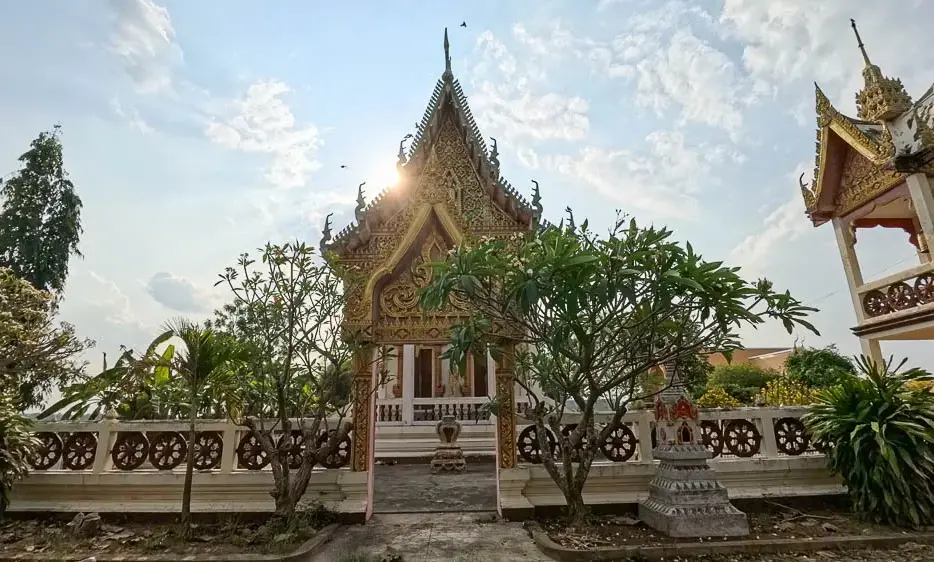
Wat Sawai So (Thanon Hak)
Open Days: Daily
Opening Hours: 08.00 – 17.00
Wat Sawai So (Thanon Hak), officially known as Wat Sin Sophon Thammaram, is a community Buddhist temple in Ban Sawai So, Moo 9, Thanon Hak Subdistrict, Nang Rong District, Buriram Province. The temple is meaningful not only as a place of worship for the local village, but also as a site that preserves an important element of Isan Buddhist heritage: an old ordination structure standing in water, known locally as a “sim” or water-surrounded ordination hall. For foreign travelers interested in Thai Buddhism beyond major tourist temples, Wat Sawai So offers a quiet and culturally rich experience of a living village temple in southern Isan.
The most distinctive feature of Wat Sawai So is its old water-surrounded ordination hall. In the past, this structure was used for monastic ceremonies performed by Buddhist monks. It stands in water and has survived for a long time, although it is no longer used for religious ceremonies today because the roof has leaked and the building has deteriorated. Even so, the building remains valuable as a local religious heritage site. It helps visitors understand the meaning of the word “sim,” a term deeply connected with Buddhist life and temple architecture in the Isan region.
The official name of the temple is Wat Sin Sophon Thammaram, while local people commonly call it Wat Sawai So after the village where it is located. The temple stands at No. 105, Moo 9, Ban Sawai So, Thanon Hak Subdistrict, Nang Rong District, Buriram Province. The temple area covers 12 rai, 2 ngan, and 140 square wah. This space supports Buddhist worship, community activities, merit-making, local learning programs, and the temple’s present-day role as a center of both faith and community development.
Wat Sin Sophon Thammaram, or Wat Sawai So, was established in 1979. It was founded because the people of Ban Sawai So lived far from other temples and found it inconvenient to travel for merit-making, ceremonies, funerals, ordinations, Buddhist holy days, and other religious activities. The villagers therefore agreed to establish a temple within their own community. The foundation was supported by Phra Mongkhon Phattharachan, also known as Luang Pu Thaem, the abbot of Wat Nong Phum Phuang in Saraburi Province. His support helped the temple develop and remain connected with the wider Buddhist community.
This background shows the practical importance of a village temple in rural Isan. In many communities, a temple is not just a place for worship. It is a center for life-cycle ceremonies, community gatherings, moral education, collective work, and spiritual support. Before the temple was established, people in Ban Sawai So had to travel to other temples for religious needs. The creation of Wat Sawai So gave the community its own sacred center and strengthened the relationship between monks, villagers, and Buddhist practice in everyday life.
The old sim at Wat Sawai So is especially important because it helps explain how local communities created sacred space in the past. In Isan culture, the word “sim” refers to an ordination hall or a sacred building used for formal monastic acts. In many Thai regions, the term “ubosot” or “bot” is more common, but in Isan, “sim” carries a distinct regional identity. A sim could be small, practical, and closely adapted to the needs and resources of a village. At Wat Sawai So, the sim was built in water, making it a rare and memorable feature of the temple.
A water-surrounded sim reflects both Buddhist function and local wisdom. The water around the building creates a visible boundary between the sacred ritual space and the ordinary ground around it. In earlier times, constructing a large ordination hall required considerable money, materials, and labor. For rural communities, a smaller sim was often a more suitable solution. It allowed monks to perform necessary religious ceremonies while keeping the structure within the economic capacity of the village. This is why the sim at Wat Sawai So has high cultural value even though it is modest in size.
Today, the old water-surrounded ordination hall is no longer used for ceremonies because of its damaged roof and deteriorated condition. The current abbot has described a plan to restore the structure and adapt it into a viharn, or chapel hall, for storing the Tipitaka. This plan gives the building a new future. Instead of disappearing as an unused structure, the old sim can continue to serve Buddhism by becoming a place connected with sacred texts and religious learning.
Restoring the old sim is therefore more than a repair project. It is a way to preserve community memory, religious vocabulary, and local architecture. If such small religious buildings are neglected, future generations may lose the chance to understand how rural Isan communities practiced Buddhism in the past. Wat Sawai So is important because it keeps the meaning of “sim” visible. It allows people to learn that Buddhist architecture in Thailand is diverse and deeply shaped by local culture.
Compared with large ordination halls in urban temples, a sim has a quieter charm. It is not built to display grandeur. It is built for religious use, with simplicity and purpose. The water-surrounded sim at Wat Sawai So shows how villagers used available resources to create a sacred space suitable for their community. Its value lies in sincerity, function, and cultural continuity. Visitors who appreciate local architecture will find the building highly meaningful even in its aged condition.
The current abbot of Wat Sawai So is Phra Khru Prathip Worayan, also known as Phra Praserm Yanathipo, family name Malaeng Phueng. He was born on April 11, 1967, in Nang Rong District, Buriram Province, and was ordained on December 21, 2003. His preceptor was Phra Khru Preecha Kitchanuyok at the consecrated boundary of Wat Pho Tharam in Nang Rong District. Today, he serves as the abbot of Wat Sin Sophon Thammaram and oversees the temple’s religious life, community activities, and development work.
Under the leadership of Phra Khru Prathip Worayan, Wat Sawai So has become notable not only for its old sim, but also for its community development activities. The abbot has promoted creative work such as vegetable gardening from fences into temple grounds, a shared vegetable garden, and food-sharing activities for the community. These projects support food security, safe vegetables, and local self-reliance. They also show how a Buddhist temple can serve modern community needs while remaining rooted in religious values.
Wat Sawai So therefore has 2 important identities. The first is its cultural and religious identity, represented by the old water-surrounded sim. The second is its contemporary community identity, represented by the rubber-tree forest, vegetable gardens, mixed agriculture, and learning activities. These 2 sides make the temple especially interesting. Visitors can learn about old Isan Buddhist architecture and also see how a temple can become a learning space for sufficiency-based living and community cooperation.
The rubber-tree forest and vegetable garden areas inside the temple are more than decorative green spaces. They function as learning areas where students, government officers, villagers, and visitors can study vegetable gardening, mixed planting, and productive land use. The temple has become a local learning center for vegetable cultivation in Nang Rong District. This makes Wat Sawai So a rare temple where religious heritage and practical community learning exist together in the same place.
The temple’s role as a model for sufficiency-based community learning gives it strong social value. The temple does not teach Dhamma only through sermons. It also teaches through action: planting, sharing, conserving, and helping the community become more self-reliant. Buddhist values such as moderation, generosity, compassion, and mindfulness can be seen through practical activities. This makes Wat Sawai So meaningful for visitors interested in both religion and sustainable local development.
Ban Sawai So is a village in Thanon Hak Subdistrict, Nang Rong District, Buriram Province. It is located in a rural area and is connected with Khlong Sawai So, an important local water resource. This setting gives the temple a different atmosphere from temples in central Nang Rong town. Visitors will feel the character of a village temple surrounded by local life, fields, water, and community space. The temple is suitable for travelers who want to see a quieter side of Buriram and understand Buddhism in a rural context.
The temple atmosphere is calm and simple. Visitors can pay respect to Buddha images, observe the old water-surrounded sim, walk through the temple grounds, see the learning areas, and appreciate the way monks and villagers use the space. The temple should not be visited in a rushed way. Its value lies in small details: the old building in water, the plants, the paths, the quiet surroundings, and the relationship between the temple and the village.
For travelers interested in Isan art and architecture, Wat Sawai So is a valuable stop. The word “sim” opens a deeper understanding of regional Buddhist culture. In central Thailand, the ordination hall is often called a bot or ubosot. In Isan, the sim has its own identity. Some sims are decorated with mural paintings, some are wooden, some are brick-and-mortar, and some are built in water. Wat Sawai So belongs to this living vocabulary of regional Buddhist architecture.
The old water-surrounded sim also raises an important issue of heritage preservation. Many small temples in rural communities are not nationally famous, but they contain local heritage that is deeply meaningful. Without documentation and care, such buildings can deteriorate and disappear. Wat Sawai So shows why small religious buildings deserve attention. They preserve local memory, craftsmanship, language, religious practice, and community identity.
From a travel perspective, Wat Sawai So is suitable for people who prefer quiet cultural routes rather than crowded attractions. It can be combined with nearby temples in Thanon Hak and Nang Rong, such as Wat Pho Tharam, Wat Thanon Hak, Wat Mai Rerai Thong, Wat Pa Rerai, Wat Hua Saphan, Wat Khun Kong, and Wat Rong Man Thet. This temple route reveals several layers of Nang Rong: old community temples, local Buddhist architecture, meditation and learning spaces, historical temples, and living village faith.
A respectful visit should begin with worship at the main Buddha image or worship area. After that, visitors can observe the old sim from a safe and appropriate point. Because the structure is old and partly damaged, visitors should not enter unstable areas, climb on the building, or touch fragile parts. After seeing the sim, visitors can walk through the rubber-tree forest, vegetable garden, and community learning areas. If activities or study visits are taking place, visitors should give priority to the participants.
Visitors should dress modestly when entering the temple. Clothing should be appropriate for a Buddhist religious site, and behavior should remain calm around sacred areas, monks, and worshippers. Photography should be respectful. The old sim should be photographed as a cultural and religious heritage site, not treated merely as a background for casual posing. Visitors should avoid disturbing temple activities and should not use drones or professional equipment without permission.
The best time to visit Wat Sawai So is in the morning or late afternoon. Morning is suitable for worship, quiet observation of the old sim, and walking through the learning areas before the day becomes hot. Late afternoon offers softer light and a calm atmosphere around the water and temple grounds. If visiting on a day with community or agricultural learning activities, travelers may see the temple’s modern social role more clearly.
Getting There is most convenient from Nang Rong town by private car, motorcycle, or local hired vehicle. From central Nang Rong, travel toward Thanon Hak Subdistrict and Ban Sawai So. Ban Sawai So is about 9 km from Nang Rong district area. Travelers staying in Nang Rong town can combine Wat Sawai So with Wat Pho Tharam, Wat Thanon Hak, and Wat Mai Rerai Thong, all of which are related to the Thanon Hak area. Visitors coming from Buriram city should first travel to Nang Rong District and then continue by local roads toward Ban Sawai So.
Wat Sawai So works well as part of a half-day temple route in Nang Rong District. A practical route can include Wat Pho Tharam in Ban Phak Wan, Wat Sawai So, Wat Thanon Hak, Wat Mai Rerai Thong, and Wat Pa Rerai before returning to Nang Rong town for food or rest. Travelers who want a full-day cultural route can continue to Wat Phu Man Fah or Phanom Rung Historical Park. This approach allows visitors to experience both local temples and major attractions in southern Buriram.
For families, Wat Sawai So offers several learning points. Children can learn about village temples, the Isan sim, water-surrounded ordination halls, heritage preservation, vegetable gardens, and sufficiency-based learning. Elderly visitors can come to worship and rest in a calm environment. Adults can observe the relationship between Buddhist practice, local architecture, and community development. Groups interested in agricultural learning or temple-based sufficiency activities should contact the temple in advance.
For foreign travelers, Wat Sawai So is a strong example of an Isan community temple. It introduces the important regional term “sim,” shows how sacred space could be created in water, and demonstrates how a modern temple can also function as a community learning center. With a Thai companion or local guide, visitors can understand the difference between a sim and a standard ordination hall, why communities built small water-surrounded halls in the past, and how the temple now supports agriculture and self-reliance.
The charm of Wat Sawai So lies in the way it brings the past and present together. The past appears through the old water-surrounded sim and the regional language of Isan Buddhism. The present appears through Phra Khru Prathip Worayan, the rubber-tree forest, vegetable gardens, and community development activities. The temple is not only a place of ritual, but also a place of learning, sharing, conservation, and cultural continuity.
In summary, Wat Sawai So, officially Wat Sin Sophon Thammaram, in Ban Sawai So, Thanon Hak Subdistrict, Nang Rong District, Buriram Province, is a meaningful community temple with religious, cultural, and educational value. Its most important feature is the old water-surrounded sim, formerly used for monastic ceremonies and now preserved as a valuable heritage structure. The temple is currently led by Phra Khru Prathip Worayan and is also known for its rubber-tree forest, vegetable gardens, and sufficiency-based learning activities. Wat Sawai So is suitable for worship, cultural learning, studying Isan Buddhist architecture, and inclusion in a temple route around Thanon Hak and Nang Rong.
| Name | Wat Sawai So (Thanon Hak) / Wat Sin Sophon Thammaram |
| Location | Ban Sawai So, Moo 9, Thanon Hak Subdistrict, Nang Rong District, Buriram Province, Thailand |
| Address | No. 105, Moo 9, Ban Sawai So, Thanon Hak Subdistrict, Nang Rong District, Buriram Province, Thailand |
| Highlights | Old water-surrounded sim, Ban Sawai So community temple, rubber-tree forest, vegetable garden, local learning center for vegetable cultivation, and sufficiency-based community activities |
| History | Wat Sin Sophon Thammaram, or Wat Sawai So, was established in 1979 by local villagers who needed a temple for merit-making and Buddhist ceremonies within Ban Sawai So |
| Name Origin | The local name Wat Sawai So comes from Ban Sawai So, while the official temple name is Wat Sin Sophon Thammaram |
| Community Characteristics | Ban Sawai So is a rural community in Thanon Hak Subdistrict with Khlong Sawai So as an important local water resource and the temple as the village’s spiritual and community center |
| Temple Area | 12 rai, 2 ngan, and 140 square wah |
| Key Buildings And Evidence | Old water-surrounded sim, worship area, pavilion, rubber-tree forest, vegetable garden, and community learning area for vegetable cultivation |
| Meaning Of The Sim | A sim is an ordination hall or sacred building used for monastic acts in Isan Buddhist culture. The water-surrounded sim at Wat Sawai So is an important example of regional Buddhist heritage |
| Travel Information | From Nang Rong town, travel toward Thanon Hak Subdistrict and Ban Sawai So. Ban Sawai So is about 9 km from Nang Rong district area. Private car, motorcycle, or local hired vehicle is recommended |
| Current Status | Open as a community Buddhist temple. The old water-surrounded sim remains in the temple but is no longer used for ceremonies, with a plan to restore it as a viharn for storing the Tipitaka |
| Open Days | Daily |
| Opening Hours | 08.00 – 17.00 |
| Facilities | Worship area, pavilion, activity courtyard, parking area, visitor toilets, rubber-tree forest, vegetable garden, and community learning space |
| Main Areas / Zones | 1. Old Water-Surrounded Sim 2. Buddha Image And Worship Area 3. Pavilion And Merit-Making Area 4. Temple Activity Courtyard 5. Rubber-Tree Forest 6. Vegetable Garden And Kitchen Forest 7. Sufficiency-Based Learning Area 8. Monks’ Residence And Community Service Area |
| Abbot / Caretaker | Phra Khru Prathip Worayan (Phra Praserm Yanathipo, family name Malaeng Phueng), Abbot of Wat Sin Sophon Thammaram or Wat Sawai So |
| Main Contact Number | 085-4119139 |
| Official Website / Official Page | Wat Sin Sophon Thammaram information page by the Nang Rong Sangha and the Wat Sawai So Facebook page linked from the Sangha information page |
| Nearby Tourist Attractions | 1. Wat Pho Tharam, Ban Phak Wan, about 4 km 2. Wat Thanon Hak (Sri Wisuttharam), about 6 km 3. Wat Mai Rerai Thong, about 6 km 4. Wat Pa Rerai, about 7 km 5. Wat Hua Saphan, about 8 km 6. Sa Ya Ma Market, about 9 km 7. Wat Khun Kong, about 10 km 8. Wat Rong Man Thet, about 10 km 9. Wat Phu Man Fah, about 18 km 10. Phanom Rung Historical Park, about 35 km |
| Nearby Restaurants | 1. Naka Ahan Tam Sang, Thanon Hak Branch, about 7 km, Tel. 082-1294308 2. Cha Payom By.NY Thanon Hak, about 7 km, Tel. 093-3579482 3. Kiniku Japanese Curry Rice, Nang Rong Branch, about 9 km, Tel. 099-0055456 4. CHANN Terrace, about 10 km, Tel. 065-5619353 5. Jing Nam Kha Mu, about 10 km, Tel. 044-631473, 080-1528880 6. Laksana Kha Mu Branch 2, about 10 km, Tel. 044-631319 7. SOFIT Cafe' Nang Rong, about 11 km, Tel. 094-2515080 |
| Nearby Accommodations | 1. Akelada Hotel, about 9 km, Tel. 084-8259214, 044-622199 2. The Room@Nangrong, about 10 km, Tel. 044-633366 3. Socool Grand Hotel, about 10 km, Tel. 044-632333, 080-4881888 4. Bumnsaya Place, about 10 km, Tel. 085-4956929 5. Phanom Rung Puri Boutique Hotel & Resort, about 11 km, Tel. 044-632222, 086-3366618 6. Laksana Boutique Hotel, about 10 km |
Frequently Asked Questions (FAQ)
Q: Where is Wat Sawai So located?
A: Wat Sawai So, officially Wat Sin Sophon Thammaram, is located at No. 105, Moo 9, Ban Sawai So, Thanon Hak Subdistrict, Nang Rong District, Buriram Province.
Q: Why is Wat Sawai So important?
A: The temple is important because it preserves an old water-surrounded sim, a regional Isan Buddhist ordination structure that reflects local religious architecture and community faith.
Q: What is the water-surrounded sim at Wat Sawai So?
A: It is an old ordination structure once used for monastic ceremonies. The building stands in water, which helped separate the sacred ritual space from the surrounding area.
Q: Is the old sim at Wat Sawai So still used for ceremonies?
A: The old water-surrounded sim remains in the temple but is no longer used for ceremonies because it has deteriorated. The temple plans to restore it as a viharn for storing the Tipitaka.
Q: Who is the abbot of Wat Sawai So?
A: The abbot is Phra Khru Prathip Worayan, also known as Phra Praserm Yanathipo, family name Malaeng Phueng.
Q: What are the opening hours of Wat Sawai So?
A: Wat Sawai So is open daily from 08.00 to 17.00. Morning and late afternoon are suitable times for worship, observing the old sim, and walking through the temple grounds.
Q: Does Wat Sawai So have other highlights besides the old sim?
A: Yes. The temple also has a rubber-tree forest, vegetable garden, kitchen forest, and learning areas related to mixed agriculture and sufficiency-based community development.
Q: What nearby places can be visited with Wat Sawai So?
A: Nearby places include Wat Pho Tharam, Wat Thanon Hak, Wat Mai Rerai Thong, Wat Pa Rerai, Wat Hua Saphan, Wat Khun Kong, Wat Rong Man Thet, Wat Phu Man Fah, and Phanom Rung Historical Park.
 Category: ●Places of Worship
 Group: ●Temple
Last Update : 2 MonthAgo
 Last Update : 2 MonthAgo
 Click to Access the Navigation Map GPS
Wat Sawai So (Thanon Hak) Map
Recommend

 Art, Culture and Heritage
 Historical Sites and Monuments(14)
 Landmarks and Memorials(2)
 Art, Craft Centres, Tradition(6)
 Museums(3)
 Educational Places
 Museum for Study(1)
Temple(74)
Museum for Study(1)
Temple(74)
 Other Sacred Sites(5)
 Suburban Living
 Village, Community(3)
 Nature and Wildlife
 National Parks and Marine Reserves(2)
 Mountain (Doi)(1)
 Dam, Reservoir, Lake(14)
 River, Canal(1)
 Bays and Beaches(1)
 Other natural attractions(2)
 Entertainment and Agricultural
 Animal camps and shows(1)
 Stadium(2)
 Farms, Parks and Ecotourism(2)
 Waterpark(1)


