
lovethailand home >Northeastern Travel Attractions >Buri Ram Travel Attractions >Nang Rong >Thanon Hak > Wat Photharam
TL;DR: Wat Photharam is located at Moo 5, Ban Phak Wan, Thanon Hak Subdistrict, Nang Rong District, Buriram Province, Thailand, open Daily, hours 08.00 – 17.00.
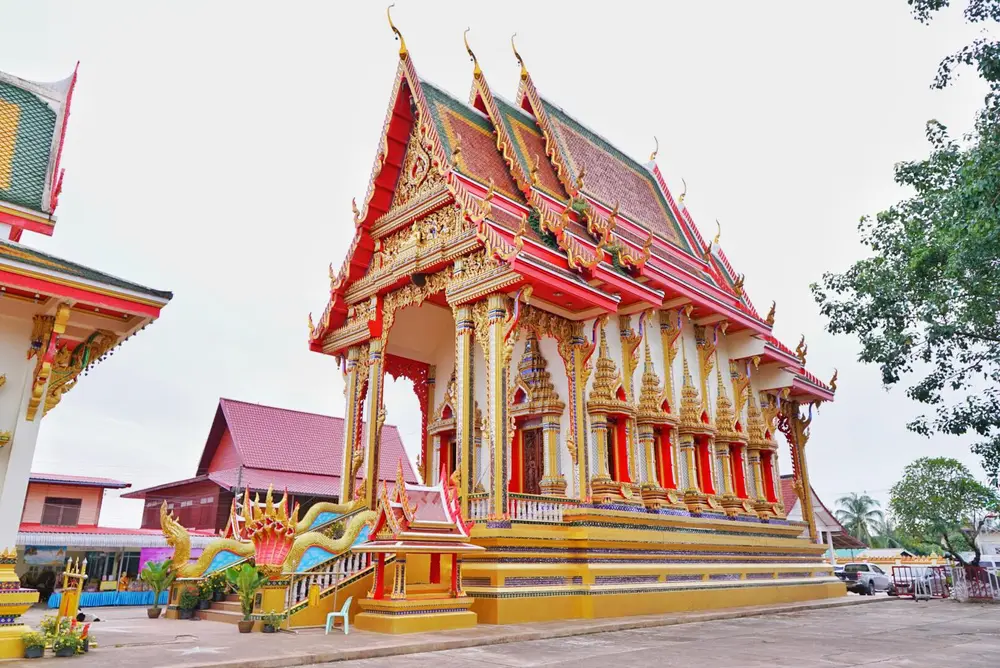
Wat Photharam
Open Days: Daily
Opening Hours: 08.00 – 17.00
Wat Pho Tharam is an old Buddhist temple in Moo 5, Ban Phak Wan, Thanon Hak Subdistrict, Nang Rong District, Buriram Province. The temple is one of the historically important community temples of Nang Rong and is closely connected with the rural landscape, local Buddhist faith, and the cultural identity of Ban Phak Wan. Located east of Nang Rong town and about 3 km from the Nang Rong District Office, the temple originally stood among rice fields in a small rural settlement. This setting gives Wat Pho Tharam a strong sense of place: it is not only a temple building, but a sacred center within an old agricultural community.
Ban Phak Wan has a distinctive landscape. In the past, the village was surrounded by rice fields and smaller settlements in all 4 directions. During the flood season, water covered the surrounding fields and the village appeared like an island floating in the middle of water. Local people often compared this scene with villages in the central plains around Wang Noi District in Ayutthaya Province. This memory of water, fields, and village life is important for understanding Wat Pho Tharam. The temple grew within a landscape shaped by seasonal water, farming, and close community relationships.
Wat Pho Tharam is a large old temple in Nang Rong District. Temple records identify it as a temple dating to the Ayutthaya period, built around 1704 CE, or 2247 BE. It received its royal grant of consecrated boundary on December 27, 1983. The temple therefore carries both historical and religious significance. It represents the long continuity of Buddhism in the Nang Rong area and shows that local communities in southern Buriram had established Buddhist institutions long before modern administrative systems became widespread.
The cultural background of Ban Phak Wan also connects the temple with the wider history of Nang Rong and Korat. Local people in the Ban Phak Wan and Nang Rong area commonly speak Thai Korat, a regional form of Thai associated with communities connected to Nakhon Ratchasima. In historical discussions of Korat, Nang Rong often appears as a related old town. This suggests that Nang Rong developed as an old community alongside important towns in the lower Northeast. Wat Pho Tharam is therefore not only a village temple; it is also part of a wider cultural landscape shaped by language, settlement, and regional history.
For local people, Wat Pho Tharam has long served as the spiritual center of Ban Phak Wan. In rural Thai society, a temple is more than a place for worship. It is a place for merit-making, ordination, funerals, Buddhist holy days, annual festivals, community meetings, moral education, and social memory. Wat Pho Tharam has supported all of these roles across generations. The temple is meaningful because it grew together with the village and remains part of the daily religious life of local people.
The earliest period of the temple administration is not fully preserved in written records. Local memory says that some old records may have been lost when a monks’ residence at the temple was destroyed by fire in 1946. Even so, the history of the temple has remained alive through oral memory, temple records, and the continuity of Buddhist practice. This combination of formal records and community memory gives Wat Pho Tharam a layered identity. It is a temple with documented history, but also a place shaped by the stories passed down by older generations.
Several former abbots are remembered in the temple history, including Phra Mae, Phra Da, Phra Klin, Phra Kon Yasotharo, Phra Plang Siripunno, Phra Maha Sum Chanasako, Phra Thanom Chotiwaro, Phra Thongphun Chanthachoto, and Phra Sawai. These names show the continuity of monastic leadership at the temple. Each abbot contributed to maintaining the buildings, supporting Buddhist practice, teaching moral values, and keeping the temple connected with the people of Ban Phak Wan and Thanon Hak Subdistrict.
One of the most important former abbots was Luang Pho Kon Yasotharo. He became abbot in 1908. In 1925, he was appointed ecclesiastical district chief of Nang Rong, and in 1930 he received the ecclesiastical title Phra Khru Sophon Thammakhut. He passed away in 1951 at the age of 64. His leadership shows that Wat Pho Tharam was not only a small village temple, but also a temple with influence within the wider Sangha administration of Nang Rong District.
Luang Pho Kon remains important in the memory of the temple because he led Wat Pho Tharam during a period of social change. At that time, temples were central to education, morality, community discipline, and Buddhist practice. Monks were spiritual teachers, advisers, and community leaders. Luang Pho Kon’s role as both abbot and district ecclesiastical leader reflects the importance of Wat Pho Tharam within Nang Rong’s Buddhist and social life.
The current abbot of Wat Pho Tharam is Phra Khru Phothi Thamma Rangsi, also known as Phra Sawai Ditthadhammo, family name Sawangchaeng. He was born on August 30, 1963, in Ban Phak Wan, Thanon Hak Subdistrict, Nang Rong District, Buriram Province, and was ordained on May 4, 1985. His preceptor was Phra Khru Preecha Kitchanuyok of Wat Hua Saphan in Nang Rong District. He currently serves as both ecclesiastical chief of Thanon Hak Subdistrict and abbot of Wat Pho Tharam. His role maintains the temple’s importance in both local temple life and Sangha administration.
The fact that the current abbot was born in Ban Phak Wan gives the temple a strong local connection. His leadership is rooted in the same community that the temple serves. This helps preserve the relationship between temple, village, and local identity. Wat Pho Tharam remains a living temple because it is cared for by monks and laypeople who understand the history, language, landscape, and religious needs of the community.
The temple grounds cover 7 rai, 2 ngan, and 97 square wah, with additional monastic land of 37 rai, 2 ngan, and 81 square wah. These areas allow the temple to support worship, ceremonies, education, community activities, and monastic life. Although the temple was once surrounded mostly by fields, improved roads and community development have made it easier to reach. Even so, the temple still preserves its identity as a sacred center of Ban Phak Wan and Thanon Hak Subdistrict.
The temple’s main structures include the ordination hall, monks’ residence, funeral pavilion, worship areas, and other religious spaces. The ordination hall is 24 meters wide and 42 meters long. It was built in 1979 as a reinforced concrete structure and serves as the main sacred space for formal Buddhist ceremonies. The monks’ residence was built in 1953 as a wooden building, while the funeral pavilion is a concrete structure used for community ceremonies. These buildings show how the temple has developed over time according to the needs of monks and local people.
Important sacred objects at Wat Pho Tharam include the ordination hall and the chedi, both associated with the temple’s older religious history. Even though some buildings have been repaired, rebuilt, or expanded in later periods, the temple still preserves a strong sense of historical continuity. Visitors should therefore see Wat Pho Tharam as a living temple with several layers: an old Ayutthaya-period foundation, later community development, and present-day religious activity.
Wat Pho Tharam also has an important educational role. A Dhamma section of a Buddhist scripture school was opened at the temple in 1908. This shows that the temple served as a center for religious learning long before modern educational institutions reached every rural community. In traditional Thai society, temples were important places for literacy, morality, Buddhist knowledge, and cultural transmission. The school at Wat Pho Tharam reflects this long educational role.
The temple also has a subdistrict training unit, appointed in 1992. This gives Wat Pho Tharam a role in moral training and community development at the subdistrict level. The temple is not used only for worship or festivals. It also supports Dhamma training, community values, and the development of people’s minds. This role makes the temple important in the present as well as in the past.
The atmosphere of Wat Pho Tharam is calm and local. It is not a large commercial tourist attraction, and that is part of its charm. Visitors will find a community temple shaped by village life, rice fields, local language, old memory, and Buddhist devotion. The temple is best appreciated by travelers who enjoy slow cultural travel, local history, and authentic religious places rather than only large scenic landmarks.
A visit to Wat Pho Tharam should begin with paying respect to the Buddha images and the main worship areas. After that, visitors can walk around the ordination hall, pavilions, monks’ residence area, and temple grounds. The visit becomes more meaningful when the temple is seen together with the surrounding village landscape. The temple is part of Ban Phak Wan, and the village is part of the temple’s identity.
Wat Pho Tharam is suitable for travelers interested in southern Isan history. It connects several important themes: the Ayutthaya period, the settlement of Ban Phak Wan, the Thai Korat language, the cultural relationship between Nang Rong and Korat, flood-season village landscapes, and the continuity of Buddhism in a local community. Travelers who visit Phanom Rung Historical Park or Prasat Muang Tam can include Wat Pho Tharam to understand the living Buddhist side of Nang Rong beyond ancient stone monuments.
For Buddhist visitors, Wat Pho Tharam is suitable for making merit, praying, offering alms, and joining temple activities when appropriate. The temple can be combined with nearby temples such as Wat Thanon Hak, Wat Mai Rerai Thong, Wat Pa Rerai, Wat Hua Saphan, Wat Khun Kong, Wat Rong Man Thet, and Wat Klang Nang Rong. This makes it a good stop on a half-day temple route around Nang Rong and Thanon Hak Subdistrict.
The temple also remains part of the annual religious life of the community. Local temples like Wat Pho Tharam often host Kathin, robe-offering ceremonies, merit-making days, ordination ceremonies, funeral rites, and Buddhist holy day activities. These events keep the temple active and maintain its relationship with local families. Visitors who come during community events may see the temple at its most lively, but should always give priority to worshippers and local participants.
Photographers should focus on the quiet atmosphere of the temple and its relationship with the community landscape. The ordination hall, pavilions, trees, local roads, village surroundings, and rice-field setting all help tell the story of Wat Pho Tharam. Photography should be respectful. Visitors should not disturb monks, ceremonies, or people making merit, and should avoid inappropriate poses near Buddha images or sacred spaces.
Visitors should dress modestly when entering Wat Pho Tharam. Clothing should be appropriate for a Buddhist religious site, and behavior should remain calm near the ordination hall, pavilions, monks, and worshippers. Because this is an active community temple, courtesy toward local people is important. Visitors should keep the temple clean, speak quietly, and respect the religious use of the space.
The best time to visit Wat Pho Tharam is in the morning or late afternoon. Morning is suitable for worship and a quiet start to the day, while late afternoon is comfortable for walking and photography. During the rainy season, visitors may better understand the historical memory of Ban Phak Wan as a village surrounded by water. Even with modern roads and improved access, the temple still carries the identity of a community shaped by fields and seasonal water.
Getting There is straightforward from Nang Rong town. From the Nang Rong District Office, the temple is about 3 km east toward Thanon Hak Subdistrict and Ban Phak Wan. Private car, motorcycle, local taxi, or hired vehicle are the most convenient options. Travelers staying in Nang Rong can reach the temple in a short ride. If planning a temple route, Wat Pho Tharam can be combined with Wat Thanon Hak and Wat Mai Rerai Thong in the same subdistrict.
Travelers coming from Buriram city should first drive to Nang Rong District, then continue toward Thanon Hak Subdistrict and Ban Phak Wan by local roads. The temple can be visited in the morning before returning to Nang Rong town for lunch, or as part of a longer route to Wat Phu Man Fah and Phanom Rung Historical Park. Nang Rong has restaurants, hotels, markets, and local services, making it a practical base for exploring temples and cultural sites in southern Buriram.
A good local route can begin with Wat Thanon Hak, Wat Mai Rerai Thong, Wat Pho Tharam, Wat Pa Rerai, and Wat Hua Saphan before returning to central Nang Rong to visit Wat Khun Kong, Wat Rong Man Thet, or Wat Klang Nang Rong. This route allows travelers to see different types of temples: old community temples, temples with educational roles, temples connected with local history, and temples that remain central to village life.
For families, Wat Pho Tharam is easy to visit and does not require a long walk. Elderly visitors can come to pray and rest quietly. Children can learn about an old temple, Ban Phak Wan, the Thai Korat language, flood-season village life, and the role of temples in Thai communities. Adults can make merit and observe how a temple preserves local memory. A short visit can therefore become an educational cultural experience.
For foreign travelers, Wat Pho Tharam is a useful example of a southern Isan community temple. It shows that a Thai temple is not only a place for worshipping Buddha images. It is also a village center, a religious school, a moral training space, a place for ceremonies, and a record of community memory. With a Thai companion or local guide, visitors can better understand Ban Phak Wan, the flood-season landscape, the Thai Korat language, Luang Pho Kon, and the current role of the abbot.
The charm of Wat Pho Tharam lies in its quiet authenticity. It does not rely on grandeur or tourist spectacle. Its value comes from age, continuity, village identity, Buddhist education, the memory of past abbots, and the continued faith of local people. Travelers who prefer slow cultural travel will find that Wat Pho Tharam offers a meaningful view of Nang Rong beyond famous landmarks.
In summary, Wat Pho Tharam in Moo 5, Ban Phak Wan, Thanon Hak Subdistrict, Nang Rong District, Buriram Province, is an old Ayutthaya-period Buddhist temple built around 1704 CE. It is closely connected with Ban Phak Wan, a rural community known for its rice-field landscape, flood-season island-like village setting, and Thai Korat language. The temple’s highlights include its old history, ordination hall, chedi, Buddhist scripture school, subdistrict training unit, the memory of Luang Pho Kon, and the present leadership of Phra Khru Phothi Thamma Rangsi. Wat Pho Tharam is suitable for worship, merit-making, cultural learning, and a temple route around Nang Rong and southern Buriram.
| Name | Wat Pho Tharam |
| Location | Moo 5, Ban Phak Wan, Thanon Hak Subdistrict, Nang Rong District, Buriram Province, Thailand |
| Address | Ban Phak Wan, Moo 5, Thanon Hak Subdistrict, Nang Rong District, Buriram 31110, Thailand |
| Highlights | Old Ayutthaya-period temple, Ban Phak Wan rice-field landscape, flood-season village identity, Thai Korat language, ordination hall, chedi, Buddhist scripture school, and subdistrict training unit |
| History | Built around 1704 CE during the Ayutthaya period and received its consecrated boundary on December 27, 1983. It is one of the old large temples of Nang Rong District |
| Name Origin | The name Wat Pho Tharam has been used by the Ban Phak Wan community and represents the temple as the long-standing spiritual center of the village |
| Community Characteristics | Ban Phak Wan is an old rice-field community surrounded by villages in all 4 directions. During flood season, the settlement appears like an island in water, and local people commonly speak Thai Korat |
| Temple Area | 7 rai, 2 ngan, and 97 square wah, with additional monastic land of 37 rai, 2 ngan, and 81 square wah |
| Key Buildings And Evidence | Ordination hall measuring 24 meters by 42 meters, built in 1979; wooden monks’ residence built in 1953; concrete funeral pavilion; ordination hall, chedi, Buddhist scripture school, and subdistrict training unit |
| Important Figure | Luang Pho Kon Yasotharo, former abbot from 1908 to 1951, became ecclesiastical district chief of Nang Rong in 1925 and received the title Phra Khru Sophon Thammakhut in 1930 |
| Travel Information | About 3 km east of Nang Rong District Office toward Thanon Hak Subdistrict and Ban Phak Wan. Accessible by private car, motorcycle, local taxi, or hired vehicle |
| Current Status | Open as an active community Buddhist temple under the Mahanikaya order, with monks residing at the temple and regular religious activities for Ban Phak Wan community |
| Open Days | Daily |
| Opening Hours | 08.00 – 17.00 |
| Facilities | Worship area, ordination hall, pavilion, merit-making area, activity courtyard, monks’ residence, parking area, and visitor toilets |
| Main Areas / Zones | 1. Ordination Hall 2. Principal Buddha Image And Worship Area 3. Chedi And Sacred Object Area 4. Pavilion And Merit-Making Area 5. Buddhist Scripture School Area 6. Subdistrict Training Unit 7. Monks’ Residence Area 8. Community And Temple Activity Area |
| Abbot / Caretaker | Phra Khru Phothi Thamma Rangsi (Phra Sawai Ditthadhammo, family name Sawangchaeng), Ecclesiastical Chief of Thanon Hak Subdistrict and Abbot of Wat Pho Tharam |
| Main Contact Number | 085-2052305 |
| Official Website / Official Page | Wat Pho Tharam information page by the Nang Rong Sangha and Wat Pho Tharam Ban Phak Wan Facebook Page |
| Nearby Tourist Attractions | 1. Wat Thanon Hak (Sri Wisuttharam), about 2 km 2. Wat Mai Rerai Thong, about 2 km 3. Wat Pa Rerai, about 3 km 4. Wat Hua Saphan, about 4 km 5. Sa Ya Ma Market, about 5 km 6. Wat Khun Kong, about 5 km 7. Wat Rong Man Thet, about 5 km 8. Wat Klang Nang Rong, about 5 km 9. Wat Phu Man Fah, about 14 km 10. Phanom Rung Historical Park, about 32 km |
| Nearby Restaurants | 1. Naka Ahan Tam Sang, Thanon Hak Branch, about 3 km, Tel. 082-1294308 2. Cha Payom By.NY Thanon Hak, about 3 km, Tel. 093-3579482 3. Kiniku Japanese Curry Rice, Nang Rong Branch, about 4 km, Tel. 099-0055456 4. CHANN Terrace, about 5 km, Tel. 065-5619353 5. Jing Nam Kha Mu, about 5 km, Tel. 044-631473, 080-1528880 6. Laksana Kha Mu Branch 2, about 5 km, Tel. 044-631319 7. SOFIT Cafe' Nang Rong, about 6 km, Tel. 094-2515080 |
| Nearby Accommodations | 1. Akelada Hotel, about 4 km, Tel. 084-8259214, 044-622199 2. The Room@Nangrong, about 5 km, Tel. 044-633366 3. Socool Grand Hotel, about 5 km, Tel. 044-632333, 080-4881888 4. Bumnsaya Place, about 5 km, Tel. 085-4956929 5. Phanom Rung Puri Boutique Hotel & Resort, about 6 km, Tel. 044-632222, 086-3366618 6. Laksana Boutique Hotel, about 5 km |
Frequently Asked Questions (FAQ)
Q: Where is Wat Pho Tharam located?
A: Wat Pho Tharam is located in Moo 5, Ban Phak Wan, Thanon Hak Subdistrict, Nang Rong District, Buriram Province, about 3 km east of Nang Rong District Office.
Q: What is the history of Wat Pho Tharam?
A: Wat Pho Tharam is an old Ayutthaya-period temple built around 1704 CE and received its consecrated boundary on December 27, 1983.
Q: What makes Wat Pho Tharam distinctive?
A: Its distinctive features include its old history, Ban Phak Wan rice-field setting, flood-season island-like village landscape, Thai Korat language, ordination hall, chedi, Buddhist scripture school, and subdistrict training unit.
Q: Who was Luang Pho Kon of Wat Pho Tharam?
A: Luang Pho Kon Yasotharo was a former abbot of Wat Pho Tharam from 1908 to 1951. He became ecclesiastical district chief of Nang Rong in 1925 and received the title Phra Khru Sophon Thammakhut in 1930.
Q: Who is the current abbot of Wat Pho Tharam?
A: The current abbot is Phra Khru Phothi Thamma Rangsi, also known as Phra Sawai Ditthadhammo, who also serves as ecclesiastical chief of Thanon Hak Subdistrict.
Q: What are the opening hours of Wat Pho Tharam?
A: Wat Pho Tharam is open daily from 08.00 to 17.00. Morning and late afternoon are suitable times for worship and a quiet visit.
Q: How long should visitors spend at Wat Pho Tharam?
A: A normal visit takes about 30 minutes to 1 hour. Visitors who want to combine several temples in Thanon Hak and Nang Rong should allow half a day.
Q: What nearby places can be visited with Wat Pho Tharam?
A: Nearby places include Wat Thanon Hak, Wat Mai Rerai Thong, Wat Pa Rerai, Wat Hua Saphan, Wat Khun Kong, Wat Rong Man Thet, Wat Klang Nang Rong, Wat Phu Man Fah, and Phanom Rung Historical Park.
 Category: ●Places of Worship
 Group: ●Temple
Last Update : 2 MonthAgo
 Last Update : 2 MonthAgo
 Click to Access the Navigation Map GPS
 Art, Culture and Heritage
 Historical Sites and Monuments(14)
 Landmarks and Memorials(2)
 Art, Craft Centres, Tradition(6)
 Museums(3)
 Educational Places
 Museum for Study(1)
Temple(74)
Museum for Study(1)
Temple(74)
 Other Sacred Sites(5)
 Suburban Living
 Village, Community(3)
 Nature and Wildlife
 National Parks and Marine Reserves(2)
 Mountain (Doi)(1)
 Dam, Reservoir, Lake(14)
 River, Canal(1)
 Bays and Beaches(1)
 Other natural attractions(2)
 Entertainment and Agricultural
 Animal camps and shows(1)
 Stadium(2)
 Farms, Parks and Ecotourism(2)
 Waterpark(1)


