
lovethailand home >Northeastern Travel Attractions >Buri Ram Travel Attractions >Cham Ni >La Luat > Wat Laluad Folk Museum
TL;DR: Wat Laluad Folk Museum is located at Wat Laluad, Moo 3, Laluad Subdistrict, Chamni District, Buriram Province, open Daily, hours 08.00 – 17.00.

Wat Laluad Folk Museum
Open Days: Daily
Opening Hours: 08.00 – 17.00
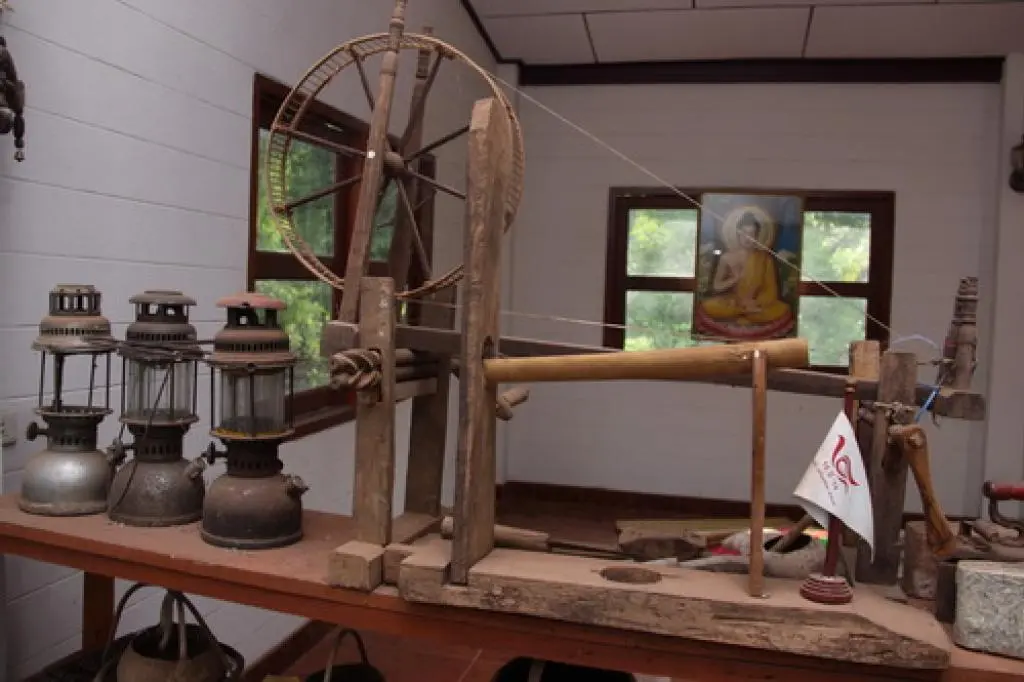
Wat Laluad Folk Museum in Buriram Province is located inside Wat Laluad, Moo 3, Laluad Subdistrict, Chamni District. It is a small community-based folk museum created under the Thai Culture and Community Network project of Laluad Subdistrict. The museum uses a small viharn, or minor chapel, within the temple grounds as a place to preserve and display local cultural heritage. Inside, visitors can see old household tools, occupational implements, archaeological objects, and sacred items found or preserved in the village, including Buddha images, jars, knives, and other objects connected with the history and wisdom of the local community.
The museum is important because it preserves the memory of a rural Isan community through real objects. The items displayed here are not merely old things kept in storage. They are evidence of how people in Laluad once lived, worked, worshipped, farmed, cooked, stored food, and passed knowledge from one generation to the next. Each object opens a window into village life before modern tools and modern systems changed the way local people lived. The fact that the museum is located inside a temple makes the place even more meaningful, because temples have long served as spiritual, social, and cultural centers in Thai rural communities.
Laluad Subdistrict in Chamni District is a rural area of Buriram Province where community life has traditionally been connected with rice fields, streams, forests, local temples, and household labor. People in the past relied on agriculture, natural resources, local craftsmanship, and inherited knowledge. The objects collected at Wat Laluad Folk Museum therefore reflect a complete way of life rather than a single historical theme. Religion, work, family, food, tools, and community identity are all connected in the museum’s small but meaningful collection.
The origin of the museum lies in the intention of the temple, local committee, and community members to gather old tools and cultural objects found in the village. Some objects were discovered in the local area. Some had been kept in households for many years. Others were once used in everyday life but gradually lost their practical role as society changed. By collecting these items in the small viharn at Wat Laluad, the community transformed ordinary objects into learning materials for younger generations and visitors.
Wat Laluad Folk Museum is housed in a small viharn within the temple compound. Although the display space is modest, its cultural value is significant. The collection includes objects related to Buddhism, local belief, domestic life, and traditional occupations. Buddha images represent religious faith. Jars represent food storage, household management, and rural material culture. Knives and metal tools represent labor, farming, craft, and daily work. Together, these objects help visitors understand how the spiritual and practical dimensions of village life were closely intertwined.
The Buddha images preserved in the museum reflect the deep connection between the people of Laluad and Buddhism. In rural Isan, a Buddha image is not just a religious sculpture. It represents faith, merit-making, moral life, and the relationship between the household and the temple. Keeping Buddha images in the museum is therefore a way to preserve both sacred art and community memory. It allows visitors to see how faith shaped the identity of the village and how the temple became a center of shared values.
Jars are another important type of object in the museum. In rural households, jars were used for more than simple storage. They could be used for water, rice, fermented food, preserved ingredients, or household supplies. A jar could be connected with food culture, kitchen organization, family economy, and seasonal preparation. Seeing jars in the museum helps visitors understand how everyday containers were part of a larger household system. What may look like a simple vessel can actually reveal much about food, labor, and domestic knowledge.
Knives and metal tools displayed in the museum reflect the practical skills of villagers in the past. A knife was one of the most essential tools in rural life. It could be used for cutting wood, preparing food, clearing vegetation, repairing household objects, farming, and craftwork. Such tools show that everyday life depended on manual skill, patience, and practical knowledge. They also remind visitors that rural households once needed to be highly self-reliant, able to make, repair, and adapt tools according to local needs.
Household tools in the collection help visitors imagine the interior life of rural homes in Buriram. A home was not only a place to sleep. It was a place to cook, store tools, manage food, care for family members, teach children, and perform small rituals. Kitchen utensils, storage containers, and handmade objects reveal how families organized daily life before modern appliances became widespread. These objects preserve knowledge that may not be written in books but lives in materials, shapes, and ways of use.
Traditional occupational tools are also central to the museum’s meaning. Laluad was a rural community where agriculture and manual work formed the foundation of life. Tools related to work tell stories of farming, food gathering, craft, repair, and seasonal labor. They show how villagers understood soil, water, weather, animals, plants, and household needs. When these tools are viewed together with sacred objects and household items, visitors can see the full structure of rural life: faith, labor, family, and community working as one system.
The value of Wat Laluad Folk Museum does not depend on a large building or advanced exhibition technology. Its value comes from the fact that the objects were collected from the community and remain close to the cultural landscape where they belonged. Visitors are not seeing objects separated from their place of origin. They are seeing community heritage inside the temple that continues to serve the village. This makes the museum intimate, authentic, and strongly connected with local identity.
The location inside a temple also reflects a traditional Thai pattern of community heritage preservation. In many rural villages, temples are trusted public spaces where people bring important objects for safekeeping. Temples are sacred, familiar, and shared by the community. Wat Laluad therefore functions not only as a religious site but also as a cultural repository. The museum shows how a temple can help protect local wisdom, village history, and inherited objects for future generations.
For travelers interested in local history, Wat Laluad Folk Museum is a meaningful starting point for understanding Chamni District. Chamni is a rural district of Buriram with old communities, village temples, agricultural life, and local traditions. A visit to the museum helps travelers see Chamni not just as a name on a map, but as a place shaped by people, work, faith, and community memory. The museum gives depth to the experience of traveling through this part of Buriram.
The museum is especially useful for students and young visitors. Textbook ideas such as folk wisdom, local heritage, old tools, and community culture become much easier to understand when visitors can see real objects. A Buddha image, jar, knife, or old household tool has form, surface, weight, and function. Learning through objects makes local history more direct and memorable. It also helps younger generations recognize that the history of their own community is valuable.
For those interested in community museums, Wat Laluad Folk Museum is a strong example of how a small museum can preserve local identity. It does not need a large budget or a modern exhibition system to be meaningful. When a community recognizes the value of its old objects and gathers them in a shared place, a museum can become an important educational space. Objects that were once ordinary household items become cultural evidence that explains how people lived.
Visitors should take time to look at each object carefully. The museum is best understood by connecting objects with the roles they once played. Buddha images tell stories of faith. Jars tell stories of food and storage. Knives tell stories of labor and craft. Household tools tell stories of family life. Occupational tools tell stories of work and self-reliance. When these categories are connected, the museum presents a fuller picture of Laluad’s past.
The atmosphere of Wat Laluad adds to the museum experience. This is not a museum isolated from the community. It is located in an active temple where villagers continue to make merit, attend ceremonies, and participate in community life. The museum therefore allows visitors to understand the relationship between religion, local culture, and heritage preservation. A visit should be made with respect for both the museum objects and the temple environment.
Respectful behavior is important. Visitors should dress modestly, speak quietly, avoid touching objects without permission, and refrain from moving any display items. If photography is desired, visitors should ask the caretaker first, especially in areas with sacred or fragile objects. Many objects in a community museum are irreplaceable. If damaged or lost, they cannot simply be replaced because their value comes from their connection to the local community.
Wat Laluad Folk Museum also expands the common image of Buriram Province. Many travelers know Buriram for Phanom Rung Historical Park, Muang Tam Sanctuary, Chang Arena, motorsport, football, and major tourist sites. This museum presents another side of Buriram: the world of village temples, household tools, local artifacts, and community wisdom. It is a good destination for travelers who want to understand Buriram beyond the most famous attractions.
The museum can be included in a cultural travel route around Chamni District and nearby areas. Visitors can begin at Wat Laluad and the museum, then continue to Ban Muat Moo OTOP Nawatwithi Tourism Community, the Ban Muat Moo overflow weir, Wat Nong Pha-ong, Wat Khok Phalai, or other temples in Laluad Subdistrict. With more time, travelers can continue toward Nang Rong District or Buriram city for larger attractions. This kind of route combines local learning, temple visits, rural scenery, and broader provincial travel.
Ban Muat Moo OTOP Nawatwithi Tourism Community is a useful nearby stop because it is also located in Laluad Subdistrict. Its story connects water, forest, local plants, community identity, and rural life. Visiting both the museum and the community tourism area helps travelers understand Laluad from two perspectives: preserved objects from the past and living community culture in the present.
Wat Nong Pha-ong and Wat Khok Phalai are nearby temples that can be visited together with Wat Laluad. They show how village temples form a network of religious and social life in rural Isan. Each temple serves its own community while also reflecting the broader Buddhist culture of the district. For travelers interested in local temple culture, visiting several small temples in the area can be more meaningful than seeing only major landmark temples.
With more time, visitors can continue to Wat Phu Man Fah in Nang Rong District, a large faith-based attraction, or travel onward to Buriram city to visit the Southern Isan Cultural Center, Khao Kradong Forest Park, and Chang Arena. This route allows travelers to combine a small community museum, local temples, a major religious attraction, a cultural learning center, natural scenery, and modern Buriram landmarks.
For planning purposes, the museum can be visited in about 30 minutes to 1 hour. Visitors who want to study the objects carefully should allow more time. School groups, cultural study groups, or travelers who need detailed explanations should contact the temple in advance. Since the museum is located inside a temple, visitors should also be aware of religious activities and maintain appropriate behavior during their visit.
The museum is open daily from 08.00 to 17.00 and does not charge an admission fee. This makes it easy to include in a travel plan around Chamni District. However, contacting the museum or temple before visiting is helpful, especially for group visits or visitors interested in specific details of the collection. Advance contact also helps ensure that a caretaker is available.
Getting There is most convenient by private car. Travel to Chamni District in Buriram Province, then continue to Laluad Subdistrict and Wat Laluad, Moo 3. From Buriram city, drive toward Chamni District and then enter Laluad Subdistrict. From Nang Rong District, travel toward Chamni and continue to Wat Laluad. Private transport is recommended because it allows visitors to combine the museum with nearby temples and community attractions in the same trip.
Travelers using public transport should first reach Chamni District or a nearby town, then continue by local transport or hired vehicle to Laluad Subdistrict. Since the museum is located inside a community temple rather than a large tourist complex, public transport may not go directly to the entrance. Allowing extra time and asking local residents for directions is recommended.
Photography should be done respectfully. Wat Laluad is a religious site and a community space, so visitors should avoid disruptive behavior. Do not move objects for photographs, do not touch sacred items, and do not photograph restricted areas without permission. Responsible travel helps the museum remain open and welcoming to future visitors.
For international travelers interested in Thai culture, Wat Laluad Folk Museum is a useful place to understand Thailand at the community level. Thai history is not found only in royal palaces, national museums, or major archaeological sites. It is also found in small village temples, old jars, knives, Buddha images, farming tools, and household objects once used by ordinary people. This museum offers a sincere and accessible introduction to rural Isan life.
Overall, Wat Laluad Folk Museum is a meaningful cultural attraction that deserves attention. It preserves community heritage within its original temple and village setting. Every object in the museum tells a story of faith, family, work, local wisdom, and the relationship between people and place. A visit here is not only about seeing old objects. It is about understanding the roots of Laluad Subdistrict, Chamni District, and Buriram Province through the lived experience of local people.
| Name | Wat Laluad Folk Museum |
| Thai Name | พิพิธภัณฑ์พื้นบ้านวัดละลวด |
| Location | Wat Laluad, Moo 3, Laluad Subdistrict, Chamni District, Buriram Province |
| Address | Wat Laluad, Moo 3, Laluad Subdistrict, Chamni District, Buriram Province 31110, Thailand |
| Highlights | A community folk museum inside a temple, preserving local artifacts, household tools, occupational tools, Buddha images, jars, knives, and cultural objects from Laluad Subdistrict |
| History / Period | Established under the Thai Culture and Community Network project of Laluad Subdistrict, using a small viharn inside Wat Laluad as a place to preserve and display local cultural heritage |
| Abbot / Caretaker | Phra Khru Sathittham Wisut, abbot of Wat Laluad / Managed by the temple and local community committee under the Thai Culture and Community Network project |
| Distinctive Features | A small viharn inside the temple is used as the museum building, preserving objects found in the village and community collections related to local history and ancestral wisdom |
| Key Objects | Buddha images, jars, knives, household tools, traditional occupational tools, archaeological objects, and cultural artifacts found in the village or preserved by the community |
| Name Origin | The museum is named after Wat Laluad and Laluad Subdistrict, the local community that owns and preserves the cultural heritage displayed in the museum |
| Main Areas / Zones | Small Viharn Museum Building Buddha Images And Sacred Artifacts Area Jars And Local Vessels Area Knives And Metal Tools Area Household Tools Area Traditional Occupational Tools And Folk Wisdom Area Wat Laluad Temple Grounds As The Religious And Community Center |
| Travel Information | Travel to Chamni District, Buriram Province, then continue to Laluad Subdistrict and Wat Laluad, Moo 3. Private car is recommended because nearby temples and community attractions in Laluad can be combined in the same route |
| Current Status | Open And Operating |
| Open Days | Daily |
| Opening Hours | 08.00 – 17.00 |
| Fees | No Admission Fee |
| Facilities | Temple grounds, small viharn museum building, parking area within the temple, and merit-making area |
| Main Contact Number | 09-8581-7166 |
| Nearby Tourist Attractions | 1. Ban Muat Moo OTOP Nawatwithi Tourism Community, about 4 km 2. Ban Muat Moo Overflow Weir, about 4 km 3. Wat Nong Pha-Ong, Laluad Subdistrict, about 5 km 4. Wat Khok Phalai, Laluad Subdistrict, about 6 km 5. Wat Chanataram, Chamni District, about 11 km 6. Wat Phu Man Fah, Nang Rong District, about 24 km 7. Nong Bua Khok Folk Museum, Lam Plai Mat District, about 32 km |
| Nearby Restaurants | 1. Ban Suan Chom Dao Chamni, about 8 km, Tel. 044-609-235, 094-323-6629 2. Madam Interfood Near Chamni Hospital, about 10 km, Tel. 081-703-4410 3. Green Black Chamni, about 11 km, Tel. 090-019-7691 4. Cook & Coff Ban Khok Matoom Chamni, about 13 km 5. Café Khok Sanuan Chamni, about 15 km, Tel. 080-067-4723 6. Restaurants In Nang Rong Town, about 25 km |
| Nearby Accommodations | 1. Home Style Resort, Chamni District, about 9 km, Tel. 088-128-3423, 098-118-2904 2. Phanomrungpuri Boutique Hotel And Resort, Nang Rong District, about 29 km, Tel. 044-632-222, 086-336-6618 3. Thanaphat Place Lam Plai Mat, about 33 km, Tel. 095-194-7955 4. B2 Buriram Boutique & Budget Hotel, about 34 km, Tel. 1328 5. Best Western Royal Buriram Hotel, about 35 km, Tel. 044-666-600 6. Buriram Judy Park & Resort, about 39 km, Tel. 090-249-4402 |
Frequently Asked Questions (FAQ)
Q: Where is Wat Laluad Folk Museum located?
A: The museum is located inside Wat Laluad, Moo 3, Laluad Subdistrict, Chamni District, Buriram Province 31110, Thailand. It uses a small viharn inside the temple as the museum building.
Q: What does Wat Laluad Folk Museum display?
A: The museum displays local cultural objects such as Buddha images, jars, knives, household tools, traditional occupational tools, archaeological objects, and artifacts preserved by the Laluad community.
Q: Is there an admission fee?
A: No. The museum does not charge an admission fee.
Q: What are the opening days and hours?
A: The museum is open daily from 08.00 to 17.00.
Q: Who manages Wat Laluad Folk Museum?
A: The museum is managed by Wat Laluad and the local community committee under the Thai Culture and Community Network project. Wat Laluad is led by Phra Khru Sathittham Wisut, the abbot of the temple.
Q: Who should visit Wat Laluad Folk Museum?
A: It is suitable for students, teachers, cultural travelers, visitors interested in community museums, local temples, folk wisdom, rural Isan life, and the local history of Buriram Province.
Q: How can visitors get to Wat Laluad Folk Museum?
A: Travel to Chamni District in Buriram Province, then continue to Laluad Subdistrict and Wat Laluad, Moo 3. Private car is the most convenient option because nearby temples and community attractions can be combined in the same trip.
Q: What nearby places can be visited after Wat Laluad Folk Museum?
A: Nearby places include Ban Muat Moo OTOP Nawatwithi Tourism Community, Ban Muat Moo Overflow Weir, Wat Nong Pha-Ong, Wat Khok Phalai, Wat Chanataram, Wat Phu Man Fah, and attractions in Buriram city depending on travel time and route.
 Category: ●Art, Culture and Heritage
 Group: ●Museums
Last Update : 4 MonthAgo
 Last Update : 4 MonthAgo
 Click to Access the Navigation Map GPS
Wat Laluad Folk Museum Map
Recommend

 Historical Sites and Monuments(14)
 Landmarks and Memorials(2)
 Art, Craft Centres, Tradition(6)
Museums(3)
Art, Craft Centres, Tradition(6)
Museums(3)
 Educational Places
 Museum for Study(1)
 Places of Worship
 Temple(74)
 Other Sacred Sites(5)
 Research and Development
 Royal Project(1)
 Suburban Living
 Village, Community(3)
 Nature and Wildlife
 National Parks and Marine Reserves(2)
 Mountain (Doi)(1)
 Dam, Reservoir, Lake(14)
 River, Canal(1)
 Bays and Beaches(1)
 Other natural attractions(2)
 Entertainment and Agricultural
 Animal camps and shows(1)
 Stadium(2)
 Farms, Parks and Ecotourism(2)
 Waterpark(2)
 Travel Articles, Recipes
 Travel Review, Food Review(1)


