
lovethailand home >Northeastern Travel Attractions >Amnat Charoen Travel Attractions >Muang Amnat Charoen >Na Mo Ma > Wat Dong Thao Kao
TL;DR: Wat Dong Thao Kao is located at North of Mu 2 Ban Nong Ruea, Na Mo Ma Subdistrict, Mueang Amnat Charoen District, Amnat Charoen Province, open Daily, hours Morning To Evening.

Wat Dong Thao Kao
Open Days: Daily
Opening Hours: Morning To Evening
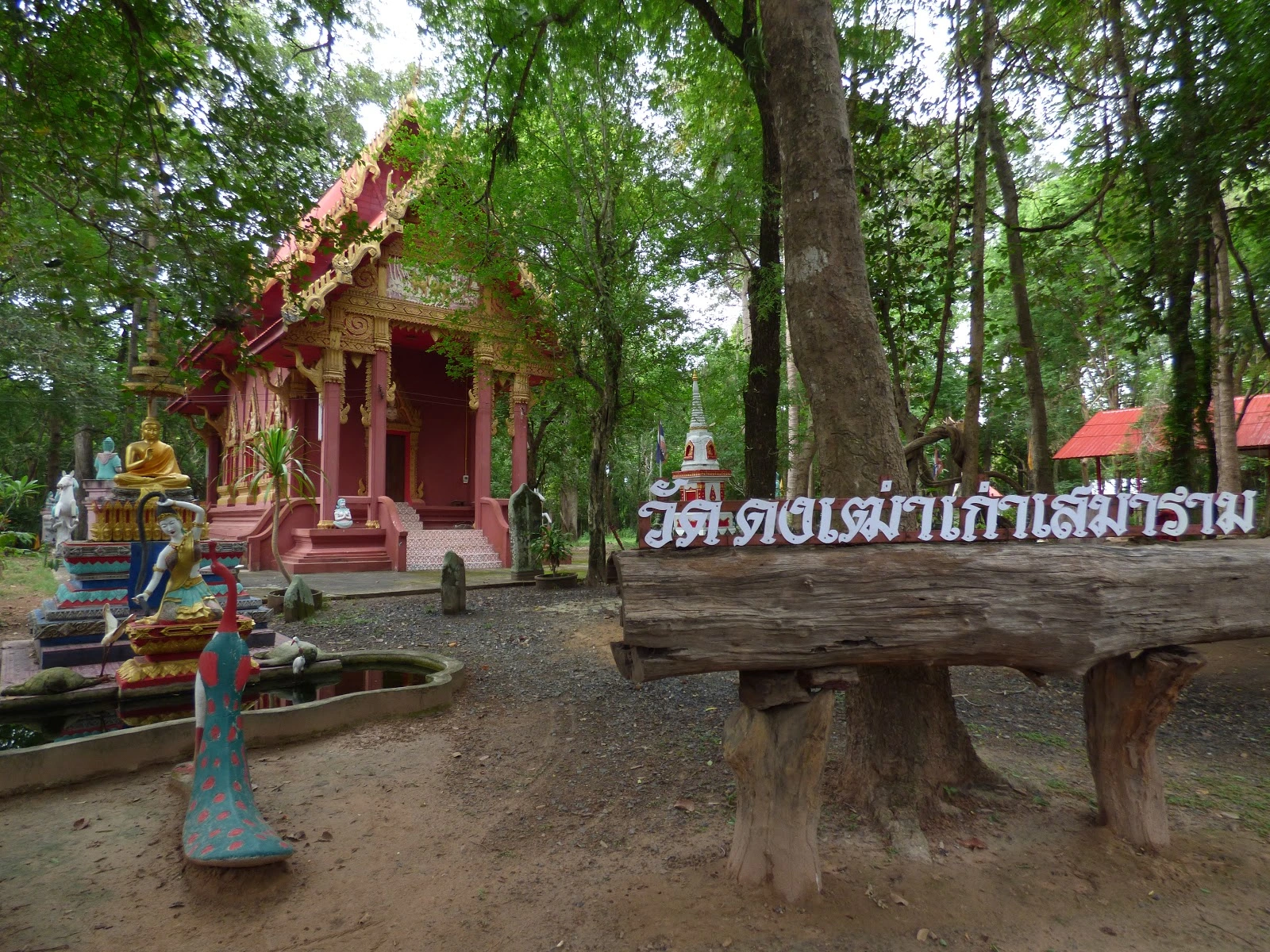
Wat Dong Thao Kao in Amnat Charoen Province is an old Buddhist temple and important archaeological site in Ban Nong Ruea, Na Mo Ma Subdistrict, Mueang Amnat Charoen District. Located north of Mu 2 Ban Nong Ruea and about 700 meters south of Na Mo Ma Subdistrict Municipality, the temple is known for its ancient sandstone boundary stones, or bai sema, which are believed to be at least from the 12th–13th Buddhist centuries. These large carved stones, together with late Dvaravati-style sandstone Buddha images, make the temple one of the most meaningful cultural heritage sites in Amnat Charoen.
Wat Dong Thao Kao is not only a place for merit-making. It is a site where visitors can see evidence of early Buddhist presence in the region. The ancient bai sema found here are large sandstone slabs carved in low relief with floral patterns, water-pot motifs, and upper circular forms resembling a dharmachakra, or Wheel of Dhamma. These motifs are closely linked with Buddhist symbolism and help explain why the site is considered sacred and historically significant.
One of the most distinctive features of Wat Dong Thao Kao is the large number of bai sema scattered across a wide area. Some are visible above ground, while others remain partly buried in the soil around the dense forest area. The stones appear in unusual long alignments along the same direction, suggesting that they may have marked a sacred boundary, a Buddhist ritual zone, a mandapa area, or even the limits of an ancient settlement. This unusual distribution makes the site highly valuable for understanding ancient religious landscapes in northeastern Thailand.
In addition to the sandstone boundary stones, the area has yielded late Dvaravati-style sandstone Buddha images. The presence of both bai sema and Buddha images strengthens the interpretation of Wat Dong Thao Kao as an important ancient Buddhist site. These objects show that the area was connected to broader Buddhist and artistic networks more than 1,000 years ago, long before the modern provincial identity of Amnat Charoen was formed.
The age of the bai sema, not less than the 12th–13th Buddhist centuries, places the site within an early period of Buddhist cultural development in the region. For foreign travelers, this means that Wat Dong Thao Kao offers more than a temple visit. It provides a rare opportunity to encounter ancient Buddhist art still preserved in its original landscape, surrounded by trees, local village life, and the quiet atmosphere of a forest temple.
The name Dong Thao Kao evokes a sense of old forest and deep memory. The word “dong” suggests woodland or dense vegetation, while “thao kao” carries a feeling of age and antiquity. This name fits the character of the temple, where ancient stones remain in a shaded landscape with large trees. Walking through the area, visitors can feel that the archaeological remains are not isolated museum objects, but part of a living sacred landscape connected with the temple and community.
Wat Dong Thao Kao has already been registered as an archaeological monument. This status confirms the cultural value of the site and its importance for preservation. Visitors should therefore treat the area with particular care. Even though the boundary stones are made of sandstone, they are ancient and fragile. Touching, moving, climbing, scratching, or leaning on them can cause permanent damage to the carved surfaces and archaeological context.
The temple is also a useful learning site for students, researchers, cultural travelers, and anyone interested in Dvaravati art, Buddhist boundary stones, local archaeology, and the history of Buddhism in northeastern Thailand. The site helps explain how sacred space may have been marked in the past and how Buddhist communities used stone markers to define ritual or spiritual areas. It also encourages further study of Amnat Charoen as a province with deep historical roots.
Getting There from Mueang Amnat Charoen is convenient by private car, rental car, or local hired transport. Take Arun Prasert Road toward Na Mo Ma Subdistrict. Around kilometer 19, near the route from Mueang Amnat Charoen to the Nam Plik junction, continue into Na Mo Ma Subdistrict and proceed to Wat Dong Thao Kao. The total distance from the town area is about 23 km. The temple is located north of Mu 2 Ban Nong Ruea and about 700 meters south of Na Mo Ma Subdistrict Municipality.
The best time to visit is in the morning or late afternoon when the weather is more comfortable for walking. The forested temple grounds can have uneven surfaces, and some sema stones are partly buried in the ground, so visitors should wear comfortable shoes and walk carefully. Daylight visits are recommended because they make it easier to see the carved motifs and understand the layout of the archaeological area.
Wat Dong Thao Kao can be included in a cultural and nature-based route around Na Mo Ma and Mueang Amnat Charoen. Nearby attractions include Wat Phu Champa, Wat Tham Saeng Kaeo, Wat Tham Saeng Phet, Wat Pa Thewi Tham, and Phra Mongkhon Ming Mueang. A half-day route can focus on Wat Dong Thao Kao and Wat Phu Champa, while a full-day route can include cave temples, forest temples, and other sacred sites in the province.
The value of Wat Dong Thao Kao lies in its quiet but powerful evidence of the past. Its ancient bai sema, late Dvaravati-style sandstone Buddha images, forested setting, and registered archaeological status make it a site that deserves careful attention. For travelers who want to understand Amnat Charoen beyond modern attractions, Wat Dong Thao Kao offers a direct connection with early Buddhist culture, local heritage, and the long spiritual history of northeastern Thailand.
| Name | Wat Dong Thao Kao / Wat Dong Thao Kao Archaeological Site |
| Location | North of Mu 2 Ban Nong Ruea, Na Mo Ma Subdistrict, Mueang Amnat Charoen District, Amnat Charoen Province |
| Address | Ban Nong Ruea, Na Mo Ma Subdistrict, Mueang Amnat Charoen District, Amnat Charoen 37000, Thailand |
| Highlights | Ancient sandstone bai sema from at least the 12th–13th Buddhist centuries, low-relief floral motifs, water-pot motifs, dharmachakra-like forms, late Dvaravati-style sandstone Buddha images, and a wide distribution of boundary stones in a forested area |
| History / Period | An ancient archaeological site with bai sema and late Dvaravati-style sandstone Buddha images dating to at least the 12th–13th Buddhist centuries |
| Key Evidence | Large carved sandstone bai sema, late Dvaravati-style sandstone Buddha images, and long alignments of boundary stones partly buried across a wide area |
| Name Origin | The name suggests an old forested area with deep historical memory, matching the temple’s shaded landscape and ancient archaeological remains |
| Distinctive Features | A forest temple and archaeological site with unusually wide distribution of bai sema, some arranged in long lines along the same direction |
| Travel Information | From Mueang Amnat Charoen, take Arun Prasert Road to kilometer 19 near the route to Nam Plik junction, then enter Na Mo Ma Subdistrict and continue to Wat Dong Thao Kao; the total distance is about 23 km |
| Current Status | Open as a local Buddhist temple and archaeological site in Ban Nong Ruea; Wat Dong Thao Kao has been registered as an archaeological monument |
| Open Days | Daily |
| Opening Hours | Morning To Evening |
| Main Areas / Zones | Forested Temple Grounds Sandstone Bai Sema Area Long Alignment Of Partly Buried Boundary Stones Area Where Late Dvaravati-Style Sandstone Buddha Images Were Found Merit-Making And Worship Area Registered Archaeological Monument Area |
| Abbot / Caretaker | Phra Khru Chittapalakun |
| Visitor Etiquette | Dress modestly, keep noise low, do not touch, move, climb, or scratch the bai sema, and avoid littering in the archaeological area |
| Nearby Tourist Attractions | 1. Wat Phu Champa, about 9 km 2. Wat Tham Saeng Kaeo, about 16 km 3. Wat Tham Saeng Phet, about 19 km 4. Wat Pa Thewi Tham / Wat Khao Dueai Kai, about 21 km 5. Phra Mongkhon Ming Mueang / Buddha Park, about 26 km |
| Nearby Restaurants | 1. Baan Pinto 1984, about 26 km, Tel. 061-463-4497 2. Kuay Jap Kung Amnat Charoen, about 26 km, Tel. 045-984-495 3. B'More Love Bakehouse & Café Amnat Charoen, about 26 km 4. Isan Thai Kan Eng, about 27 km 5. Naem Nueang Ing Than, about 28 km |
| Nearby Accommodations | 1. Faikid Hotel, about 26 km 2. Ramiarndao Boutique Place, about 26 km 3. LJ The Emerald Hotel, about 26 km 4. Baan Ing Daan Hotel, about 27 km 5. Hotels And Resorts In Mueang Amnat Charoen, about 26 km |
Frequently Asked Questions (FAQ)
Q: Where is Wat Dong Thao Kao located?
A: Wat Dong Thao Kao is located north of Mu 2 Ban Nong Ruea, Na Mo Ma Subdistrict, Mueang Amnat Charoen District, Amnat Charoen Province.
Q: Why is Wat Dong Thao Kao important?
A: It is an important archaeological site with ancient sandstone bai sema dating to at least the 12th–13th Buddhist centuries and late Dvaravati-style sandstone Buddha images.
Q: What makes the bai sema at Wat Dong Thao Kao special?
A: The bai sema are large sandstone slabs carved with low-relief floral patterns, water-pot motifs, and dharmachakra-like forms; many are scattered across a wide area and some appear in long alignments.
Q: How is Wat Dong Thao Kao related to Dvaravati culture?
A: The site contains sandstone boundary stones and late Dvaravati-style sandstone Buddha images, showing ancient Buddhist and artistic influence in the Amnat Charoen area.
Q: How can travelers get to Wat Dong Thao Kao?
A: From Mueang Amnat Charoen, take Arun Prasert Road to kilometer 19 near the Nam Plik junction, then enter Na Mo Ma Subdistrict and continue to Wat Dong Thao Kao. The total distance is about 23 km.
Q: Is Wat Dong Thao Kao a registered archaeological monument?
A: Yes. Wat Dong Thao Kao has been registered as an archaeological monument and is an important cultural heritage site of Na Mo Ma Subdistrict.
Q: When is the best time to visit Wat Dong Thao Kao?
A: Morning or late afternoon is best because the weather is more comfortable for walking around the forested temple grounds and viewing the bai sema.
Q: What nearby attractions can be visited with Wat Dong Thao Kao?
A: Nearby attractions include Wat Phu Champa, Wat Tham Saeng Kaeo, Wat Tham Saeng Phet, Wat Pa Thewi Tham, and Phra Mongkhon Ming Mueang.
 Category: ●Places of Worship
 Group: ●Temple
Last Update : 3 MonthAgo
 Last Update : 3 MonthAgo
 Click to Access the Navigation Map GPS
 Art, Culture and Heritage
 Historical Sites and Monuments(1)
 Art, Craft Centres, Tradition(3)
 Museums(1)
Temple(30)
Museums(1)
Temple(30)
 Other Sacred Sites(7)
 Suburban Living
 Village, Community(3)
 Nature and Wildlife
 National Parks and Marine Reserves(3)
 Mountain (Doi)(5)
 Dam, Reservoir, Lake(5)
 Waterfalls(3)
 Caves(2)
 River, Canal(3)
 Other natural attractions(5)
 Entertainment and Agricultural
 Zoos and Aquariums(1)
 Farms, Parks and Ecotourism(4)
 Shopping
 Shopping and Night Market(1)


