
lovethailand home >Northeastern Travel Attractions >Amnat Charoen Travel Attractions >Muang Amnat Charoen >Kai Kham > Wat Rasi Yaram
TL;DR: Wat Rasi Yaram is located at Mu 1, Ban Kai Kham, Kai Kham Subdistrict, Mueang Amnat Charoen District, Amnat Charoen Province, open Daily, hours Morning To Evening.
Wat Rasi Yaram
Open Days: Daily
Opening Hours: Morning To Evening
Wat Rasi Yaram in Ban Kai Kham, Kai Kham Subdistrict, Mueang Amnat Charoen District, Amnat Charoen Province, is one of the most culturally significant local temples in the province. The temple is especially known for its old ubosot, or Isan-style sim, and the painted murals on the front façade of the ordination hall. These murals tell Buddhist stories, especially the Vessantara Jataka, and include the striking scene of Jujaka leading Kanha and Chali, as well as images of trees, animals, heaven, and hell.
For foreign travelers interested in Thai Buddhist art beyond major tourist cities, Wat Rasi Yaram offers a rare opportunity to see local religious painting in its original community setting. This is not a large commercial temple, but a living village temple with an old sacred building that preserves traces of local craftsmanship, Buddhist teaching, and community devotion. Its value lies in the quiet presence of the old sim and the way its paintings still communicate moral stories to visitors today.
Ban Kai Kham is an old community in Mueang Amnat Charoen. Historical accounts describe the community as having roots connected with people who migrated from Vientiane during the early Rattanakosin period. This background gives Wat Rasi Yaram cultural depth. The temple is not only a place of worship, but also part of the community’s memory, identity, and social history. It reflects how local people built temples as centers of faith, education, and collective life.
The name Wat Rasi Yaram is connected with a local story about land donation and temple establishment. Nai La donated 12 rai of land for the temple. Later, Nai La and Nai Lin, who were brothers, were ordained and stayed at the temple. The temple name is therefore linked with local people whose faith and generosity helped establish the monastery as a spiritual center for Ban Kai Kham.
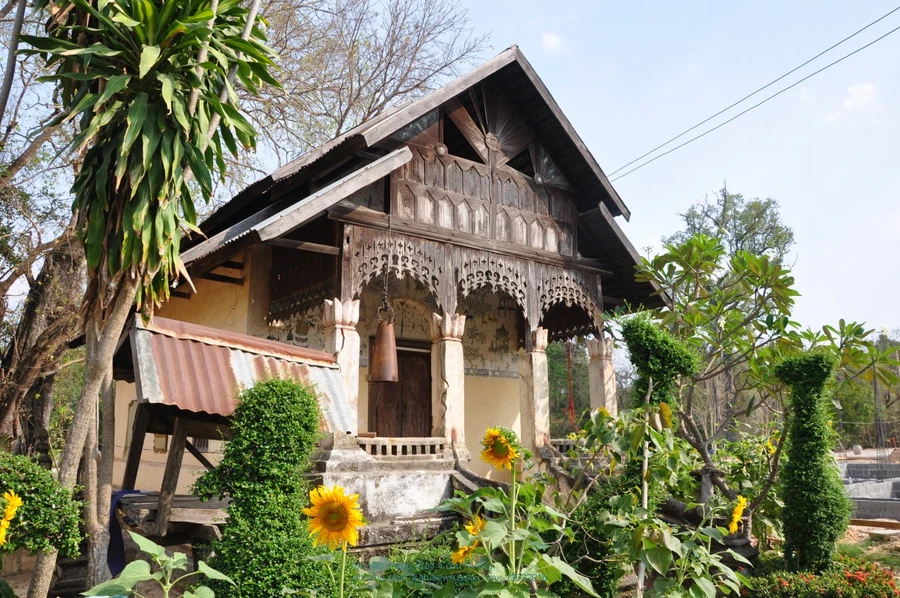
The old ubosot, or sim, is the most important feature of Wat Rasi Yaram. It is a small brick-and-plaster building with a modest but meaningful form. Inside are three Buddha images, with the central image serving as the principal Buddha image. The building is valuable not because of large scale or luxury, but because of its old local craftsmanship, carved wooden details, and painted stories that preserve the religious imagination of the community.
The Fine Arts Department records that the old ubosot was built in 1925 and completed in 1928. Its construction involved monks, novices, local leaders, village headmen, and residents who worked together to create and restore the sacred building. This history shows that the sim was a community achievement, built through shared Buddhist faith and local cooperation.
According to information related by the abbot in 2002, the painted murals on the front of the ubosot were created by Chang Phon from Ban Bo Bu in Kai Kham Subdistrict. The paintings are said to have been made in 1921, during the reign of King Vajiravudh, Rama VI. Although the exact artistic classification of the murals has not been formally concluded, their importance is clear. They represent the skill of a local painter and preserve the visual language of Buddhist storytelling in rural northeastern Thailand.
The murals mainly narrate the Vessantara Jataka, one of the most important Buddhist birth stories in Thai and Lao-Isan culture. The famous scene of Jujaka leading Kanha and Chali is especially powerful because it reflects the emotional heart of the story: sacrifice, generosity, suffering, and the testing of spiritual resolve. In the past, such paintings helped villagers understand Buddhist teachings through images even if they could not study written texts deeply.
The paintings also include trees, animals such as tigers, elephants, and horses, and scenes of heaven and hell. These elements were not merely decorative. They helped create a moral universe on the wall of the temple. Heaven represented the fruit of merit and good conduct, while hell reminded people of the results of harmful actions. The animals and trees made the story world feel alive and closer to the everyday imagination of local viewers.
The wooden and architectural details of the old sim are also worth observing. The first bay of the roof structure includes carving of entwined naga figures, while another section includes vine patterns. The gable and eaves preserve traces of carved decoration, including motifs associated with the setting sun. These details show how Buddhist symbolism, local craftsmanship, and village aesthetics came together in the architecture of the temple.
The front façade of the ubosot presents several Buddhist subjects in a layered composition. The upper part includes an image of Phra That Ket Kaew Chulamanee. Below are scenes of the Buddha subduing Mara, Phra Malai visiting hell, and the Vessantara Jataka. Together, these images create a Buddhist cosmos on the front of the building, linking heaven, enlightenment, compassion, hell, and the perfection of generosity.
Getting There is convenient from Mueang Amnat Charoen. Travelers can head toward Kai Kham Subdistrict and Ban Kai Kham by private car, rental car, or local hired transport. Since the temple is located within a local village community, visiting during daylight hours is recommended in order to clearly see the old ubosot and its murals. Visitors can also ask local residents for directions once they reach Ban Kai Kham.
The best time to visit Wat Rasi Yaram is in the morning or late afternoon when the light is softer. These times are comfortable for merit-making and for viewing the paintings on the front of the ubosot. Visitors who wish to take photographs should avoid touching the paintings, leaning against the wall, or using flash at close range. The murals and the old sim are fragile cultural heritage that should be treated with care.
Wat Rasi Yaram can be included in a cultural itinerary around Mueang Amnat Charoen. Nearby places include Phra Mongkhon Ming Mueang, Amnat Charoen Clock Tower, Ming Mueang Chaloem Phra Kiat Park, Wat Pa Thewi Tham, and Wat Tham Saeng Phet. Travelers with a half day can combine the temple with attractions in town, while those with a full day can explore old temples, forest temples, cave temples, and local natural sites around the province.
For students, researchers, and travelers interested in local heritage, Wat Rasi Yaram is a valuable field site. The murals invite further study in terms of painting technique, pigments, composition, Buddhist narrative, Isan-Lao cultural influence, and the role of local artists such as Chang Phon from Ban Bo Bu. The temple shows how a small village monastery can preserve knowledge that is historically and artistically important.
The importance of Wat Rasi Yaram lies in its ability to preserve the memory of Ban Kai Kham through art, architecture, and faith. The painted façade does more than decorate the old ubosot. It tells stories of Buddhist morality, local devotion, craftsmanship, and community life. A visit to the temple is therefore not only an act of worship or sightseeing, but also a chance to appreciate one of Amnat Charoen’s meaningful local cultural treasures.
| Name | Wat Rasi Yaram |
| Location | Mu 1, Ban Kai Kham, Kai Kham Subdistrict, Mueang Amnat Charoen District, Amnat Charoen Province |
| Address | Ban Kai Kham, Kai Kham Subdistrict, Mueang Amnat Charoen District, Amnat Charoen 37000, Thailand |
| Highlights | Old ubosot or sim, painted murals on the front façade, Vessantara Jataka scenes, Jujaka leading Kanha and Chali, heaven and hell scenes, trees, and animal figures |
| History / Period | The murals are said to have been painted in 1921 during the reign of King Rama VI, while the old ubosot was built between 1925 and 1928 |
| Painter / Local Craftsman | Chang Phon from Ban Bo Bu, Kai Kham Subdistrict, Mueang Amnat Charoen District |
| Name Origin | The name is linked with the story of Nai La, who donated land for the temple, and Nai La and Nai Lin, brothers who were later ordained and resided at the temple |
| Distinctive Features | A small brick-and-plaster Isan-style sim with three Buddha images inside, carved wooden details, naga and vine motifs, and Buddhist narrative murals on the front wall |
| Travel Information | Travel from Mueang Amnat Charoen toward Kai Kham Subdistrict and Ban Kai Kham by private car, rental car, or local hired transport |
| Current Status | Open as a local Buddhist temple and cultural heritage site with an old ubosot and important mural paintings in Amnat Charoen Province |
| Open Days | Daily |
| Opening Hours | Morning To Evening |
| Main Areas / Zones | Old Ubosot / Sim Painted Mural Façade Three Buddha Images Inside The Ubosot Merit-Making And Worship Area Temple Grounds And Ban Kai Kham Community Area |
| Visitor Etiquette | Dress modestly, keep noise low, do not touch the murals, do not lean against the ubosot wall, do not write on the building, and avoid using flash at close range |
| Nearby Tourist Attractions | 1. Phra Mongkhon Ming Mueang / Buddha Park, about 9 km 2. Amnat Charoen Clock Tower, about 10 km 3. Ming Mueang Chaloem Phra Kiat Park, about 10 km 4. Wat Pa Thewi Tham / Wat Khao Dueai Kai, about 13 km 5. Wat Tham Saeng Phet, about 18 km |
| Nearby Restaurants | 1. Baan Pinto 1984, about 10 km, Tel. 061-463-4497 2. Kuay Jap Kung Amnat Charoen, about 10 km 3. B'More Love Bakehouse & Café Amnat Charoen, about 10 km 4. Isan Thai Kan Eng, about 11 km 5. Naem Nueang Ing Than, about 12 km |
| Nearby Accommodations | 1. Faikid Hotel, about 10 km, Tel. 061-324-5465 2. Ramiarndao Boutique Place, about 10 km, Tel. 081-067-4149 3. LJ The Emerald Hotel, about 10 km 4. Baan Ing Daan Hotel, about 11 km 5. Hotels And Resorts In Mueang Amnat Charoen, about 10 km |
Frequently Asked Questions (FAQ)
Q: Where is Wat Rasi Yaram located?
A: Wat Rasi Yaram is located in Mu 1, Ban Kai Kham, Kai Kham Subdistrict, Mueang Amnat Charoen District, Amnat Charoen Province.
Q: What is Wat Rasi Yaram known for?
A: It is known for its old ubosot or sim and the painted murals on the front façade depicting the Vessantara Jataka, heaven, hell, trees, and animals.
Q: When were the murals at Wat Rasi Yaram painted?
A: According to information related by the abbot in 2002, the murals were painted in 1921 by Chang Phon from Ban Bo Bu during the reign of King Rama VI.
Q: What story do the murals at Wat Rasi Yaram tell?
A: The murals mainly tell the Vessantara Jataka, especially the scene of Jujaka leading Kanha and Chali, along with images of trees, animals, heaven, and hell.
Q: Why is the old ubosot of Wat Rasi Yaram important?
A: It is a small Isan-style sim with brick-and-plaster construction, carved wooden details, Buddha images, and valuable local Buddhist murals.
Q: What should visitors pay special attention to at Wat Rasi Yaram?
A: Visitors should observe the mural façade, the Vessantara Jataka scene, the Phra Malai scene, the Buddha subduing Mara, and the carved wooden details of the old sim.
Q: When is the best time to visit Wat Rasi Yaram?
A: Morning or late afternoon is best because the light is softer and more comfortable for viewing the mural details on the old ubosot.
Q: What nearby attractions can be visited with Wat Rasi Yaram?
A: Nearby attractions include Phra Mongkhon Ming Mueang, Amnat Charoen Clock Tower, Ming Mueang Chaloem Phra Kiat Park, Wat Pa Thewi Tham, and Wat Tham Saeng Phet.
 Category: ●Places of Worship
 Group: ●Temple
Last Update : 3 WeekAgo
 Last Update : 3 WeekAgo
 Click to Access the Navigation Map GPS
 Art, Culture and Heritage
 Historical Sites and Monuments(1)
 Art, Craft Centres, Tradition(3)
 Museums(1)
Temple(30)
Museums(1)
Temple(30)
 Other Sacred Sites(7)
 Suburban Living
 Village, Community(3)
 Nature and Wildlife
 National Parks and Marine Reserves(3)
 Mountain (Doi)(5)
 Dam, Reservoir, Lake(5)
 Waterfalls(3)
 Caves(2)
 River, Canal(3)
 Other natural attractions(5)
 Entertainment and Agricultural
 Zoos and Aquariums(1)
 Farms, Parks and Ecotourism(4)
 Shopping
 Shopping and Night Market(1)


