
lovethailand home >Northeastern Travel Attractions >Amnat Charoen Travel Attractions >Senangkha Nikhom >Nong Hai > Phu Phanom Di
TL;DR: Phu Phanom Di is located at Ban Na Udom, Nong Hai Subdistrict, Senangkhanikhom District, Amnat Charoen Province, open Daily, hours 08.00 – 17.00.
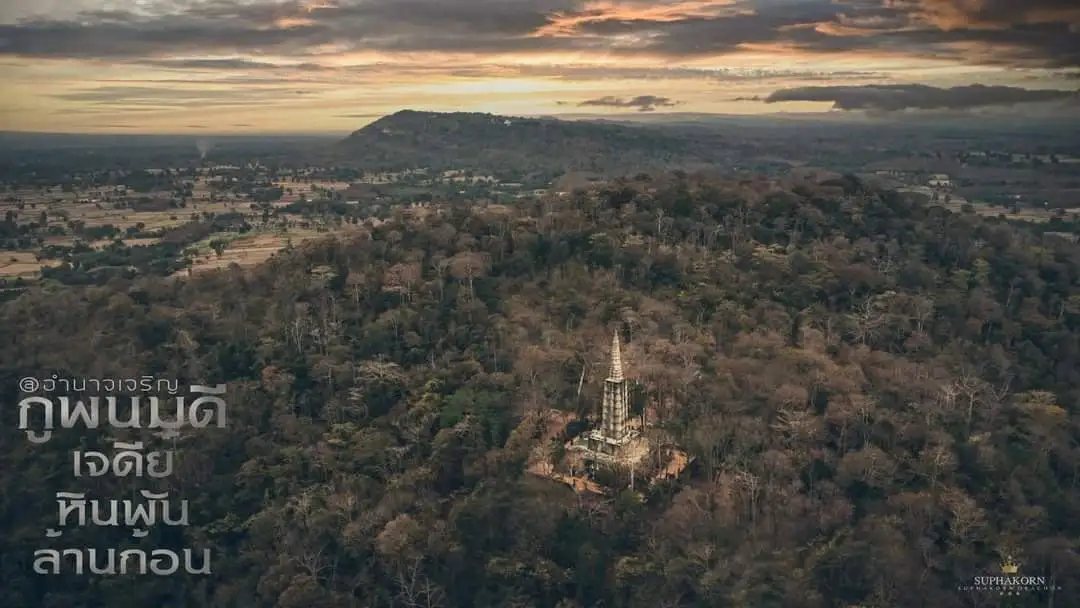
Phu Phanom Di
Open Days: Daily
Opening Hours: 08.00 – 17.00
Phu Phanom Di in Amnat Charoen Province is a natural and Buddhist cultural attraction in Nong Hai Subdistrict, Senangkhanikhom District. It is a small earthen hill that is home to Wat Phu Phanom Di, also widely known as Wat Hin Lan Kon, or the temple of a million stones. The site is famous for its laterite-and-stone pagoda, often called the Billion Stone Pagoda, which rises about 39 meters high. It also features a white Buddha image built on a high cliff, a convenient stairway leading up the hill, beautifully carved wooden Buddha images, and a peaceful forest-temple atmosphere. For foreign travelers who want to experience a less commercial and more meaningful side of Amnat Charoen, Phu Phanom Di is one of the most distinctive places to visit.
Phu Phanom Di is not a large mountain, but its presence is visually powerful because the religious structures stand prominently on the hill. As travelers approach the area near Ban Na Udom, the stone pagoda can be seen rising above the landscape. This makes the temple highly recognizable and gives visitors an immediate sense that the hill is not only a natural site, but also a place shaped by faith, community effort, and local craftsmanship.
The charm of Phu Phanom Di lies in the way it brings together a hill, a forest temple, caves, stone art, Buddha images, and local legends. Within the temple area, monks’ dwellings are found in caves or rock recesses, while the sermon hall stands on a stone terrace surrounded by trees. The visit is therefore not just a walk up a hill to see a viewpoint. It is a journey through a living religious landscape where nature, Buddhist practice, and community memory are closely connected.
The hill was once locally known as “Phu Mae Mai,” or the widow hill. Local stories describe the area as a once-abundant forest with wildlife and natural resources. In the past, some villagers entered the forest to hunt animals or cut trees. Folk beliefs say that misfortune fell upon some family heads who disturbed the forest, leaving their wives widowed. This gave rise to the name Phu Mae Mai and strengthened the belief that guardian spirits protected the mountain and its forest.
Later, when meditation monks came to practice in the area, the name was changed from Phu Mae Mai to “Phu Phanom Di” for auspiciousness. The new name transformed the image of the place from one associated with fear and taboo into one associated with goodness, merit, and Buddhist practice. Some official references also call the area Phu Pha Di. These names show that the place has several layers of meaning: natural landscape, local belief, and Buddhist faith.
Phu Phanom Di became more important when monks and local villagers in Nong Hai Subdistrict jointly built a white Buddha image in the subduing Mara posture on the cliff in 1986. This Buddha image is known as Phra Si Rattana Trai Rat. Standing high on the hill, it became a spiritual landmark for the community and visitors. The image is not only an object of worship, but also an element that defines the sacred landscape of Phu Phanom Di.
The stairway of 245 steps is another important feature of the site. It connects the lower area with the religious structures on the hill and makes access easier for monks, local worshippers, and visitors. Walking up the stairs allows travelers to gradually enter the atmosphere of the temple. The climb also gives time to slow down, breathe, and prepare the mind before reaching the sacred area above.
The most famous landmark of Wat Phu Phanom Di is the Billion Stone Pagoda. The pagoda was created from concrete structure and decorated with countless small stones arranged across walls, ceilings, statues, and decorative elements. It is a remarkable example of community-based religious art. The stones were selected, carried, and placed with patience and dedication, turning the pagoda into a visible record of local cooperation and faith.
Travel sources describe the pagoda as rising more than 39 meters high, while local accounts connect its construction with the work of Phra Ajarn Panya, the first abbot, and the villagers. The pagoda became a place for meditation, Buddhist ceremonies, Buddha images, and statues of respected Thai forest-monk masters such as Luang Pu Sao, Luang Pu Mun, Luang Pu Fan, and Luang Pu Chah Subhatto. Inside and around the pagoda, visitors can sense both the devotional purpose and the extraordinary handmade quality of the structure.
The Billion Stone Pagoda is more than a photo landmark. Each small stone attached to the structure represents human effort, patience, and shared faith. When visitors walk around the pagoda, they can see the texture created by countless stones arranged together. Unlike ordinary pagodas with smooth surfaces, this pagoda has a rugged and handmade appearance that gives it a distinctive identity.
Another important feature is the Ratchasi Junk Boat, located about 20 meters from the pagoda. It was originally created to store water for the construction of the pagoda. Later, it developed into a sculptural boat with a lion-like head and a reclining Buddha image carved along the center of the boat. This work shows how local craftsmanship can transform a practical structure into religious art filled with meaning.
The carved wooden Buddha images are also worth seeing. Wood carving has a different feeling from stone and concrete. It gives warmth, detail, and a strong sense of local craft. These wooden Buddha images add another artistic dimension to the temple, allowing visitors to see different materials and techniques within the same site: laterite, small stones, concrete, and carved wood.
The wider Phu Phanom Di area includes several points of interest: Pha Di, Nong Ma Chok, Pha Kluai Mai, Pom Farangset, Tham Kia or the bat cave, Tham Pu Angkha Hat, Tham Saeng Kaew, the Billion Stone Pagoda, the Ratchasi Junk Boat, and Phra Si Rattana Trai Rat. These zones make the site more than a single hilltop temple. Visitors with enough time can explore the relationship between cliffs, caves, stone terraces, monastic spaces, and religious sculptures.
Pha Di is a natural viewpoint where visitors can experience the hill atmosphere and surrounding landscape. Although Phu Phanom Di is a small earthen hill, the upper area offers a sense of openness. During the rainy season, the surroundings become green and fresh, while the cool season offers more comfortable weather for walking and photography.
The cave areas help create the forest-temple identity of Phu Phanom Di. Some monks’ dwellings are located in caves or rock recesses, emphasizing the quiet and meditative character of the site. Visitors should walk respectfully, avoid loud noise, and refrain from entering monastic areas without permission. This is an active religious place, not only a tourist attraction.
The best seasons to visit Phu Phanom Di are the rainy season and the cool season. The rainy season makes the forest scenery lush and fresh, while the cool season is more comfortable for climbing the stairs and walking around the hilltop area. During the hot season, visitors should avoid the strongest midday sun and prepare drinking water, a hat, and proper walking shoes.
A visit to Phu Phanom Di should not be rushed. To understand the value of the site, travelers should spend time at the lower area, the stairway, the cliff Buddha image, the Billion Stone Pagoda, the Ratchasi Junk Boat, the carved wooden Buddha images, and the natural zones around the temple. Walking slowly helps visitors notice the details of the stonework and the devotion behind the place.
Getting There is convenient because Phu Phanom Di is located near the Don Wai-Chanuman road. From Amnat Charoen town, travelers can use Arun Prasert Road, the main road, and turn left at Ban Don Wai onto the Don Wai-Chanuman secondary road. After passing Ban Na Udom for about 3 km, the Billion Stone Pagoda can be seen standing prominently on Phu Phanom Di. From the entrance sign, the road continues through rubber plantations, sugarcane fields, and cassava fields before rising toward the temple area.
A private car or rental car is the most convenient way to visit. The road to the temple is accessible, but visitors should drive carefully, especially during the rainy season or after heavy rain. Because the site is on a hill and includes some sloping sections, cautious driving is recommended. Having a private vehicle also allows travelers to combine the trip with nearby attractions in Senangkhanikhom District or Amnat Charoen town.
Phu Phanom Di is suitable for a half-day or full-day trip from Amnat Charoen town. It can be combined with Phra Mongkhon Ming Mueang and Phuttha Utthayan, Wat Tham Saeng Phet, Huai Si Tho Reservoir, or Phu Kaset. Travelers who plan to stay overnight may find more accommodation and restaurant options in Amnat Charoen town, while those who prefer a quieter rural experience can look for lodging in nearby districts.
According to public tourism information, there is no admission fee for Wat Phu Phanom Di. Visitors can enter, worship, and explore the main areas without paying an entrance charge. However, donations are appropriate for those who wish to support the maintenance of the temple and its religious structures.
Because this is a temple on a hill, visitors should dress modestly and behave respectfully. Avoid loud noise, do not climb unsafe areas, do not write on stones or religious structures, and do not enter monks’ residences or meditation zones without permission. Photography should be done respectfully and should not disturb monks or practitioners.
For photographers, Phu Phanom Di offers several strong visual subjects: the stone pagoda on the hill, the stairway, the cliff Buddha image, carved wooden Buddha images, the Ratchasi Junk Boat, and the natural scenery around the temple. Morning and late afternoon light are better than harsh midday sun because they bring out the texture of the stones and the dimension of the structures more clearly.
Phu Phanom Di is suitable for many types of travelers: Buddhist pilgrims, cultural travelers, temple lovers, those interested in folk craftsmanship, photographers, and visitors looking for a quiet destination in Amnat Charoen. Its value does not come from luxury or commercial facilities. It comes from the sincerity of community effort, the faith of the monks and villagers, and the peaceful atmosphere of a small hill transformed into a sacred place.
Families should consider the physical condition of all travelers before climbing the stairs and exploring the hilltop. Although the stairway is convenient, it still requires effort. Elderly visitors should walk slowly and rest when needed. Children should remain under adult supervision because the site includes stairs, stone terraces, and high areas that require care.
Overall, Phu Phanom Di is a place that clearly reflects the strength of local faith. The Billion Stone Pagoda, the Ratchasi Junk Boat, the cliff Buddha image, and the carved wooden Buddha images were all shaped by dedication and local craftsmanship. Visiting the site is not only about seeing beautiful religious structures. It is also about understanding how a small earthen hill became an important spiritual and cultural landmark of Amnat Charoen.
In summary, Phu Phanom Di in Amnat Charoen Province deserves a place on the itinerary of travelers interested in temples, folk art, nature, and local stories. Its highlights include Wat Phu Phanom Di on a small earthen hill, a laterite-and-stone pagoda about 39 meters high, a Buddha image on a high cliff, an accessible stairway, the Ratchasi Junk Boat, carved wooden Buddha images, and a calm forest-temple atmosphere. Located near the Don Wai-Chanuman road, it is convenient to reach and suitable for merit-making, cultural sightseeing, photography, and learning about the power of community faith in northeastern Thailand.
| Name | Phu Phanom Di / Wat Phu Phanom Di / Wat Hin Lan Kon / The Billion Stone Pagoda |
| Location | Ban Na Udom, Nong Hai Subdistrict, Senangkhanikhom District, Amnat Charoen Province |
| Address | Nong Hai Subdistrict, Senangkhanikhom District, Amnat Charoen Province |
| Highlights | Laterite-and-stone pagoda about 39 meters high, Buddha image on a high cliff, 245-step stairway, Ratchasi Junk Boat, carved wooden Buddha images, and a forest-temple setting on a small earthen hill |
| History | The hill was formerly known as Phu Mae Mai and was later renamed Phu Phanom Di for auspiciousness. In 1986, monks and villagers built Phra Si Rattana Trai Rat on the cliff, followed by the construction of the Billion Stone Pagoda through community faith. |
| Name Origin | Phu Phanom Di was renamed from Phu Mae Mai for auspicious meaning. The names Wat Hin Lan Kon and the Billion Stone Pagoda come from the use of countless stones in the pagoda’s construction and decoration. |
| Distinctive Features | Small earthen hill with a temple on top, stone pagoda, cliff Buddha image, caves, rock recesses, monks’ dwellings, sermon hall on a stone terrace, and natural viewpoints |
| Travel Information | From Amnat Charoen town, use Arun Prasert Road. At Ban Don Wai, turn left onto the Don Wai-Chanuman road. After passing Ban Na Udom for about 3 km, the stone pagoda can be seen on Phu Phanom Di. From the entrance sign, continue through local agricultural areas for about 3 km to reach the hilltop temple area. |
| Current Status | Open as a Buddhist temple and faith-based attraction in Nong Hai Subdistrict |
| Open Days | Daily |
| Opening Hours | 08.00 – 17.00 |
| Fees | No admission fee |
| Facilities | Local guides, electricity, water supply, waste management system, and temple areas for religious activities |
| Main Areas / Zones | 1. Billion Stone Pagoda 2. Phra Si Rattana Trai Rat on the cliff 3. 245-step stairway 4. Ratchasi Junk Boat 5. Carved wooden Buddha images 6. Pha Di 7. Nong Ma Chok 8. Pha Kluai Mai 9. Pom Farangset 10. Tham Kia or Bat Cave 11. Tham Pu Angkha Hat 12. Tham Saeng Kaew 13. Sermon hall on the stone terrace 14. Monks’ dwellings in caves and rock recesses |
| Official Website / Official Page | Tourism Authority of Thailand Ubon Ratchathani Office public page and Tourism Authority of Thailand attraction information |
| Nearby Tourist Attractions | 1. Phu Kaset / Wat Tham Hua Nak Phu Kaset, about 35 km 2. Phra Mongkhon Ming Mueang and Phuttha Utthayan, about 35 km 3. Huai Si Tho Reservoir, about 38 km 4. Wat Tham Saeng Phet, about 40 km 5. Kaeng Khan Sung, about 50 km |
| Nearby Restaurants | 1. Srabai Jai Cafe, about 30 km, Tel. 081-079-6855 2. Cafe Thanai Zaap, about 32 km, Tel. 064-086-2424 3. Krua Phet Nam Ngoen, about 30 km 4. Kuai Tiao Ruea Tang Khong, about 31 km 5. Jungle Cafe Senangkhanikhom Branch, about 32 km |
| Nearby Accommodations | 1. Zwa Hotel Amnat Charoen, about 35 km 2. Baan Ing Daan, about 36 km 3. Penphit Hotel, about 36 km 4. Nakarin Hotel, about 37 km 5. Baan Na Resort Grand, Pathum Ratchawongsa District, about 55 km, Tel. 083-629-8797, 063-989-3454, 080-992-6529 |
Frequently Asked Questions (FAQ)
Q: Where is Phu Phanom Di located?
A: Phu Phanom Di is located at Ban Na Udom, Nong Hai Subdistrict, Senangkhanikhom District, Amnat Charoen Province. It is home to Wat Phu Phanom Di, also known as Wat Hin Lan Kon.
Q: What makes Phu Phanom Di special?
A: Its highlights include a laterite-and-stone pagoda about 39 meters high, a Buddha image on a high cliff, a 245-step stairway, the Ratchasi Junk Boat, carved wooden Buddha images, and a peaceful forest-temple atmosphere.
Q: What are the opening days and hours of Phu Phanom Di?
A: Phu Phanom Di is open daily from 08.00 to 17.00. Morning and late afternoon are good times for walking and photography.
Q: Is there an admission fee for Phu Phanom Di?
A: There is no admission fee. Visitors may enter and pay respect without an entrance charge, and donations can be made voluntarily.
Q: How do I get to Phu Phanom Di?
A: From Amnat Charoen town, take Arun Prasert Road. At Ban Don Wai, turn left onto the Don Wai-Chanuman road. After passing Ban Na Udom for about 3 km, the stone pagoda can be seen on the hill. Follow the entrance road up to the temple area.
Q: Why is the Billion Stone Pagoda important?
A: The Billion Stone Pagoda is a community-built religious artwork created through the cooperation of monks and villagers. Countless small stones were used to decorate the structure, making it a major symbol of Wat Phu Phanom Di.
Q: When is the best time to visit Phu Phanom Di?
A: The rainy season and cool season are the best times to visit because the hill is greener, the weather is more comfortable, and the outdoor temple area is easier to enjoy.
Q: What should visitors prepare before visiting Phu Phanom Di?
A: Visitors should dress modestly, wear comfortable shoes for stairs and stone surfaces, bring drinking water and sun protection, and behave respectfully because this is an active Buddhist temple and meditation area.
 Category: ●Nature and Wildlife
 Group: ●Mountain (Doi)
Last Update : 2 MonthAgo
 Last Update : 2 MonthAgo
 Click to Access the Navigation Map GPS
 Art, Culture and Heritage
 Historical Sites and Monuments(1)
 Art, Craft Centres, Tradition(3)
 Museums(1)
 Places of Worship
 Temple(30)
 Other Sacred Sites(7)
 Suburban Living
 Village, Community(3)
 National Parks and Marine Reserves(3)
Mountain (Doi)(5)
National Parks and Marine Reserves(3)
Mountain (Doi)(5)
 Dam, Reservoir, Lake(5)
 Waterfalls(3)
 Caves(2)
 River, Canal(3)
 Other natural attractions(5)
 Entertainment and Agricultural
 Zoos and Aquariums(1)
 Farms, Parks and Ecotourism(4)
 Shopping
 Shopping and Night Market(1)


