
lovethailand home >Northeastern Travel Attractions >Amnat Charoen Travel Attractions >Hua Taphan >Phon Mueang Noi > Bai Sema
TL;DR: Bai Sema is located at Lam Sebai riverside area, Amnat Charoen Province, connected with riverside communities in Hua Taphan District, open Daily, hours No Official Opening Hours Specified.

Bai Sema
Open Days: Daily
Opening Hours: No Official Opening Hours Specified
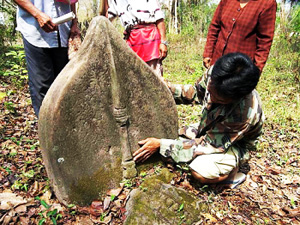
The Boundary Stone of Amnat Charoen Province, often referred to in local accounts as the bai sema found in Lam Sebai, is a small but meaningful cultural and archaeological site connected with the river landscape of Amnat Charoen. According to local tradition, the boundary stone was being transported from another place to be enshrined in a nearby temple or community. During the journey, the boat sank in Lam Sebai. Later, villagers who went fishing discovered the stone and brought it up to be placed on the riverbank. This story gives the site a distinctive identity that links Buddhist heritage, river travel, local memory, and the everyday life of riverside communities.
This is not a large tourist attraction with monumental architecture, but it is valuable as a local heritage point. A bai sema is an important object in Buddhist tradition. It is used to mark a sacred boundary, especially around an ubosot or ordination area where monks perform formal religious ceremonies. When such a sacred object is found in a river, its meaning expands beyond the temple compound. It becomes connected to water, transportation, fishing life, and the memory of the people who found and preserved it.
In Buddhist culture, boundary stones serve as markers of consecrated space. They help define the area where important monastic rituals such as ordination and Sangha ceremonies are performed. In northeastern Thailand, many ancient boundary stones are associated with early Buddhist communities and Dvaravati cultural influence. They are often made of sandstone or laterite and may appear in simple forms, pointed forms, waisted forms, or carved forms. The presence of bai sema in Amnat Charoen reflects the province’s long cultural depth and its connection with early Buddhist traditions in the Isan region.
The story of the bai sema and the sunken boat in Lam Sebai is important because it reflects how waterways functioned in the past. Rivers were not only natural features but also routes for people, goods, construction materials, and sacred objects. Transporting a boundary stone by boat suggests that the object was considered important enough to be brought into a community for religious use. The accident in the river turned the object into part of local memory, and its later discovery by fishermen gave it a new life as a sacred object on the riverbank.
Lam Sebai is an important waterway in Amnat Charoen, especially for communities in the western and southern parts of the province, including the Hua Taphan area. The river has long supported agriculture, local fishing, and community life. For this reason, the discovery of a bai sema in Lam Sebai is not only an archaeological story but also a river story. It shows how sacred objects, natural landscapes, and everyday livelihoods can become intertwined in local heritage.
Placing the boundary stone on the riverbank allowed the local community to restore its visible and sacred presence. Villagers did not treat it as an ordinary old stone. They recognized it as an object with religious and cultural meaning. By raising it from the water and placing it where people could see and respect it, the community gave the bai sema a new setting. It became both a Buddhist symbol and a marker of local discovery.
For cultural travelers, the value of this site lies in its story as much as in the object itself. The important details include the original intention to enshrine the stone in a temple or community, the transportation by river, the sinking of the boat, the rediscovery by fishermen, and the placement of the stone along Lam Sebai. Together, these details create a local heritage narrative that is different from boundary stones found in formal temple settings.
The bai sema of Amnat Charoen also connects with the wider archaeological landscape of the province. Amnat Charoen contains several sites with ancient boundary stones, sandstone Buddha images, late Dvaravati-style remains, and old temples. Places such as Wat Pho Sila, Wat Dong Thao Kao, Wat Santiwanaram, and Wat Pancha Samana Ram show that the province preserves many traces of older Buddhist communities. This makes the Lam Sebai boundary stone part of a broader cultural pattern rather than an isolated object.
The special character of this boundary stone is its movement from one context to another. If the stone was originally intended for a temple boundary, the accident in Lam Sebai temporarily removed it from that ritual context. When villagers later found it and placed it on the riverbank, it gained a new meaning as a sacred object of a riverside community. This gives the site a rare and memorable identity among local heritage places in Amnat Charoen.
Visitors should approach the site respectfully. The boundary stone should not be climbed on, scratched, written on, moved, or touched unnecessarily. Although stone may appear durable, repeated contact can damage edges, surfaces, and any existing marks. Offerings, if made, should not damage the stone surface. Visitors should also keep the riverside clean, because the area is part of both a natural waterway and a cultural landscape.
Getting There should be planned around the Hua Taphan and Jik Du areas, where Lam Sebai is closely connected with local communities. From Amnat Charoen city, travel toward Hua Taphan District, then continue toward Jik Du Subdistrict and the riverside communities along Lam Sebai. Because this is a small cultural point rather than a heavily signposted tourist attraction, travelers should ask local residents or local authorities for precise directions before visiting.
Traveling by private car is the most convenient option. Visitors can combine the trip with nearby heritage and religious sites in Hua Taphan District. Those using public transportation should first reach Amnat Charoen town or Hua Taphan District, then arrange local transport to the Lam Sebai area. Return transportation should be arranged in advance because riverside locations may not have regular public transport.
The best time to visit is in the morning or late afternoon, when the weather is cooler and the natural light is suitable for observing the riverside setting. During the rainy season, visitors should be careful around the riverbank because water levels may rise and the ground may become slippery. The dry and cool seasons are generally more comfortable for walking around the area.
From an educational perspective, this site is a good example of community-based heritage. Not every heritage place has a large monument or a detailed interpretive sign. Some places consist of a single object and a story passed down by local people. Yet that story can reveal much about community memory, river transport, Buddhist belief, and the relationship between people and landscape.
The bai sema also helps visitors understand how heritage can belong to a community. Its value is not only determined by size or fame. It is shaped by the meaning local people give to it. A boundary stone found by fishermen and placed along Lam Sebai becomes part of shared memory. It tells visitors that local heritage often survives because people recognize, protect, and continue to speak about it.
A visit to this site can be combined with other cultural and religious places in Amnat Charoen, such as the old ubosot of Wat Pho Si Jik Du, Wat Phra Lao Thep Nimit, Wat Santiwanaram, Wat Pho Sila, and major landmarks in Mueang Amnat Charoen. This kind of route is suitable for travelers interested in archaeology, old temples, Isan Buddhist art, and local stories rather than fast-paced sightseeing.
Overall, the Boundary Stone of Amnat Charoen Province found in Lam Sebai is a small heritage site with a rich story. The account of a sacred boundary stone being transported for temple use, lost in a river accident, discovered by local fishermen, and placed on the riverbank gives the site a unique cultural meaning. It allows visitors to see how one object can connect Buddhist practice, waterway transport, local fishing life, and community memory in a single place.
| Name | Boundary Stone of Amnat Charoen / Bai Sema at Lam Sebai |
| Location | Lam Sebai riverside area, Amnat Charoen Province, connected with riverside communities in Hua Taphan District |
| Highlights | A bai sema found in Lam Sebai, with a local story that it was being transported for temple use before the boat sank and villagers later found it while fishing |
| History / Importance | A cultural object connected with Buddhist boundary-stone tradition and local memory of riverside communities along Lam Sebai |
| Name Origin | The name refers to a bai sema, or Buddhist boundary stone, found in the Lam Sebai area of Amnat Charoen Province |
| Distinctive Features | A sacred object associated with Buddhist ritual boundaries, river transport, local fishing life, and community heritage |
| Travel Information | From Amnat Charoen city, travel toward Hua Taphan District, then continue to Jik Du Subdistrict and riverside communities along Lam Sebai. Visitors should ask local residents or local authorities for precise directions before visiting. |
| Current Status | A small local cultural and archaeological learning point along Lam Sebai |
| Open Days | Daily |
| Opening Hours | No Official Opening Hours Specified |
| Fees | No confirmed admission fee found |
| Facilities | Riverside area, boundary-stone viewing point, and nearby community area depending on actual site conditions |
| Main Areas / Zones | Bai sema location, Lam Sebai riverbank, riverside community area, natural river landscape, and local fishing environment |
| Caretaker | Local riverside community and relevant local authorities |
| Related Tradition / Ritual | Respectful worship of the boundary stone as a sacred object and learning about Buddhist sacred-boundary tradition |
| Nearby Tourist Attractions | 1. Lam Sebai, about 0 km 2. Ubosot of Wat Pho Si Jik Du, about 3 km 3. Hua Taphan District Center, about 10 km 4. Wat Phra Lao Thep Nimit, about 20 km 5. Buddha Park and Phra Mongkhon Ming Mueang, about 38 km |
| Nearby Restaurants | 1. Local Restaurants in Jik Du Subdistrict, about 3 km 2. Local Restaurants in Hua Taphan District, about 10 km 3. Local Restaurants in Phana District, about 20 km 4. Baan Pinto 1984, Mueang Amnat Charoen, about 37 km, Tel. 097-141-6966 5. Mum Ocha, Mueang Amnat Charoen, about 38 km, Tel. 080-150-5666, 097-057-1678 |
| Nearby Accommodations | 1. Accommodations in Hua Taphan District, about 10 km 2. Accommodations in Phana District, about 20 km 3. Nakarin Hotel, Mueang Amnat Charoen, about 38 km 4. Faikid Hotel, Mueang Amnat Charoen, about 38 km 5. L.J. The Emerald Hotel Amnat Charoen, about 39 km |
Frequently Asked Questions (FAQ)
Q: Where is the Boundary Stone of Amnat Charoen located?
A: It is associated with the Lam Sebai area in Amnat Charoen Province, connected with riverside communities in Hua Taphan District.
Q: What is the local story behind the bai sema found in Lam Sebai?
A: Local tradition says the boundary stone was being transported from another place to be enshrined in a temple or community, but the boat sank in Lam Sebai. Later, villagers found it while fishing and placed it on the riverbank.
Q: What is a bai sema in Buddhism?
A: A bai sema is a Buddhist boundary stone used to mark a sacred area, especially around an ubosot or ordination space where monks perform formal rituals.
Q: Who should visit this site?
A: It is suitable for travelers interested in local archaeology, ancient boundary stones, Isan culture, river communities, and the cultural history of Amnat Charoen.
Q: Is there an admission fee?
A: No confirmed admission fee was found. Visitors should approach the site respectfully and avoid touching or moving the boundary stone.
Q: What is the best time to visit?
A: Morning and late afternoon are the best times because the weather is cooler and the natural light is suitable for viewing the riverside setting.
Q: What should visitors be careful about?
A: Visitors should be careful near the riverbank, especially during the rainy season. They should not climb, scratch, write on, or move the boundary stone, and should help keep Lam Sebai clean.
Q: What nearby places can be visited in the same trip?
A: Nearby and connecting places include Lam Sebai, the old ubosot of Wat Pho Si Jik Du, Hua Taphan District Center, Wat Phra Lao Thep Nimit, and attractions in Mueang Amnat Charoen.
 Category: ●Places of Worship
 Group: ●Other Sacred Sites
Last Update : 3 MonthAgo
 Last Update : 3 MonthAgo
 Art, Culture and Heritage
 Historical Sites and Monuments(1)
 Art, Craft Centres, Tradition(3)
 Museums(1)
 Temple(30)
Other Sacred Sites(7)
Temple(30)
Other Sacred Sites(7)
 Suburban Living
 Village, Community(3)
 Nature and Wildlife
 National Parks and Marine Reserves(3)
 Mountain (Doi)(5)
 Dam, Reservoir, Lake(5)
 Waterfalls(3)
 Caves(2)
 River, Canal(3)
 Other natural attractions(5)
 Entertainment and Agricultural
 Zoos and Aquariums(1)
 Farms, Parks and Ecotourism(4)
 Shopping
 Shopping and Night Market(1)


