
lovethailand home >Northeastern Travel Attractions >Amnat Charoen Travel Attractions >Hua Taphan >Kham Phra > Wat Chai Kham
TL;DR: Wat Chai Kham is located at Ban Kham Phra, Kham Phra Subdistrict, Hua Taphan District, Amnat Charoen Province, open Daily, hours 08.00 – 17.00.
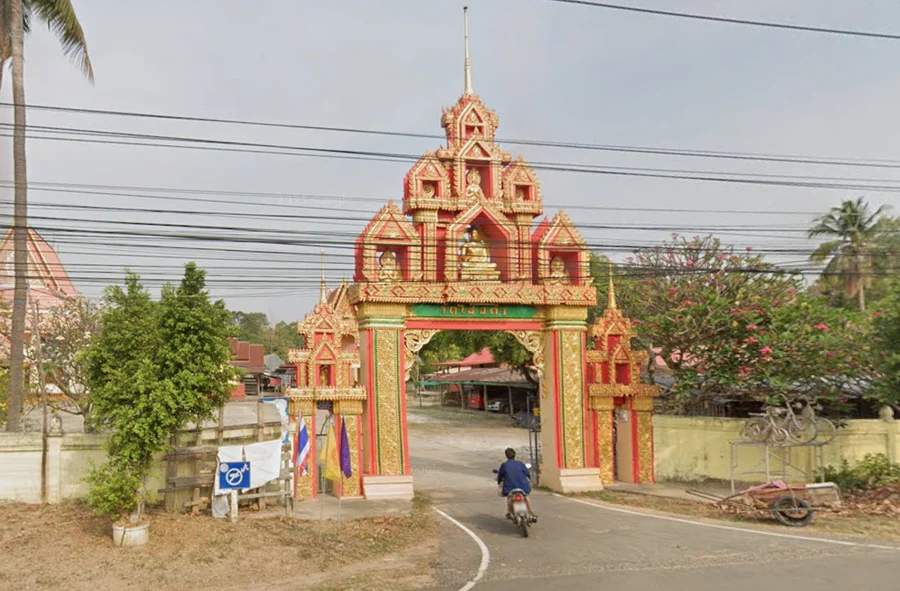
Wat Chai Kham
Open Days: Daily
Opening Hours: 08.00 – 17.00
Wat Chai Kham is a historic Buddhist temple located in Ban Kham Phra, Kham Phra Subdistrict, Hua Taphan District, Amnat Charoen Province. Established in 1792, the temple is deeply connected with the history of Ban Kham Phra, the relocation of local settlements, and the long-standing Buddhist faith of the community. It was built by monks together with villagers from Moo 1 and Moo 3 after local households had moved to a new area. The temple itself was also relocated from an older site near Moo 2 at the southwestern end of Ban Kham Phra to its present location.
Wat Chai Kham is valuable for travelers interested in old temples, northeastern Thai architecture, local craftsmanship, and community-based Buddhist heritage. Its most important features include the old ordination hall, locally known in Isan as a “sim,” the ancient stone boundary markers, the principal Buddha image known as Phra Chao Yai Chai Mongkhon, and the evidence of traditional construction techniques using locally made bricks and lime from burned seashells. These elements make the temple more than a place of worship; it is also a living record of local history and craftsmanship.
The temple’s history begins with the movement of the Ban Kham Phra community. When the villagers relocated their homes, the temple was moved as well, showing how closely a temple was tied to village life in traditional northeastern Thailand. A temple was never just a religious building. It was the center of merit-making, ceremonies, moral guidance, social gathering, and collective identity. The relocation of Wat Chai Kham therefore reflects the importance of keeping the spiritual heart of the community close to the people.
In its early period, Wat Chai Kham had only 2 or 3 small wooden monks’ residences. These simple structures provided a place for monks to stay, study, meditate, and carry out religious duties for the villagers. Although the original wooden residences were modest, they were essential for maintaining the temple’s religious function. Over time, these old wooden structures deteriorated and were replaced by newer buildings, as the temple continued to adapt to the needs of the community.
The most remarkable structure at Wat Chai Kham is the ordination hall, or sim. It was built through the joint effort of monks and villagers using traditional local methods. Clay was shaped into bricks and fired. Lime was made from burned seashells, then ground and mixed with yang bong resin and sand to create mortar for building, plastering, and coating. This method reflects the skill and resourcefulness of local craftsmen before modern construction materials became widely available.
In Isan culture, the word “sim” refers to an ordination hall. It is one of the most sacred buildings in a Buddhist temple because it is used for important monastic ceremonies such as ordination and formal Sangha activities. At Wat Chai Kham, the sim carries both religious and artistic significance. Its materials, construction methods, and spiritual function all reflect the faith of the monks and villagers who built it together.
Inside the ordination hall, Phra Chao Yai Chai Mongkhon is enshrined as the principal Buddha image. This sacred image has long been respected by local residents and visitors. People come to pay homage, make merit, pray for blessings, and express devotion to the Triple Gem. As the principal Buddha image of the temple, Phra Chao Yai Chai Mongkhon is the spiritual center of Wat Chai Kham and one of the most important reasons why the temple remains meaningful to the community.
The temple area also contains ancient stone boundary markers, known in Thai as bai sema. These markers are associated with the sacred boundary of the ordination hall and are important evidence of Buddhist art in northeastern Thailand. Some stone boundary markers in the region bear carved motifs reflecting Buddhist symbolism and local craftsmanship. At Wat Chai Kham, the bai sema help strengthen the temple’s value as both a religious site and a cultural heritage place.
Near the ordination hall and shrine area, visitors can also see a large Buddha image known locally as Luang Pho To Uttama in the Mara-vijaya posture. This image creates a strong visual presence in the temple grounds and serves as another focus of devotion for visitors. Large Buddha images in community temples often express the collective faith of villagers, who build them as shared symbols of protection, merit, and spiritual unity.
Local historical information describes Wat Chai Kham as a Buddhist temple associated with Mahayana tradition, while its present community function is closely aligned with the practice of a Thai Buddhist temple. The temple continues to host merit-making, Buddhist ceremonies, community gatherings, and seasonal religious activities. For visitors, the most important way to understand Wat Chai Kham is through its old sim, Phra Chao Yai Chai Mongkhon, stone boundary markers, and its role in Ban Kham Phra’s local identity.
Phra Athikan Samphan appears in earlier reference information related to Wat Chai Kham and its history. More recent public temple activity information and local news identify Phra Khru Theeratham Malangkan as the current abbot of Wat Chai Kham and ecclesiastical chief of Kham Phra Subdistrict. The abbot’s role is essential for temple administration, monastic care, religious ceremonies, and the preservation of the temple as the spiritual center of Ban Kham Phra.
The name “Wat Chai Kham” carries an auspicious meaning. “Chai” means victory, success, and good fortune, while “Kham” connects the temple with Ban Kham Phra and the local identity of Kham Phra Subdistrict. Together, the name suggests prosperity, blessing, and a strong connection to the community that built and preserved the temple.
The atmosphere of Wat Chai Kham is quiet, local, and culturally rich. Visitors should take time to observe the sim, the stone boundary markers, the Buddha images, and the details of the temple grounds. The temple is best experienced slowly, with respect for its religious function. Appropriate clothing, quiet behavior, and care around heritage elements such as stone markers are important.
Wat Chai Kham remains connected with the Buddhist calendar and local religious life. Important occasions include Makha Bucha Day, Visakha Bucha Day, Asalha Bucha Day, Buddhist Lent, the end of Buddhist Lent, Kathin ceremonies, robe-offering events, and regular Buddhist holy days. During these times, villagers gather at the temple for merit-making, food offerings, chanting, Dhamma listening, and community participation. These activities keep the temple alive as a living religious place, not merely an old monument.
For travelers interested in cultural routes around Hua Taphan District, Wat Chai Kham can be the main stop on a route through Ban Kham Phra and nearby areas. The temple offers old architecture, sacred Buddha images, stone boundary markers, and a story of community relocation. Travelers with more time can continue to Wat Phra Lao Thep Nimit, Phuttha Utthayan and Phra Mongkhon Ming Mueang, Wat Tham Saeng Phet, or central Amnat Charoen attractions.
Getting There is most convenient by private car or rental car. From central Amnat Charoen, drive toward Hua Taphan District and continue to Kham Phra Subdistrict, Ban Kham Phra. Using a navigation map is recommended, especially for visitors unfamiliar with local roads. The temple is suitable for a half-day visit or as part of a wider cultural route in Amnat Charoen.
Food options near Wat Chai Kham are mostly local restaurants in Ban Kham Phra, Hua Taphan District, and the surrounding community. Travelers can find simple Thai food, noodle shops, northeastern-style dishes, made-to-order restaurants, and local cafés. For a wider range of restaurants and accommodation, travelers may continue to Hua Taphan town center or central Amnat Charoen.
For overnight stays, options in Hua Taphan include local resorts such as Pim And Pu Resort and Suksamran Resort. Travelers who prefer more hotel choices can stay in Mueang Amnat Charoen, where options include Zwa Hotel Amnat Charoen, Ramiarndao Boutique Place Hotel, Nakarin Hotel, and Baan Ing Daan Hotel. Staying in town is convenient for those planning to visit several attractions across the province.
The best time to visit Wat Chai Kham is in the morning or late afternoon when the weather is more comfortable and the light is suitable for viewing the old sim, stone boundary markers, and Buddha images. Visitors should dress respectfully, avoid loud behavior, and refrain from touching or climbing on heritage objects. A visit to Wat Chai Kham is most rewarding when approached as a cultural and spiritual experience rather than a quick photo stop.
Wat Chai Kham is therefore one of the important old temples of Hua Taphan District. Its history since 1792, relocation from the older temple site, traditional sim construction, Phra Chao Yai Chai Mongkhon, ancient stone boundary markers, and continuing role in Ban Kham Phra make it a valuable destination for anyone seeking to understand Amnat Charoen beyond its main tourist landmarks.
| Name | Wat Chai Kham |
| Location | Ban Kham Phra, Kham Phra Subdistrict, Hua Taphan District, Amnat Charoen Province |
| Address | Ban Kham Phra, Kham Phra Subdistrict, Hua Taphan District, Amnat Charoen Province 37240, Thailand |
| Coordinates | Latitude 15.758007, Longitude 104.470127 |
| Highlights | Old sim, ancient stone boundary markers, Phra Chao Yai Chai Mongkhon, local brick-making and shell-lime construction techniques |
| History | Established in 1792 by monks and villagers from Moo 1 and Moo 3 after the local community relocated and moved the temple from the older site near Moo 2 of Ban Kham Phra |
| Name Origin | “Chai” means victory and auspicious success, while “Kham” connects the temple with Ban Kham Phra and the identity of Kham Phra Subdistrict. |
| Distinctive Features | A historic community temple with an old Isan-style sim, stone boundary markers, and a principal Buddha image deeply respected by local people |
| Main Religious Structures | Ordination hall or sim, monks’ residences, shrine hall, stone boundary marker area, and the Buddha image courtyard |
| Sacred Images | Phra Chao Yai Chai Mongkhon, the principal Buddha image inside the ordination hall, and Luang Pho To Uttama in the Mara-vijaya posture |
| Main Areas / Zones | Ordination hall or sim, shrine hall, monks’ residences, stone boundary marker courtyard, Buddha image courtyard, merit-making area, and community religious activity spaces |
| Abbot / Caretaker | Phra Khru Theeratham Malangkan |
| Important Related Monk | Phra Athikan Samphan appears in earlier reference information related to Wat Chai Kham and its temple history. |
| Travel Information | Best reached by private car or rental car from central Amnat Charoen toward Hua Taphan District and Kham Phra Subdistrict |
| Current Status | Open as a local Buddhist temple and cultural heritage site in Ban Kham Phra, Hua Taphan District |
| Open Days | Daily |
| Opening Hours | 08.00 – 17.00 |
| Fees | No admission fee |
| Facilities | Merit-making area, religious activity spaces, temple courtyard, and parking area within the temple |
| Nearby Tourist Attractions | 1. Wat Chai Kham Stone Boundary Marker Archaeological Site, about 0 km 2. Wat Phra Lao Thep Nimit, about 22 km 3. Hua Taphan District Center And Local Market, about 12 km 4. Phuttha Utthayan And Phra Mongkhon Ming Mueang, about 35 km 5. Wat Tham Saeng Phet, about 37 km 6. Ming Mueang Chalerm Phrakiat Park, Amnat Charoen, about 35 km 7. Amnat Charoen Clock Tower, about 36 km |
| Nearby Restaurants | 1. Ban Kham Phra Local Restaurant, about 2 km 2. Noodle Shops In Hua Taphan Town Center, about 12 km 3. Made-To-Order Thai Restaurants In Hua Taphan, about 12 km 4. Local Cafes In Hua Taphan Town Center, about 12 km 5. Isan Food Restaurants In Hua Taphan, about 13 km 6. Restaurants In Central Amnat Charoen, about 35 km |
| Nearby Accommodations | 1. Pim And Pu Resort Hua Taphan, about 13 km, Tel. 092-299-1788, 065-625-0444 2. Suksamran Resort Hua Taphan, about 18 km 3. Zwa Hotel Amnat Charoen, about 35 km, Tel. 082-867-6150 4. Ramiarndao Boutique Place Hotel, about 35 km, Tel. 081-067-4149 5. Nakarin Hotel, about 36 km, Tel. 045-511-226 6. Baan Ing Daan Hotel, about 36 km, Tel. 090-405-5504 |
Frequently Asked Questions (FAQ)
Q: Where is Wat Chai Kham located?
A: Wat Chai Kham is located in Ban Kham Phra, Kham Phra Subdistrict, Hua Taphan District, Amnat Charoen Province.
Q: When was Wat Chai Kham established?
A: Wat Chai Kham was established in 1792 by monks and villagers from Moo 1 and Moo 3 after the local community relocated.
Q: What are the main highlights of Wat Chai Kham?
A: The main highlights are the old ordination hall or sim, ancient stone boundary markers, Phra Chao Yai Chai Mongkhon, and traditional local construction techniques.
Q: What is Phra Chao Yai Chai Mongkhon?
A: Phra Chao Yai Chai Mongkhon is the principal Buddha image enshrined inside the ordination hall and is highly respected by local people.
Q: Does Wat Chai Kham have ancient stone boundary markers?
A: Yes. Wat Chai Kham has old stone boundary markers associated with the ordination hall, making the temple important as a local cultural heritage site.
Q: Who is the current abbot of Wat Chai Kham?
A: The current abbot of Wat Chai Kham is Phra Khru Theeratham Malangkan.
Q: What are the opening hours of Wat Chai Kham?
A: Wat Chai Kham is open daily from 08.00 to 17.00.
Q: Is there an admission fee for Wat Chai Kham?
A: No. There is no admission fee for visiting the temple.
 Category: ●Places of Worship
 Group: ●Temple
Last Update : 2 MonthAgo
 Last Update : 2 MonthAgo
 Click to Access the Navigation Map GPS
 Art, Culture and Heritage
 Historical Sites and Monuments(1)
 Art, Craft Centres, Tradition(3)
 Museums(1)
Temple(30)
Museums(1)
Temple(30)
 Other Sacred Sites(7)
 Suburban Living
 Village, Community(3)
 Nature and Wildlife
 National Parks and Marine Reserves(3)
 Mountain (Doi)(5)
 Dam, Reservoir, Lake(5)
 Waterfalls(3)
 Caves(2)
 River, Canal(3)
 Other natural attractions(5)
 Entertainment and Agricultural
 Zoos and Aquariums(1)
 Farms, Parks and Ecotourism(4)
 Shopping
 Shopping and Night Market(1)


