
lovethailand home >Northeastern Travel Attractions >Amnat Charoen Travel Attractions >Lu Amnat >Amnat > Wat Yang Cha
TL;DR: Wat Yang Cha is located at Moo 3, Amnat Subdistrict, Lue Amnat District, Amnat Charoen Province, open Daily, hours 08.00 – 17.00. Highlights include Old Isan-style sim with exterior and interior hoop taem murals painted by Abbot Pheng Kanyawimon.
Wat Yang Cha
Open Days: Daily
Opening Hours: 08.00 – 17.00
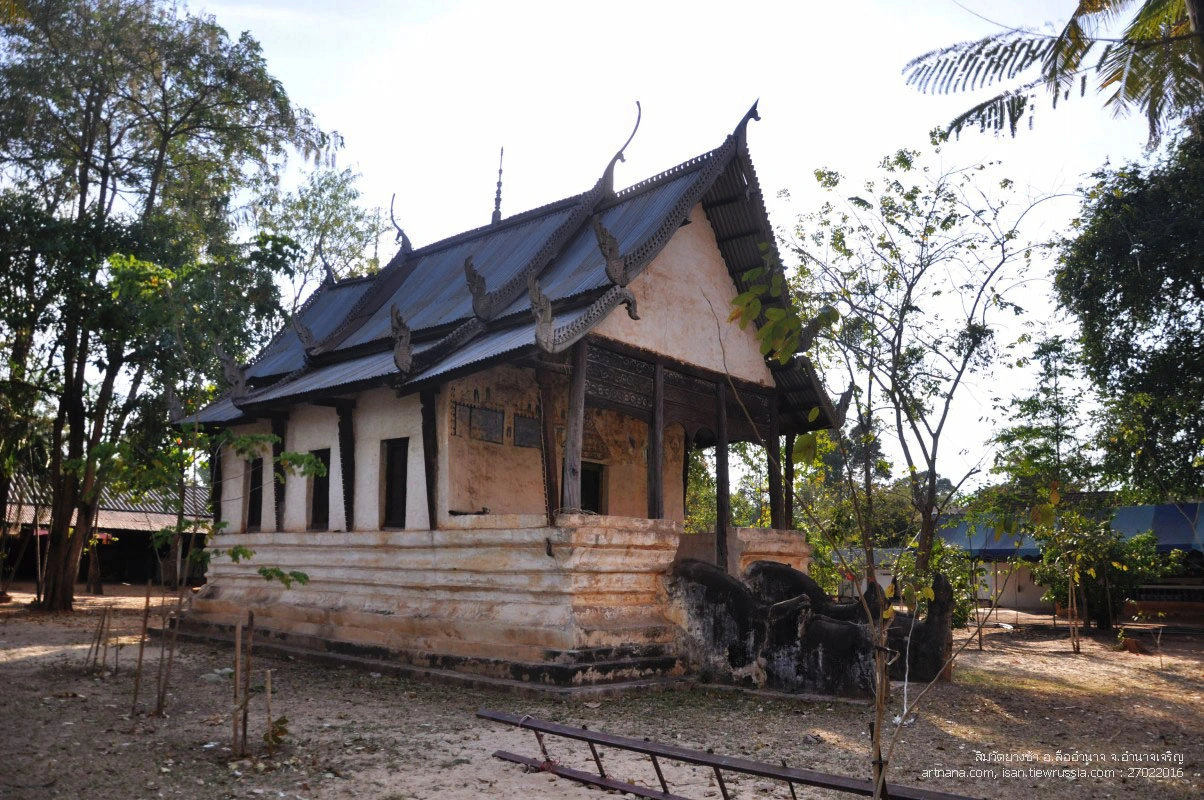
Wat Yang Cha is a local Buddhist temple in Moo 3, Amnat Subdistrict, Lue Amnat District, Amnat Charoen Province. The temple is especially important for its old sim, or Isan-style ordination hall, built between 1917 and 1932 by Abbot Pheng Kanyawimon and local villagers with strong Buddhist faith. For travelers interested in northeastern Thai temple architecture, folk murals, local craftsmanship, and community-based Buddhist heritage, Wat Yang Cha is one of the most meaningful cultural stops in Amnat Charoen.
The old sim at Wat Yang Cha is the main highlight of the temple. It is a rectangular Isan folk-style ordination hall measuring 6.80 meters wide, 10.70 meters long, and 8 meters high. The building is modest in size but rich in artistic details. It contains both exterior and interior murals, known in Isan as hoop taem, painted by Abbot Pheng Kanyawimon. Inside the sim, a gilded brick-and-plaster Buddha image in the Mara-vijaya posture is enshrined as the principal image.
The sim is a closed-style ordination hall with only one entrance at the front. It was built using brick-and-plaster construction. Its compact and solid form reflects the character of traditional community temples in northeastern Thailand. The enclosed walls create a calm interior space suitable for religious rituals and the enshrinement of the principal Buddha image, while the exterior architectural elements give the building a strong local identity.
The front of the sim has a 6-step plaster staircase leading to the porch and entrance. The stair railings are sculpted in the form of crocodiles holding lions in their mouths. The lions stand on 4 legs, raise their heads, and open their mouths, while their bodies are decorated with floral patterns. These sculptural details show the imagination of local craftsmen and the blending of Buddhist belief, protective symbolism, and folk artistic expression.
The sculptural style at Wat Yang Cha resembles work found at Wat Phra Lao Thep Nimit, which is located not far away. This similarity suggests a shared local artistic language in the Lue Amnat area and nearby communities. Folk temple art often developed through local networks of craftsmen, monks, and villagers, with forms and motifs moving between temples through shared experience and faith.
The front porch is divided into 3 bays and supported by 4 wooden posts. The central bay aligns with the staircase and leads directly to the entrance of the sim. The wooden door has carved decoration mainly on the door frame and door edges, using a cart-wheel-like pattern that leans toward a scrolling vine motif. In a sacred building, the doorway is more than a functional opening; it marks the transition from the ordinary world into the sacred interior.
The 3 decorative wooden panels above the front bays are carved with scrolling vine patterns. They are made from joined wooden planks rather than a single piece of wood. The gable is plain plaster without sculpted or painted decoration, allowing the staircase, railing sculptures, carved doorway, wooden panels, and murals to become the main visual elements. Roof components such as nak sadung, hong, bai raka, and chofa are made of wood, while the roof is covered with zinc sheets.
Viewed from the side, the sim is divided into 4 sections. The first section is the front porch with an open wall, while the second to fourth sections form the enclosed body of the sim. Each section has one wooden window, giving 6 windows on both sides. The wooden brackets, or khanthueai, are carved from straight wooden planks with repeated notched patterns resembling banana-stalk motifs. There are 5 on each side, making 10 in total. These repeated wooden details give rhythm and refinement to the otherwise simple building.
The roof is raised in 2 tiers and divided into 3 rhythmic sections. Although the roof is covered with zinc sheets, the wooden decorative components preserve the visual language of traditional temple architecture. The building therefore combines practicality with local beauty. It reflects how rural communities adapted available materials while still preserving sacred architectural forms.
Inside the sim, the principal Buddha image is in the Mara-vijaya posture. It is made of brick and plaster and coated in gold color. The Mara-vijaya posture represents the Buddha’s victory over Mara before enlightenment. It symbolizes determination, wisdom, and triumph over inner obstacles. In the intimate space of the sim, the Buddha image functions as the spiritual center of the building and the focus of devotion for visitors and local worshippers.
The hoop taem, or mural paintings, are among the most valuable features of Wat Yang Cha. They appear on both the exterior and interior walls and were painted by Abbot Pheng Kanyawimon. The style is clearly folk-based, not courtly or academic. Its strength lies in storytelling, accessibility, and religious meaning. The murals helped local villagers learn Buddhist stories and moral lessons through images rather than written texts.
Above the entrance, the murals likely depict scenes from the life of the Buddha and the realm of hell. The scenes may include the Great Renunciation, the encounter with the 4 heavenly messengers, and a corner scene of hell where a monk holding a ceremonial fan resembles Phra Malai visiting hell and heaven. At the top appears a Dhamma chedi. These images express key Buddhist teachings about impermanence, suffering, moral consequence, and the path toward spiritual awakening.
Inside the sim, behind the principal Buddha image, the upper wall shows the Buddha seated on a blooming lotus in the Mara-vijaya posture, flanked by the chief disciples on the left and right. This composition strengthens the sacred atmosphere around the principal image. The lotus represents purity and enlightenment, while the disciples represent the continuation of the Dhamma after the Buddha’s awakening.
The lower walls around the interior depict the Maha Vessantara Jataka, one of the most beloved Buddhist stories in northeastern Thailand. The story of Prince Vessantara is associated with generosity, sacrifice, and the perfection of giving. In Isan culture, this story is closely linked with Bun Phawet or Bun Mahachat, an important merit-making festival centered on listening to the Great Birth Sermon. The murals therefore connect the sim with both Buddhist teaching and local festival culture.
Above the interior doorway, the paintings are now heavily faded. Traces of trees and soldiers holding guns remain visible and may represent a Mara assault scene. Some parts of the murals have been repaired, as seen from newer color applied over older lines. These traces of fading and repair make the murals especially meaningful because they show both age and community efforts to preserve the paintings over time.
The sim of Wat Yang Cha is a complete example of Isan folk religious art. Architecture, sculpture, wood carving, murals, and the principal Buddha image all work together in one sacred building. Its value does not come from royal-style perfection, but from sincerity, local craftsmanship, and the direct connection between Buddhist teaching and village life.
Visitors should take time to walk slowly around the sim. Start at the front to observe the staircase, crocodile-and-lion railings, carved wooden door, decorative panels, and front porch. Then walk along the sides to see the rhythm of the windows, wooden brackets, and roof structure. Finally, enter respectfully to pay homage to the principal Buddha image and view the murals inside. This order helps visitors understand the relationship between the exterior architecture and interior storytelling.
Wat Yang Cha is suitable for cultural travelers, students of Isan architecture, researchers of folk murals, and anyone interested in old community temples. The site shows that important Buddhist art is not found only in major cities or royal temples. Small rural temples can also preserve extraordinary craftsmanship, religious knowledge, and local historical memory.
Wat Yang Cha remains connected with the Buddhist calendar followed by local communities. Important occasions include Makha Bucha Day, Visakha Bucha Day, Asalha Bucha Day, Buddhist Lent, the end of Buddhist Lent, Kathin ceremonies, robe-offering events, and regular Buddhist holy days. If Bun Phawet or Bun Mahachat is held, the Maha Vessantara Jataka murals become even more meaningful because they connect painted stories with living festival practice.
Getting There is most convenient by private car or rental car. From central Amnat Charoen, drive toward Lue Amnat District and continue to Amnat Subdistrict, Moo 3. A navigation map is recommended because the temple is located within a local community area. Wat Yang Cha can be combined with nearby temples and cultural sites such as Wat Amnat, Wat Pho Sila, and Wat Phra Lao Thep Nimit.
Nearby attractions include Wat Amnat and Phra Chao Yai Lue Chai, Wat Pho Sila in Ban Pueai with its Dvaravati bai sema, Wat Phra Lao Thep Nimit, Phuttha Utthayan and Phra Mongkhon Ming Mueang, Amnat Charoen Clock Tower, and Wat Tham Saeng Phet. This route allows travelers to experience Isan folk architecture, sacred Buddha images, ancient boundary stones, and important provincial landmarks in one trip.
Food options near Wat Yang Cha are mostly local restaurants in Lue Amnat District. Examples include Lap Pet Khon Lue, Lueang Lue, Khanom Chin Sen Sot Mae Phon, Long Nua Coffee And Foods, Khun Tum Ban Lao Noi, and made-to-order Thai restaurants in Lue Amnat town. For a wider range of restaurants, travelers can continue to central Amnat Charoen.
For accommodation, most practical choices are located in Mueang Amnat Charoen rather than directly around the temple. Options include Zwa Hotel Amnat Charoen, Ramiarndao Boutique Place Hotel, Nakarin Hotel, Baan Ing Daan Hotel, Penphit Hotel, and LJ The Emerald Hotel. Staying in the provincial town is convenient for travelers planning to visit several temples and cultural attractions over 1 or 2 days.
The best time to visit Wat Yang Cha is in the morning or late afternoon, when the light is softer and the details of the sim, woodwork, plaster sculpture, and murals are easier to see. Visitors should dress respectfully, avoid touching or scratching the mural walls, avoid leaning on old wooden doors or fragile details, and refrain from using flash photography close to faded paintings. These simple actions help protect the temple’s cultural heritage.
Wat Yang Cha is one of the most important temples in Lue Amnat District for anyone interested in Isan folk architecture and Buddhist mural painting. Its closed-style sim, crocodile-and-lion stair railings, carved wooden door, decorative brackets, gilded Buddha image, and hoop taem telling stories of the Buddha’s life, hell realms, and the Maha Vessantara Jataka make it a valuable cultural destination in Amnat Charoen Province.
| Name | Wat Yang Cha |
| Location | Moo 3, Amnat Subdistrict, Lue Amnat District, Amnat Charoen Province |
| Address | Wat Yang Cha, Moo 3, Amnat Subdistrict, Lue Amnat District, Amnat Charoen Province, Thailand |
| Highlights | Old Isan-style sim with exterior and interior hoop taem murals painted by Abbot Pheng Kanyawimon |
| History | The sim was built by Abbot Pheng Kanyawimon and faithful local villagers between 1917 and 1932. |
| Distinctive Features | A closed-style rectangular sim with one front entrance, measuring 6.80 meters wide, 10.70 meters long, and 8 meters high, with plaster sculpture, carved woodwork, and folk murals |
| Main Religious Structures | Old sim or ordination hall, Mara-vijaya Buddha image, front porch, plaster staircase, carved wooden door, decorative wooden panels, brackets, and temple merit-making area |
| Sacred Image | A gilded brick-and-plaster Buddha image in the Mara-vijaya posture enshrined inside the sim |
| Hoop Taem / Murals | Murals depicting the Buddha’s life, hell realms, Phra Malai visiting hell and heaven, Dhamma chedi, the Buddha on a lotus, chief disciples, and the Maha Vessantara Jataka |
| Main Areas / Zones | Old sim, front porch, exterior mural viewing area, interior mural area, principal Buddha image, temple courtyard, and merit-making area |
| Important Related Monk | Abbot Pheng Kanyawimon, who built the sim and painted its interior and exterior murals |
| Travel Information | Best reached by private car or rental car from central Amnat Charoen toward Lue Amnat District and Amnat Subdistrict, Moo 3 |
| Current Status | Open as a community temple and learning site for Isan folk architecture and old mural paintings |
| Open Days | Daily |
| Opening Hours | 08.00 – 17.00 |
| Fees | No admission fee |
| Facilities | Parking area, temple courtyard, merit-making area, and old sim viewing area |
| Nearby Tourist Attractions | 1. Wat Amnat And Phra Chao Yai Lue Chai, about 2 km 2. Lue Amnat District Center, about 3 km 3. Wat Pho Sila, Ban Pueai, about 9 km 4. Wat Phra Lao Thep Nimit, about 17 km 5. Phuttha Utthayan And Phra Mongkhon Ming Mueang, about 21 km 6. Amnat Charoen Clock Tower, about 22 km 7. Wat Tham Saeng Phet, about 26 km |
| Nearby Restaurants | 1. Lap Pet Khon Lue, Lue Amnat, about 3 km 2. Lueang Lue, Lue Amnat, about 3 km 3. Khanom Chin Sen Sot Mae Phon, about 4 km 4. Long Nua Coffee And Foods, about 4 km 5. Khun Tum Ban Lao Noi, Nong Daeng Intersection, about 5 km 6. Made-To-Order Thai Restaurants In Lue Amnat Town, about 3 km 7. Restaurants In Central Amnat Charoen, about 22 km |
| Nearby Accommodations | 1. Zwa Hotel Amnat Charoen, about 22 km, Tel. 082-867-6150 2. Ramiarndao Boutique Place Hotel, about 22 km, Tel. 081-067-4149 3. Nakarin Hotel, about 23 km, Tel. 045-511-226 4. Baan Ing Daan Hotel, about 23 km, Tel. 090-405-5504 5. Penphit Hotel, about 24 km 6. LJ The Emerald Hotel, about 24 km |
Frequently Asked Questions (FAQ)
Q: Where is Wat Yang Cha located?
A: Wat Yang Cha is located in Moo 3, Amnat Subdistrict, Lue Amnat District, Amnat Charoen Province.
Q: When was the sim of Wat Yang Cha built?
A: The sim was built between 1917 and 1932 by Abbot Pheng Kanyawimon and faithful local villagers.
Q: What makes the sim of Wat Yang Cha special?
A: It is a closed-style Isan folk ordination hall with one front entrance, plaster staircase, crocodile-and-lion railings, carved woodwork, brackets, and murals on both the interior and exterior walls.
Q: What stories are shown in the murals at Wat Yang Cha?
A: The murals depict the Buddha’s life, hell realms, Phra Malai visiting hell and heaven, Dhamma chedi, the Buddha in the Mara-vijaya posture, chief disciples, and the Maha Vessantara Jataka.
Q: What is the principal Buddha image inside the sim?
A: The principal image is a gilded brick-and-plaster Buddha image in the Mara-vijaya posture.
Q: Is there an admission fee for Wat Yang Cha?
A: No. There is no admission fee for visiting the temple.
Q: What nearby places can be visited with Wat Yang Cha?
A: Nearby places include Wat Amnat and Phra Chao Yai Lue Chai, Wat Pho Sila, Wat Phra Lao Thep Nimit, Phuttha Utthayan and Phra Mongkhon Ming Mueang, and Wat Tham Saeng Phet.
Q: When is the best time to visit Wat Yang Cha?
A: Morning or late afternoon is best because the light is softer and the details of the sim, woodwork, plaster sculpture, and murals are easier to see.
 Category: ●Places of Worship
 Group: ●Temple
Last Update : 3 WeekAgo
 Last Update : 3 WeekAgo
 Click to Access the Navigation Map GPS
 Art, Culture and Heritage
 Historical Sites and Monuments(1)
 Art, Craft Centres, Tradition(3)
 Museums(1)
Temple(30)
Museums(1)
Temple(30)
 Other Sacred Sites(7)
 Suburban Living
 Village, Community(3)
 Nature and Wildlife
 National Parks and Marine Reserves(3)
 Mountain (Doi)(5)
 Dam, Reservoir, Lake(5)
 Waterfalls(3)
 Caves(2)
 River, Canal(3)
 Other natural attractions(5)
 Entertainment and Agricultural
 Zoos and Aquariums(1)
 Farms, Parks and Ecotourism(4)
 Shopping
 Shopping and Night Market(1)


