
lovethailand home >Central Travel Attractions >Suphan Buri Travel Attractions >Muang Suphan Buri >Tha Phi Liang > Dragon Descendants Museum
TL;DR: Dragon Descendants Museum, Suphan Buri attractions : Art, Culture and Heritage, Museums.
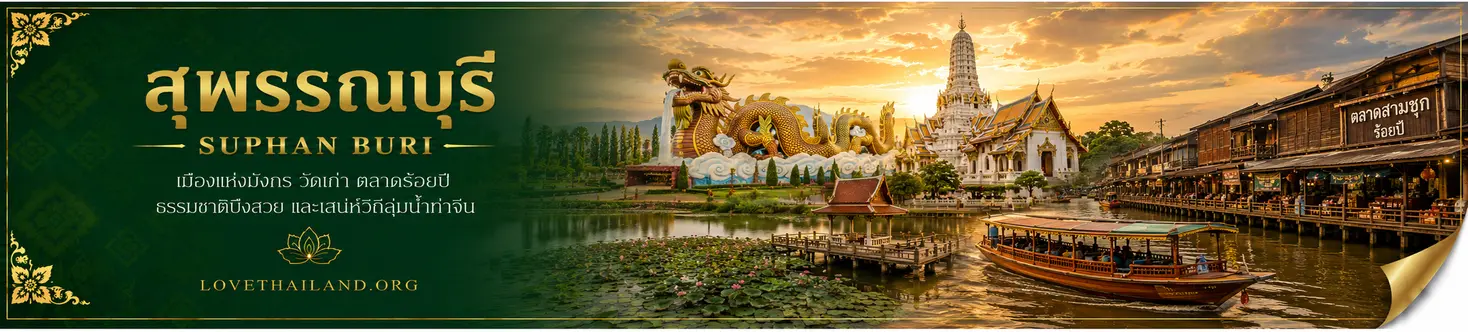
Dragon Descendants Museum
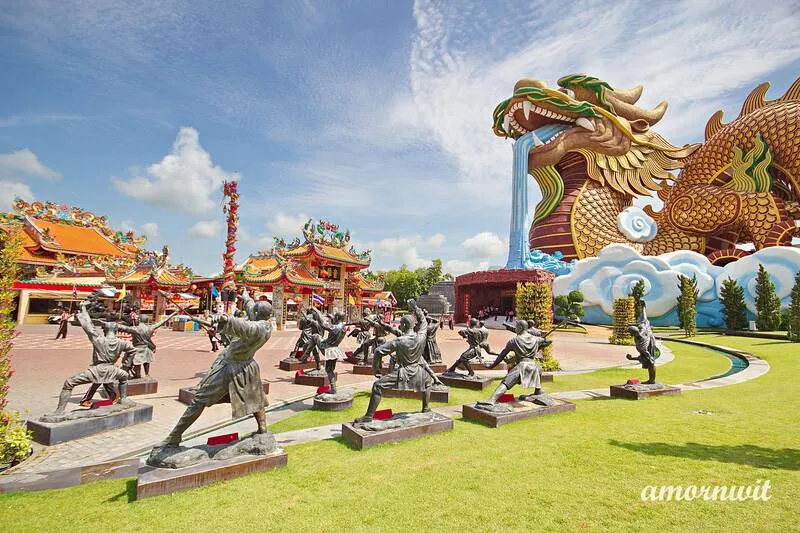
Open Days: Wednesday – Sunday
Opening Hours: Wednesday – Friday 10.00 – 16.00 / Saturday – Sunday 09.00 – 16.20
The Dragon Descendants Museum, also known as Heaven Dragon Park, is one of the most distinctive Thai-Chinese cultural attractions in Suphan Buri Province. Located within the grounds of Suphan Buri City Pillar Shrine on Malai Maen Road, Rua Yai Subdistrict, Mueang Suphan Buri District, the museum is instantly recognizable by its enormous golden dragon-shaped building. The dragon is not only a spectacular landmark for photographs; it is also a powerful cultural symbol representing Chinese civilization, prosperity, wisdom, sacred power, and the long historical relationship between Thai and Chinese communities. The museum was created to commemorate the 20th anniversary of diplomatic relations between Thailand and the People’s Republic of China, during the time when H.E. Banharn Silpa-Archa served as the 21st Prime Minister of Thailand.
The Dragon Descendants Museum is more than an impressive architectural attraction. It was designed as a large-scale educational museum presenting more than 5,000 years of Chinese civilization inside the body of a dragon. Visitors follow a chronological journey through Chinese mythology, early legendary rulers, major dynasties, historical events, influential thinkers, inventions, philosophy, cultural wisdom, and the history of Thai people of Chinese descent in Thailand. The museum uses modern presentation techniques including film, computer-controlled audiovisual systems, lighting, sound, models, recreated scenes, and dramatic exhibition rooms. This makes the museum accessible for families, students, cultural travelers, and foreign visitors who may not already be familiar with Chinese history.
The background of the museum is closely connected with the long relationship between Thailand and China. For many centuries, Chinese migrants came to Thailand, settled in local communities, built families, traded, worked, and contributed to the economic and cultural development of the country. Suphan Buri is one of the provinces with a strong Thai-Chinese community, and Suphan Buri City Pillar Shrine has long served as a spiritual center for local devotees. The dragon-shaped museum therefore represents not only Chinese heritage, but also gratitude toward the Thai homeland, respect for ancestors, and pride among descendants of Chinese migrants who grew up as part of Thai society.
The dragon building is one of the most striking features of the site. It is approximately 135 meters long, 35 meters high, and 18 meters wide. Its golden body stretches over stylized clouds, creating a dramatic image that reflects the dragon’s role in Chinese belief as an auspicious creature associated with power, dignity, heaven, rain, and imperial authority. The museum stands within a wider cultural landscape that includes Suphan Buri City Pillar Shrine, a large bronze bell pavilion, a seven-tier waterside pavilion, Tiananmen-style ceremonial hall, landscaped areas, and Chinese-style architectural elements. Together, these features make Heaven Dragon Park a combined shrine, museum, garden, and cultural landmark.
Suphan Buri City Pillar Shrine is essential to understanding the meaning of this place. The sacred City Pillar figure is a low-relief stone sculpture believed to represent the four-armed Narayana and is estimated to be around 1,300 to 1,400 years old. It has been venerated by Thai-Chinese communities and local residents for generations. Local accounts say that Chinese residents found the sacred figure in mud near a canal around 150 years ago and enshrined it in a shrine. Later, the shrine was renovated and expanded several times. In the modern period, Banharn Silpa-Archa and the shrine committee improved the site, expanded the shrine area, built Chinese-style structures, and helped transform the area into one of Suphan Buri’s major cultural attractions.
The museum visit usually begins with a film room that introduces Chinese civilization and prepares visitors for the chronological exhibition route. This first section helps explain the meaning of the dragon, the depth of Chinese history, and the structure of the museum. Because the museum is visited in rounds, the experience is organized and easy to follow. Visitors move from room to room while the exhibition gradually develops from mythology to dynastic history and finally to modern China and Thai-Chinese heritage.
The early exhibition rooms present Chinese myths about the creation of the world and the creation of humankind. One room introduces Pangu, the primordial being who separated heaven and earth. According to the myth, natural features such as the sun, moon, mountains, rivers, and other elements of the world came from Pangu’s body after his sacrifice. Another room presents Nuwa, the goddess who created the first human beings from the clay of the Yellow River. These stories show how Chinese culture connects humanity with earth, water, sacrifice, and cosmic order. They also provide a mythological foundation before visitors move into early historical periods.
The exhibition then introduces Shennong, the legendary father of herbal medicine, who is associated with knowledge of plants, healing, and the discovery of tea. Tea later became one of the most important beverages in Chinese culture. The museum also presents Huangdi and Yandi, legendary tribal leaders and ancestral figures revered by Chinese people. The expression “descendants of Yan and Huang” reflects this cultural ancestry. These early sections show that Chinese identity was shaped not only by political dynasties, but also by myths, ancestors, moral memory, and shared cultural origins.
The Xia and Shang periods introduce visitors to ancient state formation, bronze technology, flood control, and early writing. The story of Yu the Great reflects the importance of managing the Yellow River, while oracle bone inscriptions represent one of the earliest forms of Chinese writing. The Zhou period presents the age of thinkers and philosophers, including Laozi, Confucius, Sun Wu, and Qu Yuan. These figures shaped Chinese philosophy, ethics, military thought, poetry, and ritual culture. The museum also connects Qu Yuan with the origin of zongzi and dragon boat traditions, showing how historical memory can live on through food and festivals.
The Qin dynasty section focuses on Qin Shi Huang, the first emperor of a unified China. He is associated with the Great Wall, the Terracotta Army, administrative reforms, standardized writing, currency, weights, and measures. This section helps visitors understand the meaning of imperial unification and state power. The Han dynasty section presents a flourishing age of Chinese civilization, including the Silk Road, the invention of paper, the spread of Mahayana Buddhism into China, and the reason many Chinese people identify themselves as Han. These rooms help connect early China with trade, religion, technology, and long-lasting cultural identity.
The Three Kingdoms room is especially engaging for many visitors because the story is well known across East and Southeast Asia. Based on historical events at the end of the Han dynasty and popularized through literature, drama, opera, film, and television, the Three Kingdoms period is full of strategy, loyalty, conflict, and memorable heroes. The museum presents important episodes such as the Battle of Red Cliffs, where Cao Cao’s naval forces were defeated. This section demonstrates that Chinese history is not only a list of dynasties, but also a rich world of storytelling, political conflict, military strategy, and moral lessons.
The Sui and Tang sections present reunification, infrastructure, and cultural brilliance. The Sui dynasty is associated with the Grand Canal, one of the most important waterway projects in Chinese history. The Tang dynasty is remembered as a golden age of art, literature, Buddhism, cosmopolitan culture, and international exchange. The exhibition includes references to Shaolin Temple, Wu Zetian, the only female emperor in Chinese history, and Yang Guifei, one of the legendary beauties of China. These sections allow visitors to see China at a time of prosperity, openness, and remarkable cultural creativity.
The Northern Song and Southern Song sections introduce famous figures such as Bao Zheng, remembered as a symbol of justice, and Yue Fei, a patriotic general who was betrayed and executed. Bao Zheng’s story is strongly linked with Chinese opera and popular ideas of fairness and moral courage. Yue Fei’s story represents loyalty, patriotism, and the tragedy of injustice. The museum also connects his story with the origin of youtiao, known in Thailand as patongo, showing how food can preserve historical memory and emotional response across generations.
The Yuan dynasty section presents the Mongol period, resistance among the Chinese population, and the legend of secret messages hidden inside mooncakes to organize rebellion. This gives visitors a historical explanation for one of the most famous Chinese festival foods. The Ming dynasty section presents Zheng He, the great admiral who led treasure fleets across the seas, and Chinese blue-and-white porcelain, which became admired worldwide. The exhibition also includes Chinese garden design and furniture, helping visitors understand refined Chinese aesthetics in daily life and elite culture.
The Qing dynasty rooms present Chinese opera, opium dens, the Opium Wars, the loss of Hong Kong, and the final emperor Puyi. These sections show a turning point in Chinese history, when the imperial system faced foreign pressure, internal weakness, and political change. Puyi, who became emperor as a young child, represents the end of more than 2,000 years of imperial rule. The following Republican-era room continues the story through Sun Yat-sen, Mao Zedong, Deng Xiaoping, and the transformation of China into a modern global power. This allows visitors to connect ancient China with the political and economic China of today.
The final section on Chinese people in Siam is highly meaningful for Thai visitors and foreign travelers who want to understand Thailand’s multicultural society. It presents the history of Chinese migration to Thailand, the origins of family clans, settlement, livelihood, and the development of Thai-Chinese communities under the protection of the Thai monarchy. This section explains why Chinese heritage is so deeply woven into Thai society, especially through trade, temples, shrines, surnames, festivals, cuisine, and local communities. The phrase “dragon descendants” therefore refers to people of Chinese ancestry who continue to honor their roots while living proudly as part of Thailand.
The museum also provides several visitor facilities. These include a film room, storage area, book sales corner, souvenir shop, and audio guide headsets in English and Chinese. These services make the museum more accessible to international visitors. For elderly visitors and wheelchair users, there is a ramp into the building, although assistance is recommended when using the ramp. An accessible restroom is available outside the main building. Visitors should follow museum rules by avoiding loud noise, not bringing food inside the exhibition, not bringing pets, not touching display objects, and not playing around inside the museum.
Visitors should allow at least 1.5 to 2 hours for the museum because the exhibition contains many rooms and detailed historical content. Entry is arranged in timed rounds every 30 minutes, which helps keep the visit organized. Those who prefer a deeper experience should listen carefully to the narration or use the available language headsets. The museum is particularly suitable for families, students, photographers, cultural travelers, and anyone interested in Chinese history or Thai-Chinese identity.
Getting There is convenient by private car, intercity bus, or local transport within Suphan Buri town. From Bangkok, travelers can take Rattanathibet Road or Kanchanaphisek Road toward Bang Bua Thong, then continue onto Highway 340 toward Suphan Buri. After entering the town area, proceed to Malai Maen Road and Suphan Buri City Pillar Shrine. Intercity buses to Suphan Buri operate from Bangkok bus terminals, and local transport can be used from Suphan Buri Bus Terminal to the museum area. The museum is located in the town center, making it easy to combine with nearby attractions.
After visiting the Dragon Descendants Museum, travelers can continue to Suphan Buri City Pillar Shrine, the Old City Wall and City Gate, Wat Pa Lelai Worawihan, Banharn-Jamsai Tower, Suphan Buri National Museum, and the Thai Farmers National Museum. A half-day route can focus on Heaven Dragon Park, the shrine, and the old city area. A full-day route can include temples, museums, viewpoints, and local restaurants in Suphan Buri town.
The Dragon Descendants Museum is therefore more than a colorful landmark. It combines history, architecture, mythology, education, faith, and Thai-Chinese memory in one place. Visitors can see the enormous dragon, learn about 5,000 years of Chinese civilization, understand the roots of Thai-Chinese communities, and experience the spiritual atmosphere of Suphan Buri City Pillar Shrine. For international travelers, it is one of the clearest and most visually memorable introductions to Chinese heritage in Thailand.
| Name | Dragon Descendants Museum / Heaven Dragon Park |
| Location | Within Suphan Buri City Pillar Shrine, Malai Maen Road, Rua Yai Subdistrict, Mueang Suphan Buri District, Suphan Buri Province |
| Address | 491/1 Moo 1, Malai Maen Road, Rua Yai Subdistrict, Mueang Suphan Buri District, Suphan Buri 72000, Thailand |
| Coordinates | Latitude 14.4828833877, Longitude 100.114828096 |
| Highlights | A giant dragon-shaped museum presenting more than 5,000 years of Chinese civilization through film, lighting, sound, models, and immersive historical exhibition rooms |
| History | Established to commemorate the 20th anniversary of Thailand–China diplomatic relations, inspired by Banharn Silpa-Archa and supported by the Suphan Buri City Pillar Shrine committee, local merchants, and devotees |
| Distinctive Features | A dragon-shaped building approximately 135 meters long, 35 meters high, and 18 meters wide, symbolizing Chinese civilization and Thai-Chinese cultural ties |
| Travel Information | From Bangkok, take Rattanathibet Road or Kanchanaphisek Road toward Bang Bua Thong, then continue on Highway 340 to Suphan Buri and proceed to Malai Maen Road and Suphan Buri City Pillar Shrine. Bus travelers can continue from Suphan Buri Bus Terminal by local transport. |
| Current Status | Open as a Chinese history museum and major Thai-Chinese cultural attraction in Suphan Buri Province |
| Open Days | Wednesday – Sunday; closed Monday and Tuesday, except for some public holiday announcements |
| Opening Hours | Wednesday – Friday 10.00 – 16.00 / Saturday – Sunday 09.00 – 16.20; exhibition rounds every 30 minutes |
| Fees | 99 Baht per person for adults, children, and senior visitors / Free admission for children under 5 years old |
| Facilities | Film room, storage area, book sales corner, souvenir shop, English and Chinese audio guide headsets, entrance ramp, and accessible restroom outside the main building |
| Main Areas / Zones | 1. Suphan Buri City Pillar Shrine 2. Dragon Descendants Museum Building 3. Film Room 4. Creation Myth and Human Origin Rooms 5. Early Chinese Ancestors and Shennong Rooms 6. Xia, Shang, Zhou, Qin, Han, and Three Kingdoms Rooms 7. Sui, Tang, Song, Yuan, Ming, and Qing Rooms 8. Republican Era and Thai-Chinese Heritage Room 9. Bronze Bell Pavilion 10. Seven-Tier Waterside Pavilion 11. Tiananmen-Style Hall |
| Caretaker / Related Organizations | Suphan Buri City Pillar Shrine Committee and related local authorities |
| Main Contact Number | 0 3552 6212, 08 9443 9709 |
| Visitor Rules | Do not play around inside the museum, do not make loud noise, do not bring food into the exhibition area, do not bring pets inside, and do not touch display objects |
| Nearby Tourist Attractions | 1. Suphan Buri City Pillar Shrine, about 0 km 2. Old City Wall and City Gate of Suphan Buri, about 1 km 3. Wat Pa Lelai Worawihan, about 2 km 4. Banharn-Jamsai Tower, about 3 km 5. Suphan Buri National Museum, about 4 km 6. Thai Farmers National Museum, about 4 km 7. Hall of Fame of H.E. Banharn Silpa-Archa, about 5 km |
| Nearby Restaurants | 1. Café Amazon at Heaven Dragon Park, about 0.1 km 2. Playground Bistro, about 0.5 km, Tel. 061-446-9442 3. Je Pai Noodle Shop, about 0.4 km 4. Zaap Yok Krok Som Tam Suphan Buri, about 0.6 km 5. Nopparatana Restaurant, about 3 km, Tel. 035-555-333, 081-587-6154 6. Surachai Pla Phao, about 6 km, Tel. 081-763-6102, 081-942-4654 |
| Nearby Accommodations | 1. Songphanburi Hotel, about 3 km 2. Vasidtee City Hotel Suphan Buri, about 3 km, Tel. 035-526-111, 035-526-123 3. Sri U-Thong Grand Hotel, about 3 km 4. Hop Inn Suphan Buri, about 4 km, Tel. 02-080-2222 5. B2 Suphan Buri Premier Hotel, about 4 km 6. Country Lake View Hotel, about 6 km |
Frequently Asked Questions (FAQ)
Q: Where is the Dragon Descendants Museum located?
A: The Dragon Descendants Museum is located within Suphan Buri City Pillar Shrine on Malai Maen Road, Rua Yai Subdistrict, Mueang Suphan Buri District, Suphan Buri Province.
Q: What does the Dragon Descendants Museum display?
A: The museum presents more than 5,000 years of Chinese civilization, from creation myths and early legendary rulers to major dynasties, the Republican era, and the history of Thai-Chinese communities in Thailand.
Q: When is the Dragon Descendants Museum open?
A: It is open Wednesday to Sunday. On Wednesday to Friday, it opens from 10.00 to 16.00. On Saturday and Sunday, it opens from 09.00 to 16.20. Exhibition rounds are held every 30 minutes.
Q: How much is the admission fee?
A: Admission is 99 baht per person for adults, children, and senior visitors. Children under 5 years old can enter free of charge.
Q: What is the main highlight of the museum?
A: The main highlight is the giant dragon-shaped building and its immersive Chinese history exhibition using film, lighting, sound, models, and multimedia presentation techniques.
Q: Is the museum suitable for foreign visitors?
A: Yes. The museum provides English and Chinese audio guide headsets, making it suitable for foreign visitors who want to understand Chinese history and Thai-Chinese heritage.
Q: How long should visitors spend at the museum?
A: Visitors should allow at least 1.5 to 2 hours to follow the exhibition route, listen to narration, and explore the surrounding Heaven Dragon Park area.
Q: What nearby attractions can be visited with the Dragon Descendants Museum?
A: Nearby attractions include Suphan Buri City Pillar Shrine, Old City Wall and City Gate, Wat Pa Lelai Worawihan, Banharn-Jamsai Tower, Suphan Buri National Museum, and the Thai Farmers National Museum.
 Category: ●Art, Culture and Heritage
 Group: ●Museums
Last Update : 4 MonthAgo
 Last Update : 4 MonthAgo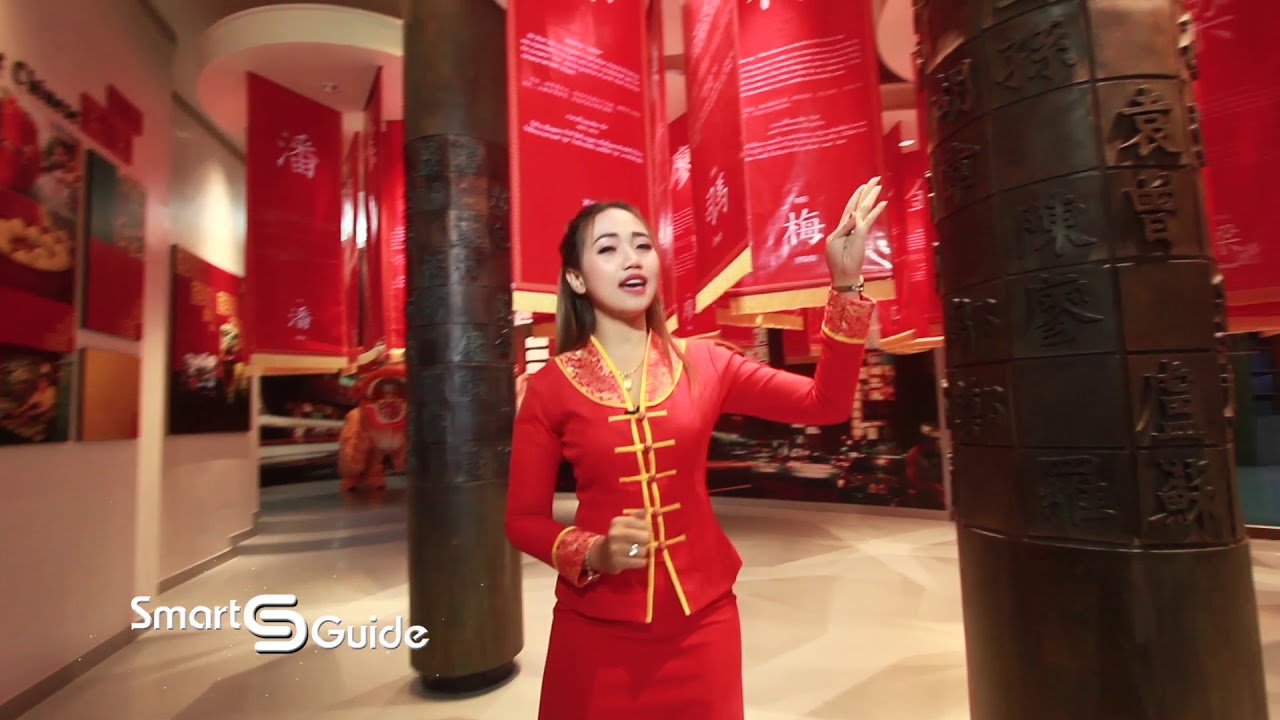
 Click to Access the Navigation Map GPS
Dragon Descendants Museum Map
Gellery
Recommend

 Historical Sites and Monuments(2)
 Landmarks and Memorials(4)
 Art, Craft Centres, Tradition(2)
Museums(5)
Art, Craft Centres, Tradition(2)
Museums(5)
 Educational Places
 Educational Gardens, Farm(4)
 Training Center(2)
 Places of Worship
 Temple(36)
 Other Sacred Sites(4)
 Suburban Living
 Village, Community(6)
 Local Market(7)
 Floating Market(1)
 Nature and Wildlife
 National Parks and Marine Reserves(4)
 Mountain (Doi)(2)
 Dam, Reservoir, Lake(3)
 Caves(1)
 Bays and Beaches(1)
 Entertainment and Agricultural
 Farms, Parks and Ecotourism(6)
 Theater(1)


