
lovethailand home >Central Travel Attractions >Sing Buri Travel Attractions >Phrom Buri >Bang Nam Chieow > Wat Kudi Thong
TL;DR: Wat Kudi Thong is located at Village No. 3, Bang Nam Chiao Subdistrict, Phrom Buri District, Sing Buri Province, Thailand, open Daily, hours Please contact in advance to visit the Thai Phuan Folk Art and Cultural Center.
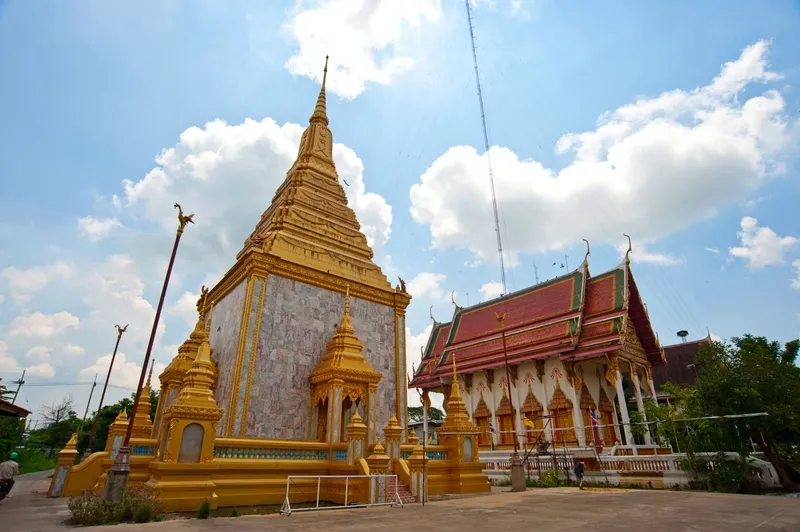
Wat Kudi Thong
Open Days: Daily
Opening Hours: Please contact in advance to visit the Thai Phuan Folk Art and Cultural Center
Wat Kudi Thong in Sing Buri Province is an important Buddhist temple in Bang Nam Chiao Subdistrict, Phrom Buri District. It is known for its sacred mondop built in 1900 by Luang Pho Panya Uttama Phichai, the former abbot of the temple. The mondop has a form resembling a traditional Thai chedi with twelve indented corners. Sacred relics of the Buddha are enshrined at the top, while inside the mondop is a metal replica of the Buddha’s footprint for worshippers to pay respect. The temple is also home to the Thai Phuan Folk Art and Cultural Center, which preserves household tools, clothing, ornaments, farming equipment, fishing tools, animal-trapping devices, and old watercraft used by the Thai Phuan community. This makes Wat Kudi Thong both a religious site and a valuable cultural learning center.
Wat Kudi Thong is located in Village No. 3, Bang Nam Chiao Subdistrict, Phrom Buri District, Sing Buri Province. The surrounding community is strongly associated with Thai Phuan heritage, a cultural identity preserved through language, clothing, food, rituals, household objects, and everyday ways of life. For travelers who want to understand Sing Buri beyond its better-known temples and historical attractions, Wat Kudi Thong offers an important opportunity to learn about a local ethnic community and its relationship with Buddhism.
The most important sacred structure inside the temple is the mondop built in 1900. Its architectural form resembles a small chedi with twelve indented corners, a refined style found in Thai religious architecture. The form gives the building a sense of balance, rhythm, and sacred dignity. Because the mondop houses important Buddhist objects, it is not only an architectural feature but also a place of devotion. Visitors should begin their visit by paying respect here before continuing to other areas of the temple.
The top of the mondop contains relics of the Buddha, while the interior enshrines a metal replica of the Buddha’s footprint. In Thai Buddhist tradition, Buddha footprints are deeply meaningful sacred objects. They symbolize the presence of the Buddha, the path of the Dhamma, and the act of following the Buddha’s teachings. Paying respect to the Buddha footprint at Wat Kudi Thong is therefore an act of remembrance, devotion, and moral reflection.
The construction of the mondop by Luang Pho Panya Uttama Phichai reflects the role of monks and local communities in building sacred places. In rural and semi-rural Thai communities, temples often grow through cooperation between monks, villagers, and local supporters. The mondop at Wat Kudi Thong is a lasting sign of faith from the early modern period and remains an important spiritual landmark for the temple today.
The Thai Phuan Folk Art and Cultural Center is another major reason to visit Wat Kudi Thong. The center collects and displays everyday objects used by the Thai Phuan people, including household utensils, textiles, ornaments, farming tools, fishing equipment, animal-trapping tools, and traditional watercraft. These objects show how people lived, worked, dressed, traveled, and adapted to their environment in the past. For cultural travelers, the center provides a rare and tangible look into community life that cannot be understood through written history alone.
The cultural center should not be seen merely as a place for old objects. Each item helps tell a story. Farming tools reveal agricultural knowledge and labor systems. Fishing tools show the importance of waterways and seasonal knowledge. Clothing and ornaments reflect taste, identity, social values, and craft traditions. Household objects show how families lived, cooked, stored food, and organized domestic life. Old watercraft reveal how strongly local communities depended on rivers and canals for transport and trade.
The Thai Phuan people are an important cultural group found in several parts of Thailand, including central provinces such as Sing Buri. Their cultural identity is expressed through language, customs, textiles, food, rituals, and community memory. The presence of a Thai Phuan cultural center inside Wat Kudi Thong shows how temples can preserve not only Buddhist practice but also ethnic heritage. Visitors can therefore learn about the close relationship between religion and local identity in Thai community life.
Wat Kudi Thong is also known as a meditation and Dhamma practice site with practical facilities. Local information mentions separate accommodation for men and women, clean restrooms, and meditation halls. This means the temple supports both short visits and deeper religious practice. Visitors who come for worship can pay respect to sacred objects, while those interested in Buddhist practice can appreciate the temple’s role as a place for calm reflection and moral cultivation.
A meaningful visit to Wat Kudi Thong can begin at the sacred mondop, where visitors pay respect to the relics and the Buddha footprint. After that, they can walk through the temple grounds and visit the Thai Phuan Folk Art and Cultural Center by prior arrangement. Contacting the temple or the museum caretakers in advance is recommended because the cultural center operates by appointment. This allows visitors to receive better guidance and helps the caretakers prepare the space properly.
When visiting the cultural center, travelers should observe the objects carefully and respectfully. The displays are not simply decorative; they are records of community knowledge. Farming tools, fishing equipment, textiles, ornaments, and old boats all reveal different aspects of Thai Phuan life. Taking time to understand these objects turns the visit into a cultural learning experience rather than a quick stop.
On important Buddhist days such as Makha Bucha Day, Visakha Bucha Day, Asalha Bucha Day, Buddhist Lent, the end of Buddhist Lent, and Kathin season, Wat Kudi Thong serves as a gathering place for local Buddhists. People come to make merit, offer food to monks, listen to sermons, and join religious ceremonies. These activities show that the temple remains an active religious center for the Bang Nam Chiao community.
Getting There is convenient by private car. Wat Kudi Thong is located near Highway 32 around kilometer markers 125–126 in Bang Nam Chiao Subdistrict, Phrom Buri District. Travelers from Sing Buri town can follow the main highway toward Phrom Buri and then enter the local road to the temple. Travelers coming from Bangkok or other central provinces can also use Highway 32 as the main route. A navigation app can be used to search for Wat Kudi Thong or the Thai Phuan Folk Art and Cultural Center.
The best time to visit is in the morning or afternoon when the weather is more comfortable. Visitors who want to see the Thai Phuan Folk Art and Cultural Center should contact the temple or caretakers in advance. Proper temple etiquette is important. Visitors should dress modestly, wear shirts with sleeves and appropriate trousers or skirts, remove shoes before entering sacred areas, and avoid touching museum objects without permission.
Wat Kudi Thong can be combined with several nearby attractions. Travelers interested in Buddhist temples can continue to Wat Amphawan, Wat Phra Non Chak Si Worawihan, Wat Phikun Thong, Wat Sadao, or Wat Laem Khang. Travelers interested in history can continue toward Wat Pho Kao Ton, the Bang Rachan Heroes Monument, and Ban Rachan Retro Market. In this way, Wat Kudi Thong adds a cultural and ethnic heritage dimension to a Sing Buri travel route.
Food options can be found along Highway 32, in Phrom Buri, and in Sing Buri town. Travelers who want more established restaurants may continue toward Phaibun Kai Yang, Ramphueng Restaurant, Charoen Thip Restaurant, or Ban Suan Mae La Ka Rong. Planning meal stops in advance is useful, especially when visiting the cultural center by appointment.
Accommodation options are available in the wider Sing Buri area. Public hotel listings near Wat Kudi Thong include Saen Sabai Resort, Somsri Apartment, Chaisaeng Villa Sing Buri, Pa Pan Resort, Zen Garden Resort, Central Park, Golden Dragon Resort, and Chaisaeng Palace. Staying in Sing Buri town is convenient for travelers who need restaurants and services, while staying near Highway 32 is practical for those continuing onward to other provinces.
Overall, Wat Kudi Thong is valuable because it combines faith, architecture, meditation practice, and Thai Phuan cultural heritage. The sacred mondop, Buddha relics, Buddha footprint, and cultural center make the temple more than a place of worship. It is a living archive of community memory and a meaningful learning site for travelers who want to understand the cultural diversity of Sing Buri.
For foreign travelers, Wat Kudi Thong offers a quiet but rich experience. It shows how a Thai Buddhist temple can preserve sacred objects, support meditation practice, and protect the cultural identity of an ethnic community at the same time. A visit here is ideal for travelers who enjoy temples, local museums, folk culture, and meaningful cultural travel beyond mainstream attractions.
| Name | Wat Kudi Thong |
| Location | Village No. 3, Bang Nam Chiao Subdistrict, Phrom Buri District, Sing Buri Province, Thailand |
| Address | Wat Kudi Thong, Village No. 3, Bang Nam Chiao Subdistrict, Phrom Buri District, Sing Buri Province 16120 |
| Highlights | Twelve-indented-corner mondop built in 1900, Buddha relics, metal Buddha footprint replica, and the Thai Phuan Folk Art and Cultural Center |
| History | The important mondop was built in 1900 by Luang Pho Panya Uttama Phichai, the former abbot, and remains a key sacred structure of the temple |
| Distinctive Features | A Thai Phuan community temple combining Buddhist worship, meditation practice, and folk cultural learning in one place |
| Main Sacred Objects / Features | Buddha relics enshrined at the top of the mondop, metal replica of the Buddha’s footprint, and the twelve-indented-corner mondop |
| Cultural Learning Center | Thai Phuan Folk Art and Cultural Center displaying household objects, clothing, ornaments, farming tools, fishing tools, animal-trapping devices, and traditional watercraft |
| Travel Information | Best reached by car via Highway 32 around kilometer markers 125–126, then entering Bang Nam Chiao Subdistrict, Phrom Buri District |
| Current Status | An active Buddhist temple and the site of the Thai Phuan Folk Art and Cultural Center. Advance contact is recommended for museum visits |
| Open Days | Daily |
| Opening Hours | Please contact in advance to visit the Thai Phuan Folk Art and Cultural Center |
| Fees | No admission fee |
| Facilities | Parking area, separate meditation accommodation for men and women, restrooms, meditation halls, worship areas, and the folk cultural center |
| Main Areas / Zones | Buddha relic mondop, Buddha footprint replica, meditation halls, Dhamma practice areas, and Thai Phuan Folk Art and Cultural Center |
| Abbot / Caretaker | Contact the abbot of Wat Kudi Thong or the Thai Phuan Folk Art and Cultural Center caretakers before visiting the museum |
| Main Contact Number | 08 1853 3574, 08 7117 8925 |
| Official Website / Related Page | Museum Database Thailand, Sing Buri Provincial Office of Tourism and Sports, Tourism Authority of Thailand, and Bang Nam Chiao Municipality |
| Nearby Tourist Attractions | 1. Wat Amphawan, about 5 km 2. Wat Phra Non Chak Si Worawihan, about 9 km 3. Wat Phikun Thong, about 10 km 4. Wat Sadao, about 13 km 5. Wat Laem Khang, about 14 km 6. Sing Buri City Pillar Shrine, about 15 km 7. Wat Pho Kao Ton, also known as Wat Mai Daeng, about 22 km |
| Nearby Restaurants | 1. Local restaurants along Highway 32, about 2 km 2. Phaibun Kai Yang, about 9 km, Tel. 09-9104-0362, 0-3651-2132 3. Ramphueng Restaurant, about 12 km, Tel. 0-3652-0757 4. Charoen Thip Restaurant, about 12 km, Tel. 0-3651-2539 5. Ban Suan Mae La Ka Rong, about 15 km, Tel. 036-501-047, 081-448-3678 |
| Nearby Accommodations | 1. Saen Sabai Resort, about 11 km 2. Somsri Apartment, about 11 km 3. Chaisaeng Villa Sing Buri, about 12 km 4. Pa Pan Resort, about 12 km 5. Zen Garden Resort, about 13 km 6. Golden Dragon Resort, about 13 km 7. Chaisaeng Palace, about 13 km |
Frequently Asked Questions (FAQ)
Q: Where is Wat Kudi Thong located?
A: Wat Kudi Thong is located in Village No. 3, Bang Nam Chiao Subdistrict, Phrom Buri District, Sing Buri Province, near Highway 32 around kilometer markers 125–126.
Q: What is Wat Kudi Thong known for?
A: The temple is known for its twelve-indented-corner mondop built in 1900, Buddha relics, metal Buddha footprint replica, and the Thai Phuan Folk Art and Cultural Center.
Q: What can visitors see at the Thai Phuan Folk Art and Cultural Center?
A: Visitors can see household objects, clothing, ornaments, farming tools, fishing tools, animal-trapping devices, and traditional watercraft used by the Thai Phuan community.
Q: Is there an admission fee for Wat Kudi Thong?
A: There is no admission fee for the temple or the Thai Phuan Folk Art and Cultural Center, but visitors should contact the caretakers in advance before visiting the center.
Q: Should visitors contact the temple before visiting the cultural center?
A: Yes. Advance contact is recommended because the Thai Phuan Folk Art and Cultural Center requires caretakers to open the space and assist visitors.
Q: How can visitors travel to Wat Kudi Thong?
A: Visitors can travel by car via Highway 32 around kilometer markers 125–126, then enter Bang Nam Chiao Subdistrict in Phrom Buri District.
Q: What should visitors wear when visiting Wat Kudi Thong?
A: Visitors should dress modestly, wear shirts with sleeves and appropriate trousers or skirts, remove shoes before entering sacred areas, and avoid touching museum objects without permission.
Q: What nearby places can visitors see after Wat Kudi Thong?
A: Nearby places include Wat Amphawan, Wat Phra Non Chak Si Worawihan, Wat Phikun Thong, Wat Sadao, Wat Laem Khang, Sing Buri City Pillar Shrine, and Wat Pho Kao Ton.
 Category: ●Places of Worship
 Group: ●Temple
Last Update : 4 MonthAgo
 Last Update : 4 MonthAgo
 Click to Access the Navigation Map GPS
 Art, Culture and Heritage
 Historical Sites and Monuments(4)
 Landmarks and Memorials(3)
 Art, Craft Centres, Tradition(3)
 Museums(1)
 Educational Places
 Library(1)
Temple(42)
Library(1)
Temple(42)
 Church(1)
 Other Sacred Sites(2)
 Research and Development
 Royal Project(3)
 Suburban Living
 Village, Community(1)
 Local Market(1)
 Nature and Wildlife
 National Parks and Marine Reserves(1)
 River, Canal(7)
 Bays and Beaches(1)
 Other natural attractions(2)
 Entertainment and Agricultural
 Animal camps and shows(1)
 Farms, Parks and Ecotourism(1)
 Travel Articles, Recipes
 Travel Review, Food Review(1)


