
lovethailand home >Central Travel Attractions >Saraburi Travel Attractions >Sao Hai >Sao Hai > Ram Rong Ritual
TL;DR: Ram Rong Ritual, open Held according to the vow and ritual arrangement of the host family, hours Usually begins in the morning and continues throughout the day.
Ram Rong Ritual
Open Days: Held according to the vow and ritual arrangement of the host family
Opening Hours: Usually begins in the morning and continues throughout the day
Ram Rong Ritual is an important ceremonial tradition among Thai people of Mon descent in Central Thailand. In Saraburi, this ancestral spirit ritual is locally known as “Ram Rong” or sometimes “Ram Lakhon.” The ritual is closely connected with vow fulfillment, ancestral worship, and the belief that the spirits of forebears continue to protect and guide their descendants. When someone has made a vow and later receives the desired result, the family will organize this ritual as an act of repayment and respect.
The importance of Ram Rong lies not only in its role as a vow-fulfilling ceremony, but also in its moral meaning. It represents the keeping of one’s word. In this sense, the ritual expresses both devotion and responsibility. For the host family, performing the ceremony is a public and spiritual confirmation that their promise has been honored after their wish was granted.
From a cultural perspective, the ritual is also one of the clearest surviving signs of Mon ancestral belief in Central Thailand. It shows how traditional Mon spiritual practice has continued within Thai society through shared ritual space, family cooperation, and inherited ceremonial knowledge. Ram Rong is therefore not merely a religious performance. It is a cultural framework that connects the living with the dead, the present with the past, and the individual with the wider kinship network.
A major preparatory step in the ritual is the construction of the ceremonial pavilion, known as the “rong.” Once the vow has been fulfilled, the family prepares the pavilion as a dedicated ritual structure. It is traditionally built from local wood and roofed with grass or thatch. The pavilion faces west, with one side used for offerings and another side reserved for the Mon pi phat musical ensemble. It must be completed within a single day before the ceremony. Importantly, it cannot be built under the roofline of a house, and once the ritual ends, its materials must never be reused in a dwelling.
This act of building the pavilion reflects strong communal cooperation. Men usually join together to construct the ritual space, while women and relatives help prepare offerings and food. As a result, Ram Rong is never only the business of one person. It becomes a shared act of kinship and community labor.
The offerings are central to the ritual. Each offering tray may include special cakes for ancestral spirits, betel nut, cigarettes, incense, candles, bananas, flowers, and additional items depending on the vow itself, such as boiled pig’s head, whole boiled chicken, or white liquor. These are not ordinary food items. Within the ritual context, they are symbolic gifts presented in gratitude and reverence to the ancestral spirits who are believed to have granted assistance.
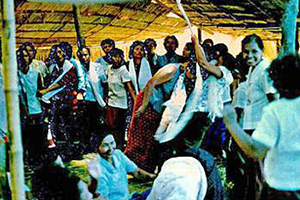
On the day of the ritual, villagers and relatives gather at the pavilion from early morning. The ritual leader, known locally as the “Ton Phi,” begins by lighting incense and candles to invite the ancestral spirits. Offerings are placed on the raised platform while the Mon pi phat ensemble plays continuously. A thick rope wrapped in raw white thread hangs in the center of the pavilion. Participants hold and swing from this rope during spirit possession sequences, which are among the most distinctive moments of the ritual.
When the ancestral spirits are believed to enter the participants, their behavior changes dramatically. Their eyes become distant, their bodies sway or tremble, and they begin to dance, jump, and move energetically to the music. Some dance near the offering platform, while others pull relatives into the ceremonial space. Within the community’s interpretation, this is not simple performance. It is a sign that the invited spirits have truly arrived to receive the offerings and join the ritual.
Around midday, the ceremony pauses for a communal meal, but the food is not taken into the house. It must be eaten near the pavilion or under nearby trees. This rule reflects the distinction between sacred ritual space and domestic living space, a separation that remains important in the traditional order of the ceremony.
Another remarkable sequence is the cutting of the banana trunk. A large banana plant is set within the pavilion, and at the proper moment the ritual leader, while possessed, approaches it with a sword and cuts it. Parts of the trunk are then used in later steps of the ceremony, including the making of symbolic “arrow pellets” from the banana base. The middle section is turned into a dish of shredded banana pith for communal eating. This stage shows how everyday natural materials are transformed into sacred and symbolic ritual elements.
During the noon period, there is also a spirit-feeding sequence in which older women enter the pavilion, allow the spirits to enter them, and sit in a circle while offerings are brought forward. This is understood as feeding the ancestral spirits. Questions may be asked about the identity of the possessing spirit or the well-being of the ancestors, and answers are believed to come through the possessed participants. Such moments reinforce family memory and ancestral presence within the ceremony.
In the afternoon, the ritual continues with the “chicken continuation” ceremony. A rooster is tied in front of the pavilion, and the ritual leader, dressed like a hunter, approaches it with a crossbow-like implement. Symbolic pellets made from banana-root material are fired toward the rooster. The act is highly symbolic and does not function as a literal hunt. It expresses ritual power, release of misfortune, and ceremonial completion.
Later, a coconut used earlier in divination is smashed so that the blessed flesh can be shared. Water is then poured over the person who originally made the vow to wash away misfortune and restore auspiciousness. Finally, a small boat made from banana sheath is sent away in a “boat sending” rite, symbolically carrying misfortune and bad luck out of the household.
When everything is complete, the pavilion is dismantled, the remaining offerings are divided, and the community shares what is considered blessed food left by the ancestors. Even though the ritual materials may be reused for other purposes, they must never be turned into structural parts of a residence. This rule preserves the sacred boundary of the ceremony from beginning to end.
The underlying belief behind Ram Rong is that human spirits do not simply disappear after death. The spirits of ancestors remain present and continue to watch over their descendants. If they are properly honored, they can grant help in times of hardship. The ritual therefore acts as a bridge between living family members and ancestral spirits while also strengthening gratitude, kinship, and neighborhood solidarity.
Getting There Ram Rong is not a fixed tourist-site event tied to one permanent venue. It is held at the house or community of the host family when a vow is to be fulfilled according to Mon ritual custom. Anyone wishing to observe or study the ritual should contact local Mon cultural networks, community leaders, or knowledgeable families in advance, especially in Central Thai provinces where Mon communities still preserve the practice.
| Name | Ram Rong Ritual |
| Cultural Group | Thai people of Mon descent |
| Cultural Area | Found in Mon communities in Central Thailand, and locally called “Ram Rong” in Saraburi |
| Highlights | Ceremonial pavilion building, ancestral spirit possession, Mon pi phat music, banana-trunk cutting, chicken rite, bathing, and boat-sending rite |
| Significance | Represents vow fulfillment, gratitude to ancestors, and kinship solidarity |
| Distinctive Features | A spirit ritual performed inside a dedicated pavilion with Mon ceremonial music |
| Key Offerings | Ancestral cakes, betel nut, cigarettes, incense, candles, bananas, flowers, pig’s head, chicken, and white liquor |
| Ritual Structure | Build pavilion – invite spirits – ritual dancing – spirit-feeding – banana-trunk cutting – chicken rite – bathing – boat sending – dismantling pavilion |
| Open Days | Held according to the vow and readiness of the host family |
| Opening Hours | Usually begins in the morning and continues throughout the day |
| Travel Information | Depends on the host household or community for each ceremony; advance local contact is recommended |
| Current Status | Still preserved in some Mon-descended communities in Central Thailand as a vow-fulfilling and ancestral spirit ritual |
Frequently Asked Questions (FAQ)
Q: What is the Ram Rong ritual?
A: It is a Mon-descended ritual performed to fulfill a vow, honor ancestral spirits, and maintain a promise that has been made.
Q: Why is the Ram Rong ritual important?
A: It expresses gratitude to ancestors, preserves one’s word, and strengthens family and community relationships.
Q: Where is this ritual held?
A: It is held at the host household or community of Thai Mon-descended families, and in Saraburi it is commonly called “Ram Rong.”
Q: What are the main highlights of the ritual?
A: Important elements include pavilion building, spirit possession, banana-trunk cutting, the chicken rite, bathing, and the boat-sending rite.
Q: Can outsiders take part in the ritual space?
A: In most cases, outsiders may observe from outside, while entry into the inner ceremonial space depends on custom and invitation.
Q: What belief does the Ram Rong ritual reflect most strongly?
A: It reflects the belief that ancestral spirits remain present and can continue to protect and guide their descendants when properly honored.
 Category: ●Art, Culture and Heritage
 Group: ●Art, Craft Centres, Tradition
Last Update : 5 MonthAgo
 Last Update : 5 MonthAgo
Recommend

 Historical Sites and Monuments(2)
 Landmarks and Memorials(2)
 Royal Palace(4)
Art, Craft Centres, Tradition(4)
Royal Palace(4)
Art, Craft Centres, Tradition(4)
 Museums(1)
 Educational Places
 Museum for Study(1)
 Educational Gardens, Farm(2)
 Places of Worship
 Temple(8)
 Other Sacred Sites(5)
 Research and Development
 Royal Project(1)
 Suburban Living
 Village, Community(3)
 Nature and Wildlife
 National Parks and Marine Reserves(3)
 Mountain (Doi)(3)
 Waterfalls(5)
 Caves(6)
 Flower Field(1)
 River, Canal(1)
 Bays and Beaches(1)
 Other natural attractions(2)
 Entertainment and Agricultural
 Zoos and Aquariums(1)
 Animal camps and shows(1)
 Farms, Parks and Ecotourism(8)
 Outdoor and Adventure Activities(1)


