
lovethailand home >Central Travel Attractions >Saraburi Travel Attractions >Wihan Daeng >Nong Mu > Chedi Phra Khun Mae
TL;DR: Chedi Phra Khun Mae is located at Wat Khlong Mai, Nong Moo Subdistrict, Wihan Daeng District, Saraburi, open Daily, hours 08:30 – 16:30.
Chedi Phra Khun Mae
Open Days: Daily
Opening Hours: 08:30 – 16:30
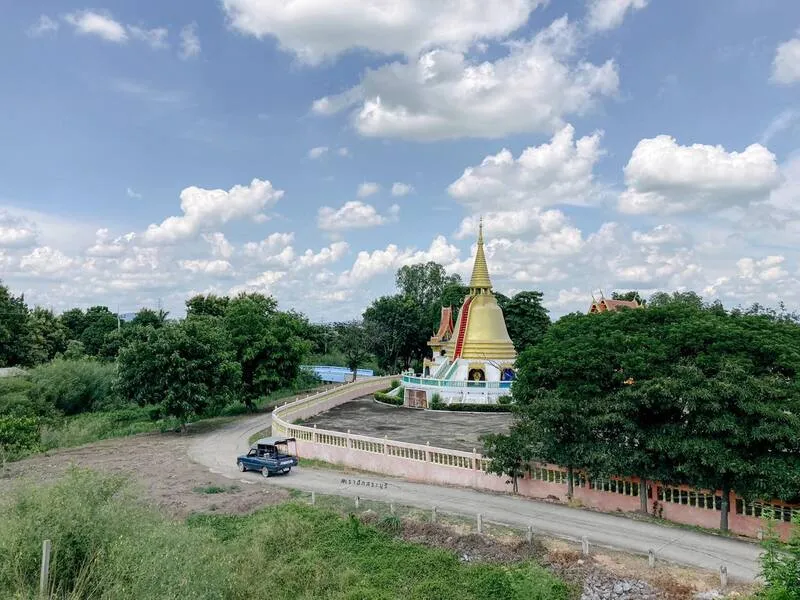
Chedi Phra Khun Mae, located within Wat Khlong Mai in Nong Moo Subdistrict, Wihan Daeng District, Saraburi, is one of those places that immediately feels different from an ordinary temple stop. It is not only a place for Buddhist worship, but also a monument built around a deeply emotional idea: gratitude toward one’s mother. That single concept gives the site an identity that is both spiritual and personal. Visitors do not come here merely to admire a stupa or pass through another provincial temple. They come to reflect, pay respect, make merit, and reconnect with one of the most important values in Thai culture – filial gratitude.
The chedi is visually striking because its form resembles Phra Pathom Chedi, one of Thailand’s most recognizable Buddhist monuments. Even though it is much smaller in scale, the resemblance gives the structure an immediate sense of familiarity and dignity. Rising above the grounds of Wat Khlong Mai, the white body of the chedi stands out clearly against the sky, and its elegant silhouette makes it easy to recognize from a distance. The result is a sacred structure that feels both monumental and approachable, graceful without being overwhelming.
What truly defines the site, however, is its meaning. Chedi Phra Khun Mae was created to encourage sons and daughters to remember and repay the kindness of their mothers. In Thailand, gratitude toward parents is not treated as a private sentiment alone; it is also a moral ideal closely tied to religion and daily life. This chedi turns that ideal into a real place that people can visit. The experience of coming here is therefore more than a temple visit. It becomes an act of remembrance, reflection, and emotional offering, especially for visitors who wish to dedicate merit to their mothers, whether living or deceased.
Inside the chedi is a replica of the Buddha’s footprint, which adds another important layer of religious meaning. The Buddha’s footprint is a long-standing sacred symbol in Thai Buddhism, and its presence here reinforces the chedi’s role as a place of worship rather than simply a symbolic monument. Visitors who walk inside or approach the inner sacred area often experience a more focused and meditative atmosphere. The site speaks to both faith and memory at the same time, and that combination is what makes it especially memorable.
Surrounding the main chedi are Buddha images associated with the days of the week. This is another element that feels deeply Thai and immediately accessible to local visitors. Many Thai Buddhists like to pay respect to the Buddha image connected with their day of birth, so the arrangement around the chedi creates a natural sequence of worship. A visitor may first come to honor the meaning of the site as a tribute to maternal kindness, then continue by paying respect to the Buddha image of their birth day for personal blessing and spiritual reassurance.
Because the chedi stands within Wat Khlong Mai, the wider temple environment also shapes the experience. Wat Khlong Mai is not a crowded urban temple. It sits within a community landscape that still feels local and grounded, with canals and agricultural surroundings helping preserve a quieter rural atmosphere. This setting matters. It allows the chedi to feel less like a sightseeing object and more like a lived sacred place. Visitors often spend time slowly walking around the grounds, sitting quietly, or simply taking in the stillness that is harder to find in more commercial temple destinations.
For travelers interested in Thai cultural values, this place offers more than architecture. It shows how religion, family ethics, and community memory can be combined into one meaningful landmark. Many Buddhist sites are known primarily for age, relics, or artistic value. Chedi Phra Khun Mae stands out because its core message is immediately understandable: remember your mother, honor her kindness, and transform gratitude into good action. That message makes the site especially powerful for Thai visitors, but it also resonates well with international travelers who want to understand how moral values are expressed in Thai sacred spaces.
Architecturally, the chedi achieves a good balance between familiarity and individuality. The familiarity comes from its resemblance to the great Buddhist chedi tradition, especially Phra Pathom Chedi. Its individuality comes from the purpose behind it. This is not simply a reduced version of a famous stupa form. It is a site with its own emotional and symbolic identity. That combination gives it a special place among lesser-known religious attractions in Saraburi Province.
Another reason the site leaves a strong impression is the emotional openness suggested by its name. Even first-time visitors often feel an immediate connection because the idea of maternal kindness is universal. Some come to make merit for their mothers, some come with family members, and some come because they are seeking a peaceful place with moral meaning rather than a busy sightseeing destination. The name itself invites reflection, and the atmosphere of the temple supports that response in a natural way.
From a travel planning perspective, Chedi Phra Khun Mae is suitable for a half-day route in Saraburi or nearby districts. It works particularly well for travelers interested in faith-based tourism, local cultural landmarks, or quiet temple visits outside the main tourist crowds. It is not a large destination that requires an entire day, but it is also not a place to rush through in five minutes. Around 30 minutes to 1 hour is usually enough to walk around the chedi, pay respect, look at the Buddha images for each day of the week, and absorb the atmosphere properly.
The best times to visit are usually in the morning or later in the afternoon, when the light is softer and the weather is more comfortable. On clear days, the white body of the chedi contrasts beautifully with the blue sky, making it especially appealing for photography. Still, the strongest appeal of the site is not visual alone. Its real value lies in the quiet emotional space it creates. It gives visitors a chance to slow down and reflect on gratitude, which is rare even among many temple attractions.
In practical terms, the site is around 42 kilometers from Saraburi town. The commonly described route is via Highway 1, following Phahonyothin Road toward the Bangkok direction, then entering the road along the irrigation canal toward Wat Khlong Mai. For most travelers, driving is the easiest option. It gives the greatest flexibility and makes it easier to include nearby temples, cafés, or local attractions in the same trip. Those relying on public transportation may need to travel first to Nong Khae or a nearby area, then continue by local hire vehicle, since the temple is not located at a major transit hub.
Getting There is therefore most convenient by private car. If you are using digital navigation, searching for Wat Khlong Mai or Chedi Phra Khun Mae usually helps you reach the correct destination more directly. This is especially useful for foreign travelers unfamiliar with local road names. Because the temple sits within a community setting rather than a dense commercial zone, it is wise to plan the route before departure and combine the visit with a few other stops nearby.
For researchers, writers, and culturally curious travelers, the site is also valuable as an example of how Thai sacred architecture can communicate ethical ideas in public space. It demonstrates that a temple monument does not need to be ancient to be culturally meaningful. By centering the theme of gratitude to one’s mother, the chedi transforms a timeless moral principle into a place people can physically visit, experience, and remember. That makes it an especially rich destination for those who want to go beyond surface-level sightseeing.
Overall, Chedi Phra Khun Mae is one of Saraburi’s more distinctive faith-based attractions. It combines Buddhist devotion, symbolic architecture, emotional meaning, and a peaceful local atmosphere in a way that feels sincere rather than staged. For travelers looking for a quiet destination near Bangkok with a strong cultural message, this is a worthwhile stop. The image of the white chedi may be what first draws attention, but the enduring impression comes from the idea behind it – gratitude, remembrance, and the wish to repay the kindness of a mother through merit and devotion.
| Name | Chedi Phra Khun Mae |
| Location | Wat Khlong Mai, Nong Moo Subdistrict, Wihan Daeng District, Saraburi |
| Address | Village No. 3, Ban Khlong Mai, Nong Moo Subdistrict, Wihan Daeng District, Saraburi 18150 |
| Coordinates | 14.332458, 100.942277 |
| Highlights | A stupa modeled after Phra Pathom Chedi, dedicated to honoring mothers, with a replica Buddha’s footprint inside and weekday Buddha images around the base |
| Distinctive Features | A religious landmark centered on filial gratitude, peaceful temple atmosphere, and a clear symbolic identity within local Buddhist culture |
| History | An important chedi within Wat Khlong Mai, built as a sacred monument that encourages remembrance and repayment of a mother’s kindness |
| Name Origin | Its name reflects the intention to create a place where people can remember and honor the kindness of their mothers through merit-making |
| Travel Information | Around 42 km from Saraburi town; the easiest route is by car via Highway 1 and the irrigation canal road leading to Wat Khlong Mai |
| Current Status | Open for visits and worship |
| Open Days | Daily |
| Opening Hours | 08:30 – 16:30 |
| Facilities | Temple grounds, worship space, and on-site parking subject to local conditions |
| Main Areas / Zones | Main chedi, replica Buddha’s footprint area, weekday Buddha images surrounding the structure |
| Abbot / Caretaker | Phra Khru Wimon Wihan Khun (Chantasaro) |
| Main Contact Number | 087-115-9629 |
| Official Website / Official Page | Wat Khlong Mai Chedi Phra Khun Mae (Facebook) |
| Nearby Tourist Attractions | 1) Bamboo Tunnel at Wat Chulabhorn Wanaram, about 15 km 2) Wat Phra Phuttha Saeng Tham, about 18 km 3) Namtok Sam Lan National Park, about 24 km 4) Wat Phra Phutthachai, about 27 km 5) Nong Moo Local Way of Life Museum, about 6 km |
| Nearby Restaurants | 1) Mae Sangat Duck Noodle, about 9 km, Tel. 036-377-810, 098-284-9223 2) Mae Lao Curry Puff, about 10 km, Tel. 085-561-6149 3) Wihan Kaeng, about 11 km, Tel. 098-857-4574 4) Homu Cafe, about 11 km, Tel. 099-185-7776 5) Rim Chon Nong Khae, about 14 km, Tel. 036-380-988 |
| Nearby Accommodations | 1) Yoo Rung Rueang Resort Wihan Daeng, about 9 km, Tel. 081-772-9236 2) Grand Pruksasiri Saraburi, about 20 km, Tel. 091-009-4169 3) Baan Dara Resort, about 28 km, Tel. 086-450-0570, 036-222-875 4) Tongta Homestay, about 34 km, Tel. 084-881-4412 5) Maai Horm Boutique Resort, about 45 km, Tel. 097-999-5890 |
Frequently Asked Questions (FAQ)
Q: Where is Chedi Phra Khun Mae located?
A: It is located inside Wat Khlong Mai in Nong Moo Subdistrict, Wihan Daeng District, Saraburi Province.
Q: Why is Chedi Phra Khun Mae important?
A: The chedi was created as a sacred place that encourages sons and daughters to remember and repay the kindness of their mothers, making it spiritually and culturally distinctive.
Q: What can visitors worship at the site?
A: Visitors can pay respect to the main chedi, the replica Buddha’s footprint inside, and the Buddha images for each day of the week around the structure.
Q: When is the site open?
A: The available tourism information states that it is open daily from 08:30 to 16:30.
Q: What is the best way to get there?
A: The easiest way is by private car via Highway 1, then continuing along the irrigation canal road toward Wat Khlong Mai.
Q: Is this place suitable for foreign travelers?
A: Yes. It is especially suitable for travelers interested in Buddhism, Thai cultural values, peaceful temple visits, and meaningful local destinations outside crowded tourist routes.
 Category: ●Places of Worship
 Group: ●Other Sacred Sites
Last Update : 3 MonthAgo
 Last Update : 3 MonthAgo
 Click to Access the Navigation Map GPS
Chedi Phra Khun Mae Map
Recommend

 Art, Culture and Heritage
 Historical Sites and Monuments(2)
 Landmarks and Memorials(2)
 Royal Palace(4)
 Art, Craft Centres, Tradition(4)
 Museums(1)
 Educational Places
 Museum for Study(1)
 Educational Gardens, Farm(2)
 Temple(8)
Other Sacred Sites(5)
Temple(8)
Other Sacred Sites(5)
 Research and Development
 Royal Project(1)
 Suburban Living
 Village, Community(3)
 Nature and Wildlife
 National Parks and Marine Reserves(3)
 Mountain (Doi)(3)
 Waterfalls(5)
 Caves(6)
 Flower Field(1)
 River, Canal(1)
 Bays and Beaches(1)
 Other natural attractions(2)
 Entertainment and Agricultural
 Zoos and Aquariums(1)
 Animal camps and shows(1)
 Farms, Parks and Ecotourism(8)
 Outdoor and Adventure Activities(1)


