
lovethailand home >Central Travel Attractions >Saraburi Travel Attractions >Sao Hai >Suan Dok Mai > Wat Samuha Pradittharam
TL;DR: Wat Samuha Pradittharam is located at Suan Dok Mai Subdistrict, Sao Hai District, Saraburi, open Daily, hours 06:00 - 18:00.
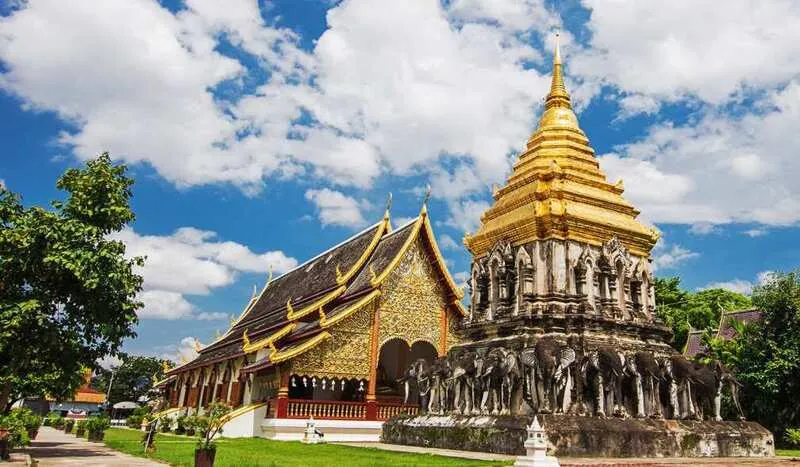
Wat Samuha Pradittharam
Open Days: Daily
Opening Hours: 06:00 - 18:00
Wat Samuha Pradittharam is a third-class royal temple of the Maha Nikaya order located in Suan Dok Mai Subdistrict, Sao Hai District, Saraburi Province. It is one of the most historically interesting temples in Sao Hai, valued for its early Rattanakosin architecture, royal connection, educational legacy, and quiet atmosphere. The temple is especially admired for its old ubosot from the reign of King Nangklao, where Thai and Chinese artistic influences are blended in a refined and memorable way.
The temple was established during the reign of King Rama III by Chao Phraya Nikornbodin, or To Kanlayanamit, the ancestor of the Kanlayanamit family. He built the temple in dedication to his mother, and once construction was completed, the temple was respectfullyถวาย as a royal monastery. This origin gives the temple a distinctive emotional and historical dimension, since its foundation reflects both filial devotion and public religious patronage.
Wat Samuha Pradittharam is also connected with an important local historical tradition. It is believed that the temple may once have been used as the site for the Taking the Oath of Allegiance ceremony for officials in Saraburi Province before that practice was later discontinued. This suggests that the temple once played a civic role that extended beyond ordinary religious life and connected directly with provincial administration and royal ritual.
Its importance in education is equally remarkable. The dhamma hall, or preaching pavilion, was once used as the first public elementary school in Saraburi Province under the name Samuha Pradit Primary School, which opened on May 9, R.S. 126, corresponding to 1908. Later, during the period of Phra Silawisutthidilok, the temple also opened classes in dhamma studies in 1915 and Pali studies in 1934. This makes the temple an important historical center not only for religion, but also for local learning and community development.
The architectural heart of the temple is the ubosot, completed around 1861. Its pediment features stucco reliefs of the royal emblem of King Rama III surrounded by floral motifs and lions. The front entrance zone and the boundary gate shrine show strong Chinese artistic influence, while the rear doorway frame and door-panel designs include Chinese guardian figures standing on lions. These details give the building a distinctive appearance and clearly connect it to the artistic climate of the Rama III period.
The principal Buddha image inside the ubosot is called Phra Phuttha Ratcha Kanlayanamit Pradittharam. It is a Mara-victory Buddha image cast in metal, lacquered and gilded, and brought from old Sukhothai. The interior also contains mural paintings, including decorative khao bin flame motifs above the windows and a scene of traditional daily life on the wall behind the principal image. These artistic details make the ubosot especially rewarding for visitors who enjoy temple painting and architectural observation.
Beside the ubosot stands a round chedi on an octagonal base, enclosed by its own boundary wall and approached by stairways on all four sides. It is said that Chao Phraya Nikornbodin placed his mother’s relics inside this chedi, which adds a deeply personal layer to the temple’s founding story. The chedi is therefore not just a structural feature, but a memorial tied directly to the original intention of the temple’s construction.
Another striking element is the pair of Chinese stone figures now placed on the prayer hall. They originally stood in front of the ubosot, although their exact provenance is no longer known. The temple also preserves a gilded pulpit bearing the royal monogram of King Chulalongkorn, a funerary ceremonial object associated with the royal cremation of King Rama V. These objects strengthen the temple’s cultural value and make it more than just a local religious site.
Today, Wat Samuha Pradittharam remains peaceful and dignified. It is not an overly crowded temple, which makes it ideal for slow cultural travel. Visitors can spend time studying the stucco work, the old ubosot, the murals, and the surrounding sacred structures without feeling rushed. It suits both merit-makers and travelers who enjoy older temples with clear historical texture.
For temple enthusiasts visiting Saraburi, this site works particularly well as part of a Sao Hai route. It offers a balance of architecture, heritage, religious atmosphere, and accessibility. Visitors who appreciate old royal temples with subtle but meaningful details will find it especially rewarding.
Travel Information From Saraburi town, travel toward Sao Hai District and continue into Phichai Narong Songkhram Road in Suan Dok Mai Subdistrict. The temple stands at 2 Moo 7 and is about 2 kilometers from the Sao Hai District Office. The easiest way to visit is by private car, and the route is straightforward enough for a half-day or full-day cultural trip.
After visiting the temple, travelers can continue to nearby attractions, cafés, local restaurants, and accommodations in Sao Hai and central Saraburi. This makes Wat Samuha Pradittharam a practical anchor point for a compact worship-and-culture itinerary in the province.
| Name | Wat Samuha Pradittharam |
| Location | Suan Dok Mai Subdistrict, Sao Hai District, Saraburi |
| Address | 2 Moo 7, Phichai Narong Songkhram Road, Suan Dok Mai, Sao Hai, Saraburi 18160 |
| Highlights | Rama III period ubosot, Phra Phuttha Ratcha Kanlayanamit Pradittharam, mural paintings, octagonal-based chedi, Chinese stone figures, gilded pulpit |
| History | Built in the reign of King Rama III by Chao Phraya Nikornbodin (To Kanlayanamit) and laterถวาย as a royal monastery |
| Distinctive Features | Stucco royal emblem of King Rama III, Chinese-influenced gate and guardian motifs, historic murals, and a chedi believed to enshrine the founder’s mother’s relics |
| Travel Information | About 2 km from the Sao Hai District Office, easiest to reach by private car from Saraburi town |
| Current Status | Open to worshippers and visitors as usual |
| Open Days | Daily |
| Opening Hours | 06:00 - 18:00 |
| Facilities | Parking area, worship space, pavilions, restrooms |
| Main Areas / Zones | Ubosot, principal Buddha image zone, murals, chedi, prayer hall, boundary wall and gateways |
| Abbot / Caretaker | Phra Wachiramethi (Warapong Waranyu) |
| Main Contact Number | 036-332-346, 081-745-8955 |
| Official Website / Official Page | Wat Samuha Pradittharam Royal Temple official Facebook page |
| Nearby Tourist Attractions | 1. Wat Sao Hai Chonnaphan - 3 km 2. Wat Chanthaburi - 4 km 3. Wat Phayao - 6 km 4. Ban Ton Tan Ancient Floating Market - 9 km 5. Wat Khao Kaew Worawihan - 9 km |
| Nearby Restaurants | 1. Pak Mor Pa Tha - 1 km - Tel. 092-825-2595 2. Baan Suan Phu Thong Restaurant - 2 km - Tel. 095-561-9282 3. Kuaitiao Yai Rak - 6 km - Tel. 061-417-1426, 061-565-9509 4. LaoVien Cafe & Eatery - 7 km - Tel. 088-664-6926 5. 26 Tuesday Cafe in Garden - 8 km |
| Nearby Accommodations | 1. HOP INN Saraburi - 8 km - Tel. 083-996-5783 2. Saraburi Garden Resort - 9 km - Tel. 083-465-1464, 036-222-228 3. I-Oon Resort Saraburi - 10 km - Tel. 036-340-209, 065-513-6097 4. Pasak River House - 10 km - Tel. 083-833-4449 5. Maai Horm Boutique Resort - 18 km - Tel. 097-999-5890 |
Frequently Asked Questions (FAQ)
Q: Where is Wat Samuha Pradittharam located?
A: It is located in Suan Dok Mai Subdistrict, Sao Hai District, Saraburi Province, about 2 km from the Sao Hai District Office.
Q: What is the main highlight of Wat Samuha Pradittharam?
A: Its main highlights are the Rama III period ubosot, the principal Buddha image from Sukhothai, mural paintings, and the Chinese-influenced architectural details.
Q: What time is the temple open?
A: The temple is open daily from 06:00 to 18:00.
Q: Why is this temple historically important?
A: It was built by Chao Phraya Nikornbodin in the reign of King Rama III, later became a royal monastery, and is believed to have once hosted the oath-taking ceremony for provincial officials.
Q: Does the temple have an educational role in Saraburi history?
A: Yes. Its dhamma hall once served as the first public elementary school in Saraburi Province, and the temple later opened both dhamma and Pali studies.
Q: What can I visit after Wat Samuha Pradittharam?
A: Nearby options include Wat Sao Hai Chonnaphan, Wat Chanthaburi, Wat Phayao, Ban Ton Tan Ancient Floating Market, and Wat Khao Kaew Worawihan.
Q: Are there restaurants and hotels nearby?
A: Yes. There are several nearby dining options and accommodations, including Pak Mor Pa Tha, LaoVien Cafe & Eatery, HOP INN Saraburi, Saraburi Garden Resort, and I-Oon Resort Saraburi.
 Category: ●Places of Worship
 Group: ●Temple
Last Update : 7 MonthAgo
 Last Update : 7 MonthAgo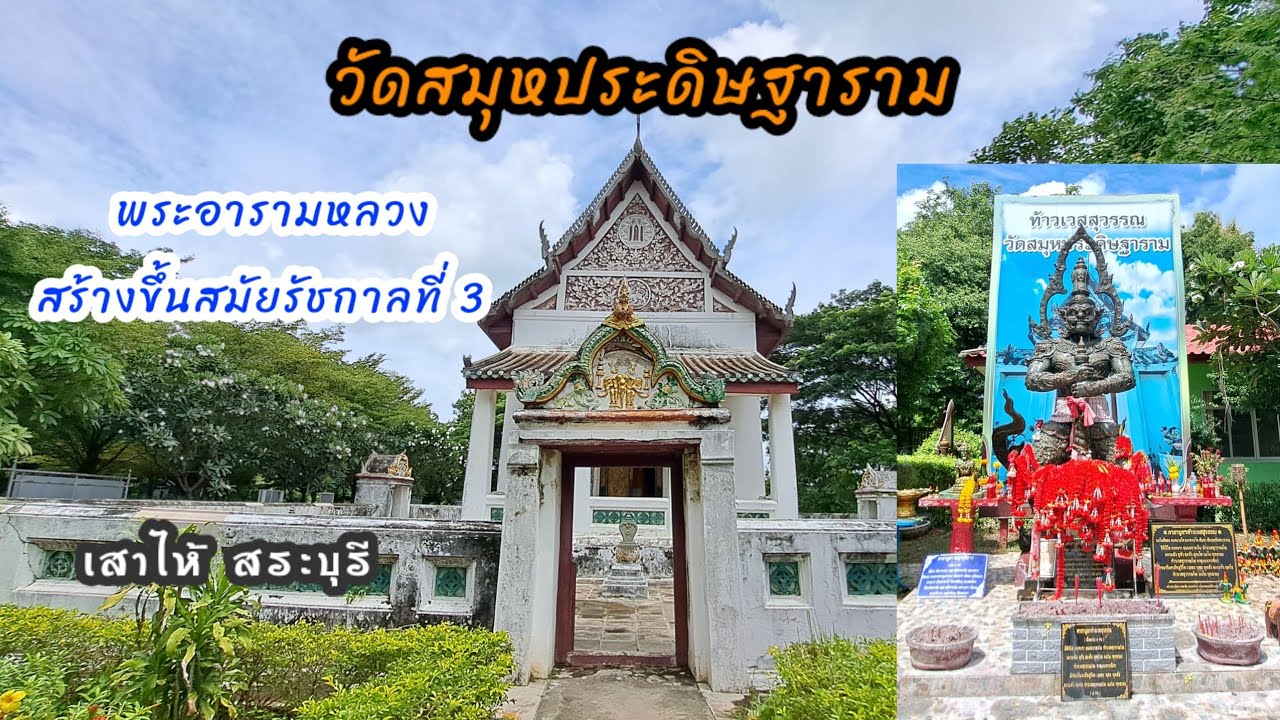
 Click to Access the Navigation Map GPS
Wat Samuha Pradittharam Map
Recommend

 Art, Culture and Heritage
 Historical Sites and Monuments(2)
 Landmarks and Memorials(2)
 Royal Palace(4)
 Art, Craft Centres, Tradition(4)
 Museums(1)
 Educational Places
 Museum for Study(1)
 Educational Gardens, Farm(2)
Temple(8)
Educational Gardens, Farm(2)
Temple(8)
 Other Sacred Sites(6)
 Research and Development
 Royal Project(1)
 Suburban Living
 Village, Community(3)
 Nature and Wildlife
 National Parks and Marine Reserves(3)
 Mountain (Doi)(3)
 Waterfalls(5)
 Caves(6)
 Flower Field(1)
 River, Canal(1)
 Bays and Beaches(1)
 Other natural attractions(2)
 Entertainment and Agricultural
 Zoos and Aquariums(1)
 Animal camps and shows(1)
 Farms, Parks and Ecotourism(8)
 Outdoor and Adventure Activities(1)
 Travel Articles, Recipes
 Travel Review, Food Review(1)


