
lovethailand home >Central Travel Attractions >Saraburi Travel Attractions >Muang Saraburi >Dao Rueang > Ban Khao Kaeo
TL;DR: Ban Khao Kaeo is located at Ton Tan Subdistrict, Sao Hai District, Saraburi, open Daily, hours 08:30 – 16:30.
Ban Khao Kaeo
Open Days: Daily
Opening Hours: 08:30 – 16:30
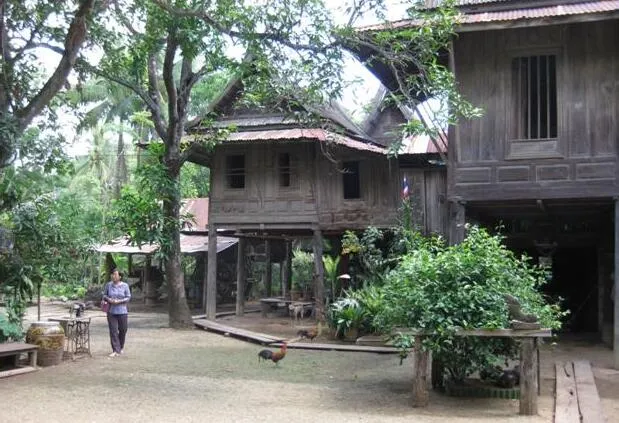
Baan Khao Kaeo in Saraburi is one of the most meaningful places to visit for anyone who wants to understand the roots of Tai Yuan culture in the Pa Sak River basin. It is not simply an old traditional wooden Thai house. It is also a cultural learning center that preserves the memory, craftsmanship, and way of life of the Tai Yuan community in Saraburi. The house is around 80-100 years old and has been developed into the “Tai Yuan Folk Cultural Study Center” by Ajarn Songchai Wannakun, who has devoted himself to preserving local heritage for future generations.
The first charm of Baan Khao Kaeo lies in the house itself. The old wooden Thai structure creates a warm, peaceful, and deeply traditional atmosphere. As soon as visitors enter the grounds, they can feel the calm character of the place through the trees, the breeze, and the riverside setting. This makes the site much more than an exhibition area. It feels like stepping back into the living environment of an older Thai community rather than entering a formal museum.
The importance of Baan Khao Kaeo goes far beyond the age of the building. Its real value lies in its role as a center for learning about Tai Yuan culture. The Tai Yuan are an ethnic group with roots in Chiang Saen in northern Thailand, and their descendants settled in the Pa Sak River area around 200 years ago. Over time, the Tai Yuan community in Saraburi has managed to preserve many important elements of its identity, including speech, dress, food, textiles, customs, and daily practices. Baan Khao Kaeo serves as a bridge between that living heritage and modern visitors.
Inside the house, visitors will find a rich collection of folk objects, including containers, weapons, farming tools, household utensils, and items related to traditional livelihoods. These displays are valuable because they reveal how earlier generations actually lived, worked, cooked, stored their belongings, and used local resources. Seeing the objects in an old Thai house rather than in an abstract display gives the experience more depth and emotional realism.
One of the strongest highlights of the center is its collection of ancient textiles, many of which are more than a century old. These include muk yok dok fabric, khit-pattern cloth, and chok weaving, all of which are closely associated with Tai Yuan artistic traditions. Each piece reflects extraordinary patience, skill, and aesthetic sophistication. These textiles are not important merely because they are old. They are cultural evidence that reveals identity, social meaning, inherited knowledge, and the refined textile traditions of Tai Yuan women in the past.
Viewing these textiles within the context of a traditional wooden house makes the experience especially complete. The fabrics are not separated from life. Instead, they are presented as part of the household world in which they once belonged. This helps visitors understand that weaving was not only a decorative craft. It was part of family life, community identity, and cultural continuity. In this sense, Baan Khao Kaeo is much more than a house full of old objects. It is a place where architecture, textiles, tools, and memory all work together.
Ajarn Songchai Wannakun, the owner and caretaker of the house, plays a central role in preserving and sharing Tai Yuan heritage in Saraburi. His work is not limited to collecting antiques or maintaining an old house for visual appeal. Instead, he has created a meaningful learning space where people can experience the value of local heritage directly. Baan Khao Kaeo therefore reflects not only love for Thai architecture, but also deep commitment to community knowledge and cultural transmission.
The atmosphere around the house is another reason it stands out. Located near the Pa Sak River and close to Wat Khao Kaeo Worawihan, the site offers a gentle and restful environment. Large trees, riverside light, and the texture of aged wood all combine to create a soft and reflective mood. Many visitors find that the place invites them to slow down, observe details, and appreciate the quiet beauty of a traditional cultural landscape.
As a travel destination, Baan Khao Kaeo is especially suitable for cultural tourism. Visitors can spend time studying the house, the antique textiles, the folk tools, and the Tai Yuan way of life, then continue their journey to nearby cultural landmarks such as Wat Khao Kaeo Worawihan, Ban Ton Tan Floating Market, or local weaving centers in the surrounding area. This makes the site a strong anchor point for a full cultural route in Sao Hai District.
For photography lovers, Baan Khao Kaeo also offers a distinct visual atmosphere. The wooden house, old woven fabrics, traditional objects, and green riverside setting produce images that feel authentically Thai without being artificial. Still, the real value of the site is not in its photogenic quality alone. Its deeper appeal lies in the stories embedded in every part of the place: the story of a house, a people, a river community, and a cultural identity carefully preserved over time.
In practical terms, Baan Khao Kaeo is located in Ton Tan Subdistrict, Sao Hai District, Saraburi Province, in the same general area as several important cultural attractions. Travelers coming from Bangkok can follow the Phahonyothin route into Saraburi, then continue toward the Pa Sak River and Wat Khao Kaeo Worawihan. The house lies nearby and is easiest to visit by private car, making it well suited to a one-day cultural trip.
Getting There from Saraburi town is straightforward. Visitors can travel toward Sao Hai District, cross into the local road network toward Ban Pak Bang and Wat Khao Kaeo Worawihan, and continue to the Tai Yuan cultural house area. Digital map searches for “Baan Khao Kaeo,” “Thai Yuan Folk Cultural Center Saraburi,” or similar location names usually help guide travelers accurately.
Overall, Baan Khao Kaeo is far more than a beautiful old Thai house. It is a living cultural learning space that helps preserve the identity of the Tai Yuan community in Saraburi. It is peaceful, visually memorable, and intellectually rewarding at the same time. For travelers looking for a Saraburi destination with depth, atmosphere, and real cultural meaning, Baan Khao Kaeo is one of the most worthwhile places to visit.
| Name | Baan Khao Kaeo / Thai Yuan Folk Cultural Center, Saraburi |
| Location | Ton Tan Subdistrict, Sao Hai District, Saraburi |
| Address | Ton Tan Subdistrict, Sao Hai District, Saraburi 18160 |
| Highlights | An 80-100-year-old traditional Thai wooden house displaying Tai Yuan culture, antique textiles, folk tools, and a peaceful riverside atmosphere |
| History | Created as a cultural learning space by Ajarn Songchai Wannakun to preserve the heritage of the Tai Yuan community of Saraburi, whose roots in the Pa Sak basin go back around 200 years |
| Distinctive Features | Traditional Thai wooden architecture, ancient textiles such as muk yok dok, khit, and chok weaving, plus folk objects and household tools presented in a lived cultural setting |
| Travel Information | Reachable by car from Saraburi via the local road toward Ban Pak Bang and Wat Khao Kaeo Worawihan in Sao Hai District |
| Current Status | Open for visits and cultural learning |
| Open Days | Daily |
| Opening Hours | 08:30 – 16:30 |
| Facilities | Traditional house viewing area, cultural display space, activity yard, and shaded relaxation areas |
| Main Areas / Zones | Main house, smaller house units, antique textile section, Tai Yuan lifestyle exhibition area, and riverside surroundings |
| Caretaker | Ajarn Songchai Wannakun |
| Main Contact Number | 089-900-6248, 036-725-224 |
| Official Page | Thai Yuan Folk Cultural Center Saraburi |
| Nearby Tourist Attractions | 1) Wat Khao Kaeo Worawihan, about 0 km 2) Ban Ton Tan Weaving Learning Center, about 3 km 3) Ban Ton Tan Floating Market, about 3 km 4) Wat Phayao, about 5 km 5) Benjasutthikhongkha, about 6 km |
| Nearby Restaurants | 1) Lao Vien Cafe, about 5 km, Tel. 088-664-6926 2) Baan Mitmaitri Cafe & Restaurant, about 8 km, Tel. 064-332-4767 3) Eighteen Cafe, about 9 km, Tel. 061-942-9542 4) Cuppe' Café, about 9 km, Tel. 084-141-5541 5) Khaona Café, about 15 km, Tel. 062-795-5500 |
| Nearby Accommodations | 1) Maai Horm Boutique Resort, about 12 km 2) Grand Pruksasiri Saraburi, about 12 km 3) Paplern, about 11 km 4) Chuan Chom The High Resort Saraburi, about 14 km 5) The T Hostel Saraburi, about 15 km |
Frequently Asked Questions (FAQ)
Q: Where is Baan Khao Kaeo located?
A: It is located in Ton Tan Subdistrict, Sao Hai District, Saraburi Province, near Wat Khao Kaeo Worawihan and the Pa Sak River.
Q: Why is Baan Khao Kaeo important?
A: It is an important Tai Yuan cultural learning center that preserves traditional architecture, household objects, old textiles, and the cultural identity of the Tai Yuan community in Saraburi.
Q: What can visitors see inside Baan Khao Kaeo?
A: Visitors can see an old Thai wooden house, antique utensils, weapons, livelihood tools, and traditional textiles such as muk yok dok, khit, and chok woven fabrics.
Q: Who is responsible for the center?
A: The center is associated with Ajarn Songchai Wannakun, who has played a major role in preserving and presenting Tai Yuan heritage in Saraburi.
Q: Is Baan Khao Kaeo suitable for cultural tourism?
A: Yes. It is especially suitable for travelers interested in traditional Thai architecture, ethnic heritage, local weaving, and quiet educational travel.
Q: Should visitors contact the center before visiting?
A: It is recommended, especially for group visits or if you want a more focused cultural tour of the exhibitions.
Tel : 036391100
 Tel : 036391100
Mobile : 0830123133
 Mobile : 0830123133
 Category: ●Suburban Living
 Group: ●Village, Community
Last Update : 3 MonthAgo
 Last Update : 3 MonthAgo
 Click to Access the Navigation Map GPS
 Art, Culture and Heritage
 Historical Sites and Monuments(2)
 Landmarks and Memorials(2)
 Royal Palace(4)
 Art, Craft Centres, Tradition(4)
 Museums(1)
 Educational Places
 Museum for Study(1)
 Educational Gardens, Farm(2)
 Places of Worship
 Temple(8)
 Other Sacred Sites(5)
 Research and Development
 Royal Project(1)
Village, Community(3)
Royal Project(1)
Village, Community(3)
 Nature and Wildlife
 National Parks and Marine Reserves(3)
 Mountain (Doi)(3)
 Waterfalls(5)
 Caves(6)
 Flower Field(1)
 River, Canal(1)
 Bays and Beaches(1)
 Other natural attractions(2)
 Entertainment and Agricultural
 Zoos and Aquariums(1)
 Animal camps and shows(1)
 Farms, Parks and Ecotourism(8)
 Outdoor and Adventure Activities(1)


