
lovethailand home >Central Travel Attractions >Samut Sakhon Travel Attractions >Muang Samut Sakhon >Khok Kham > Khok Kham Mangrove Forest
TL;DR: Khok Kham Mangrove Forest is located at Khok Kham Subdistrict, Mueang Samut Sakhon District, Samut Sakhon, open Daily, hours 09:00 AM - 05:00 PM.
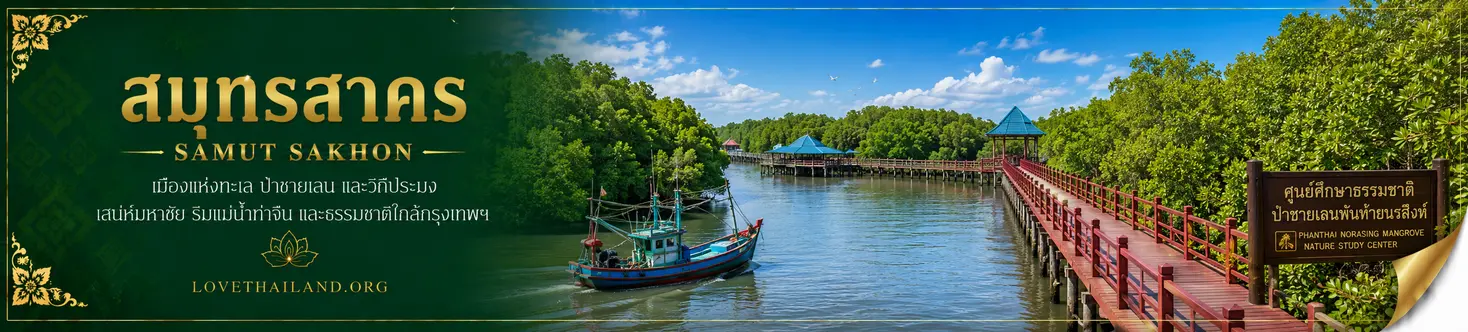
Khok Kham Mangrove Forest
Open Days: Daily
Opening Hours: 09:00 AM - 05:00 PM
Khok Kham Mangrove Forest, Samut Sakhon is one of the most meaningful coastal conservation destinations in Samut Sakhon. It is not simply a mangrove planting site or a nature stop, but a place that shows how coastal communities, environmental agencies, and restoration efforts can work together in a real landscape. Visitors come here to see mangrove forest, wetland scenery, and wooden walkways, but the deeper value of the place lies in its role as a living example of shoreline recovery.
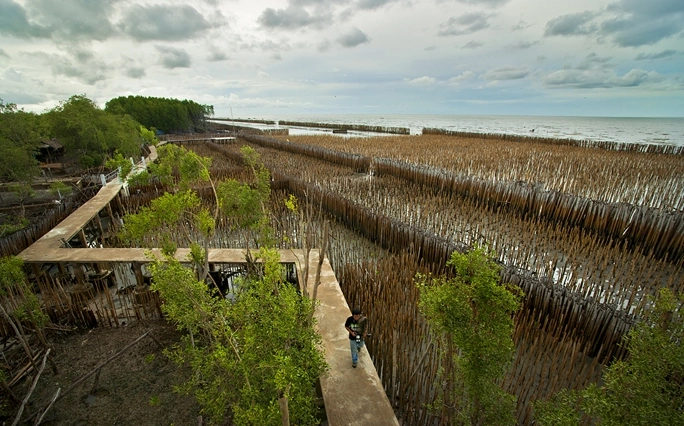
In the clearest sense, Khok Kham is a place where coastal conservation can be seen rather than merely described. The area is known for mangrove planting and for bamboo wave-breaking barriers that were installed to reduce shoreline erosion. As these structures helped slow wave energy, mud sediment gradually accumulated, marine life began to return, and the community gained renewed confidence in protecting its own coast. That is what makes the site far more meaningful than an ordinary sightseeing stop.
One of the strongest features of Khok Kham Mangrove Forest is that it allows visitors to understand shoreline restoration in a practical way. You do not just see trees. You see the wider process of recovery: mangrove planting, coastal erosion control, habitat improvement, and the return of aquatic life. The experience gives travelers a better understanding of how fragile coastal systems are, and how thoughtful intervention can help them recover over time.
Khok Kham has long been important as a coastal community within Mueang Samut Sakhon District. Like many shoreline areas around the inner Gulf of Thailand, it has been shaped by marine resources, local fishing culture, and the challenges of coastal change. When erosion became a serious problem, shoreline protection and restoration naturally became a priority. One of the approaches that gained attention in this area was the use of bamboo barriers to reduce wave impact and support natural sediment build-up.
The success of these bamboo barriers is one of the most interesting aspects of the site. Their purpose is not simply to stand in the water as a physical structure, but to reduce wave force so that mud can settle again. Once sediment begins to accumulate, mangroves have a better chance to establish themselves, and the coastal ecosystem becomes more stable. In Khok Kham, this process has helped create visible signs of improvement, which is why the area is often discussed as an encouraging example of community-supported coastal restoration.
The atmosphere of the site is calm and open. Visitors experience sea breeze, wetland views, mangrove vegetation, and the quiet rhythm of a coastal landscape rather than the noise of a conventional tourist attraction. This makes Khok Kham especially attractive to travelers who enjoy slow travel, environmental destinations, and places with real meaning behind the scenery.
For those interested in environmental topics, Khok Kham is a strong destination because it clearly demonstrates why mangrove forests matter. Mangroves help reduce wave energy, hold sediment in place, support aquatic nurseries, and protect the coastline from further damage. When these ecological roles are viewed together with bamboo wave-breaking structures, visitors gain a fuller picture of how shoreline restoration can combine natural recovery with simple but effective intervention.
The site is also used for mangrove planting activities, which makes it suitable for families, school groups, university teams, and organizations looking for meaningful conservation experiences. Participating in planting helps visitors connect with the area directly. Instead of only observing the landscape, they become part of the restoration story, even in a small way.
Many travelers also know Khok Kham as a place for releasing crabs or aquatic species as part of conservation-related activities. This adds another layer to the destination. It is not just scenic, but participatory. People leave with a stronger sense that coastal restoration is not an abstract issue but something tangible and local.
Another strength of Khok Kham is its accessibility. Because it lies within Mueang Samut Sakhon District, it works very well as a day trip from Bangkok. The area can also be combined with other nearby attractions such as Phanthainorasingh Learning Park, Phanthai Norasing Historical Park, Wat Krok Krak, Mahachai Market, or Tha Chalom community. This makes it possible to build a route that includes nature, history, and seafood in a single day.
Travel Information is especially useful here because the route follows local roads rather than a major tourist corridor. From Samut Sakhon town, take Sahakorn Road, cross the bridge at Wat Sahakorn, continue past the temple, turn right at the junction onto the bridge, go down the bridge and turn left, then turn right again. After that, continue along the road beside Phanthainorasing School for about 3 km and you will reach the mangrove planting area. This route closely matches the actual local approach to the site and is most convenient for travelers using a private car.
Visitors without their own vehicle can first travel into Samut Sakhon and continue with local transport, but in practice a private car remains the easiest option because it gives more flexibility and makes it easier to combine this stop with nearby places. Travelers planning to spend time outdoors should prepare a hat, umbrella, comfortable clothing, and suitable footwear for wetland pathways and coastal ground.
The best time to visit is usually in the morning or late afternoon. The weather is more comfortable, the light is better for photography, and the mangrove and shoreline scenery becomes more visually striking. On clear days, the combination of open sky, coastal breeze, bamboo barriers, and wetland landscape creates a quiet but memorable atmosphere.
What gives Khok Kham Mangrove Forest lasting value is that it represents more than a scenic patch of nature. It shows how a community can respond to erosion, rebuild confidence, and protect its own shoreline with visible results. The returning sediment, recovering mangrove zone, and reappearing aquatic life all help tell that story. For travelers who want a destination with environmental meaning, this is one of the most worthwhile coastal visits in Samut Sakhon.
| Name | Khok Kham Mangrove Forest / Mahachai East Nature and Environmental Restoration Learning Center |
| Location | Khok Kham Subdistrict, Mueang Samut Sakhon District, Samut Sakhon |
| Address | Moo 3, Khok Kham Subdistrict, Mueang Samut Sakhon District, Samut Sakhon 74000 |
| Highlights | Mangrove planting, bamboo wave-breaking barriers, nature walkway, aquatic-release activities, and coastal restoration learning |
| History | A coastal restoration area in Khok Kham where bamboo wave-breaking methods and mangrove planting helped improve sediment build-up and support the return of aquatic life |
| Name Origin | The site is named after Khok Kham, one of the important coastal communities of Mueang Samut Sakhon District |
| Distinctive Features | A conservation destination where visitors can clearly see real shoreline protection and mangrove restoration in action |
| Travel Information | From Samut Sakhon town, take Sahakorn Road, cross the bridge at Wat Sahakorn, pass the temple, turn right at the junction onto the bridge, go down and turn left, then turn right again and continue beside Phanthainorasing School for about 3 km |
| Current Status | Still active as a coastal learning and conservation area in Khok Kham |
| Open Days | Daily |
| Opening Hours | 09:00 AM - 05:00 PM |
| Facilities | Nature walkway, mangrove planting area, crab or aquatic-release area, coastal restoration learning points, and nearby parking areas |
| Main Areas / Zones | Mangrove zone, wooden walkway, planting area, bamboo wave-breaking barrier zone, and aquatic-release points |
| Main Contact Number | +66 34 871 253 |
| Official Website / Official Page | Department of Marine and Coastal Resources, Marine and Coastal Resources Office 8, Samut Sakhon tourism information |
| Nearby Tourist Attractions | 1. Phanthainorasingh Learning Park - approx. 3 km 2. Phanthai Norasing Historical Park - approx. 8 km 3. Wat Krok Krak - approx. 9 km 4. Tha Chalom Community - approx. 10 km 5. Samut Sakhon Aquarium - approx. 11 km |
| Nearby Restaurants | 1. Jeng Krua Chai Talay - approx. 2 km, Tel. 098-795-4563 2. Aoun Song Thai & Resort - approx. 2 km, Tel. 087-031-5924 3. Rak Talay Seafood - approx. 3 km, Tel. 085-256-5296 4. Lomtalay Restaurant - approx. 4 km 5. Krua Chai Talay, Khok Kham - approx. 2 km |
| Nearby Accommodations | 1. Aoun Song Thai & Resort - approx. 2 km, Tel. 087-031-5924 2. Grand Inter Hotel - approx. 12 km 3. Central Place Serviced Apartment - approx. 12 km 4. The Eight - approx. 13 km 5. Accommodations in the Mahachai area - approx. 10 km |
Frequently Asked Questions (FAQ)
Q: What is Khok Kham Mangrove Forest best known for?
A: It is best known as a mangrove planting and coastal restoration site where bamboo wave-breaking barriers helped support sediment build-up and ecological recovery.
Q: What kind of trip is this place suitable for?
A: It is ideal for conservation-focused travel, nature walks, mangrove planting, aquatic-release activities, and educational visits for families or groups.
Q: How do I get there from Samut Sakhon town?
A: Take Sahakorn Road, cross the bridge at Wat Sahakorn, continue past the temple, turn right at the junction onto the bridge, go down and turn left, then turn right again and continue beside Phanthainorasing School for about 3 km.
Q: Is Khok Kham suitable for a day trip?
A: Yes. It is very suitable for a day trip and can easily be combined with several nearby attractions in Samut Sakhon.
Q: Why are bamboo wave-breaking barriers important here?
A: They help reduce wave impact, encourage mud sediment to settle, support mangrove recovery, and improve conditions for aquatic life to return.
Q: When is the best time to visit?
A: Morning and late afternoon are usually the best times because the weather is more comfortable and the coastal scenery is more photogenic.
 Category: ●Nature and Wildlife
 Group: ●Other natural attractions
Last Update : 3 MonthAgo
 Last Update : 3 MonthAgo
 Click to Access the Navigation Map GPS
Khok Kham Mangrove Forest Map
Recommend

 Art, Culture and Heritage
 Historical Sites and Monuments(3)
 Landmarks and Memorials(4)
 Art, Craft Centres, Tradition(2)
 Museums(1)
 Historic Homes and Cities(1)
 Educational Places
 Museum for Study(1)
 Places of Worship
 Temple(31)
 Other Sacred Sites(12)
 Research and Development
 Royal Project(1)
 Suburban Living
 Village, Community(4)
 Local Market(2)
 Floating Market(2)
 National Parks and Marine Reserves(1)
 River, Canal(4)
 Bays and Beaches(1)
Other natural attractions(3)
Bays and Beaches(1)
Other natural attractions(3)
 Entertainment and Agricultural
 Zoos and Aquariums(1)
 Shopping
 Shopping and Night Market(1)


