
lovethailand home >Central Travel Attractions >Samut Sakhon Travel Attractions >Muang Samut Sakhon >Tha Chalom > Chao Mae Buai Nia Shrine
TL;DR: Chao Mae Buai Nia Shrine is located at Tha Chalom Subdistrict, Mueang Samut Sakhon District, Samut Sakhon, along the Tha Chin riverside community near Thawai Road, open Daily, hours 08.00 - 17.00.
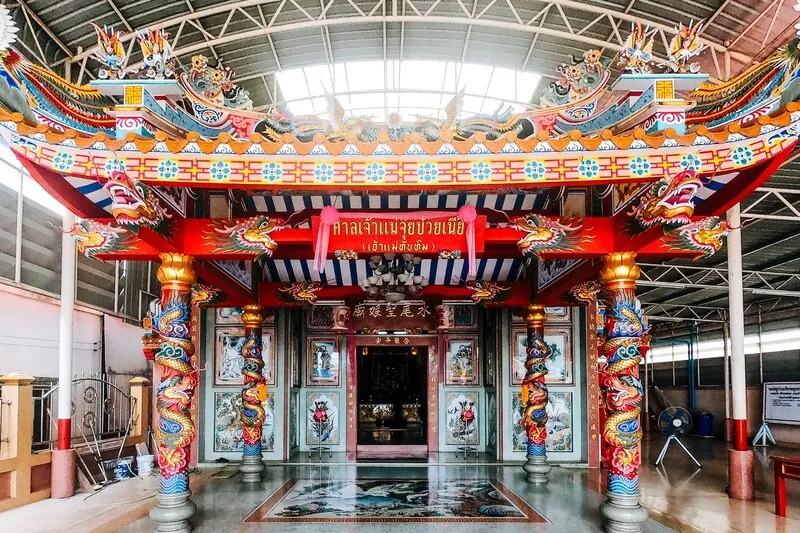
Chao Mae Buai Nia Shrine
Open Days: Daily
Opening Hours: 08.00 - 17.00
Buai Ni Shrine, also widely known as Jao Mae Tubtim Shrine in Tha Chalom, is one of the most meaningful sacred places in Tha Chalom, Samut Sakhon. More than a shrine, it reflects the living relationship between faith, fishing culture, and the long-established Chinese-Thai community along the Tha Chin River. Travelers who want to understand Tha Chalom beyond its photogenic old-town atmosphere will find that this shrine offers a much deeper connection to the area’s identity.
The shrine stands in Tha Chalom Subdistrict, Mueang Samut Sakhon District, in the old riverside community near Thawai Road. Its setting is part of what makes it so memorable. This is not an isolated attraction created only for visitors. It remains an active place of worship where local people continue to come with genuine faith, especially those whose lives are closely tied to the river and the sea.
No clear evidence identifies the exact period when the shrine was first established, yet its importance in local memory is undeniable. The worship of Jao Mae Buai Ni is strongly associated with the Hainanese Chinese community that settled in Tha Chalom. In local belief, the goddess is connected to the sea and to waterside life, and is regarded as a divine protector of those who travel by boat. This is why fishermen and river-based families in Samut Sakhon continue to revere her so deeply.
The name Jao Mae Tubtim comes from the red gemstone decoration associated with the goddess image. Over time, this familiar name became the one most people use when referring to the shrine. It gives the place a warm, recognizable identity while still preserving its deeper Chinese cultural roots. In practical terms, both names point to the same sacred place in Tha Chalom.
One of the shrine’s most distinctive traditions is the firewalking ritual. This is the ceremony that most strongly defines the shrine in the public imagination. It is not treated as an ordinary performance. Instead, it is tied to spiritual belief, mediumship, and warnings of danger that may affect the community, especially water-related accidents. During the ritual, devotees walk across burning coals with the belief that the goddess will protect them and help drive away misfortune.
Because of that, the firewalking ceremony is not only visually striking but also culturally meaningful. It reflects how local spiritual traditions are used to protect the community, restore morale, and reinforce collective belief. In Tha Chalom, such rituals are not abstract symbols. They remain closely connected to real fears, real livelihoods, and the shared emotional world of the people who live there.
The shrine also has an annual procession for the goddess, both on land and on water, linking Tha Chalom with Maha Chai across the river landscape that shaped the province. This annual festival period usually falls in February and is one of the liveliest times to visit. It is when religious devotion, local identity, and communal participation become especially visible throughout the neighborhood.
Another important annual observance is the birthday celebration of the goddess on 26 November. Devotees gather for auspicious ceremonies, invite monks to chant blessings, and hold Chinese opera performances in honor of the shrine’s sacred presence. This shows that the shrine is not active only during one festival season, but remains an important spiritual center throughout the year.
Inside the shrine, visitors will find that the sacred setting includes more than the main goddess alone. Other revered figures are also worshipped there, including Guan Yu, Zhang Fei, and Pun Tao Kong. This gives the shrine the character of a local Chinese sacred complex rather than a single-focus worship hall. It reflects the layered nature of faith in old Tha Chalom, where community devotion developed through overlapping traditions rather than one isolated belief.
For travelers, the shrine is especially rewarding because it sits within the wider historic district of Tha Chalom, the first sanitary district established in provincial Thailand. A visit here can easily be combined with other nearby places such as Rong Chae Cheng Hiang Tua, Pun Tao Kong Shrine, Guan Yu Shrine, Baan Tha Chalom, and Wat Suthiwat Wararam or Wat Chong Lom. This makes the shrine part of a larger cultural walking route rather than a single stop.
As a travel experience, Buai Ni Shrine suits both spiritual visitors and culture-focused travelers. People come here to pray for protection, safe journeys, successful work, and peace of mind, but they also come to understand the historical role of the Hainanese Chinese community and the fishing culture that shaped the old waterfront town. Visiting the shrine therefore offers both emotional resonance and cultural depth.
Getting There is fairly easy. If you are coming by car, head into Tha Chalom via Suthiwat Witthi Road or Thawai Road, then continue on foot through the historic neighborhood. If you prefer public transport, you can cross the river from Maha Chai by ferry and continue walking through the old community. This makes the shrine ideal for a one-day cultural route that combines worship, local history, cafés, and traditional food.
In the end, Buai Ni Shrine or Jao Mae Tubtim Shrine is much more than a sacred stop in Samut Sakhon. It is a living expression of waterfront faith, Chinese-Thai heritage, fishing traditions, and community memory. Anyone who wants to understand Tha Chalom in a more meaningful way should place this shrine high on their list.
| Name | Buai Ni Shrine / Jao Mae Tubtim Shrine, Tha Chalom |
| Location | Tha Chalom Subdistrict, Mueang Samut Sakhon District, Samut Sakhon, along the Tha Chin riverside community near Thawai Road |
| Coordinates | 13.537859, 100.274771 |
| Highlights | A respected Tubtim shrine closely linked to fishermen’s faith, the firewalking ritual, and the annual February procession tradition |
| History | Its exact founding date is unclear, but the shrine has long been associated with the Hainanese Chinese community of Tha Chalom |
| Name Origin | The name “Tubtim” comes from the red gemstone decoration associated with the goddess image, while “Buai Ni” reflects its Chinese cultural origin |
| Distinctive Features | A shrine of the waterside goddess believed to protect seafarers, with important rituals tied to community safety and spiritual protection |
| Travel Information | Accessible by car through the old Tha Chalom area, or by ferry from Maha Chai followed by a short walk through the historic neighborhood |
| Current Status | Still an active and respected local shrine, with annual observances and the February festival season remaining important to the community |
| Main Areas / Sacred Elements | Main image of Jao Mae Buai Ni, firewalking ceremony tradition, goddess procession, and other sacred figures such as Guan Yu, Zhang Fei, and Pun Tao Kong |
| Official Website / Official Page | Local announcements are commonly shared through community and Tha Chalom tourism pages; check the latest notice before visiting |
| Nearby Tourist Attractions | 1) Rong Chae Cheng Hiang Tua – 0.1 km 2) Pun Tao Kong Shrine, Tha Chalom – 0.4 km 3) Guan Yu Shrine, Tha Chalom – 0.5 km 4) Baan Tha Chalom – 0.6 km 5) Wat Suthiwat Wararam (Wat Chong Lom) – 0.9 km |
| Nearby Restaurants | 1) Republic Coffee Tha Chalom Pier – 0.3 km Tel. 088-253-4183 2) Jae Na Tha Chalom – 0.4 km Tel. 085-047-0825 3) Tiew Tha Chalom – 0.7 km Tel. 087-674-6749 4) Jeab Heng Lee (Hia Huat Tha Chalom) – 0.8 km Tel. 034-498-147 5) Krua Chom Ao Tha Chalom – 1.8 km Tel. 085-190-5677 |
| Nearby Accommodations | 1) Baan Ruea Udom Homestay – 0.2 km Tel. 094-326-6261 2) The Seaport Mahachai – 1.8 km Tel. 083-436-5434, 034-836-880-2 3) Kasem Hotel – 2.6 km Tel. 034-441-078 4) Central Place Hotel – 2.8 km Tel. 034-412-818, 085-312-9999 5) The Eight Mahachai – 3.3 km Tel. 092-470-2888 6) Grand Inter Hotel – 4.8 km Tel. 099-949-8889 |
Frequently Asked Questions (FAQ)
Q: Are Buai Ni Shrine and Jao Mae Tubtim Shrine the same place?
A: Yes. They are two commonly used names for the same shrine in Tha Chalom, Samut Sakhon.
Q: Why is the shrine important to local people?
A: The shrine is a major center of faith for local Chinese-Thai residents and fishing families who believe the goddess protects travelers and those whose lives are tied to the water.
Q: Is the firewalking ritual held every year?
A: Firewalking is one of the shrine’s best-known rituals, and the annual festival season of the shrine takes place in February.
Q: When is the best time to visit?
A: February is the most atmospheric period if you want to experience the annual festival mood, while regular days are better for a quieter cultural walk through old Tha Chalom.
Q: What else can I visit nearby?
A: You can continue to Rong Chae Cheng Hiang Tua, Pun Tao Kong Shrine, Guan Yu Shrine, Baan Tha Chalom, and Wat Chong Lom in the same area.
Q: Can I reach the shrine without a car?
A: Yes. You can cross from Maha Chai by ferry and then explore the Tha Chalom old town area on foot.
Tel : 034498182
 Tel : 034498182
 Category: ●Places of Worship
 Group: ●Other Sacred Sites
Last Update : 3 MonthAgo
 Last Update : 3 MonthAgo
 Click to Access the Navigation Map GPS
Chao Mae Buai Nia Shrine Map
Recommend

 Art, Culture and Heritage
 Historical Sites and Monuments(3)
 Landmarks and Memorials(4)
 Art, Craft Centres, Tradition(2)
 Museums(1)
 Historic Homes and Cities(1)
 Educational Places
 Museum for Study(1)
 Temple(31)
Other Sacred Sites(12)
Temple(31)
Other Sacred Sites(12)
 Research and Development
 Royal Project(1)
 Suburban Living
 Village, Community(4)
 Local Market(2)
 Floating Market(2)
 Nature and Wildlife
 National Parks and Marine Reserves(1)
 River, Canal(4)
 Bays and Beaches(1)
 Other natural attractions(3)
 Entertainment and Agricultural
 Zoos and Aquariums(1)
 Shopping
 Shopping and Night Market(1)


