
lovethailand home >Central Travel Attractions >Samut Sakhon Travel Attractions >Muang Samut Sakhon >Tha Chalom > Baan Silasuwan
TL;DR: Baan Silasuwan is located at Tha Chalom Subdistrict, Mueang Samut Sakhon District, Samut Sakhon, open Advance appointment required, hours Subject to permission from the owner.
Baan Silasuwan
Open Days: Advance appointment required
Opening Hours: Subject to permission from the owner
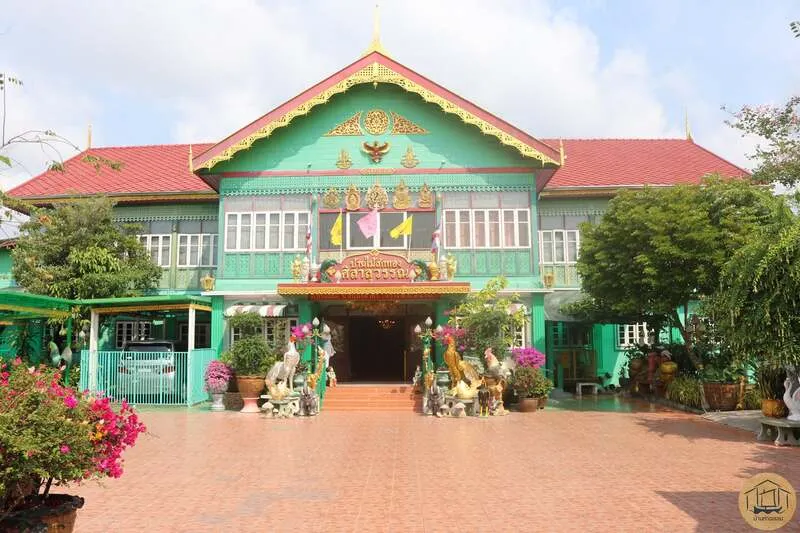
Baan Silasuwan in Samut Sakhon is one of the most distinctive old houses in Tha Chalom and one of the clearest architectural landmarks of the district. Located at 678 Chalom Road in Tha Chalom, Mueang Samut Sakhon District, this two-storey teakwood residence stands out for its refined Thai-applied architecture with strong gingerbread-house influence. Its Manila-style gabled roof, decorative wooden fretwork, ornamental gable crest, bargeboard details, and carved ventilation panels give the house a graceful but highly distinctive character. This makes it much more than an old residence. It is also an important surviving example of local architectural heritage in Tha Chalom.
Seen from the outside, Baan Silasuwan immediately conveys the elegance of an old elite residence. The carved wooden details along the roof edges, gables, and decorative trim create a visual richness that is rare to find in ordinary residential architecture. The fretwork extending along the gable edges and roofline, together with the turned wooden columns and pointed detailing, gives the building the delicacy associated with gingerbread-style houses while still preserving a strong Thai identity. This balance is one of the main reasons the house is remembered as one of the beautiful historic houses of Tha Chalom.
The value of Baan Silasuwan is not limited to its exterior. Inside, the house is divided into 5 rooms: Phalang Chit Prathan Room, Athitthan Barami Room, Bupphakariyan Room, Wiman Khanawon Room, and Phon Sanong Uthai Room. Each room is decorated with antique objects and visually striking interior elements, giving the house a unique atmosphere shaped by art, collected heritage items, and symbolic naming. This makes the interior feel different from a standard heritage house and adds another layer of individuality to the property.
Baan Silasuwan is also meaningful because of its place within Tha Chalom itself. Tha Chalom is one of the most historically important areas in Samut Sakhon, known for its old community, riverside identity, and long-standing urban history. The house therefore does not stand alone as an isolated architectural object. It is part of a broader historic landscape that includes old streets, temples, and traditional community life. Visiting or learning about the house helps deepen the understanding of Tha Chalom as more than a scenic old quarter. It is a place where local history still survives in built form.
Architecturally, the house is especially valuable as an example of a large teakwood residence built in a style associated with the late early-modern period of Thai urban architecture. Public heritage information describes it as reflecting a style popular in the reign of King Rama VI. Its applied Thai form, combined with decorative wooden ornament in the gingerbread manner, makes it an especially important case for anyone interested in old domestic architecture, decorative woodwork, or provincial historic houses.
Another important point is that Baan Silasuwan remains a living house rather than a fully public museum. Public heritage records indicate that the property has been restored and is still occupied. Because of that, visits need to respect the fact that this is a private residence with historical value, not a general walk-in attraction. This is why advance permission from the owner is essential. That condition is not a limitation in a negative sense. It is part of what preserves the dignity and authenticity of the place.
This living quality is part of the house’s charm. Rather than being separated from daily reality, the house continues to exist within the actual life of Tha Chalom. For visitors who appreciate heritage spaces with strong atmosphere, that makes Baan Silasuwan especially memorable. It feels personal, rooted, and connected to its neighborhood in a way that many formal exhibition sites do not.
For travelers interested in architecture, antiques, and community heritage, Baan Silasuwan is a highly attractive destination. The craftsmanship of the wooden structure, the detailed fretwork, the formal gable composition, and the carefully arranged interior spaces all contribute to its identity. Even learning about the house from the outside already reveals why it is considered one of the valuable artistic and architectural places of Tha Chalom.
The house also adds another dimension to travel in Samut Sakhon. Many visitors know the province for seafood, markets, and short trips from Bangkok, but Baan Silasuwan shows that Samut Sakhon also has a rich heritage of old residential architecture and community culture. In that sense, it helps broaden the image of the province beyond its better-known commercial and coastal identity.
The names of the 5 interior rooms are also part of what gives the house its distinctive personality. They suggest not only design intention, but also a deeper emotional and symbolic character within the residence. Together with the antiques displayed inside, these room names make the house feel not merely decorative, but expressive of the worldview and taste associated with its owners and its past.
Baan Silasuwan can also be incorporated into a wider Tha Chalom route. Nearby places such as Thanon Thawai, Wat Laem Suwannaram, Wat Sutthiwat Wararam or Wat Chong Lom, the Tha Chalom Roundabout, and Baan Tha Chalom can all be visited in the same area. This makes the house a valuable stop for travelers who want to experience Tha Chalom through architecture, old-community atmosphere, and local history in a single trip.
Getting There from Bangkok is convenient by private car via Rama II Road toward Samut Sakhon. After passing the main intersection into Samut Sakhon town, continue for about 3 kilometers, cross the Tha Chin River bridge, then turn toward Tha Chalom and continue for roughly another 5 kilometers to reach Baan Silasuwan. Because the house is a private residence with historical significance, visitors should always arrange permission in advance before traveling.
Overall, Baan Silasuwan is one of the most memorable heritage houses in Samut Sakhon. Its two-storey teak construction, gingerbread-style decorative woodwork, and antique-filled interior rooms give it a strong and highly individual character. For anyone who wants to experience Samut Sakhon through old architecture and the historic atmosphere of Tha Chalom, this is one of the most remarkable places associated with the district.
| Name | Baan Silasuwan |
| Location | Tha Chalom Subdistrict, Mueang Samut Sakhon District, Samut Sakhon |
| Address | 678 Chalom Road, Tha Chalom, Mueang Samut Sakhon, Samut Sakhon |
| Coordinates | 13.538199, 100.272117 |
| Highlights | Two-storey teakwood house, Thai-applied gingerbread architecture, fine wooden fretwork, and 5 interior rooms decorated with antiques |
| History | An old teakwood house reflecting an architectural style associated with the reign of King Rama VI and restored in later years |
| Name Origin | Named after the Silasuwan family, associated with the ownership of the house in the Tha Chalom community |
| Distinctive Features | Manila-style gabled roof, decorative fretwork, ornamental gable details, and 5 interior rooms filled with antique objects |
| Travel Information | Travel via Rama II Road toward Samut Sakhon, continue about 3 km past the main town intersection, cross the Tha Chin River bridge, then continue about 5 km into Tha Chalom |
| Current Status | Restored, still occupied, and should be visited only with prior permission |
| Open Days | Advance appointment required |
| Opening Hours | Subject to permission from the owner |
| Main Areas / Zones | Phalang Chit Prathan Room, Athitthan Barami Room, Bupphakariyan Room, Wiman Khanawon Room, and Phon Sanong Uthai Room |
| Official Website / Official Page | Tourism Authority of Thailand, ONEP heritage database |
| Nearby Tourist Attractions | 1) Thanon Thawai – approx. 1 km 2) Wat Laem Suwannaram – approx. 1 km 3) Wat Sutthiwat Wararam (Wat Chong Lom) – approx. 2 km 4) Tha Chalom Roundabout – approx. 2 km 5) Baan Tha Chalom – approx. 2 km |
| Nearby Restaurants | 1) Joke Baan Silasuwan Tha Chalom – approx. 0 km – Tel. 061-006-5144 2) Jae Phrai Rim Khuean Tha Chalom – approx. 2 km – Tel. 086-313-5613 3) Meng Bamee Kiew Mahachai – approx. 4 km – Tel. 088-653-2464 4) The White Oven – approx. 5 km – Tel. 092-916-9191 5) Khrua Khun Toom Mahachai – approx. 5 km – Tel. 084-229-5159 |
| Nearby Accommodations | 1) The Seaport Mahachai – approx. 5 km – Tel. 083-436-5434 2) Orchid Mahachai Hotel – approx. 5 km – Tel. 097-119-4744, 034-425-382 3) At Samut Sakhon Mahachai – approx. 6 km – Tel. 099-095-4541 4) Taweesuk Residence – approx. 7 km – Tel. 092-529-0011 5) Grand Inter Hotel – approx. 9 km – Tel. 099-949-8889 |
Frequently Asked Questions (FAQ)
Q: Where is Baan Silasuwan located?
A: Baan Silasuwan is located at 678 Chalom Road in Tha Chalom, Mueang Samut Sakhon District, Samut Sakhon.
Q: Is Baan Silasuwan open for general walk-in visits?
A: No. Visitors should request permission in advance from the owner before visiting.
Q: What is the main architectural highlight of Baan Silasuwan?
A: It is a two-storey teakwood house in an applied Thai style with strong gingerbread-style decorative woodwork.
Q: What can be seen inside the house?
A: The interior is divided into 5 main rooms, each decorated with antique objects and distinctive interior details.
Q: Who would enjoy visiting or learning about this house?
A: It is especially suitable for people interested in old houses, architecture, wood craftsmanship, art, and the historic atmosphere of Tha Chalom.
Q: What can I visit nearby after Baan Silasuwan?
A: Nearby places include Thanon Thawai, Wat Laem Suwannaram, Wat Chong Lom, the Tha Chalom Roundabout, and Baan Tha Chalom.
 Category: ●Art, Culture and Heritage
 Group: ●Historic Homes and Cities
Last Update : 7 MonthAgo
 Last Update : 7 MonthAgo
 Click to Access the Navigation Map GPS
Baan Silasuwan Map
Recommend

 Historical Sites and Monuments(3)
 Landmarks and Memorials(4)
 Art, Craft Centres, Tradition(2)
 Museums(1)
Historic Homes and Cities(1)
Museums(1)
Historic Homes and Cities(1)
 Educational Places
 Museum for Study(1)
 Places of Worship
 Temple(31)
 Other Sacred Sites(12)
 Research and Development
 Royal Project(1)
 Suburban Living
 Village, Community(4)
 Local Market(2)
 Floating Market(2)
 Nature and Wildlife
 National Parks and Marine Reserves(1)
 River, Canal(4)
 Bays and Beaches(1)
 Other natural attractions(3)
 Entertainment and Agricultural
 Zoos and Aquariums(1)
 Shopping
 Shopping and Night Market(1)
 Travel Articles, Recipes
 Travel Review, Food Review(1)


