
lovethailand home >North Travel Attractions >Lampang Travel Attractions >Mae Tha >Pa Tan > Wat Nakot Luang
TL;DR: Wat Nakot Luang is located at Ban Nakot Phatthana, Village No. 9, Pa Tan Subdistrict, Mae Tha District, Lampang Province, open Daily, hours 08.30 – 16.30.

Wat Nakot Luang
Open Days: Daily
Opening Hours: 08.30 – 16.30
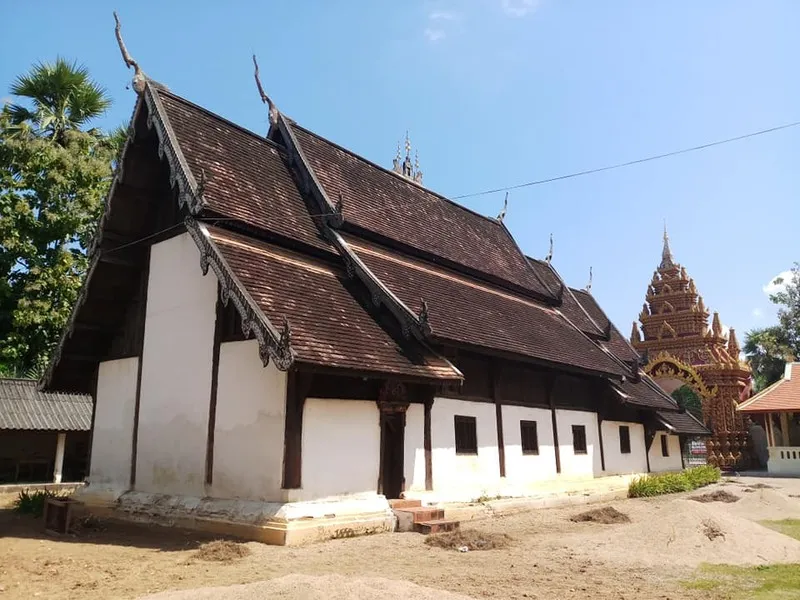
Wat Nakot Luang is located in Ban Nakot Phatthana, Village No. 9, Pa Tan Subdistrict, Mae Tha District, Lampang Province. This historic Buddhist temple is one of the culturally significant temples in northern Thailand, especially for travelers interested in Lanna architecture, Buddhist art, old wooden viharns, local religious traditions, and community-based heritage. The temple was founded by Khruba Nanchai in 1816 and later received its consecrated boundary on September 2, 1937. Its most remarkable features include an old teak viharn built in 1858, a 24-meter-long Phra Bot or painted Buddhist cloth depicting the Vessantara Jataka, and a naturally occurring inverted shadow image of the temple’s stupa.
Wat Nakot Luang is not merely a small local temple. It is a place where history, craftsmanship, religious belief, and community memory come together. Visitors can see how a rural Lanna temple continues to preserve its spiritual role while also functioning as a cultural learning site. The temple is especially suitable for travelers who prefer meaningful cultural experiences rather than crowded tourist stops. Its atmosphere is quiet, modest, and deeply connected to the surrounding village.
The history of Wat Nakot Luang dates back to 1816, when it was established by Khruba Nanchai. During that period, temples in northern Thailand were central to community life. They were not only places for worship, but also centers of education, moral instruction, traditional ceremonies, and local identity. The founding of Wat Nakot Luang therefore reflects the faith and collective effort of the Ban Nakot community to create a permanent Buddhist center for local people.
The temple received its consecrated boundary on September 2, 1937. In Thai Buddhist tradition, this boundary is important because it allows monks to conduct formal monastic ceremonies within the temple grounds. This recognition strengthened the temple’s role as a proper religious institution and confirmed its importance for the Buddhist community of Pa Tan Subdistrict and nearby areas in Mae Tha District.
The viharn of Wat Nakot Luang was built on May 29, 1858. It is a low teakwood viharn built in the Lanna architectural style. The low proportion of the building gives it a calm and grounded appearance, while the gabled roof and decorative elements create a refined northern Thai aesthetic. The use of teak is significant because teak was one of the most important traditional building materials in northern Thailand. It is strong, durable, and well suited to religious architecture.
The roof of the viharn is decorated with sculpted naga-tail forms and colored glass. The gable is adorned with traditional chofa and bai raka ornaments, while the ridge includes decorative castle-like elements and symbolic figures combining a lion-like face with a bird-like body. These details show the imagination and technical skill of Lanna craftsmen. The entrance stairway is decorated with guardian lion figures, including the distinctive singha-na-nang forms, creating a dignified approach to the sacred space inside the viharn.
The wooden viharn is important not only because it is old, but also because it preserves the knowledge of traditional temple construction. Lanna craftsmen used proportion, timber framing, symbolic ornamentation, and religious imagery to create a space that was both functional and sacred. For visitors, the viharn offers a rare opportunity to observe craftsmanship that has survived for more than a century and remains closely tied to local Buddhist practice.
One of the temple’s most valuable cultural treasures is the Phra Bot, also known locally as a painted Buddhist cloth or tung khao. The cloth is 24 meters long and approximately 80 centimeters wide. It depicts the story of the Vessantara Jataka in 13 chapters and 20 scenes, painted with powdered pigments on woven fabric. The original cloth is around 121 years old and has become fragile over time, so a replica has been produced for public study and cultural learning.
The Phra Bot is valuable on several levels. Artistically, it is a rare example of Lanna painting on cloth. Religiously, it illustrates the Vessantara Jataka, one of the most important Buddhist stories about generosity and the perfection of giving. Socially, it connects to the tradition of Mahachat sermons, during which visual storytelling helped listeners understand the narrative while listening to the recitation. In this way, the cloth served as both sacred art and a teaching medium.
The Vessantara Jataka tells the story of Prince Vessantara, who practiced supreme generosity. In northern Thailand, the story has long been associated with merit-making, sermons, community gatherings, and annual Buddhist festivals. When painted onto a long cloth, the narrative becomes visually accessible to people of different ages and levels of literacy. This makes the Phra Bot at Wat Nakot Luang an important cultural document as well as a religious artwork.
The decision to create a replica of the old cloth helps preserve both the physical original and the cultural knowledge attached to it. Instead of allowing the fragile original to deteriorate through repeated handling, the replica allows visitors, students, and local people to study the imagery and the story safely. This conservation approach ensures that the temple’s heritage continues to be shared with future generations.
Another remarkable feature of Wat Nakot Luang is the inverted stupa shadow phenomenon. When light passes through a small opening, an upside-down image of the stupa appears on a cloth inside a monastic building. Scientifically, this effect is similar to the principle of a pinhole camera, where light passing through a small aperture projects an inverted image onto a surface. Culturally, however, the phenomenon is experienced by many visitors as something sacred and deeply impressive.
Lampang is known for several temples where stupa-shadow phenomena can be observed, most famously at Wat Phra That Lampang Luang. The presence of a similar phenomenon at Wat Nakot Luang adds another layer of interest to the temple and makes it part of a wider cultural and spiritual landscape in Lampang. For travelers, it offers a chance to learn about both natural optics and local Buddhist belief in the same place.
Wat Nakot Luang is also significant as a community temple. Local residents have long taken part in temple ceremonies, merit-making events, Buddhist Lent activities, annual religious festivals, and heritage preservation. The temple is therefore not only a historical site but also a living religious space. Its heritage has survived because monks and villagers continue to care for it together.
The temple is associated with the Mahachat sermon tradition, in which the story of the Vessantara Jataka is recited in full. The hanging of the painted Phra Bot during such ceremonies helps listeners follow the story visually. This tradition shows how art, literature, religion, and community participation are woven together in Lanna Buddhist culture.
Visitors should allow at least 45 minutes to 1 hour to explore Wat Nakot Luang properly. A meaningful visit may begin with paying respect inside the viharn, then observing the teakwood structure, roof decorations, guardian lion figures, and other architectural details. After that, visitors can view the replica Phra Bot and learn about the Vessantara Jataka. Those interested in the inverted stupa shadow should ask temple staff or caretakers for appropriate viewing guidance.
Respectful behavior is essential when visiting Wat Nakot Luang. Visitors should dress modestly, keep their voices low, avoid touching old objects without permission, and refrain from using flash photography near fragile artworks. The viharn, Phra Bot, and other temple objects are part of a delicate cultural heritage. Observing them carefully is one of the best ways to support preservation.
Getting There is easiest by private car from Lampang City. Travelers can head toward Mae Tha District, then continue to Pa Tan Subdistrict and Ban Nakot Phatthana. The temple can be included in a half-day or full-day cultural route around Mae Tha District. It can also be combined with nearby attractions such as Wat Phra That Doi Phra Chan, Wat Phra That Lampang Luang, and heritage sites in Lampang City.
Mae Tha District offers a quieter side of Lampang travel. Instead of focusing only on major city attractions, visitors can use Wat Nakot Luang as a starting point for a route that connects village temples, local culture, mountain scenery, and historic Buddhist sites. This kind of route is suitable for travelers who enjoy slow travel, cultural depth, and authentic local settings.
For photography, the temple provides several interesting subjects, including the front of the teak viharn, the roofline, gable ornaments, guardian lion sculptures, the Phra Bot replica, and the peaceful temple grounds. Photography should always be done respectfully, especially inside sacred buildings or near old religious objects.
The real value of Wat Nakot Luang lies in its layered identity. It is a historic temple, a Lanna architectural site, a center of Buddhist teaching, a community heritage space, and a place where natural light creates a memorable inverted stupa image. These elements make it one of the most meaningful temples to visit in Mae Tha District for anyone interested in the cultural depth of Lampang.
In summary, Wat Nakot Luang is a historic temple in Ban Nakot Phatthana, Pa Tan Subdistrict, Mae Tha District, Lampang Province. Founded in 1816, it preserves an old teak Lanna viharn, a remarkable 24-meter Phra Bot depicting the Vessantara Jataka, and an inverted stupa-shadow phenomenon. For travelers interested in Buddhist art, Lanna heritage, local traditions, and peaceful cultural travel, this temple is a worthwhile destination in northern Thailand.
| Name | Wat Nakot Luang |
| Location | Ban Nakot Phatthana, Village No. 9, Pa Tan Subdistrict, Mae Tha District, Lampang Province |
| Highlights | Old teak Lanna viharn, 24-meter Phra Bot painted cloth, and inverted stupa-shadow phenomenon |
| History | Founded by Khruba Nanchai in 1816. The viharn was built on May 29, 1858, and the temple received its consecrated boundary on September 2, 1937 |
| Distinctive Features | Low teakwood Lanna viharn, gabled roof, chofa and bai raka ornaments, colored-glass decoration, guardian lion sculptures, and traditional Lanna craftsmanship |
| Important Objects | Replica Phra Bot showing the Vessantara Jataka in 13 chapters and 20 scenes, the temple stupa, and the inverted stupa-shadow viewing point |
| Traditions / Rituals | Mahachat sermon tradition, hanging of the Phra Bot during ceremonies, community merit-making events, and annual Buddhist activities |
| Travel Information | Best reached by private car from Lampang City toward Mae Tha District, then to Pa Tan Subdistrict and Ban Nakot Phatthana |
| Current Status | Active Buddhist temple and community cultural learning site in Mae Tha District, Lampang Province |
| Open Days | Daily |
| Opening Hours | 08.30 – 16.30 |
| Abbot / Caretaker | Phra Khru Theeratham Phiphat (Phromphiphat) |
| Main Contact Number | 054-331-892 |
| Nearby Tourist Attractions | 1. Wat Phra That Doi Phra Chan, about 13 km 2. Wat Phra That Lampang Luang, about 21 km 3. Wat Lai Hin Luang, about 22 km 4. Kad Kong Ta Walking Street, about 29 km 5. Wat Phra Kaeo Don Tao Suchadaram, about 31 km |
| Nearby Restaurants | 1. Ran Ahan Rot Dang Mae Tha, about 13 km, Tel. 088-261-2461 2. Homdoi Cafe & Homestay, about 14 km 3. Phu Doi Shiitake Mushroom Farm, about 15 km 4. Baan Khot Kat Tong, about 16 km 5. KEPT Horizonline, about 24 km, Tel. 086-428-0223 |
| Nearby Accommodations | 1. Bunnum Homestay, about 13 km 2. Bon Doi Lampang, about 15 km 3. Phorpun Resort Lampang, about 22 km 4. KEPT CABANA, about 24 km, Tel. 063-941-6426, 096-419-8928 5. ABIZZ Hotel, about 25 km, Tel. 054-209-794-5, 097-923-4994 |
Frequently Asked Questions (FAQ)
Q: Where is Wat Nakot Luang located?
A: Wat Nakot Luang is located in Ban Nakot Phatthana, Village No. 9, Pa Tan Subdistrict, Mae Tha District, Lampang Province.
Q: When was Wat Nakot Luang founded?
A: The temple was founded by Khruba Nanchai in 1816 and received its consecrated boundary on September 2, 1937.
Q: What makes the viharn at Wat Nakot Luang special?
A: The viharn is a low teakwood Lanna-style hall built on May 29, 1858, featuring a gabled roof, chofa and bai raka ornaments, colored-glass decoration, and guardian lion sculptures.
Q: Why is the Phra Bot at Wat Nakot Luang important?
A: It depicts the Vessantara Jataka in 13 chapters and 20 scenes. The original cloth is around 121 years old, while a replica is displayed for study and cultural learning.
Q: What is the inverted stupa shadow at Wat Nakot Luang?
A: It is a natural light phenomenon in which light passes through a small opening and projects an upside-down image of the stupa onto a cloth inside a monastic building.
Q: Who is the abbot of Wat Nakot Luang?
A: The listed abbot is Phra Khru Theeratham Phiphat (Phromphiphat).
Q: How can visitors get to Wat Nakot Luang?
A: The most convenient way is by private car from Lampang City toward Mae Tha District, then to Pa Tan Subdistrict and Ban Nakot Phatthana.
 Category: ●Places of Worship
 Group: ●Temple
Last Update : 5 MonthAgo
 Last Update : 5 MonthAgo
 Click to Access the Navigation Map GPS
 Art, Culture and Heritage
 Historical Sites and Monuments(2)
 Landmarks and Memorials(5)
 Art, Craft Centres, Tradition(10)
 Museums(4)
 Historic Homes and Cities(1)
Temple(86)
Historic Homes and Cities(1)
Temple(86)
 Other Sacred Sites(9)
 Research and Development
 Royal Project(2)
 Suburban Living
 Village, Community(3)
 Local Market(2)
 Nature and Wildlife
 National Parks and Marine Reserves(6)
 Mountain (Doi)(4)
 Dam, Reservoir, Lake(11)
 Waterfalls(15)
 Hot Springs(1)
 Caves(12)
 Flower Field(1)
 River, Canal(1)
 Bays and Beaches(1)
 Other natural attractions(4)
 Entertainment and Agricultural
 Animal camps and shows(1)
 Farms, Parks and Ecotourism(2)
 Outdoor and Adventure Activities(2)
 Shopping
 Shopping and Night Market(2)
 Spas and Wellness
 Spas and Wellness(1)
 Travel Articles, Recipes
 Travel Review, Food Review(1)


