
lovethailand home >North Travel Attractions >Lampang Travel Attractions >Mueang Lampang >Wiang Nuea > Wat Pong Sanuk Nuea
TL;DR: Wat Pong Sanuk Nuea is located at Wiang Nuea Subdistrict, Mueang Lampang District, Lampang Province, open Daily, hours 08.00 – 17.00.

Wat Pong Sanuk Nuea
Open Days: Daily
Opening Hours: 08.00 – 17.00
Wat Pong Sanuk Nuea in Lampang Province is one of the most important historic temples in northern Thailand. Located in Wiang Nuea Subdistrict, Mueang Lampang District, the temple is closely associated with the old city of Khelang Nakhon. Local tradition suggests that the temple may have been founded around 680 CE, during the period when Prince Anantayot, the son of Queen Chamadevi of Hariphunchai, came to establish Khelang Nakhon. Although this belief still requires archaeological and historical evidence for confirmation, it clearly reflects the deep connection between Wat Pong Sanuk and Lampang’s long cultural memory.
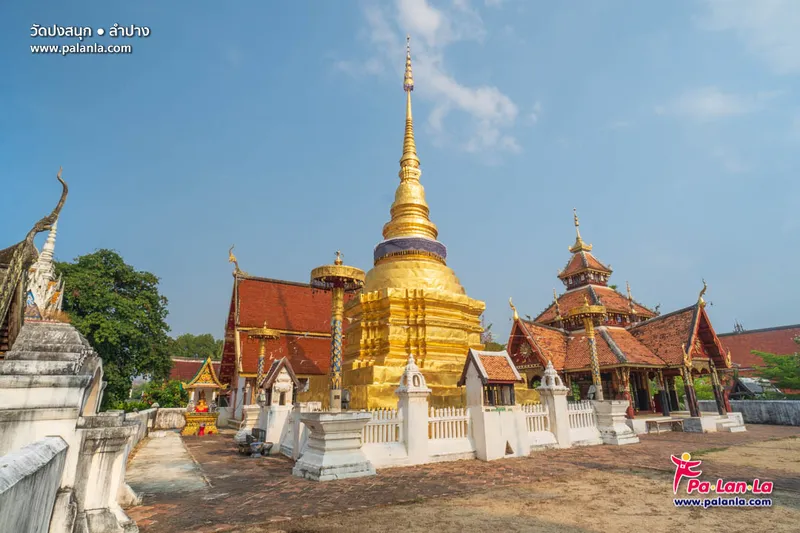
The importance of Wat Pong Sanuk Nuea is not based only on its age or legendary origin. The temple is also remarkable for the large number of historical artworks, architectural structures, and sacred objects preserved within its compound. These include the chedi, the Reclining Buddha Viharn, the Viharn Phra Chao Phan Ong, wooden Buddha images, painted Buddhist banners, ancient scripture chests, and a large white elephant flag from the reign of King Rama VI. Together, these elements make the temple a living archive of Lampang’s religious, artistic, and community history.
The most celebrated structure at the temple is the Viharn Phra Chao Phan Ong, a four-sided open pavilion more than 120 years old. This wooden Lanna-style viharn is admired for its elegant proportions, multi-tiered roof, open layout, and refined craftsmanship. Its design is so significant that it has inspired other important buildings in Thailand, including Ho Kham at Mae Fah Luang Art and Cultural Park in Chiang Rai Province.
Inside the Viharn Phra Chao Phan Ong, numerous Buddha images are enshrined, reflecting the name of the hall and the devotion of the local community. The building is not grand in size, but its beauty lies in its balanced structure, gentle atmosphere, and intricate wooden details. Visitors entering the viharn can immediately sense the calm spiritual character of Lanna Buddhist architecture.
Another major structure is the Reclining Buddha Viharn, which features traditional Lanna architecture. The exterior is decorated with stucco and colored glass, while the interior enshrines a large reclining Buddha image. This viharn is an important worship area for both local residents and visitors, offering a quiet space for prayer and reflection.
Wat Pong Sanuk also includes the Si Chom Klai Chedi, an important sacred structure connected with the religious history of Khelang Nakhon. The chedi serves as a symbol of the continuity of Buddhism in Lampang and remains a central point of worship within the temple compound. Its presence strengthens the temple’s role as a spiritual landmark of the old city.
One of the most fascinating aspects of Wat Pong Sanuk Nuea is the discovery of many sacred and artistic objects within the temple. Wooden Buddha images were found in the attic area above the Viharn Phra Chao Phan Ong, providing important evidence of local devotion and traditional craftsmanship. The temple also preserves painted Buddhist banners depicting the Vessantara Jataka on cloth and mulberry paper, with an estimated age of at least 120 years. These works are valuable not only as religious objects but also as examples of northern Thai visual storytelling and Buddhist teaching.
The ancient scripture chests kept at the temple further reflect its former role as a center of Buddhist learning. Such chests were used to store palm-leaf manuscripts and sacred texts, and their decorative patterns show the respect given to Buddhist scripture. The large white elephant flag from the reign of King Rama VI also adds a historical dimension, linking local religious heritage with broader Thai national history.
Wat Pong Sanuk Nuea is widely recognized as an important example of community-based cultural conservation. The restoration of the Viharn Phra Chao Phan Ong was not simply a repair project; it was a process of reviving collective memory, local pride, and traditional craftsmanship. Monks, villagers, scholars, and supporting organizations worked together to preserve the temple’s original character as much as possible.
Today, the temple is also home to the Wat Pong Sanuk Museum, which displays religious objects, cultural artifacts, and stories related to the temple and its surrounding community. The museum helps visitors understand Wat Pong Sanuk beyond its architecture by presenting objects connected with worship, local customs, craftsmanship, and daily life in historic Lampang.
For travelers, Wat Pong Sanuk Nuea is an excellent destination for those interested in Lanna architecture, old temples, local history, and cultural preservation. The temple is located close to Lampang’s old town and Kad Kong Ta, making it easy to combine with other nearby attractions such as Ratsadaphisek Bridge, Wat Phra Kaew Don Tao Suchadaram, and Ban Sao Nak.
The atmosphere of Wat Pong Sanuk Nuea differs from larger tourist temples. It still feels like a community temple, quiet and deeply connected to local life. The temple grounds are compact enough to explore comfortably, yet rich in details. Visitors who enjoy art and architecture should take time to observe the wooden structures, stucco decorations, religious objects, and museum displays carefully.
For those interested in Lampang’s history, Wat Pong Sanuk offers an important window into the old northern city. Its location in Wiang Nuea places it within a historically significant area of Lampang. Visiting the temple is therefore not only a religious experience but also an opportunity to understand the historical landscape of the city from the Khelang Nakhon period through later eras.
Another interesting feature of the temple is the coexistence of artistic influences from different periods. Some elements reflect traditional Lanna roots, while others show influences from Siamese and Burmese artistic traditions. Certain objects also reflect social changes during later historical periods. This diversity makes Wat Pong Sanuk Nuea more than a single-period monument; it is a layered cultural site that records the evolution of Lampang’s religious and artistic identity.
Visitors should dress respectfully because Wat Pong Sanuk Nuea remains an active Buddhist temple. Photography is generally possible around the temple grounds, but visitors should avoid touching ancient objects and museum displays. Following the guidance of temple caretakers helps preserve these valuable cultural assets for future generations.
Getting There is convenient from Lampang city. Visitors can cross Ratsadaphisek Bridge toward Wiang Nuea and continue along Pong Sanuk Road or Trok Na Soi Lane. The temple is located near Kad Kong Ta and can be reached by private car, local transport, motorcycle taxi, bicycle, or on foot from some parts of the old town.
| Name | Wat Pong Sanuk Nuea |
| Location | Wiang Nuea Subdistrict, Mueang Lampang District, Lampang Province |
| Address | 60 Trok Na Soi Lane, Wiang Nuea Subdistrict, Mueang Lampang District, Lampang 52000 |
| Highlights | Viharn Phra Chao Phan Ong, Reclining Buddha Viharn, Si Chom Klai Chedi, Wat Pong Sanuk Museum, and important historic artifacts |
| History | Traditionally believed to date back to 680 CE during the founding period of Khelang Nakhon, with historical evidence and artistic remains from later periods |
| Distinctive Features | A four-sided open Lanna-style viharn more than 120 years old, admired as an important model of northern Thai wooden architecture |
| Key Evidence | Wooden Buddha images, painted Vessantara Jataka banners, ancient scripture chests, and a large white elephant flag from the reign of King Rama VI |
| Travel Information | From Lampang city, cross Ratsadaphisek Bridge toward Wiang Nuea and continue to Pong Sanuk Road or Trok Na Soi Lane near Kad Kong Ta |
| Current Status | Open for worship, cultural visits, and museum viewing |
| Open Days | Daily |
| Opening Hours | 08.00 – 17.00 |
| Fees | No admission fee |
| Facilities | Worship areas, Wat Pong Sanuk Museum, walking areas, and nearby parking spaces |
| Abbot / Caretaker | Maintained by the temple and local community |
| Main Contact Number | 054-218602, 087-1151095 |
| Nearby Tourist Attractions | 1. Kad Kong Ta Walking Street, about 1 km 2. Ratsadaphisek Bridge, about 1 km 3. Wat Phra Kaew Don Tao Suchadaram, about 2 km 4. Ban Sao Nak, about 2 km 5. Wat Si Rong Mueang, about 3 km |
| Nearby Restaurants | 1. Khao Soi Islam, about 300 m 2. Khanom Jeen Nam Ya Pak Tai Pong Sanuk, about 400 m 3. Papacraft Cafe Kad Kong Ta, about 500 m 4. Wooden House Cafe, about 500 m 5. Long Jim New York Pizza, about 2 km, Tel. 054-010555 |
| Nearby Accommodations | 1. Baan Chiang Guest House Lampang, about 500 m 2. The Riverside Guest House, about 600 m 3. Baan Mae Boonthong, about 600 m 4. Wienglakor Hotel Lampang, about 3 km, Tel. 054-225501 5. The Coconut Hotel Lampang, about 3 km, Tel. 054-821999 |
Frequently Asked Questions (FAQ)
Q: Where is Wat Pong Sanuk Nuea located?
A: It is located at 60 Trok Na Soi Lane, Wiang Nuea Subdistrict, Mueang Lampang District, Lampang Province.
Q: Why is Wat Pong Sanuk Nuea important?
A: It is one of Lampang’s most important historic temples, known for Lanna architecture, the Viharn Phra Chao Phan Ong, and valuable cultural artifacts.
Q: What is special about the Viharn Phra Chao Phan Ong?
A: It is a four-sided open wooden Lanna-style pavilion over 120 years old and is admired as an important model of northern Thai architecture.
Q: What are the opening hours of Wat Pong Sanuk Nuea?
A: The temple is open daily from 08.00 to 17.00.
Q: Is there an entrance fee?
A: No. Visitors can enter the temple and museum free of charge.
Q: What can visitors see inside the temple?
A: Visitors can see the Viharn Phra Chao Phan Ong, Reclining Buddha Viharn, Si Chom Klai Chedi, wooden Buddha images, painted Buddhist banners, ancient scripture chests, and the Wat Pong Sanuk Museum.
Q: What nearby attractions can be visited together with Wat Pong Sanuk Nuea?
A: Nearby attractions include Kad Kong Ta Walking Street, Ratsadaphisek Bridge, Wat Phra Kaew Don Tao Suchadaram, Ban Sao Nak, and Wat Si Rong Mueang.
 Category: ●Places of Worship
 Group: ●Temple
Last Update : 5 MonthAgo
 Last Update : 5 MonthAgo
 Click to Access the Navigation Map GPS
Wat Pong Sanuk Nuea Map
Gellery
Recommend

 Art, Culture and Heritage
 Historical Sites and Monuments(2)
 Landmarks and Memorials(5)
 Art, Craft Centres, Tradition(10)
 Museums(4)
 Historic Homes and Cities(1)
Temple(86)
Historic Homes and Cities(1)
Temple(86)
 Other Sacred Sites(9)
 Research and Development
 Royal Project(2)
 Suburban Living
 Village, Community(3)
 Local Market(2)
 Nature and Wildlife
 National Parks and Marine Reserves(5)
 Mountain (Doi)(4)
 Dam, Reservoir, Lake(11)
 Waterfalls(15)
 Hot Springs(1)
 Caves(12)
 Flower Field(1)
 River, Canal(1)
 Bays and Beaches(1)
 Other natural attractions(4)
 Entertainment and Agricultural
 Animal camps and shows(1)
 Farms, Parks and Ecotourism(2)
 Outdoor and Adventure Activities(2)
 Shopping
 Shopping and Night Market(2)
 Spas and Wellness
 Spas and Wellness(1)


