
lovethailand home >North Travel Attractions >Lampang Travel Attractions >Thoen >Lom Raet > Wat Wiang
TL;DR: Wat Wiang is located at 301 Ban Wiang, Lom Raet Subdistrict, Thoen District, Lampang Province, open Daily, hours 08.00 – 17.00.

Wat Wiang
Open Days: Daily
Opening Hours: 08.00 – 17.00
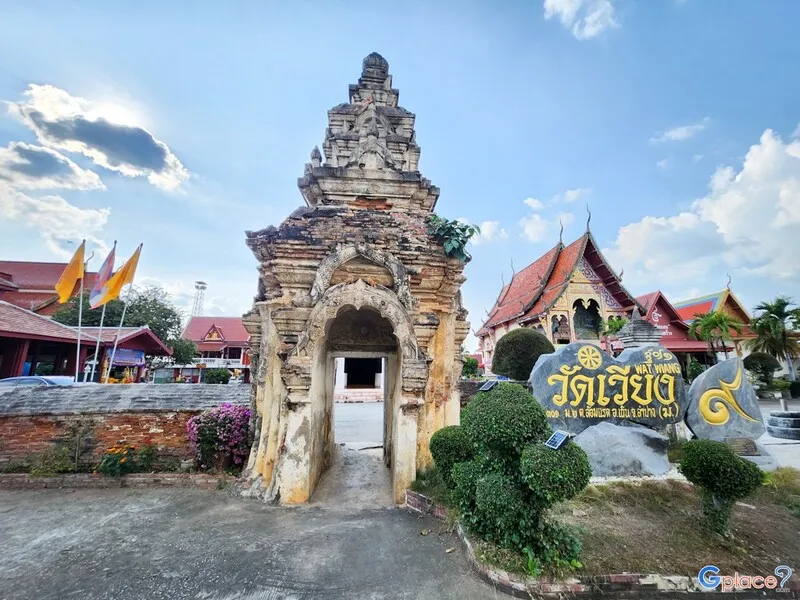
Wat Wiang is located at 301 Ban Wiang, Lom Raet Subdistrict, Thoen District, Lampang Province. This historic Buddhist temple belongs to the Mahanikaya sect and stands in the heart of old Thoen, an ancient frontier town on the western side of the Wang River. The temple is one of the most culturally significant sites in Thoen because it preserves Lanna architectural elements, Chiang Saen-style Buddha images, an old chedi, a traditional viharn, and a distinctive arched gateway known as a sum khong.
Wat Wiang is especially meaningful for travelers interested in the history of Thoen District and the cultural landscape of southern Lampang. Thoen was once an important frontier town, and Wat Wiang reflects that historical role. The temple is not merely a local place of worship; it is part of the memory of the old town, connected to legends, local chronicles, Buddhist restoration, and the artistic traditions of northern Thailand.
The history of Wat Wiang appears in the local chronicle of Thoen. It mentions Khun Luang Sutta, an important figure who preserved his honor by refusing to accept a Burmese military position. He later ordained at Wat Phra That Lampang Luang. His three sons were Khun Muen, Khun Chai, and Novice Athit. Novice Athit became a disciple of Khruba Chao Lampang Nakhon and later rose to become a senior monk. According to local tradition, Khruba Athit played an important role in restoring Wat Wiang.
This story gives Wat Wiang a deeper historical dimension. The temple is connected not only to Buddhist devotion but also to the identity of Thoen as an old fortified town. The restoration associated with Khruba Athit reflects the importance of the temple as a religious and cultural center during a period when Thoen served as a strategic settlement in the region.
The main architectural components of Wat Wiang include the arched gateway, viharn, and chedi. The arched gateway shows strong influence from the gateway of Wat Phra That Lampang Luang, one of the most important Lanna temples in Lampang. The gateway functions both as an entrance and as a symbolic transition from the ordinary world into a sacred Buddhist space.
The viharn of Wat Wiang is a rectangular open hall and is considered an example of an older local viharn style. Inside the viharn is a Buddha shrine that resembles a smaller arched gateway. This shrine enshrines the principal Buddha image and is decorated with refined details. The main pillars of the viharn include eight large columns, each approximately the size of a person’s embrace, decorated with golden patterns on a red background, including kinnari figures, lions, and Thai ornamental motifs.
The Buddha images and chedi at Wat Wiang show Chiang Saen artistic influence. Chiang Saen-style Buddhist art is known for its calm power, balanced form, and deep spiritual expression. When combined with Lanna architectural features such as the sum khong gateway and the traditional viharn, Wat Wiang becomes an important place for observing the artistic identity of northern Thailand.
The chedi is one of the most important sacred structures in the temple. It has long been respected by local people as an old relic monument of Thoen. For visitors, the chedi, viharn, gateway, and Buddha images should be viewed together because each element helps explain the temple’s status as a historic religious site in the old town center.
The location of Wat Wiang is also significant. The temple stands in Ban Wiang, Lom Raet Subdistrict, in the old urban area of Thoen near the Wang River. The river played an important role in local settlement, movement, agriculture, and communication. The temple’s location therefore reflects the relationship between Buddhism, community life, and the geography of the old town.
For travelers passing through Thoen, Wat Wiang offers a meaningful reason to stop and explore the district more slowly. Thoen is often seen as a transit point between central and northern Thailand, but the temple shows that the area has a rich cultural background. A visit to Wat Wiang reveals the historical depth of southern Lampang beyond the better-known attractions in Lampang city.
The atmosphere of Wat Wiang is calm and modest. Its beauty lies not in luxury but in age, proportion, craftsmanship, and historical meaning. The golden designs on red pillars, the Lanna gateway, the old viharn, and the Chiang Saen-style sacred images create a cultural experience that is quiet but highly rewarding for observant visitors.
Travelers interested in Lanna architecture should pay special attention to the sum khong gateway. Its form reflects the influence of Wat Phra That Lampang Luang and represents the symbolic entrance into a sacred area. In Lanna religious architecture, such gateways are more than decorative structures; they mark the spiritual boundary between everyday life and Buddhist devotion.
Inside the viharn, the golden motifs on red backgrounds are another highlight. Kinnari figures symbolize elegance and celestial beauty, while lions represent strength, guardianship, and sacred protection. These decorative elements help create an atmosphere of dignity and devotion within the worship space.
Wat Wiang remains an active community temple. Local residents continue to make merit, attend ceremonies, and use the temple as a spiritual center. At the same time, the temple also serves as a cultural learning site for those interested in the history of Thoen and the artistic heritage of Lampang Province.
Getting There is convenient by private car. Travelers can enter Thoen District, continue toward Lom Raet Subdistrict and Ban Wiang, and reach the temple within the community area. Because the temple is located in central Thoen, it is suitable for a short cultural stop during a longer journey through Lampang or as part of a southern Lampang travel route.
Visitors should allow at least 30–60 minutes to pay respect, walk around the temple, and observe the architectural details. Those interested in history may benefit from learning about old Thoen before visiting, as this helps explain why Wat Wiang is considered an important temple of the old town.
When visiting, travelers should dress respectfully, keep quiet, avoid climbing on old structures, and avoid touching ancient architectural details unnecessarily. Respectful behavior helps preserve the temple’s heritage while supporting its role as an active Buddhist place of worship.
Overall, Wat Wiang is one of the most worthwhile cultural stops in Thoen District. With its connection to the Thoen chronicle, Khun Luang Sutta, Khruba Athit, Chiang Saen-style Buddhist art, Lanna gateway, old viharn, and sacred chedi, the temple offers a rich experience for Buddhist visitors, cultural travelers, and anyone seeking a deeper understanding of Lampang’s historic landscape.
| Name | Wat Wiang |
| Location | 301 Ban Wiang, Lom Raet Subdistrict, Thoen District, Lampang Province |
| Temple Type | Buddhist Temple, Mahanikaya Sect |
| Highlights | Lanna arched gateway, traditional viharn, old chedi, Chiang Saen-style Buddha images, and golden motifs on red pillars |
| History | Connected to the chronicle of Thoen, Khun Luang Sutta, and Khruba Athit, who is associated with the restoration of the temple |
| Distinctive Features | Important temple in the old center of Thoen, a historic frontier town on the Wang River |
| Travel Information | Accessible by private car via Thoen District, Lom Raet Subdistrict, and Ban Wiang community area |
| Current Status | Active community temple and important historic site in Thoen District |
| Open Days | Daily |
| Opening Hours | 08.00 – 17.00 |
| Facilities | Merit-making area, temple courtyard, resting area, and community parking space |
| Abbot / Caretaker | Phra Khru Chantha Thammawat |
| Nearby Tourist Attractions | 1. Thoen Market, about 1 km 2. Wang River Area in Thoen, about 1 km 3. Wat Phra That Doi Noi, about 11 km 4. Mae Wa National Park, about 35 km 5. Mae Wa Waterfall, about 37 km |
| Nearby Restaurants | 1. Ko Daeng Restaurant, about 1 km 2. Krua 1994, about 1 km 3. Krua Si Moi, about 2 km 4. Phuak Rao Restaurant, about 2 km 5. Kukki Seafood, about 2 km |
| Nearby Accommodations | 1. Thoen 5 Star Rooms / Hotel, about 3 km, Tel. 098-631-3383 2. Doi Daeng Resort, about 4 km, Tel. 098-749-0047 3. Thoen Park Resort, about 3 km 4. Guesthouses around Thoen Market, about 1 km 5. Highway-side Accommodations in Thoen, about 3 km |
Frequently Asked Questions (FAQ)
Q: Where is Wat Wiang located?
A: Wat Wiang is located at 301 Ban Wiang, Lom Raet Subdistrict, Thoen District, Lampang Province.
Q: Why is Wat Wiang important?
A: Wat Wiang is an important temple in the old center of Thoen, connected to local chronicles and preserving Lanna architecture, an old chedi, and Chiang Saen-style Buddha images.
Q: What can visitors see at Wat Wiang?
A: Visitors can see the Lanna arched gateway, old viharn, chedi, Chiang Saen-style Buddha images, and golden motifs on red pillars inside the viharn.
Q: Who is Wat Wiang connected to in local history?
A: The temple is connected to the story of Khun Luang Sutta and Khruba Athit, who is associated with the restoration of the temple.
Q: What type of travelers should visit Wat Wiang?
A: It is suitable for Buddhist visitors, cultural travelers, history enthusiasts, and those interested in Lanna architecture and old towns in Lampang.
Q: What nearby places can be visited with Wat Wiang?
A: Nearby places include Thoen Market, the Wang River area, Wat Phra That Doi Noi, Mae Wa National Park, and Mae Wa Waterfall.
 Category: ●Places of Worship
 Group: ●Temple
Last Update : 5 MonthAgo
 Last Update : 5 MonthAgo
 Click to Access the Navigation Map GPS
 Art, Culture and Heritage
 Historical Sites and Monuments(2)
 Landmarks and Memorials(5)
 Art, Craft Centres, Tradition(10)
 Museums(4)
 Historic Homes and Cities(1)
Temple(86)
Historic Homes and Cities(1)
Temple(86)
 Other Sacred Sites(9)
 Research and Development
 Royal Project(2)
 Suburban Living
 Village, Community(3)
 Local Market(2)
 Nature and Wildlife
 National Parks and Marine Reserves(6)
 Mountain (Doi)(4)
 Dam, Reservoir, Lake(11)
 Waterfalls(15)
 Hot Springs(1)
 Caves(12)
 Flower Field(1)
 River, Canal(1)
 Bays and Beaches(1)
 Other natural attractions(4)
 Entertainment and Agricultural
 Animal camps and shows(1)
 Farms, Parks and Ecotourism(2)
 Outdoor and Adventure Activities(2)
 Shopping
 Shopping and Night Market(2)
 Spas and Wellness
 Spas and Wellness(1)
 Travel Articles, Recipes
 Travel Review, Food Review(1)


