
lovethailand home >North Travel Attractions >Lampang Travel Attractions >Wang Nuea >Wang Tai > Sra Cave
TL;DR: Sra Cave is located at Ban Phai Klang, Sop Pat Subdistrict, Mae Mo District, Lampang Province, open Daily, hours 09:00–17:00 (Recommended daytime access hours for the area).

Sra Cave
Open Days: Daily
Opening Hours: 09:00–17:00 (Recommended daytime access hours for the area)
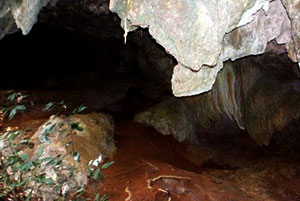
Tham Sa Cave in Lampang, also locally known as Tham Sa or Tham Sa (Sa-Ra) of Ban Phai Klang, is a natural cave in Sop Pat Subdistrict, Mae Mo District, Lampang Province. It is known for its hidden entrance, narrow access passage, beautiful inner chamber, and a discovery story closely tied to local village life. The cave entrance is a small opening of about 80 cm in diameter. Visitors descend roughly 3 meters, then crawl through another narrow passage of about 2 meters before reaching an inner hall. Inside, the cave reveals a striking chamber where rock surfaces sparkle when touched by flashlight beams, creating a vivid sense of discovery and making Tham Sa one of the more unusual local cave attractions in Mae Mo.
Tham Sa Cave was reportedly discovered in February 2006 by villagers who entered the area to collect bat guano for use as a natural substitute for chemical fertilizer. This origin story shows the close relationship between local people and the natural landscape around their village. Before the cave was discussed as a travel destination, the cave and surrounding forest were part of everyday local resource use. Villagers knew the land, walked through hills and forest routes, and used natural materials with practical knowledge passed through the community.
The charm of Tham Sa Cave begins before reaching the chamber. Unlike many caves where visitors can simply walk inside, Tham Sa requires careful movement through a small opening and a narrow crawl space. This sequence creates a strong feeling of entering a hidden world. The contrast between the tiny entrance and the beautiful inner hall makes the experience memorable. The cave feels as if nature has hidden a remarkable chamber behind a small doorway that only careful and prepared visitors can pass through.
The most memorable feature inside Tham Sa Cave is the sparkling rock surface. When a flashlight or headlamp shines on the cave wall, some stone surfaces reflect light in tiny shimmering points. This visual effect gives the cave its special character and explains why it has been described by local visitors as a cave with glowing or glittering rocks. The beauty should be observed carefully and respectfully. Visitors should not touch, scratch, or remove rocks because the cave surface is part of a fragile natural formation.
Tham Sa Cave should be visited with safety and conservation in mind. Natural caves are humid, dark, and physically demanding. The cave entrance is narrow, and movement requires crawling through a confined passage. Visitors with breathing problems, claustrophobia, dizziness, mobility limitations, or serious health conditions should avoid entering the cave. A visit is best done in a small group with a local guide or someone familiar with the area. Entering alone is unsafe.
The early story that visitors once hesitated to tell others about the cave, out of concern that government forest authorities might later restrict access, reflects the complex relationship between conservation, tourism, and local community management. For local people, a cave is not only a scenic site but also a nearby natural resource connected to daily life, identity, and community memory. Tham Sa therefore represents more than a beautiful cave; it is also a place where questions of protection, access, and local stewardship come together.
Ban Phai Klang and Sop Pat Subdistrict are part of Mae Mo District, an area with hills, forests, streams, caves, and community-based nature sites. Tham Sa Cave fits naturally into this landscape, along with nearby attractions such as Tham Pha Khok, Tham Pha Ngoen, Tham Taew, Tat Moei Waterfall, Pha Hob, and Mae Kham Dam. This part of Lampang is quieter than the main city tourism route and is better suited to travelers who appreciate rural landscapes, caves, cliffs, waterways, and local guidance.
Because of its narrow entrance and natural condition, Tham Sa Cave is not suitable for casual sightseeing by all visitors. It is better for travelers who already enjoy cave exploration and can move carefully in tight spaces. Clothing should be practical, easy to move in, and suitable for dust or dirt. Closed shoes with good grip are necessary. A headlamp is better than relying only on a mobile phone light. Spare batteries and a compact flashlight are also useful because losing light inside a cave creates immediate risk.
Photographers may find Tham Sa Cave especially interesting because of the glittering rock surface and the dramatic contrast between darkness and reflected light. Photography, however, must be done responsibly. Strong flash should not be used repeatedly near bats or wildlife. Tripods should not block the crawl path. Visitors should not climb on rock formations to create unusual angles. The best cave photography comes from patience, careful light control, and respect for the cave environment.
Bats are an important part of cave ecosystems. They help control insects, contribute to nutrient cycles, and their guano supports small cave organisms. The fact that villagers once collected bat guano for fertilizer shows how cave ecology and local livelihoods are connected. Visitors should avoid disturbing bats, keep noise low, and never shine light directly at them for long periods. A cave is a habitat, not just a tourist backdrop.
Getting There is most practical by private car. Travel toward Mae Mo District in Lampang Province, then continue to Sop Pat Subdistrict and Ban Phai Klang. The final section may involve local or natural access roads. Travelers should contact Sop Pat Subdistrict Administrative Organization or ask local residents before entering the cave area. Road and access conditions can change, especially during or after rain. A first-time visit should not be made without local direction.
Recommended access time for the area is 09:00–17:00, and visitors should plan to enter only during daylight hours. Morning or early afternoon is the safest period because it allows time to check the route, explore carefully, and leave the area before dark. Late-day visits, rainy weather, and post-rain conditions increase the risk of slippery paths, poor visibility, and difficulty exiting safely.
Tham Sa Cave works well as part of a nature route in Sop Pat Subdistrict. Travelers can combine it with Tham Pha Khok, Tham Pha Ngoen, Tham Taew, Tat Moei Waterfall, Pha Hob, and Mae Kham Dam, depending on time, road conditions, and local advice. The route gives a broader picture of Mae Mo’s natural landscape, including caves, cliffs, streams, and village surroundings. A full-day plan is better than a rushed itinerary.
Before visiting, travelers should contact the local authority or local residents for updated information. Tham Sa Cave is not a fully developed tourist site with extensive facilities, signs, lighting, or formal guiding services. Local information helps reduce the risk of taking the wrong route, entering at an unsuitable time, or underestimating the physical demands of the cave. The safest visit is one planned with local knowledge.
The value of Tham Sa Cave is not only its beautiful inner chamber. It also lies in its discovery story: villagers collecting bat guano, the excitement of finding a small entrance leading to a hidden hall, the sparkling rocks, and the community’s concern about how the cave should be protected. These details give the cave a living story and make it meaningful as a local natural attraction rather than just a scenic underground space.
If Tham Sa Cave is developed further as a community attraction, low-impact management is the most suitable approach. Visitor numbers should be controlled, safety guidance should be clear, and local people should play a central role in caring for the cave. The cave’s appeal comes from its natural condition and sense of discovery. Overdevelopment could reduce the very qualities that make it special.
In summary, Tham Sa Cave in Lampang is a distinctive natural cave in Ban Phai Klang, Sop Pat Subdistrict, Mae Mo District. Its key features are a small 80 cm entrance, a narrow crawl passage, a beautiful inner chamber, shimmering rock surfaces, and a discovery story connected to villagers collecting bat guano. Visitors should travel by private car, contact local authorities before entering, visit only during daylight hours within the recommended 09:00–17:00 access period, and treat the cave as a fragile natural site that requires respect and careful movement.
| Name | Tham Sa Cave / Tham Sa (Sa-Ra) |
| Location | Ban Phai Klang, Sop Pat Subdistrict, Mae Mo District, Lampang Province |
| Address | Sop Pat Subdistrict, Mae Mo District, Lampang Province 52220, Thailand |
| Highlights | A small cave entrance of about 80 cm, a narrow crawl passage, and a beautiful inner chamber with sparkling rock surfaces |
| History | Discovered around February 2006 by villagers collecting bat guano for use as natural fertilizer |
| Distinctive Features | A narrow cave entrance, hidden chamber, shimmering rock walls, and a strong local discovery story |
| Travel Information | Private car is the most practical option. Travel to Mae Mo District, continue to Sop Pat Subdistrict and Ban Phai Klang, then confirm the final access route with local residents or the local authority. |
| Current Status | A local natural attraction in Sop Pat Subdistrict, Mae Mo District, Lampang Province |
| Open Days | Daily |
| Opening Hours | 09:00–17:00 (Recommended daytime access hours for the area) |
| Caretaker / Local Contact Office | Sop Pat Subdistrict Administrative Organization |
| Main Contact Number | 0-5401-9714 |
| Nearby Tourist Attractions | 1. Tham Pha Khok, Ban Phai Klang – 2 km 2. Tham Pha Ngoen, Ban Phai Klang – 3 km 3. Tham Taew, Ban Phai Klang – 4 km 4. Tat Moei Waterfall / Pha Khok Waterfall – 5 km 5. Pha Hob, Mae Mo – 12 km 6. Mae Kham Dam – 18 km |
| Nearby Restaurants | 1. Mae Moh Eatery – 16 km Tel. 054-254-365 2. Coffee Synergy Space – 16 km 3. Kuai Tiao Khao Soi Pa Mai – 17 km 4. Khrua Salawin Mae Mo – 17 km 5. The Blocks – 18 km 6. Tiao Lop Mum @ Mae Mo – 18 km 7. Grandfa Farm-Cafe’&Restaurant – 45 km Tel. 086-658-2739 |
| Nearby Accommodations | 1. Huen Mae Moh – 18 km Tel. 090-656-6056, 089-261-2856 2. Mae Moh Lampang Homestay – 19 km Tel. 063-449-1926 3. Inthanin House Mae Mo – 20 km Tel. 054-340-229, 080-857-3471, 086-728-5320, 092-278-4199 4. Ploy Pae Guesthouse – 20 km Tel. 081-032-5485 5. Bang Rak Resort Mae Mo – 21 km Tel. 085-723-3735 6. U Kaew Resort – 22 km Tel. 086-069-6918 |
Frequently Asked Questions (FAQ)
Q: Where is Tham Sa Cave located?
A: Tham Sa Cave is located in Ban Phai Klang, Sop Pat Subdistrict, Mae Mo District, Lampang Province.
Q: What makes Tham Sa Cave special?
A: The cave has a very small entrance of about 80 cm, a narrow crawl passage, and an inner chamber with shimmering rock surfaces.
Q: When was Tham Sa Cave discovered?
A: Tham Sa Cave was reportedly discovered around February 2006 by villagers collecting bat guano for use as natural fertilizer.
Q: What are the recommended access hours for Tham Sa Cave?
A: The recommended access hours are 09:00–17:00, and visitors should enter only during daylight hours.
Q: Is Tham Sa Cave suitable for children or elderly travelers?
A: It is not suitable for young children, elderly travelers with mobility difficulties, or anyone uncomfortable with narrow spaces because the entrance requires crawling.
Q: What should visitors bring?
A: Visitors should bring a headlamp or flashlight, closed shoes, gloves, drinking water, and should travel with someone familiar with the local route.
Q: Which nearby attractions can be visited with Tham Sa Cave?
A: Nearby attractions include Tham Pha Khok, Tham Pha Ngoen, Tham Taew, Tat Moei Waterfall, Pha Hob, and Mae Kham Dam.
Q: Who can visitors contact for local information?
A: Visitors can contact Sop Pat Subdistrict Administrative Organization at 0-5401-9714 for local information.
 Category: ●Nature and Wildlife
 Group: ●Caves
Last Update : 2 MonthAgo
 Last Update : 2 MonthAgo
 Click to Access the Navigation Map GPS
 Art, Culture and Heritage
 Historical Sites and Monuments(2)
 Landmarks and Memorials(5)
 Art, Craft Centres, Tradition(10)
 Museums(4)
 Historic Homes and Cities(1)
 Places of Worship
 Temple(86)
 Other Sacred Sites(9)
 Research and Development
 Royal Project(2)
 Suburban Living
 Village, Community(3)
 Local Market(2)
 National Parks and Marine Reserves(5)
 Mountain (Doi)(4)
 Dam, Reservoir, Lake(11)
 Waterfalls(15)
 Hot Springs(1)
Caves(12)
Hot Springs(1)
Caves(12)
 Flower Field(1)
 River, Canal(1)
 Bays and Beaches(1)
 Other natural attractions(4)
 Entertainment and Agricultural
 Animal camps and shows(1)
 Farms, Parks and Ecotourism(2)
 Outdoor and Adventure Activities(2)
 Shopping
 Shopping and Night Market(2)
 Spas and Wellness
 Spas and Wellness(1)


