
lovethailand home >North Travel Attractions >Lampang Travel Attractions >Thoen >Mae Wa > Mae Wa National Park
TL;DR: Mae Wa National Park is located at Mae Wa Subdistrict, Thoen District, Lampang Province, open Daily, hours 08.00 – 16.30.

Mae Wa National Park
Open Days: Daily
Opening Hours: 08.00 – 16.30
Mae Wa National Park is located in Mae Wa Subdistrict, Thoen District, Lampang Province. It is one of southern Lampang’s important natural areas, known for its continuous mountain ranges, multi-tiered waterfalls, limestone caves, seasonal forest colors, nature trails, camping areas, and quiet forest atmosphere. The highest peak in the park is Doi Ta Chi, about 1,027 meters above sea level. The park’s forest changes according to elevation and moisture, including mixed deciduous forest, dry dipterocarp forest, pine forest, and dry evergreen forest. This variety gives Mae Wa strong ecological and scenic value.
The park’s mountainous landscape forms long ridges and highland terrain. In some areas, the ridges create long natural plateaus, while other areas slope down toward streams, valleys, caves, and waterfalls. The forest contains large trees, medicinal plants, orchids, wildflowers, and many local plant species. From August to November, the landscape is especially attractive because the forest is moist, waterfalls and streams carry more water, flowers appear across the forest floor, and morning mist often covers the mountain ridges.
Mae Wa National Park is appealing because it remains quieter than many major tourist destinations. It is suitable for travelers who prefer forest walks, waterfalls, camping, caves, and nature observation rather than crowded attractions. The park is not a highly commercialized destination. Its value lies in the combination of forest, water, caves, ridges, seasonal changes, and the local communities surrounding the protected area.
The diversity of soil, elevation, and forest types supports many forms of plant and animal life. One interesting species associated with the area is the flying lizard, which is now rarely seen. Flying lizards depend on forest structure and tree cover, making them a good reminder of how important continuous woodland habitats are. Visitors should observe wildlife quietly, avoid catching animals, avoid feeding wildlife, and never remove plants or natural objects from the park.
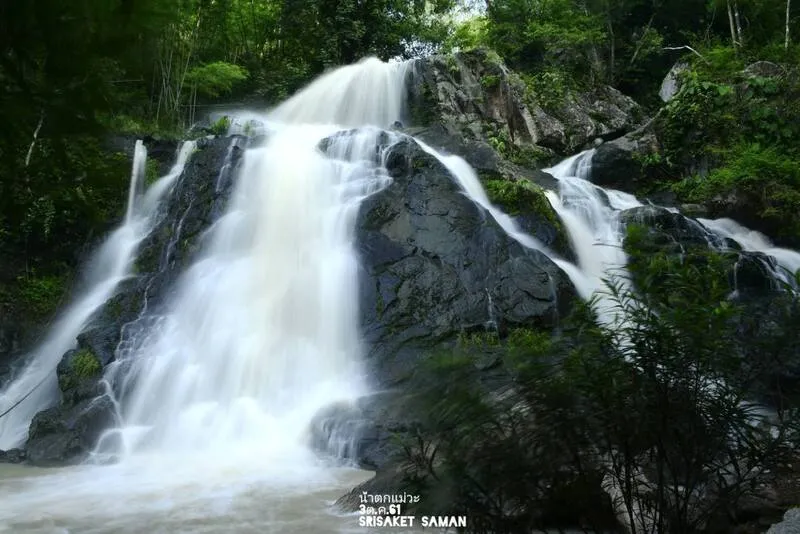
Mae Wa Waterfall is the park’s main attraction. It is located near Ban Nam Dip, Village No. 3, Mae Wa Subdistrict, Thoen District. The surrounding area is mountainous, and the waterfall originates from Doi Pla Luang before its water eventually flows into the Wang River system. Mae Wa Waterfall has nine levels, each with its own character. Lower levels are easier to access, while higher levels require more effort, better footwear, and greater caution.
The trail from the first to the fourth level is about 700 meters and is relatively convenient for general visitors. Beyond that, the trail becomes steeper and continues up to the eighth level, with a total distance of about 2.2 km. The ninth level is called Tad Luang and is about 100 meters high, but reaching it requires climbing beyond the eighth level and is not suitable for general visitors. Travelers should not attempt difficult sections without guidance from park staff or people who know the route well.
The waterfall is best visited when there is enough water but conditions remain safe. Late rainy season and early cool season often provide a good balance of flowing water and green forest. During heavy rain, visitors should be cautious of flash floods, slippery rocks, and wet trails. Swimming or entering water should be done only in safe areas. It is better to enjoy the waterfall safely than to push toward upper levels in poor conditions.
The park also has a nature trail that climbs through dry dipterocarp and mixed deciduous forest, then follows a ridge with viewpoints before reaching the eighth level of Mae Wa Waterfall. The total distance is about 3.8 km. This route is suitable for visitors interested in forest structure and seasonal change. During the dry season, the forest changes color as many trees shed leaves, creating a distinctive landscape of gold, brown, orange, and open woodland.
Walking through the nature trail helps visitors understand the differences between forest types. Dry dipterocarp forest usually appears in drier, shallower-soil areas and contains trees that tolerate drought. Mixed deciduous forest has more plant diversity and changes visibly with the seasons. Pine forest and dry evergreen forest appear under different elevation and moisture conditions. A walk here is therefore not only exercise, but also a field lesson in forest ecology.
Tham Nam Pha Pha Ngam is another interesting site in the Wang Samran area of Phra Bat Wang Tuang Subdistrict, Mae Phrik District. It is a large limestone cave with winding passages and considerable depth. Water flows through parts of the cave, and stalactites and stalagmites add to its beauty. Because the cave has complex passages and water flow, visitors should prepare proper footwear, a flashlight, and local guidance before entering.
Tham Phra Chedi is located at Ban Nam Dip, Village No. 3, Mae Wa Subdistrict, Thoen District. It is a medium-sized limestone cave known for a stalagmite formation shaped like a chedi, or pagoda, and natural basin-like formations inside the cave. Local villagers have helped develop the area as a community attraction. Nearby caves include Tham Chang and several smaller caves around Ban Nam Dip, about 3 km from the village.
Visitors to caves in Mae Wa National Park should be careful and respectful. Stalactites and stalagmites take a very long time to form. Touching, scratching, writing, smoking, or leaving waste inside caves can cause lasting damage. Visitors should stay on safe paths, avoid entering deep passages without guidance, and never remove rocks, cave formations, or natural objects. A responsible cave visit should leave no trace behind.
From August to November, Mae Wa National Park becomes especially beautiful because of wildflowers, mist, and strong water flow in waterfalls and streams. This is a good period for travelers who enjoy lush forest and active waterfalls. However, visitors should check weather and trail conditions before traveling because rain can make trails slippery and some routes less safe.
The dry season offers another kind of beauty. Dry dipterocarp and mixed deciduous forests change color, creating warm tones across the hills. The nature trail is especially interesting during this period because the forest opens up visually and the structure of trees, slopes, and ridges becomes clearer. Visitors should be careful with fire, because dry-season forests are vulnerable to wildfire.
The park provides accommodation and camping areas for visitors who want to stay overnight in nature. Staying in the park allows travelers to experience the quiet evening atmosphere, cool morning air, and forest sounds that cannot be fully appreciated on a short visit. Anyone planning to stay should contact the visitor center in advance to confirm bungalow availability, camping conditions, food service, toilets, electricity, and booking rules.
A half-day visit to Mae Wa National Park can focus on the lower levels of Mae Wa Waterfall and the visitor-service area. A full-day visit allows travelers to walk farther up the waterfall route or include the nature trail. A deeper trip may include camping, waterfall exploration, and nearby cave visits. Planning according to time and physical ability is important because routes vary in difficulty.
Getting There is most convenient by private car. From Lampang city, take Highway No. 1 toward Thoen District. After passing Thoen by about 17 km, around kilometer markers 497 – 498, turn right near Mae Wa Witthaya School and continue for about 5 km. Then take the left concrete road toward Mae Wa National Park headquarters, located near a village reservoir. The road is generally suitable for ordinary cars, but visitors should drive carefully through local roads and park access sections.
Visitors going directly to Mae Wa Waterfall can use Highway No. 1 through Mae Phrik District. Around kilometer marker 500, there is an access road into the park area. Continue for about 6 km to Mae Wa Waterfall Ranger Station, also known as Ma Wa 1. The waterfall is about 500 meters farther. Those planning to walk to upper waterfall levels should check conditions with park staff first, especially during the rainy season.
Travelers using public transport can get off near Mae Wa police box and continue by local motorcycle taxi to the park. However, private vehicles or hired transport are more convenient because park attractions and nearby places are spread out. Visitors should also plan the return trip carefully because public transport may not be available at all times near natural areas.
Nearby attractions that can be combined with Mae Wa National Park include Mae Wa Waterfall, Tham Phra Chedi, Tham Chang, Ban Nam Dip, Thoen town, Tham Nam Pha Pha Ngam in Mae Phrik District, and Bhumibol Dam in Sam Ngao District, Tak Province. Routes should be planned according to time and distance. Visitors who want a nature-focused trip can spend most of the day inside the park, while those traveling farther can connect Lampang with Tak or Mae Phrik routes.
Food options near the park are mostly found in Mae Wa community, Thoen District, and along Highway No. 1 rather than deep inside natural areas. Visitors should carry drinking water and snacks, especially if walking waterfall trails or camping. Restaurants in Thoen include local food shops, made-to-order restaurants, noodle shops, coffee shops, and roadside restaurants suitable for stopping before or after the park visit.
Accommodation options include park bungalows and camping areas, plus local hotels and resorts in Thoen and nearby districts. Visitors who want to stay close to nature should contact Mae Wa National Park to arrange park accommodation or camping. Those who prefer restaurants, fuel stations, and easier onward travel may choose accommodation in Thoen town or along Highway No. 1.
Visitors should follow park rules carefully. Do not leave trash, light fires outside permitted areas, collect medicinal plants or wildflowers, catch animals, feed wildlife, write on cave walls, or walk off trail without staff guidance. Waterfall areas can be slippery, and caves require a flashlight and caution. Responsible behavior helps protect the park and reduces travel risk.
Mae Wa National Park is well suited for travelers who want to experience a quieter natural side of Lampang. It offers a nine-level waterfall, nature trails, seasonal forest colors, limestone caves, medicinal plants, orchids, wildflowers, and camping in a mountain-forest setting. The park’s beauty is not limited to a single waterfall level. It comes from the whole system of ridges, streams, caves, forest, wildlife, and local communities around Mae Wa.
Overall, Mae Wa National Park is an important conservation and recreation area in southern Lampang. It protects forest, water sources, caves, wildlife habitats, and nature-learning routes. With good preparation, respect for park rules, and enough time to explore safely, Mae Wa offers a peaceful and rewarding experience for anyone interested in Lampang’s forests, waterfalls, and natural heritage.
| Name | Mae Wa National Park |
| Location | Mae Wa Subdistrict, Thoen District, Lampang Province |
| Address | Mae Wa National Park, Village No. 2, Mae Wa Subdistrict, Thoen District, Lampang 52213 |
| Highlights | Mae Wa Waterfall with nine levels, nature trails, seasonal forest colors, Doi Ta Chi, Tham Nam Pha Pha Ngam, Tham Phra Chedi, Tham Chang, medicinal plants, orchids, wildflowers, and camping areas |
| History | A protected natural area in Thoen District and nearby parts of Lampang, known for diverse forest types, high ridges, waterfalls, limestone caves, and community-linked natural attractions around Ban Nam Dip and Mae Wa |
| Name Origin | The park is named after Mae Wa Subdistrict and Mae Wa Waterfall, the main natural attraction of the park. |
| Distinctive Features | Continuous mountain ranges with Doi Ta Chi as the highest peak at about 1,027 meters, mixed deciduous forest, dry dipterocarp forest, pine forest, dry evergreen forest, streams, waterfalls, and limestone caves |
| Travel Information | From Lampang city, use Highway No. 1 toward Thoen District. About 17 km after Thoen, around kilometer markers 497 – 498, turn right near Mae Wa Witthaya School and continue about 5 km, then turn left onto the concrete road to the park headquarters. |
| Current Status | Open as a natural attraction, nature-learning area, waterfall and cave destination, and overnight recreation area in southern Lampang |
| Open Days | Daily |
| Opening Hours | 08.00 – 16.30 / Accommodation And Camping Should Be Arranged With The Park In Advance |
| Fees | Thai Visitors: Adult 20 Baht, Child 10 Baht / Foreign Visitors: Adult 100 Baht, Child 50 Baht / Vehicle Fees Should Be Confirmed With The Park Before Visiting |
| Facilities | Visitor center, park bungalows, camping area, welfare restaurant, toilets, parking area, waterfall walking route, and nature trail |
| Main Areas / Zones | Park headquarters, Mae Wa Waterfall, Mae Wa Waterfall Ranger Station, nature trail, Tham Phra Chedi, Tham Chang, Tham Nam Pha Pha Ngam, and seasonal forest-color areas |
| Caretaker | Department Of National Parks, Wildlife And Plant Conservation / Mae Wa National Park |
| Main Contact Number | Mae Wa National Park, Tel. 081-112-2855, 054-380-504 / Department Of National Parks, Tel. 02-562-0760 |
| Recommended Season | August – November is suitable for waterfalls, wildflowers, and misty mountain scenery. The dry season is suitable for forest-color walks and nature trails. |
| Visitor Guidelines | Do not litter, do not light fires outside permitted areas, do not collect medicinal plants or wildflowers, do not catch animals, do not write on cave walls, stay on trails, and check weather before visiting waterfalls or caves. |
| Nearby Tourist Attractions | 1. Mae Wa Waterfall, about 0.5 km 2. Tham Phra Chedi, about 3 km 3. Tham Chang, about 3 km 4. Ban Nam Dip, Mae Wa Subdistrict, about 3 km 5. Thoen Town Center, about 20 km 6. Tham Nam Pha Pha Ngam, Mae Phrik District, about 35 km 7. Bhumibol Dam, Sam Ngao District, Tak Province, about 45 km |
| Nearby Restaurants | 1. Mae Wa National Park Welfare Restaurant, about 0 km 2. Local Food Shops In Ban Mae Wa, about 5 km 3. Made-To-Order Restaurants Along Highway No. 1, Mae Wa Area, about 6 km 4. Restaurants In Thoen Town Center, about 20 km 5. Ko Daeng Restaurant, Thoen District, about 22 km 6. Roadside Restaurants On The Thoen – Mae Phrik Route, about 20 – 30 km |
| Nearby Accommodations | 1. Mae Wa National Park Bungalows And Camping Area, about 0 km, Tel. 081-112-2855 2. Thoen Park Resort / Thoen Park, about 22 km, Tel. 081-892-6386, 086-447-3200 3. Thoen 5 Star Rooms / Hotel, about 22 km, Tel. 098-631-3383 4. Doi Daeng Resort, about 19 km 5. Phae Wijan Tour, about 23 km 6. Bhumibol Dam Guesthouse, about 30 km |
Frequently Asked Questions (FAQ)
Q: Where is Mae Wa National Park located?
A: Mae Wa National Park is located in Mae Wa Subdistrict, Thoen District, Lampang Province, along the Highway No. 1 route between Lampang and Tak.
Q: What are the main attractions in Mae Wa National Park?
A: Main attractions include Mae Wa Waterfall with nine levels, nature trails, seasonal forest colors, Doi Ta Chi, Tham Phra Chedi, Tham Chang, Tham Nam Pha Pha Ngam, medicinal plants, wildflowers, and camping areas.
Q: Is Mae Wa Waterfall difficult to walk to?
A: The trail from levels 1 to 4 is relatively easy at about 700 meters. The route becomes steeper toward level 8, with a total distance of about 2.2 km. Level 9, called Tad Luang, is not suitable for general visitors.
Q: What are the opening hours of Mae Wa National Park?
A: The park is open daily from 08.00 to 16.30. Visitors who want to stay overnight or camp should contact the park in advance.
Q: How much is the entrance fee?
A: Published rates are 20 baht for Thai adults, 10 baht for Thai children, 100 baht for foreign adults, and 50 baht for foreign children. Vehicle fees should be confirmed with the park before traveling.
Q: Does Mae Wa National Park have accommodation?
A: Yes. The park has bungalows, camping areas, and a welfare restaurant. Visitors should contact the visitor center in advance to confirm availability and booking conditions.
Q: How can travelers get to Mae Wa National Park?
A: From Lampang city, use Highway No. 1 toward Thoen District. Around kilometer markers 497 – 498, turn near Mae Wa Witthaya School and continue about 5 km before turning toward the park headquarters.
Q: What nearby attractions can be visited after Mae Wa National Park?
A: Nearby attractions include Mae Wa Waterfall, Tham Phra Chedi, Tham Chang, Ban Nam Dip, Thoen town, Tham Nam Pha Pha Ngam, and Bhumibol Dam.
 Category: ●Nature and Wildlife
 Group: ●National Parks and Marine Reserves
Last Update : 5 MonthAgo
 Last Update : 5 MonthAgo
 Click to Access the Navigation Map GPS
Mae Wa National Park Map
Gellery
Recommend

 Art, Culture and Heritage
 Historical Sites and Monuments(2)
 Landmarks and Memorials(5)
 Art, Craft Centres, Tradition(10)
 Museums(4)
 Historic Homes and Cities(1)
 Places of Worship
 Temple(86)
 Other Sacred Sites(9)
 Research and Development
 Royal Project(2)
 Suburban Living
 Village, Community(3)
 Local Market(2)
National Parks and Marine Reserves(6)
Local Market(2)
National Parks and Marine Reserves(6)
 Mountain (Doi)(4)
 Dam, Reservoir, Lake(11)
 Waterfalls(15)
 Hot Springs(1)
 Caves(12)
 Flower Field(1)
 River, Canal(1)
 Bays and Beaches(1)
 Other natural attractions(4)
 Entertainment and Agricultural
 Animal camps and shows(1)
 Farms, Parks and Ecotourism(2)
 Outdoor and Adventure Activities(2)
 Shopping
 Shopping and Night Market(2)
 Spas and Wellness
 Spas and Wellness(1)
 Travel Articles, Recipes
 Travel Review, Food Review(1)


