
lovethailand home >North Travel Attractions >Lampang Travel Attractions >Sop Prap >Na Yang > Wat Nong Wua Daeng
TL;DR: Wat Nong Wua Daeng is located at Ban Nong Wua Daeng, Moo 4, Na Yang Subdistrict, Sop Prap District, Lampang Province, open Daily, hours 08.00 – 17.00.

Wat Nong Wua Daeng
Open Days: Daily
Opening Hours: 08.00 – 17.00
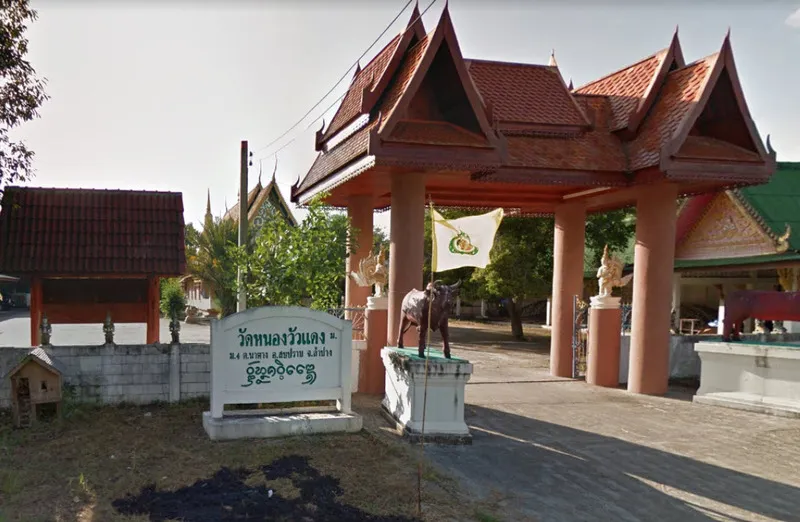
Wat Nong Wua Daeng is a community Buddhist temple located at 2 Moo 4, Ban Nong Wua Daeng, Na Yang Subdistrict, Sop Prap District, Lampang Province 52170. It is an important village temple with a distinctive local legend connected to a large pond and a mysterious herd of red cattle that once came to drink there. This story gave rise to the name Ban Nong Wua Daeng, and later to the name Wat Nong Wua Daeng. For travelers interested in rural temples, local legends, Lanna Buddhist art, and lesser-known cultural sites in Lampang, this temple offers a meaningful and quiet experience.
Wat Nong Wua Daeng is not a large tourist temple, but it is deeply significant to the local community. It serves as a place for merit-making, Buddhist ceremonies, village gatherings, and the preservation of local memory. The temple stands within Ban Nong Wua Daeng, one of the villages of Na Yang Subdistrict in Sop Prap District. The surrounding area still reflects the rural landscape of Lampang, with fields, village roads, and a calm community atmosphere.
According to local legend, there was once a large pond to the west of the village. A herd of red cattle regularly came to drink water at this pond, but villagers did not know where the animals came from. The repeated appearance of the red cattle was considered mysterious and remarkable. Because of this, the villagers began calling the area Ban Nong Wua Daeng, meaning the village of the pond of red cattle. The name has remained part of the village identity until today.
This legend reflects the way traditional communities often named places after natural features and memorable events. The pond was not merely a water source; it became a place of wonder. The red cattle became a symbol of the unusual and sacred character of the landscape. In this way, the name Nong Wua Daeng preserves the relationship between people, animals, water, and memory.
During the period remembered in the local story, a monk named Phra Ta Kham Phothiko arrived in the area while practicing tudong, the forest-wandering ascetic tradition. He had traveled from Mae Sot District in Tak Province. The villagers, impressed by his practice and presence, invited him to stay for the Buddhist rains retreat near the large pond. This invitation marked the beginning of a Buddhist monastic presence in the village.
In 1941, villagers joined together to build a small monastic residence so that Phra Ta Kham Phothiko could remain in the community. This was the origin of the religious site that later developed into Wat Nong Wua Daeng. Like many community temples in northern Thailand, the temple began with local faith and collective effort rather than formal tourism development. It was built because villagers wanted a place of worship and spiritual support close to home.
Wat Nong Wua Daeng belongs to the Mahanikaya order. The temple covers about 2 rai, 2 ngan, and 40 square wah. Its northern side is connected with rice fields, giving the temple a rural setting. Over time, stable monastic buildings were developed. On 13 January 1997, the temple received approval from the Lampang Provincial Religious Committee to be officially registered as Wat Nong Wua Daeng. This marked an important step from a local monastic site toward a recognized temple.
The temple later received its official consecrated boundary on 6 November 2007, with a boundary measuring 20 meters wide and 40 meters long. This recognition was important because a consecrated boundary allows a temple to perform formal monastic acts, including important Sangha ceremonies. It also shows that Wat Nong Wua Daeng had developed into a temple with an established role in the Buddhist monastic system.
Phra Khru Wibun Thammasak, the ecclesiastical chief of Na Yang Subdistrict, has played an important role as abbot of Wat Nong Wua Daeng. He led the villagers in restoring, improving, and building permanent religious structures at the temple. Through his leadership and the support of the local community, Wat Nong Wua Daeng developed into a stable village temple with important facilities such as the ordination hall, sermon hall, monk residence, bell tower, and entrance arch.
The line of abbots shows the continuity of temple care. The known abbots include Phra Athikan Ta Kham Phothiko in 1952, Phra Athikan Boonyuen Phutthimanto in 1959, Phra Athikan Chan Tip in 1962, Phra Athikan Boonmee Jatamaro in 1969, and Phra Khru Wibun Thammasak from 1978 onward. These names reflect the long-term development of the temple through successive generations of monastic leadership.
Phra Khru Wibun Thammasak, whose monastic name is Ratanayano and whose lay name is Sao Kaeo Phutthima, is an important monk connected with Wat Nong Wua Daeng and Na Yang Subdistrict. As both abbot and ecclesiastical chief of the subdistrict, he has supported the temple’s development and the wider work of the Sangha in the area. His role has helped make Wat Nong Wua Daeng not only a village temple, but also a religious center within Na Yang Subdistrict.
One of the most important sacred objects in the temple is a Lanna-style stucco Buddha image in the posture of subduing Mara. The image is 1.83 meters wide and 2.40 meters high, with an age of about 41 years. Made of stucco, the image reflects local craftsmanship and northern Thai Buddhist art. The posture of subduing Mara symbolizes the Buddha’s victory over obstacles before enlightenment, making it a meaningful object of worship for villagers and visitors.
The Buddha image at Wat Nong Wua Daeng is important not only because of its size and artistic style, but also because it is a spiritual center for the community. In a village temple, a Buddha image is often linked with daily worship, important life events, Buddhist holy days, and community merit-making. Visitors who pay respect to this image can experience the living faith of the people of Ban Nong Wua Daeng.
The temple’s key religious structures include the entrance arch, ordination hall, sermon hall, monk residence, and bell tower. The entrance arch marks the transition into the sacred space of the temple. The ordination hall is used for important monastic ceremonies. The sermon hall supports merit-making and community gatherings. The monk residence supports monastic life, while the bell tower marks the rhythm of temple activities.
Although Wat Nong Wua Daeng is modest in size, its importance lies in its community role. It is where villagers make merit, listen to Dhamma teachings, participate in ceremonies, and maintain social ties. In rural Thailand, a temple is often both a religious and social center. Wat Nong Wua Daeng continues to fulfill this role for Ban Nong Wua Daeng.
The temple’s history spans more than 80 years if counted from the establishment of the monastic residence in 1941. Its development shows the long-term cooperation between monks and villagers. From the arrival of a wandering monk and a simple monastic dwelling, the site grew into a recognized temple with a consecrated boundary and permanent structures.
Culturally, the legend of the red cattle is the defining identity of the village and temple. The story shows how local people understood and remembered their environment. A pond, an animal herd, and a repeated mysterious event became the basis for naming the village. This is a valuable example of how place names in rural Thailand often preserve oral history and environmental memory.
Wat Nong Wua Daeng is suitable for travelers who enjoy cultural tourism at the community level. At first glance, the temple may appear simple, but its background includes a local legend, the arrival of a forest-wandering monk, the creation of a monastic residence, official temple registration, consecration, and continued development by monks and villagers. These layers make the temple meaningful for visitors who take time to understand it.
Na Yang Subdistrict is home to several temples and monastic sites, including Wat Ban Kat, Wat Chai Mongkhon, Wat Na Prap, Wat Nong Wua Daeng, Wat Ban Na Yang, Wat Na Mai Daeng, Wat Ban Kaen, and Wat Ban Rai. This reflects how closely Buddhism is connected with village life in the area. Wat Nong Wua Daeng is one of these important religious centers serving its local community.
Travelers can also use Wat Nong Wua Daeng as part of a wider route through Sop Prap District. Nearby places of interest include Wat Na Prap, Wat Ban Kaen, Wat Luang Sop Prap, Doi Chong National Park, Mae Nga Chang Waterfall, Wat Phra That Lampang Luang, and Wat Phra That Chom Ping. This route combines village temples, local history, nature, and major Lampang cultural landmarks.
Wat Na Prap, located in the same subdistrict, is known for its older history, Lanna-style stucco Buddha image, and local stupa tradition. Wat Ban Kaen is another temple that can be included in a local temple route. Wat Luang Sop Prap represents the district center, while Doi Chong National Park and Mae Nga Chang Waterfall add a natural element to the journey. Wat Nong Wua Daeng contributes a distinct legend and village identity to this route.
Visitors to Wat Nong Wua Daeng should dress modestly, speak quietly, and respect monks and local residents. Sacred objects should not be touched without permission. Photography should be done with discretion, especially around Buddha images, the ordination hall, and monk residences. Since the temple remains an active religious site, respectful behavior is essential.
Getting There is most convenient by private car or rental car. From Lampang city, travel south toward Sop Prap District, then continue to Na Yang Subdistrict and Ban Nong Wua Daeng. Travelers using the main Lampang-Thoen or Phahonyothin route can enter Sop Prap District and then continue toward the village. The temple can be combined with nearby temples and natural attractions in the same day.
The best time to visit is from morning to late afternoon, when the weather is more comfortable for walking around the temple. Visiting on Buddhist holy days or during local merit-making events may allow travelers to observe the village’s religious life more clearly. Visitors should avoid disturbing ceremonies and follow local guidance when activities are taking place.
Food options around Sop Prap include local restaurants, noodle shops, coffee stops, and roadside eateries. Travelers can stop at Khrua Ban Suan Sop Prap, pork rib noodle shops, Khrua Khot Saep Kaeng Pa-Pla Mae Nam, Inthanin Coffee, or PunThai Coffee before or after visiting the temple. These stops are convenient for those traveling by private car through the district.
Accommodation options near Sop Prap include local resorts such as Huai Fang Resort and other small accommodations along the main road. Travelers who prefer more city facilities may stay in Lampang city and visit Wat Nong Wua Daeng as a day trip. The best choice depends on whether the trip focuses on Sop Prap’s local temples and nature or a broader Lampang itinerary.
Wat Nong Wua Daeng is valuable as a cultural destination because it shows the transformation of a local legend into a community identity, and of a simple monastic residence into an established temple. Its story includes the pond of red cattle, the wandering monk Phra Ta Kham Phothiko, the creation of the monastic site in 1941, official registration in 1997, and the consecrated boundary in 2007.
Overall, Wat Nong Wua Daeng is a temple that clearly reflects rural Buddhist life in Lampang. It preserves a local legend, houses a Lanna-style Buddha image, contains important religious structures, and remains active as a community temple. For travelers who want to explore Lampang beyond major tourist routes, this temple offers a quiet, authentic, and meaningful experience.
Wat Nong Wua Daeng deserves recognition as an important community temple of Na Yang Subdistrict, Sop Prap District. Visitors can make merit, pay respect to the Buddha image, learn the legend of the red cattle, and understand the role of the temple in village life. It is a rewarding stop for anyone interested in local history, Buddhist culture, and cultural travel in Lampang Province.
| Name | Wat Nong Wua Daeng |
| Location | Ban Nong Wua Daeng, Moo 4, Na Yang Subdistrict, Sop Prap District, Lampang Province |
| Address | 2 Moo 4, Ban Nong Wua Daeng, Na Yang Subdistrict, Sop Prap District, Lampang 52170, Thailand |
| Highlights | Community temple connected with the legend of a large pond and a mysterious herd of red cattle, the origin of the village name Ban Nong Wua Daeng |
| History | Originated when villagers invited Phra Ta Kham Phothiko, a wandering monk from Mae Sot District in Tak Province, to stay near the village pond; a monastic residence was built in 1941, the temple was officially registered on 13 January 1997, and it received its consecrated boundary on 6 November 2007 |
| Name Origin | Named after a local legend in which a herd of red cattle regularly came to drink water at a large pond west of the village |
| Distinctive Features | Mahanikaya community temple covering about 2 rai, 2 ngan, and 40 square wah, serving Ban Nong Wua Daeng and Na Yang Subdistrict |
| Antiquities / Sacred Objects | Lanna-style stucco Buddha image in the posture of subduing Mara, 1.83 meters wide and 2.40 meters high, about 41 years old |
| Travel Information | From Lampang city, travel toward Sop Prap District, then continue to Na Yang Subdistrict and Ban Nong Wua Daeng; private car or rental car is recommended |
| Current Status | Active community temple of Na Yang Subdistrict, listed in temple and ecclesiastical records |
| Open Days | Daily |
| Opening Hours | 08.00 – 17.00 |
| Fees | No Admission Fee |
| Facilities | Merit-making area, ordination hall, sermon hall, monk residence, bell tower, temple courtyard, and parking space within or near the temple depending on local conditions |
| Main Areas / Zones | Entrance arch, ordination hall, sermon hall, monk residence, bell tower, and the area housing the Buddha image in the posture of subduing Mara |
| Abbot / Caretaker | Phra Khru Wibun Thammasak (Ratanayano), abbot of Wat Nong Wua Daeng and ecclesiastical chief of Na Yang Subdistrict |
| Main Contact Number | 089-557-2643 |
| Nearby Tourist Attractions | 1. Wat Na Prap, about 2 km 2. Wat Ban Kaen, about 6 km 3. Wat Luang Sop Prap, about 10 km 4. Doi Chong National Park, about 24 km 5. Mae Nga Chang Waterfall, about 26 km 6. Wat Phra That Lampang Luang, about 36 km 7. Wat Phra That Chom Ping, about 42 km |
| Nearby Restaurants | 1. Khrua Ban Suan Sop Prap, about 10 km, Tel. 089-633-7906, 090-971-3262, 054-242-282 2. Pork Rib Noodle Restaurant Sop Prap, about 10 km 3. Khrua Khot Saep Kaeng Pa-Pla Mae Nam, about 10 km, Tel. 082-264-6982, 098-395-5982 4. Inthanin Coffee Sop Prap, about 10 km 5. PunThai Coffee Sop Prap, about 11 km 6. Kha Mu Chae Oi Restaurant, about 11 km |
| Nearby Accommodations | 1. Huai Fang Resort, about 12 km, Tel. 064-429-0763, 084-223-2117 2. Somkiat Resort, about 12 km, Tel. 081-643-6187, 084-360-8133 3. Kong Ngoen Resort, about 13 km, Tel. 085-621-3772 4. Kohkaburi Hotel, about 28 km 5. Lampang River Lodge, about 42 km 6. One Budget Hotel Lampang Phahonyothin, about 52 km 7. Sibtis Hotel, about 60 km, Tel. 065-259-7444, 065-259-8555, 054-810-111, 054-829-888 |
Frequently Asked Questions (FAQ)
Q: Where is Wat Nong Wua Daeng located?
A: Wat Nong Wua Daeng is located at 2 Moo 4, Ban Nong Wua Daeng, Na Yang Subdistrict, Sop Prap District, Lampang Province 52170.
Q: What is the origin of the name Wat Nong Wua Daeng?
A: The name comes from a local legend about a large pond west of the village where a mysterious herd of red cattle regularly came to drink water.
Q: How did Wat Nong Wua Daeng begin?
A: It began when villagers invited Phra Ta Kham Phothiko, a wandering monk from Mae Sot District in Tak Province, to stay near the village pond. A monastic residence was later built in 1941.
Q: When did Wat Nong Wua Daeng receive its consecrated boundary?
A: Wat Nong Wua Daeng received its consecrated boundary on 6 November 2007, with a boundary measuring 20 meters wide and 40 meters long.
Q: Who is the abbot of Wat Nong Wua Daeng?
A: The abbot is Phra Khru Wibun Thammasak, monastic name Ratanayano, who also serves as the ecclesiastical chief of Na Yang Subdistrict.
Q: What sacred object is important at Wat Nong Wua Daeng?
A: The important sacred object is a Lanna-style stucco Buddha image in the posture of subduing Mara, 1.83 meters wide and 2.40 meters high.
Q: How can visitors get to Wat Nong Wua Daeng?
A: From Lampang city, travel south toward Sop Prap District, then continue to Na Yang Subdistrict and Ban Nong Wua Daeng. A private car or rental car is the most convenient option.
Q: What attractions are near Wat Nong Wua Daeng?
A: Nearby attractions include Wat Na Prap, Wat Ban Kaen, Wat Luang Sop Prap, Doi Chong National Park, Mae Nga Chang Waterfall, Wat Phra That Lampang Luang, and Wat Phra That Chom Ping.
Mobile : 0895572643
 Mobile : 0895572643
 Category: ●Places of Worship
 Group: ●Temple
Last Update : 3 MonthAgo
 Last Update : 3 MonthAgo
 Click to Access the Navigation Map GPS
 Art, Culture and Heritage
 Historical Sites and Monuments(2)
 Landmarks and Memorials(5)
 Art, Craft Centres, Tradition(10)
 Museums(4)
 Historic Homes and Cities(1)
Temple(86)
Historic Homes and Cities(1)
Temple(86)
 Other Sacred Sites(9)
 Research and Development
 Royal Project(2)
 Suburban Living
 Village, Community(3)
 Local Market(2)
 Nature and Wildlife
 National Parks and Marine Reserves(5)
 Mountain (Doi)(4)
 Dam, Reservoir, Lake(11)
 Waterfalls(15)
 Hot Springs(1)
 Caves(12)
 Flower Field(1)
 River, Canal(1)
 Bays and Beaches(1)
 Other natural attractions(4)
 Entertainment and Agricultural
 Animal camps and shows(1)
 Farms, Parks and Ecotourism(2)
 Outdoor and Adventure Activities(2)
 Shopping
 Shopping and Night Market(2)
 Spas and Wellness
 Spas and Wellness(1)


