
lovethailand home >North Travel Attractions
>Lampang Travel Attractions >Mueang Lampang
>Pong Saen Thong
> Wat Mae Kuey
TL;DR: Wat Mae Kuey is located at Ban Mae Kuey, Village No. 9, Pong Saen Thong Subdistrict, Mueang Lampang District, Lampang Province, open Daily, hours 08.00 – 17.00.
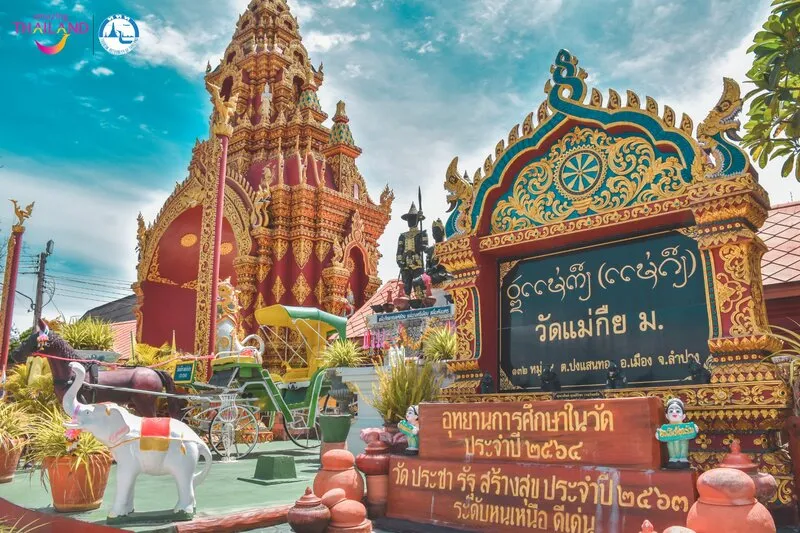
Wat Mae Kuey
Open Days: Daily
Opening Hours: 08.00 – 17.00
Wat Mae Kuey in Lampang Province is a local Buddhist temple of the Mahanikaya order, located at 132, Village No. 9, Ban Mae Kuey, Pong Saen Thong Subdistrict, Mueang Lampang District, Lampang Province, 52100. The temple covers an area of 6 rai, 3 ngan, and 13 square wah, and is overseen by Phra Khru Phuri Panyawat, also known as Phiphop Wiphawo. Wat Mae Kuey is not only a community temple but also a place deeply connected with local legends, the old settlement of Mueang Kuey, and the story of Muen Kuey Han Tae Thong, a heroic figure remembered in Lampang’s cultural memory.
Wat Mae Kuey is important because it brings together Buddhism, village history, sacred landscape beliefs, and Lanna local storytelling in one place. The temple includes important monastic structures such as an ordination hall, sermon hall, monks’ residences, dining hall, kitchen, bell tower, and pagoda. Its atmosphere is calm and local, making it suitable for visitors who want to experience a quieter side of Lampang beyond the better-known tourist routes.
The history of Wat Mae Kuey is closely tied to Ban Mae Kuey, which is regarded as one of the older villages in the area. According to local documents preserved by the temple, the village contains traces of old brick remains and an area known by villagers as “Den Lan.” Local people believe that this place is protected by guardian spirits. Anyone who behaves disrespectfully or enters the area without proper acknowledgement may suffer misfortune. This belief reflects the traditional Lanna view that certain landscapes are sacred and should be treated with respect.
Beyond village memory, the story of Ban Mae Kuey is also connected with historical and legendary sources such as the Yonok Chronicle, the legend of Phra That Lampang Luang, and the legend of Doi Tham. These traditions describe Mae Kuey as a place associated with the birth of a heroic figure remembered as a symbol of honesty, bravery, and martial excellence. His influence is said to have extended to Chiang Chuen, Chaliang, and Dong Nakhon.
This figure is known as “Muen Dong Nakhon” or “Chao Han Tae Thong,” the ruler of Dong Nakhon. He was the son of Chao Muen Lok Nakhon and Chao Nang Si Mueang, rulers connected with Khelang Nakhon, the old city of Lampang. According to local legend, he was born during a time of war, when enemy troops passed through Lampang on their way to attack Chiang Mai in 1400 CE.
At that time, Chao Muen Lok Nakhon led his army to confront the enemy near Wat Si Chai Phum, now associated with Wat Pong Sanuk. He pursued the enemy forces further, while Chao Nang Si Mueang asked to accompany him. During the pursuit, when the army reached Mueang Kuey, Chao Nang Si Mueang gave birth to a son near a mound by the Kuey River. This event became a major part of local memory and led to the naming of the area as Mueang Kuey.
Later, Muen Han Tae Thong is believed to have lived in Mueang Kuey from a young age and helped develop the settlement for as long as 30 years. For this reason, he became known by another name, “Muen Kuey Han Tae Thong.” The name Ban Mae Kuey or Mueang Kuey is therefore closely connected with this legendary birth story and the long-standing memory of a local hero.
The legend of Muen Kuey Han Tae Thong gives Ban Mae Kuey a meaning beyond that of an ordinary village. For many local people, the area is remembered as the birthplace and territory of a heroic figure connected with the history of Khelang Nakhon. Although parts of the story remain in the form of oral tradition and local legend, they are valuable as cultural heritage because they show how communities preserve their understanding of the past through people, places, and shared beliefs.
Wat Mae Kuey therefore functions as a center of local memory. It is not only a place for Buddhist ceremonies but also a site where stories of Mueang Kuey, Den Lan, ancient brick remains, and Muen Kuey Han Tae Thong are remembered and transmitted. Cultural travelers who visit the temple can gain insight into how religion, legend, and community identity are intertwined in rural Lampang.
The area known as Den Lan continues to hold powerful meaning in local belief. Local stories tell of a landowner who once developed the area into a housing estate with roads and utilities, but the land did not sell because people were afraid to buy or live there. The belief that disrespectful intrusion into the sacred area could bring misfortune remains part of the community’s memory and helps explain the spiritual atmosphere surrounding Ban Mae Kuey.
From a local historical perspective, stories about Den Lan and Mueang Kuey suggest that this area may once have contained an older settlement. The presence of ancient brick remains supports the local perception that Ban Mae Kuey has a deeper past than what is visible today. Further archaeological and historical study would help explain the site more clearly, but the oral traditions themselves already hold cultural value.
One of the artistic highlights of Wat Mae Kuey is its Lanna-style decorative viharn, often admired for its traditional design and serene atmosphere. The viharn reflects the craftsmanship and faith of the local community. Visitors interested in northern Thai temple architecture will appreciate the quiet setting, decorative details, and strong sense of local identity.
The temple’s monastic structures also show that Wat Mae Kuey remains an active community temple. The ordination hall is used for formal monastic ceremonies, the sermon hall serves local merit-making activities, the monks’ residences support monastic life, and the pagoda provides a sacred point of worship for visitors and villagers.
Phra Khru Phuri Panyawat, or Phiphop Wiphawo, the abbot of Wat Mae Kuey, plays an important role in maintaining the temple and preserving the local history of the community. The fact that the temple has collected and transmitted the story of Ban Mae Kuey shows that the temple serves not only as a religious center but also as a guardian of local memory.
As a local Mahanikaya temple, Wat Mae Kuey is closely connected with village life. Local residents use the temple for merit-making, Buddhist ceremonies, sermons, festivals, and community gatherings. This makes the temple a living institution rather than a passive historical site.
For travelers interested in Lampang’s history, Wat Mae Kuey offers a valuable perspective because it expands the understanding of the province beyond well-known landmarks such as Khelang Nakhon, Wat Phra That Lampang Luang, and Wat Pong Sanuk. The temple reveals how surrounding villages preserve their own stories and contribute to the wider historical landscape of Lampang.
Visitors to Wat Mae Kuey should explore the temple slowly and respectfully. The experience is not about grand scale but about meaning, memory, and local atmosphere. Paying respect at the temple, viewing the viharn and pagoda, and reflecting on the stories of Mueang Kuey and Den Lan all help visitors understand the deeper cultural identity of this community.
Wat Mae Kuey is also suitable for travelers who want a quiet and less commercialized temple experience. Located in Pong Saen Thong Subdistrict, not too far from Lampang city, it offers a village atmosphere with a relaxed pace. Visitors can combine the temple with other attractions in Lampang city or nearby districts during a day trip.
For those interested in Lanna legends, community memory, and local sacred geography, Wat Mae Kuey is especially rewarding. The stories of Muen Kuey Han Tae Thong, Mueang Kuey, Den Lan, and ancient brick remains can be further explored through local history, archaeology, folklore, and anthropology. The temple serves as a gateway to understanding Lampang from the perspective of its communities.
Visitors should dress respectfully and behave calmly because Wat Mae Kuey remains an active Buddhist temple. Photography should be done politely and should not disturb monks, ceremonies, or villagers. Special care should be taken during Buddhist holy days and community events.
Getting There is convenient from Lampang city. Travelers can drive toward Pong Saen Thong Subdistrict and continue to Ban Mae Kuey, Village No. 9. A private car or rental vehicle is recommended. The temple is suitable for a day trip and can be combined with other attractions in Lampang city or nearby areas.
| Name | Wat Mae Kuey |
| Location | Ban Mae Kuey, Village No. 9, Pong Saen Thong Subdistrict, Mueang Lampang District, Lampang Province |
| Address | 132, Village No. 9, Ban Mae Kuey, Pong Saen Thong Subdistrict, Mueang Lampang District, Lampang 52100 |
| Temple Type | Local Buddhist temple of the Mahanikaya order |
| Area | 6 rai, 3 ngan, 13 square wah |
| Highlights | Lanna-style viharn, pagoda, Mueang Kuey legend, Den Lan sacred area, and the story of Muen Kuey Han Tae Thong |
| History / Significance | Historic community temple of Ban Mae Kuey, associated with Mueang Kuey, Muen Dong Nakhon, Chao Han Tae Thong, and local beliefs surrounding Den Lan |
| Distinctive Features | Peaceful community temple with complete monastic structures and strong local legends connected to Lampang history |
| Main Structures | Ordination hall, sermon hall, monks’ residences, dining hall, kitchen, bell tower, and pagoda |
| Important Legend | Legend of Muen Kuey Han Tae Thong, a heroic figure connected with Mueang Kuey and the history of Khelang Nakhon |
| Travel Information | From Lampang city, travel toward Pong Saen Thong Subdistrict and continue to Ban Mae Kuey, Village No. 9; private car or rental vehicle is recommended |
| Current Status | Open for merit-making, worship, and cultural visits |
| Open Days | Daily |
| Opening Hours | 08.00 – 17.00 |
| Fees | No admission fee |
| Facilities | Worship areas, sermon hall, temple courtyard, kitchen, dining hall, and parking area within or near the temple |
| Abbot / Caretaker | Phra Khru Phuri Panyawat (Phiphop Wiphawo) |
| Nearby Tourist Attractions | 1. Wat Si Rong Mueang, about 8 km 2. Wat Phra That Lampang Luang, about 10 km 3. Kad Kong Ta Walking Street, about 10 km 4. Ratsadaphisek Bridge, about 10 km 5. Wat Phra Kaew Don Tao Suchadaram, about 12 km |
| Nearby Restaurants | 1. Kaeng Hom Lampang Northern Food Garden, about 5 km 2. Rosniyom Coffee Pong Saen Thong, about 5 km 3. Krua Prairie, about 6 km 4. Long Jim New York Pizza, about 10 km, Tel. 054-010555 5. Baan Phraya Suren by Madame Musur, about 10 km, Tel. 054-222317 |
| Nearby Accommodations | 1. Tree Tara Hotel Lampang, about 5 km, Tel. 054-019699 2. B2 Lampang City Boutique & Budget Hotel, about 8 km, Tel. 052-009161 3. Wienglakor Hotel Lampang, about 8 km, Tel. 054-225501 4. Hop Inn Lampang City Center, about 9 km, Tel. 02-6592899 5. The Coconut Hotel Lampang, about 10 km, Tel. 054-821999 |
Frequently Asked Questions (FAQ)
Q: Where is Wat Mae Kuey located?
A: Wat Mae Kuey is located at 132, Village No. 9, Ban Mae Kuey, Pong Saen Thong Subdistrict, Mueang Lampang District, Lampang Province.
Q: Who is the abbot of Wat Mae Kuey?
A: The abbot is Phra Khru Phuri Panyawat, also known as Phiphop Wiphawo.
Q: Why is Wat Mae Kuey important?
A: It is a historic community temple connected with Mueang Kuey, Den Lan, and the legend of Muen Kuey Han Tae Thong.
Q: What is Den Lan?
A: Den Lan is an area in local belief regarded as sacred and protected by guardian spirits, forming part of the cultural memory of Ban Mae Kuey.
Q: Who was Muen Kuey Han Tae Thong?
A: Muen Kuey Han Tae Thong, also known as Muen Dong Nakhon or Chao Han Tae Thong, is a legendary local hero associated with Mueang Kuey and the history of Khelang Nakhon.
Q: Is Wat Mae Kuey open daily?
A: Yes. The temple is open daily from 08.00 to 17.00.
Q: Is there an admission fee?
A: No. Visitors can make merit, worship, and visit the temple free of charge.
Mobile : 0622536229
 Mobile : 0622536229
 Category: ●Places of Worship
 Group: ●Temple
Last Update : 2 WeekAgo
 Last Update : 2 WeekAgo
 Click to Access the Navigation Map GPS
 Art, Culture and Heritage
 Historical Sites and Monuments(2)
 Landmarks and Memorials(5)
 Art, Craft Centres, Tradition(10)
 Museums(4)
 Historical Houses and The Ancient City(1)
 University Temple(86/684)
 Other religious and spiritural sites(9)
 Research and Development
 Royal Project(2)
 Suburban Living
 Village, Community(3)
 Local Market(2)
 Nature and Wildlife
 National Parks and Marine Reserves(5)
 Mountain (Doi)(4)
 Dam, Reservoir, Lake(11)
 Waterfalls(15)
 Hot Springs(1)
 Caves(12)
 Flower Field(1)
 River, Canal(1)
 Bays and Beaches(1)
 Other natural attractions(4)
 Entertainment and Agricultural
 Animal camps and shows(1)
 Farm, Parks, Gardens and Ecotourism(2)
 Outdoor and Adventure Activities(2)
 Shopping
 Shopping and Night Market(2)
 Spas and Wellness
 Spas and Wellness(1)


