
lovethailand home >North Travel Attractions >Lampang Travel Attractions >Thoen >Na Pong > Khao Ji and Khao Lam Tradition
TL;DR: Khao Ji and Khao Lam Tradition, open Held Once a Year on the Full Moon Day of the 4th Northern Lunar Month, hours Morning Until Late Morning.
Khao Ji and Khao Lam Tradition
Open Days: Held Once a Year on the Full Moon Day of the 4th Northern Lunar Month
Opening Hours: Morning Until Late Morning
Khao Ji and Khao Lam Tradition is one of the important post-harvest merit-making traditions of northern Thailand that beautifully reflects the relationship between agricultural life, Buddhist faith, community unity, and Lanna cultural identity. The ceremony takes place on the full moon day of the 4th northern lunar month, shortly after villagers finish harvesting rice. During this period, communities bring newly harvested rice to offer to monks as a sacred act of gratitude and blessing.
For Lanna people, rice is far more than a staple food. It is deeply connected to spiritual belief, livelihood, and the cultural identity of farming communities. Offering newly harvested rice to monks symbolizes gratitude toward nature, the land, and spiritual forces believed to support successful harvests. The ritual also marks the beginning of a new agricultural cycle with blessings and prosperity.
Mae Hiang Sawongtui, a respected elder in the community, explained that the tradition is highly important because villagers believe offering newly harvested rice to monks generates great spiritual merit. The ceremony also creates opportunities for families and neighbors to gather together, strengthen relationships, and continue cultural traditions from one generation to another.
The heart of the ceremony involves preparing “Khao Ji” and “Khao Lam,” both made from freshly harvested sticky rice. Northern Thai Khao Ji differs slightly from versions found in other regions. Sticky rice is shaped into balls, lightly seasoned with salt, and grilled over charcoal until fragrant. Some households coat the rice with egg before grilling to create a richer flavor and aroma.
The image of villagers grilling Khao Ji over charcoal fires is one of the most recognizable scenes of this tradition. The smell of roasted sticky rice spreads throughout the temple grounds and village community, creating a warm atmosphere strongly associated with traditional northern Thai rural life.
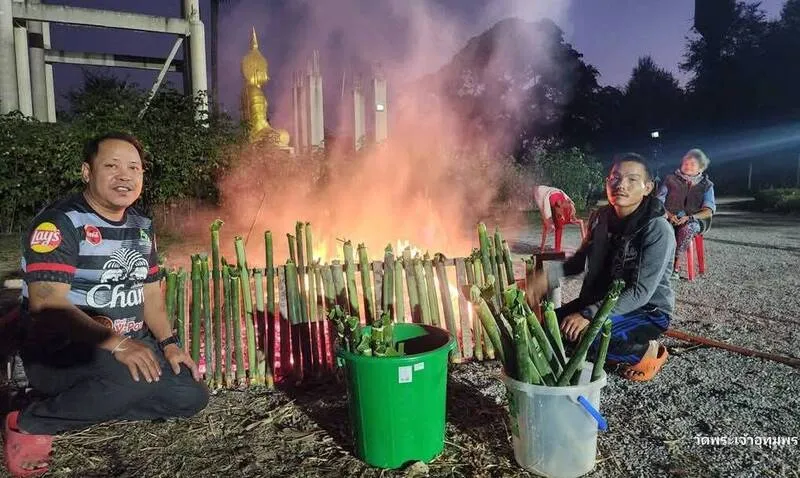
Khao Lam, or bamboo sticky rice, is another essential part of the ceremony. Villagers place sticky rice into bamboo tubes together with water and sometimes coconut milk, black beans, or sugar before roasting the tubes over fire until the rice is fully cooked. The result is fragrant bamboo sticky rice with a unique smoky flavor.
The preparation of Khao Lam reflects local wisdom and sustainable cooking methods using natural materials. After cooking, villagers carefully peel away the outer bamboo layers so monks can easily open and eat the rice inside. This process requires patience, skill, and experience.
The Khao Ji and Khao Lam Tradition therefore functions not only as a religious ceremony but also as an important learning space for local knowledge. Children and young people observe and learn traditional cooking methods, bamboo preparation, charcoal roasting, and food preservation techniques directly from elders in the community.
On the festival morning, villagers wake before sunrise to prepare Khao Ji and Khao Lam together with family members. Homes throughout the village become filled with smoke from charcoal fires, conversation among relatives, and the smell of roasted sticky rice. These moments reflect the warmth and simplicity of traditional Lanna community life.
After preparation is complete, villagers bring Khao Ji, Khao Lam, and other foods to the temple for merit-making ceremonies. They participate in almsgiving, Buddhist prayers, and offerings to monks. Presenting newly harvested rice symbolizes abundance and expresses hope for another successful agricultural season in the future.
The festival also functions as an important social gathering. Family members working in distant cities often return home to join the ceremony, making villages lively once again. Children spend time with grandparents and relatives, while elders share stories and cultural knowledge with younger generations.
The concept of “new rice” holds especially deep meaning within agricultural communities. Lanna villagers traditionally believe that newly harvested rice should first be offered to monks before being consumed within the household. This practice expresses respect for Buddhism, gratitude toward nature, and appreciation for the harvest.
The ceremony also strengthens community unity because every household participates in preparations. Families help each other cook rice, gather firewood, prepare bamboo tubes, and organize temple spaces. These shared activities create close relationships and mutual support within the village.
In some northern communities, the Khao Ji and Khao Lam Festival also includes traditional music, local dances, folk games, and cultural performances. Children play around temple grounds while adults share food and conversation together, creating an atmosphere filled with warmth and happiness.
Although modern lifestyles continue changing rapidly, many northern Thai communities still preserve this tradition strongly because it represents an essential part of Lanna identity. The ceremony helps younger generations understand the value of rice farming, gratitude, local wisdom, and sharing within the community.
For travelers, the festival offers an excellent opportunity to experience authentic northern Thai culture firsthand. Visitors can observe traditional cooking methods, participate in merit-making activities, and enjoy the warm hospitality of local communities.
The tradition also reflects the close relationship between people and nature because nearly every part of the ceremony depends on natural materials such as sticky rice, bamboo, charcoal, and firewood. This lifestyle demonstrates the sustainable wisdom of traditional Lanna communities and their harmony with the environment.
Both Khao Ji and Khao Lam are themselves important symbols of northern Thai culinary identity. Their fragrant aroma, simple preparation, and connection to family life make them closely associated with merit-making ceremonies and feelings of warmth and togetherness.
From a cultural perspective, the Khao Ji and Khao Lam Tradition represents far more than a post-harvest festival. It is a ceremony that combines religion, food, agriculture, family relationships, and community values into one harmonious cultural expression that continues living within Lanna society today.
Getting There depends on the village or temple hosting the ceremony. The tradition is commonly found throughout northern provinces such as Lampang, Lamphun, and Chiang Mai. Travelers can reach participating communities by private car or local transportation, and it is recommended to confirm festival schedules with local cultural offices in advance because details vary between communities.
The Khao Ji and Khao Lam Tradition therefore remains a beautiful reflection of simple Lanna life filled with faith, gratitude, generosity, and strong community relationships. It continues being preserved proudly as an important cultural heritage of northern Thailand.
| Festival Name | Khao Ji and Khao Lam Tradition |
| Category | Post-Harvest Lanna Merit-Making Festival |
| Region | Northern Thailand |
| Festival Period | Full Moon Day of the 4th Northern Lunar Month After Harvest Season |
| Main Highlight | Offering newly harvested rice, grilled sticky rice, and bamboo sticky rice to monks |
| Cultural Importance | Represents gratitude toward nature and blessings for future agricultural prosperity |
| Main Activities | Preparing Khao Ji, roasting Khao Lam, almsgiving, and offering newly harvested rice |
| Tradition Caretakers | Lanna communities, local temples, and northern provincial cultural offices |
| Main Foods | Khao Ji, Khao Lam, and newly harvested sticky rice |
| Main Materials | Sticky rice, bamboo, charcoal, and firewood |
| Main Belief | Offering newly harvested rice to monks brings blessings and spiritual merit |
| Traditional Dress | Traditional Lanna clothing |
| Travel Information | Found in many northern provinces including Lampang, Lamphun, and Chiang Mai |
| Nearby Tourist Attractions | 1. Wat Phra That Lampang Luang, About 18 km 2. Kad Kong Ta Lampang, About 2 km 3. Ratsadaphisek Bridge, About 2 km 4. Wat Sri Rong Mueang, About 3 km 5. Dhanabadee Ceramic Museum, About 5 km |
| Nearby Restaurants | 1. Wiang Lakon Restaurant, About 2 km, Tel. 054-222111 2. Krua Nuea Hom Lampang, About 3 km, Tel. 054-019899 3. Long Jim New York Pizza, About 2 km, Tel. 095-4465959 4. Baan Phraya Suren by Madame Musur, About 2 km, Tel. 054-314899 5. Tik Jaew Hon Lampang, About 3 km, Tel. 054-223799 |
| Nearby Accommodations | 1. Wiang Thong Hotel Lampang, About 2 km, Tel. 054-218561 2. Regent Lodge Lampang, About 2 km, Tel. 054-323111 3. The Coconut Hotel, About 4 km, Tel. 054-821999 4. Hop Inn Lampang City Center, About 3 km, Tel. 052-081777 5. Lampang River Lodge, About 8 km, Tel. 054-209999 |
Frequently Asked Questions (FAQ)
Q: What is the Khao Ji and Khao Lam Tradition?
A: It is a northern Thai post-harvest merit-making festival where newly harvested rice, grilled sticky rice, and bamboo sticky rice are offered to monks.
Q: When is the festival held?
A: The festival takes place on the full moon day of the 4th northern lunar month after the harvest season.
Q: How is Khao Ji prepared?
A: Sticky rice is shaped into balls, lightly seasoned with salt, and grilled over charcoal until fragrant.
Q: How is Khao Lam prepared?
A: Sticky rice is placed inside bamboo tubes with water and roasted over fire until fully cooked.
Q: Why is newly harvested rice offered to monks?
A: Villagers believe the offering brings blessings, prosperity, and spiritual merit.
Q: What does this tradition represent in Lanna culture?
A: It reflects agricultural life, gratitude, generosity, and strong community relationships.
Q: Can tourists participate in the festival?
A: Yes. Visitors are welcome to participate respectfully and experience authentic northern Thai culture.
 Category: ●Art, Culture and Heritage
 Group: ●Art, Craft Centres, Tradition
Last Update : 4 MonthAgo
 Last Update : 4 MonthAgo
 Click to Access the Navigation Map GPS
Khao Ji and Khao Lam Tradition Map
Recommend

 Historical Sites and Monuments(2)
 Landmarks and Memorials(5)
Art, Craft Centres, Tradition(10)
Landmarks and Memorials(5)
Art, Craft Centres, Tradition(10)
 Museums(4)
 Historic Homes and Cities(1)
 Places of Worship
 Temple(86)
 Other Sacred Sites(9)
 Research and Development
 Royal Project(2)
 Suburban Living
 Village, Community(3)
 Local Market(2)
 Nature and Wildlife
 National Parks and Marine Reserves(5)
 Mountain (Doi)(4)
 Dam, Reservoir, Lake(11)
 Waterfalls(15)
 Hot Springs(1)
 Caves(12)
 Flower Field(1)
 River, Canal(1)
 Bays and Beaches(1)
 Other natural attractions(4)
 Entertainment and Agricultural
 Animal camps and shows(1)
 Farms, Parks and Ecotourism(2)
 Outdoor and Adventure Activities(2)
 Shopping
 Shopping and Night Market(2)
 Spas and Wellness
 Spas and Wellness(1)


