
lovethailand home >North Travel Attractions >Sukhothai Travel Attractions >Si Nakhon >Nam Khum > Wat Nam Khum
TL;DR: Wat Nam Khum is located at No. 145, Ban Nam Khum, Moo 3, Nam Khum Subdistrict, Si Nakhon District, Sukhothai Province, Thailand, open Daily, hours Morning – Evening For General Worship Visits.
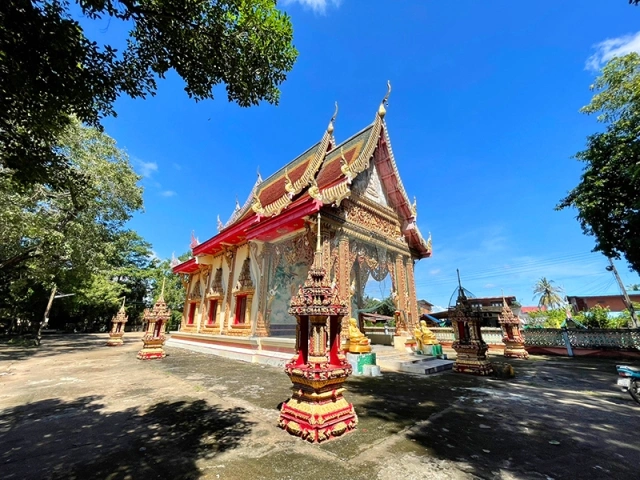
Wat Nam Khum
Open Days: Daily
Opening Hours: Morning – Evening For General Worship Visits
Wat Nam Khum is located at No. 145, Ban Nam Khum, Moo 3, Nam Khum Subdistrict, Si Nakhon District, Sukhothai Province. It is a local Buddhist temple under the Mahanikaya monastic order and one of the important spiritual and cultural centers of the Nam Khum community. With a history dating back to 1809, the temple reflects the development of a rural settlement, the faith of villagers who migrated into the area, and the continuing role of Buddhism in local life. For foreign travelers, Wat Nam Khum offers a calm and authentic experience of a community temple in Sukhothai, with local traditions such as Phuang Mahot and Tak Bat Thewo still connected to the temple’s identity.
The temple covers an area of 17 rai, 2 ngan, and 44 square wah. Its boundaries are clearly described in traditional Thai measurements: the northern side measures 88 wa and 2 sok and adjoins a public road; the southern side also measures 88 wa and 2 sok and adjoins a public road; the eastern side measures 54 wa and adjoins Khlong Yom; and the western side measures 57 wa and adjoins a public road. The temple stands on flat land, with Khlong Yom passing along one side. Although this canal is now shallow in places, it remains part of the temple’s landscape and the memory of the local community.
The name Wat Nam Khum comes from Ban Nam Khum, the old village name. The village is said to have begun around 1797, when people migrated from different places and settled in the area. As the population grew, villagers joined together to build a temple where they could make merit and perform Buddhist ceremonies. Wat Nam Khum was officially established as a temple in 1809 and later received its royal consecrated boundary on 23 August 1934. These dates show how closely the temple’s development was tied to the formation of the community itself.
Wat Nam Khum is important not only because of its age, but also because of its role as the spiritual center of the village. Local residents visit the temple for Buddhist holy days, merit-making, sermons, chanting, and annual festivals. In a rural Thai community, a temple is more than a place of worship. It is a gathering space, a cultural classroom, and a center of shared memory. Wat Nam Khum continues to perform this role for the people of Nam Khum Subdistrict.
The temple contains several important buildings. The ordination hall measures 7 meters wide and 20 meters long and was built in 1945. It is the main sacred space for important monastic ceremonies and for paying respect to the Buddha images inside. The sermon hall measures 20 meters wide and 36 meters long and was built in 1975. It is used for sermons, merit-making, and community activities. The chanting hall measures 10 meters wide and 11 meters long and was built in 1972. There are also 4 wooden monks’ residences that support the daily life of the monastic community.
Inside the ordination hall are 2 brass Buddha images, which are the temple’s important sacred objects. These images serve as the focus of worship for villagers and visitors. For local people, the Buddha images represent peace, merit, protection, and continuity of faith. Paying respect to them is not only a religious act but also a way of connecting with the spiritual identity of Ban Nam Khum.
The history of Wat Nam Khum includes several abbots who helped guide the temple’s development. The recorded lineage begins with Phra Sut, followed by Phra Pan, Phra Khru Khanuttrachan, who served from 1940 to 1960, and Phra Khru Sutham Manurak, whose name appears in the temple’s historical records. Through the leadership of these monks, the temple continued to develop its buildings, religious activities, and relationship with the local community.
One of the most distinctive cultural aspects of Wat Nam Khum is its connection with local traditions. The temple is associated with the Phuang Mahot tradition and the Tak Bat Thewo tradition. Phuang Mahot involves the preparation and offering of decorative flower garlands or symbolic floral arrangements. This tradition reflects both artistic creativity and religious faith. It also allows villagers to work together and pass local craft knowledge to younger generations.
Tak Bat Thewo is another important tradition at Wat Nam Khum and in Si Nakhon District. It is held during the end of Buddhist Lent and is connected with the Buddhist belief that the Buddha descended from Tavatimsa Heaven after preaching to his mother. During the ceremony, villagers offer food to monks and make merit together. At Wat Nam Khum, people from Moo 3, 4, 6, 7, and 10 of Nam Khum Subdistrict participate in the event, making it an important occasion for community unity.
The Tak Bat Thewo tradition at Wat Nam Khum is more than a religious ceremony. It is a community event that requires cooperation. Villagers help prepare food, organize the ceremony, welcome participants, and support the monks. Through this shared work, the temple becomes a place where faith, generosity, and social connection are strengthened. The event also helps younger people learn the meaning of Buddhist festivals through direct participation.
The presence of Khlong Yom gives Wat Nam Khum a landscape identity connected with water and rural life. Canals have long shaped settlement patterns, agriculture, travel, and daily life in many Thai communities. Although the canal near the temple is shallow today, it remains part of the temple’s historical environment. For travelers, this connection between temple, canal, and village helps explain how Buddhist temples often developed in close relationship with natural features and agricultural communities.
For cultural travelers, Wat Nam Khum is suitable for those who want to understand a quiet rural temple rather than a major tourist monument. The temple is not a large commercial attraction, but it has depth through its history, architecture, local traditions, and community role. Visitors can observe the ordination hall, sermon hall, chanting hall, monks’ residences, and the temple grounds while learning how a village temple continues to serve as a religious and cultural center.
Getting There is most convenient by private car. Travelers can head to Si Nakhon District in Sukhothai Province and continue to Nam Khum Subdistrict. The temple can be found by searching for “Wat Nam Khum Si Nakhon Sukhothai” or by using the coordinates 17.40938, 99.99282. Those using public transport should first reach Si Nakhon town and then continue by local transport or hired vehicle to Ban Nam Khum. A private car is recommended for visitors who want to combine the temple with nearby attractions.
Wat Nam Khum can be included in a local cultural route around Si Nakhon, Sawankhalok, and Si Satchanalai. Nearby and connecting places include Wat Patchantakharam Wasi, also known as Wat Nong Haen; Wat Rat Sattha Tham Royal Temple; Wat Bot Mani Ram; Sawankhalok Street Art; Sawankhaworanayok National Museum; and Si Satchanalai Historical Park. This route is suitable for travelers who want to combine community temples with historical and cultural destinations in northern Sukhothai.
Visitors should dress modestly and behave respectfully because Wat Nam Khum is an active Buddhist temple. Shoulders and knees should be covered when entering sacred areas. Shoes should be removed before entering designated buildings. Visitors should avoid loud behavior during ceremonies, and photography should be done politely. During the Tak Bat Thewo tradition or other temple events, visitors should follow the guidance of the temple and the local community.
Wat Nam Khum shows how rural Buddhist temples depend on cooperation between monks and villagers. Monks guide religious practice and maintain the spiritual life of the temple, while villagers support ceremonies, buildings, traditions, and community activities. This relationship has allowed the temple to remain active for more than 200 years. It is a strong example of how Buddhist faith continues through daily participation rather than through buildings alone.
For those interested in local history, Wat Nam Khum is a useful place to understand the development of a village temple over a long period. The village began around 1797, the temple was founded in 1809, the consecrated boundary was granted in 1934, and important buildings were constructed in 1945, 1972, and 1975. These dates show how the temple evolved with the needs, resources, and faith of its community.
The Phuang Mahot and Tak Bat Thewo traditions make Wat Nam Khum especially meaningful as a cultural site. These traditions are not only ritual events. They are occasions for creativity, cooperation, merit-making, and intergenerational learning. When children and young people see villagers preparing offerings, joining processions, and making merit, they learn how Buddhism is lived through action, art, food, and community service.
In summary, Wat Nam Khum is an important community temple in Nam Khum Subdistrict, Si Nakhon District, Sukhothai Province. It was founded in 1809, grew from a village established around 1797, and remains closely connected with local Buddhist traditions. Its brass Buddha images, old temple buildings, canal-side setting, Phuang Mahot tradition, and Tak Bat Thewo ceremony make it a meaningful destination for travelers who want to experience living Buddhist culture in rural Sukhothai.
| Name | Wat Nam Khum |
| Location | No. 145, Ban Nam Khum, Moo 3, Nam Khum Subdistrict, Si Nakhon District, Sukhothai Province, Thailand |
| Address | Ban Nam Khum, Moo 3, Nam Khum Subdistrict, Si Nakhon District, Sukhothai Province |
| Coordinates | 17.40938, 99.99282 |
| Highlights | An old community temple of Ban Nam Khum with 2 brass Buddha images, the Phuang Mahot tradition, and the Tak Bat Thewo ceremony of Si Nakhon District |
| History | Ban Nam Khum began around 1797. Wat Nam Khum was founded in 1809 and received its royal consecrated boundary on 23 August 1934. |
| Name Origin | The temple is named after Ban Nam Khum, the original village established by people who migrated from different areas. |
| Distinctive Features | The temple stands on flat land with Khlong Yom passing along the eastern side, and serves as a religious and cultural center of Nam Khum Subdistrict. |
| Sacred Objects | 2 brass Buddha images enshrined inside the ordination hall |
| Important Buildings | Ordination hall, 7 meters wide and 20 meters long, built in 1945; sermon hall, 20 meters wide and 36 meters long, built in 1975; chanting hall, 10 meters wide and 11 meters long, built in 1972; and 4 wooden monks’ residences |
| Traditions / Important Rituals | Phuang Mahot tradition and Tak Bat Thewo ceremony during the end of Buddhist Lent, joined by villagers from Moo 3, 4, 6, 7, and 10 of Nam Khum Subdistrict |
| Travel Information | Best reached by private car. Travel to Si Nakhon District and continue to Nam Khum Subdistrict. Search for “Wat Nam Khum Si Nakhon Sukhothai” or use coordinates 17.40938, 99.99282. |
| Current Status | An active Mahanikaya community temple serving as a religious and cultural center for Nam Khum Subdistrict |
| Open Days | Daily |
| Opening Hours | Morning – Evening For General Worship Visits |
| Main Areas / Zones | Ordination hall, sermon hall, chanting hall, monks’ residences, worship area for the brass Buddha images, and community festival areas |
| Former Abbots / Historical Caretakers | Phra Sut, Phra Pan, Phra Khru Khanuttrachan, and Phra Khru Sutham Manurak |
| Nearby Tourist Attractions | 1. Wat Patchantakharam Wasi, also known as Wat Nong Haen, about 8 km 2. Wat Rat Sattha Tham Royal Temple, about 10 km 3. Wat Bot Mani Ram, about 13 km 4. Mongkol Garden Cafe and Bistro, about 14 km 5. Sawankhalok Street Art, about 22 km 6. Sawankhaworanayok National Museum, about 24 km 7. Wat Sawang Arom Worawihan, about 25 km 8. Si Satchanalai Historical Park, about 29 km 9. Wat Chang Lom, Si Satchanalai, about 30 km |
| Nearby Restaurants | 1. Pa Nong Ahan Tam Sang, about 7 km 2. Yajai Homemade Cafe, about 9 km 3. Maphlap Coffee, about 10 km 4. Krua Na Long Si Nakhon, about 11 km 5. Anek Ahan Pa, about 12 km 6. Mongkol Garden Cafe and Bistro, about 14 km, Tel. 065-807-5429 7. Jungle Cafe Si Nakhon Sukhothai Branch, about 14 km |
| Nearby Accommodations | 1. D&N Resort Si Nakhon, about 10 km, Tel. 089-703-3549, 080-506-9755, 055-652-673 2. Patcharawadee Resort Si Nakhon Sukhothai, about 11 km, Tel. 099-917-9492, 091-028-4691 3. Thep Chamrat Boutique Hotel, about 22 km 4. Swankaburi Boutique Hotel, about 24 km 5. Wattanakham Serviced Apartment, about 24 km 6. Si Satchanalai Heritage & Resort, about 31 km |
Frequently Asked Questions (FAQ)
Q: Where is Wat Nam Khum located?
A: Wat Nam Khum is located at No. 145, Ban Nam Khum, Moo 3, Nam Khum Subdistrict, Si Nakhon District, Sukhothai Province, Thailand.
Q: When was Wat Nam Khum founded?
A: Wat Nam Khum was founded in 1809 and received its royal consecrated boundary on 23 August 1934.
Q: What is the origin of the name Wat Nam Khum?
A: The temple is named after Ban Nam Khum, a village that began around 1797 when people migrated from different areas and settled there.
Q: What are the main sacred objects at Wat Nam Khum?
A: The main sacred objects are 2 brass Buddha images enshrined inside the ordination hall.
Q: What important traditions are held at Wat Nam Khum?
A: The temple is associated with the Phuang Mahot tradition and the Tak Bat Thewo ceremony, especially during the end of Buddhist Lent.
Q: How can travelers get to Wat Nam Khum?
A: The easiest way is by private car. Travel to Si Nakhon District, continue to Nam Khum Subdistrict, and use “Wat Nam Khum Si Nakhon Sukhothai” or coordinates 17.40938, 99.99282 for navigation.
Q: What type of travelers should visit Wat Nam Khum?
A: The temple is suitable for travelers interested in rural Buddhist temples, local traditions, community history, merit-making, and the quiet cultural life of Sukhothai.
Q: What nearby attractions can be visited with Wat Nam Khum?
A: Nearby and connecting attractions include Wat Nong Haen, Wat Rat Sattha Tham Royal Temple, Wat Bot Mani Ram, Sawankhalok Street Art, Sawankhaworanayok National Museum, and Si Satchanalai Historical Park.
 Category: ●Places of Worship
 Group: ●Temple
Last Update : 4 MonthAgo
 Last Update : 4 MonthAgo
 Click to Access the Navigation Map GPS
Wat Nam Khum Map
Recommend

 Art, Culture and Heritage
 Historical Sites and Monuments(4)
 Landmarks and Memorials(5)
 Art, Craft Centres, Tradition(11)
 Museums(5)
Temple(40)
Museums(5)
Temple(40)
 Other Sacred Sites(10)
 Suburban Living
 Village, Community(3)
 Nature and Wildlife
 National Parks and Marine Reserves(3)
 Mountain (Doi)(2)
 Dam, Reservoir, Lake(4)
 Waterfalls(8)
 Caves(4)
 River, Canal(2)
 Entertainment and Agricultural
 Farms, Parks and Ecotourism(3)
 Travel Articles, Recipes
 Travel Review, Food Review(1)


