
lovethailand home >North Travel Attractions >Sukhothai Travel Attractions >Si Samrong >Ban San > Luang Pho Sam Phi Nong
TL;DR: Luang Pho Sam Phi Nong is located at Wat Ban San, Moo 2, Ban San Subdistrict, Si Samrong District, Sukhothai Province, open Daily, hours Daytime.
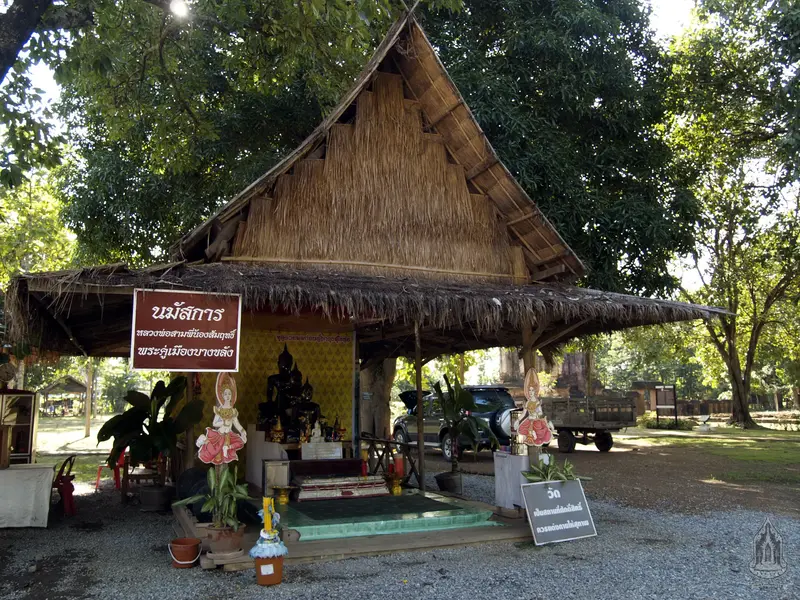
Luang Pho Sam Phi Nong
Open Days: Daily
Opening Hours: Daytime
Luang Pho Sam Phi Nong at Wat Ban San in Sukhothai Province is a group of 3 important bronze Buddha images enshrined at Wat Ban San, Ban San Subdistrict, Si Samrong District. These sacred images are deeply respected by the local community and are significant for their historical, artistic, religious, and cultural value. Each image is seated in the Subduing Mara posture and reflects the elegance of Sukhothai Buddhist art, yet each has a different facial expression and artistic character. This makes Luang Pho Sam Phi Nong not only a focus of worship but also an important living heritage of the Ban San community.
In simple terms, Luang Pho Sam Phi Nong refers to 3 bronze Buddha images that were originally enshrined at Wat Bot in Bang Khlang Subdistrict, Sawankhalok District. Around 1904, the area of Wat Bot had become deserted. Phra Athikan Ploi, the abbot of Wat Ban San at that time, learned that old and sacred Buddha images were still enshrined in the abandoned temple. He therefore performed a ritual of offering and prayer before inviting the 3 images to be enshrined at Wat Ban San. This event became the origin of the annual procession and Buddha bathing tradition that the community continues to preserve today.
Wat Ban San is a local Buddhist temple located in Moo 2, Ban San Subdistrict, Si Samrong District, Sukhothai Province. It is a community temple under the Mahanikaya order and has long served as a spiritual center for local residents. The temple is known for important sacred images, especially Luang Pho Sam Phi Nong and Luang Pho Khao. Together, these images make Wat Ban San a meaningful destination for travelers who want to understand Sukhothai beyond its famous historical park and ancient monuments.
The history of Luang Pho Sam Phi Nong begins at Wat Bot in Bang Khlang, an old temple area associated with the wider historical landscape of Sukhothai. When Phra Athikan Ploi heard about the old Buddha images in the abandoned temple, he recognized their sacred and cultural value. Rather than allowing the images to remain neglected, he performed a respectful ceremony and invited them to Wat Ban San so that the public could continue to worship them and preserve their religious importance.
The ritual of moving Luang Pho Sam Phi Nong was more than a physical transfer of Buddha images. It was an act of religious preservation and community responsibility. During the ceremony, Phra Athikan Ploi prayed that the offerings and spirit shrine used in the ritual would remain as they were, and that the spirit shrine would lean toward the east. He also established that the images should be carried in procession and ritually bathed every year during the Thai New Year period. Local belief holds that his prayer was fulfilled, giving the tradition strong sacred meaning.
When the images were brought to Wat Ban San, local villagers joined the procession with traditional piphat music and old-style ox carts. This detail reflects the rural culture of the time, when religious faith was expressed through collective effort. People contributed music, carts, labor, food, and devotion. The procession was therefore both a religious ceremony and a social act that united the community around the sacred Buddha images.
The name Luang Pho Sam Phi Nong can be translated as “the 3 venerable brother Buddha images.” The name expresses closeness and affection. Local people do not see the images merely as ancient objects; they revere them as sacred guardians of the community. The fact that there are 3 images together gives the group a sense of completeness. Artistically, they are different. Spiritually, they are united.
All 3 images are bronze Buddha images seated in the Subduing Mara posture. This posture represents the Buddha’s victory over temptation and inner obstacles. It symbolizes spiritual firmness, wisdom, patience, and the triumph of moral strength. For worshippers, bowing before Luang Pho Sam Phi Nong is not only a request for blessings but also a reminder to live with mindfulness, goodness, and determination.
The artistic importance of Luang Pho Sam Phi Nong lies in the differences among the 3 images. Each image has its own facial expression, proportion, and stylistic quality. These differences are believed to reflect the work of different craftsmen, artistic schools, or periods. As a result, the images provide a valuable opportunity to observe variations within Sukhothai Buddhist art rather than seeing it as a single fixed style.
The smallest of the 3 images bears an inscription in Sukhothai-period script. The inscription reads, “Chao Ram Luk created this so that his aspiration may reach nirvana.” This inscription is highly meaningful because it reveals the intention of the donor. The Buddha image was not created merely for beauty or ritual use. It was created as an act of merit and a spiritual aspiration toward nirvana, the ultimate goal in Buddhism.
For foreign travelers, this inscription is especially important because it helps explain how Buddhist art functioned in Thai history. A Buddha image was not just a statue. It was a religious offering, a record of faith, and a bridge between the person who made merit and the Buddhist path. The inscription on the smallest image allows visitors to hear the voice of devotion from the past.
The main purpose of inviting Luang Pho Sam Phi Nong to Wat Ban San was to allow people to worship the images and remember their religious and historical value. If the images had remained in an abandoned temple, they might have been damaged, lost, or forgotten. By bringing them to an active community temple, the local people preserved both the physical images and the living faith surrounding them.
The annual tradition connected with Luang Pho Sam Phi Nong remains active today. During the Thai New Year period, the community begins with morning almsgiving. A ritual offering ceremony is then performed before the images are carried in procession to Wat Pak Khlong Daen or a nearby related temple so that people can pay respect. After the monks finish their meal, the procession brings the images back to Wat Ban San and stops in front of the viharn of Luang Pho Khao.
In the evening, monks chant Buddhist prayers, and at night there are celebratory performances. The next day, on the 1st waxing moon of the 5th lunar month, people make merit and bathe the Buddha images as part of the annual ceremony. On the 2nd waxing moon, the community again offers alms in the morning. In the afternoon, there is a sermon in the form of question-and-answer teaching and Dhamma instruction, bringing the tradition to a complete and meaningful close.
This annual event is important because it combines many cultural elements in one tradition: almsgiving, ritual offerings, procession, sacred bathing, chanting, entertainment, preaching, and community gathering. It keeps the history of the images alive and allows younger generations to experience the faith of their ancestors directly. The tradition turns Luang Pho Sam Phi Nong from sacred images kept inside a temple into the living center of a community festival.
The connection between Wat Bot in Bang Khlang and Wat Ban San also gives the story an important historical dimension. Luang Pho Sam Phi Nong represents a movement of sacred heritage from an abandoned site to a living temple. This movement preserved the images and allowed their meaning to continue in a new community context. It shows how local people protect religious heritage not only by storing it, but by keeping it active through worship and ritual.
From the perspective of art history, Luang Pho Sam Phi Nong is a valuable example of Sukhothai Buddhist art. Sukhothai Buddha images are often admired for their graceful forms, calm expressions, and spiritual elegance. These 3 images are particularly interesting because each one has a different appearance. Together, they show that Sukhothai art was diverse, shaped by different craftsmen, periods, and devotional intentions.
A visit to Luang Pho Sam Phi Nong is therefore both an act of worship and an opportunity for cultural learning. Visitors can observe the bronze images, learn about the inscription, understand the annual procession, and see how Wat Ban San functions as a spiritual center. This makes the site suitable for travelers interested in Buddhist temples, Sukhothai art, local traditions, and community-based cultural heritage.
The atmosphere of Wat Ban San is quiet and local. It is not a large tourist complex, but that is part of its value. The temple allows visitors to experience Sukhothai through living faith rather than through ruins alone. The beauty of Luang Pho Sam Phi Nong lies not only in the images themselves but also in the continuity of devotion that has surrounded them for more than a century since their invitation to Wat Ban San.
Visitors should dress modestly, behave respectfully, and avoid touching the sacred images unnecessarily. Worship can be simple: bowing, offering flowers, lighting incense and candles where permitted, and making merit according to one’s faith. During the annual festival, visitors should follow the guidance of local organizers so that the procession and ceremonies can proceed smoothly.
Getting There is most convenient by private car, rental car, or hired local transport. From Sukhothai town, travelers can head toward Si Samrong District and continue to Ban San Subdistrict. Wat Ban San is located in Moo 2. Travelers without a private vehicle can first reach Si Samrong District and then hire local transport to the temple. A private vehicle is recommended for those who want to combine the visit with Wat Pak Khlong Daen, Wat Sopharam, Phra Mae Ya Shrine, King Rama IX Commemoration Park, and Sukhothai Historical Park.
The best time to visit is in the morning or late afternoon when the weather is more comfortable. Travelers who want a quiet visit should come on ordinary days. Those who want to experience local faith at its strongest should visit during the annual procession and Buddha bathing ceremony in March, from the 14th waning moon of the 4th lunar month to the 1st waxing moon of the 5th lunar month.
For travelers interested in local history, Luang Pho Sam Phi Nong offers a deeper understanding of Sukhothai. The province is not only about ancient city walls and World Heritage monuments. It also contains community temples, old Buddha images, annual rituals, and local stories that continue to shape people’s lives. Wat Ban San is one of the places where this living heritage can still be experienced.
The continuing care of Luang Pho Sam Phi Nong by the people of Ban San, Bang Khlang, and surrounding communities shows that cultural heritage survives through participation. The images remain meaningful because people continue to worship them, carry them in procession, bathe them ritually, listen to sermons, and pass the stories to younger generations. This is the heart of living heritage: not only preserving objects, but preserving the meaning that connects people to those objects.
In summary, Luang Pho Sam Phi Nong at Wat Ban San is a group of 3 bronze Buddha images of Sukhothai art with great religious, historical, artistic, and cultural importance. Their movement from Wat Bot in Bang Khlang to Wat Ban San around 1904, the inscription on the smallest image, the unique features of each Buddha image, and the annual procession and bathing ceremony all make this site a meaningful destination for travelers who want to experience Sukhothai through living community faith.
| Name | Luang Pho Sam Phi Nong, Wat Ban San |
| Location | Wat Ban San, Moo 2, Ban San Subdistrict, Si Samrong District, Sukhothai Province |
| Coordinates | 17.196006, 99.779336 |
| Highlights | A group of 3 bronze Buddha images in the Subduing Mara posture, showing Sukhothai artistic characteristics and serving as the center of the annual procession and Buddha bathing ceremony at Wat Ban San |
| History | Originally enshrined at Wat Bot in Bang Khlang Subdistrict, Sawankhalok District, and invited to Wat Ban San around 1904 by Phra Athikan Ploi, the abbot of Wat Ban San at that time |
| Name Origin | Named after the 3 bronze Buddha images revered together by the community as sacred guardian images of Ban San |
| Distinctive Features | All 3 images are bronze Buddha images in the Subduing Mara posture, each with a different face and artistic character, reflecting different craftsmen, schools, or periods |
| Key Evidence | The smallest image bears a Sukhothai-period inscription: “Chao Ram Luk created this so that his aspiration may reach nirvana” |
| Important Tradition / Ritual | The annual procession of Luang Pho Sam Phi Nong and Buddha bathing ceremony at Wat Ban San, held in March each year from the 14th waning moon of the 4th lunar month to the 1st waxing moon of the 5th lunar month, including almsgiving, ritual offerings, procession, bathing, chanting, celebration, and Dhamma teaching |
| Travel Information | Travel from Sukhothai town toward Si Samrong District, then continue to Ban San Subdistrict. Private car, rental car, or hired local transport is recommended |
| Current Status | Enshrined at Wat Ban San and open for worship; the images remain sacred community treasures of Ban San |
| Open Days | Daily |
| Opening Hours | Daytime |
| Facilities | Worship area, temple grounds, parking area, and community religious space |
| Abbot / Caretaker | Phra Khru Mongkhon Sathukit (Charoen) |
| Nearby Tourist Attractions | 1. Wat Pak Khlong Daen, about 3 km 2. Wat Sopharam, Si Samrong District, about 12 km 3. King Rama IX Commemoration Park, Sukhothai, about 16 km 4. Phra Mae Ya Shrine, about 18 km 5. Sukhothai Historical Park, about 28 km 6. Wat Mahathat, Sukhothai Historical Park, about 29 km |
| Nearby Restaurants | 1. Long Cafe by A Long, Ban San, about 1 km, Tel. 093-945-9896 2. Kor Kai Si Samrong, Rim Yom Branch, about 11 km, Tel. 096-687-5874 3. Ta Phut Noodle Shop, about 11 km 4. ORDINA.HOUSE, about 12 km 5. Amornbergfah Cafe’ Sukhothai, about 13 km 6. Restaurants in Sukhothai Town, about 18 km |
| Nearby Accommodations | 1. Sanrak Resort Sukhothai, about 10 km, Tel. 081-971-9709 2. Vee Wan Resort Sukhothai, about 12 km, Tel. 097-918-9966 3. Sukruthai Resort, about 12 km, Tel. 081-020-3111 4. Sun Smile Resort, Sam Ruean Subdistrict, Si Samrong District, about 15 km, Tel. 063-882-9323 5. Accommodations in Sukhothai Town, about 18 km |
Frequently Asked Questions (FAQ)
Q: Where is Luang Pho Sam Phi Nong located?
A: Luang Pho Sam Phi Nong is enshrined at Wat Ban San, Moo 2, Ban San Subdistrict, Si Samrong District, Sukhothai Province.
Q: Where were the images originally enshrined?
A: They were originally enshrined at Wat Bot in Bang Khlang Subdistrict, Sawankhalok District, before being invited to Wat Ban San around 1904.
Q: Why is Luang Pho Sam Phi Nong important?
A: The 3 bronze Buddha images are important for their religious value, Sukhothai artistic features, historical background, inscription, and annual community tradition.
Q: What does the inscription on the smallest image say?
A: The inscription says, “Chao Ram Luk created this so that his aspiration may reach nirvana,” reflecting the donor’s Buddhist faith and spiritual intention.
Q: When is the annual procession held?
A: The procession and Buddha bathing ceremony are held in March each year, from the 14th waning moon of the 4th lunar month to the 1st waxing moon of the 5th lunar month.
Q: What ceremonies are included in the annual event?
A: The event includes almsgiving, ritual offerings, procession, Buddha bathing, Buddhist chanting, evening celebrations, question-and-answer Dhamma sermon, and Dhamma teaching.
Q: When is the best time to visit?
A: For a quiet visit, morning or late afternoon on ordinary days is suitable. For a community cultural experience, visit during the annual procession and Buddha bathing ceremony in March.
Q: What nearby attractions can travelers visit after Wat Ban San?
A: Nearby places include Wat Pak Khlong Daen, Wat Sopharam, Phra Mae Ya Shrine, Sukhothai Historical Park, and Wat Mahathat.
 Category: ●Places of Worship
 Group: ●Other Sacred Sites
Last Update : 3 MonthAgo
 Last Update : 3 MonthAgo
 Click to Access the Navigation Map GPS
Luang Pho Sam Phi Nong Map
Recommend

 Art, Culture and Heritage
 Historical Sites and Monuments(4)
 Landmarks and Memorials(5)
 Art, Craft Centres, Tradition(11)
 Museums(5)
 Temple(40)
Other Sacred Sites(10)
Temple(40)
Other Sacred Sites(10)
 Suburban Living
 Village, Community(3)
 Nature and Wildlife
 National Parks and Marine Reserves(3)
 Mountain (Doi)(2)
 Dam, Reservoir, Lake(4)
 Waterfalls(8)
 Caves(4)
 River, Canal(2)
 Entertainment and Agricultural
 Farms, Parks and Ecotourism(3)


