
lovethailand home >North Travel Attractions >Sukhothai Travel Attractions >Muang Sukhothai >Muang Kao > The King Ramkhamhaeng Monument
TL;DR: The King Ramkhamhaeng Monument is located at Inside Sukhothai Historical Park, Mueang Kao Subdistrict, Mueang Sukhothai District, Sukhothai Province, open Daily, hours 06.30 – 19.30.
The King Ramkhamhaeng Monument
Open Days: Daily
Opening Hours: 06.30 – 19.30
The King Ramkhamhaeng the Great Monument is one of the most important landmarks inside Sukhothai Historical Park in Mueang Kao Subdistrict, Mueang Sukhothai District, Sukhothai Province. It is more than a statue of a great king. It is a symbolic gateway to understanding the Sukhothai Kingdom, early Thai governance, Thai writing, Buddhist cultural life, and the memory of a ruler widely associated with justice, wisdom, learning, and prosperity.
The monument stands inside the historical park, north of Wat Mahathat and close to Charot Withi Thong Road. Its location is highly meaningful because it places the image of King Ramkhamhaeng within the ancient capital itself, surrounded by temples, ponds, walls, roads, and archaeological remains of the old city. Visitors who stop here before exploring Wat Mahathat, Wat Sa Si, Wat Si Sawai, Wat Traphang Ngoen, and Ramkhamhaeng National Museum will gain a clearer understanding of the historical landscape they are about to enter.
King Ramkhamhaeng the Great was one of the most important rulers of the Phra Ruang dynasty during the Sukhothai period. He is remembered for strengthening the kingdom, expanding political influence, supporting trade, promoting Buddhist culture, and creating a style of rule often described as paternal and accessible. His name is also deeply connected with the development of Thai writing and with Inscription No. 1, one of the most significant pieces of evidence for the study of early Thai history, language, society, and administration.
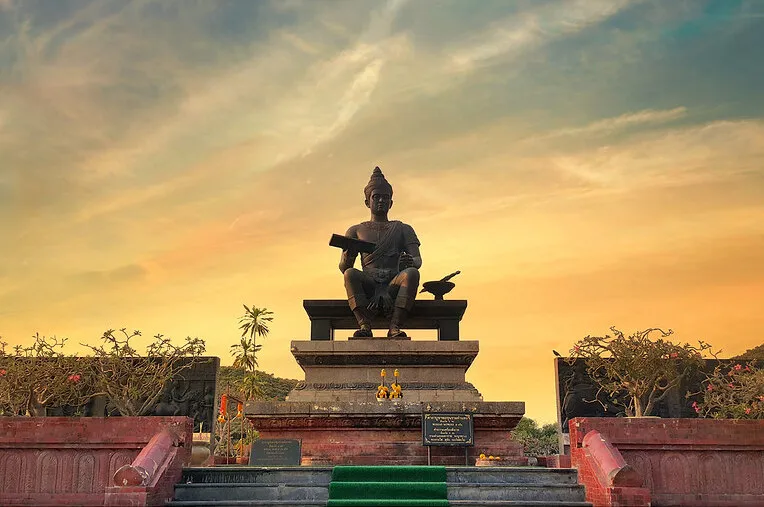
The monument was created in 1975 to commemorate the king’s outstanding contributions to the Thai nation. The bronze image, made of brass mixed with darkened copper, is about 3 meters high and weighs approximately 3 tons. It shows King Ramkhamhaeng seated on the Manangkhasila Asana throne. The face of the statue reflects inspiration from early Sukhothai art, expressing compassion, wisdom, justice, calm authority, and royal dignity.
In the statue, the king’s right hand holds a Thai manuscript, symbolizing knowledge, education, and intellectual leadership. His left hand is shown in a gesture associated with teaching or giving instruction, suggesting the image of a ruler who guided his people directly. Beside the throne is a tray holding a royal sword, representing authority, protection, and the responsibility of kingship. These elements make the monument a carefully designed historical artwork rather than a simple commemorative statue.
The sculptor of the monument was Sanan Silakorn, a master artist of the Fine Arts Department and a student of Professor Silpa Bhirasri, the founder of Silpakorn University and a key figure in the development of modern Thai art. Sanan Silakorn’s work gives the statue a balance between historical imagination and artistic discipline. The royal posture, facial expression, costume, and symbolic objects all reflect careful study of Thai art and Sukhothai visual language.
The idea of building the monument began with public desire in Sukhothai to honor King Ramkhamhaeng appropriately. On 25 January 1964, during a royal visit connected with the opening of the National Museum in Sukhothai, local people expressed their wish for a monument to commemorate the king. The proposal later received official approval on 7 July 1964. A construction committee was established, with the Fine Arts Department responsible for design, sculpting, casting, and artistic supervision.
The foundation-stone ceremony for the monument base took place on 26 November 1969. After the sculptural design and clay model were completed, the casting ceremony was held on 7 December 1970 at the Fine Arts Department. Casting such a large royal monument required great technical precision, from the model and mold to the metal composition and finishing details. The result was a monumental work that still stands as one of the most recognizable symbols of Sukhothai.
After the statue was cast, it was temporarily installed at a ceremonial pavilion near Noen Prasat on 13 April 1975 so that the public could pay respect while the permanent base and surrounding area were still under construction. One year later, on 13 April 1976, the statue was moved to its present base, accompanied by a major celebration. Since then, the monument has become one of the central ceremonial and educational points within Sukhothai Historical Park.
Around the base are relief panels depicting important events and themes from the reign of King Ramkhamhaeng. These reliefs function like an open-air historical lesson. They help visitors understand the king’s achievements in governance, public order, religion, trade, diplomacy, and cultural development. Looking carefully at the reliefs allows travelers to connect the statue with the broader history of the Sukhothai Kingdom.
The monument is also closely connected with Inscription No. 1, commonly known as the Ramkhamhaeng Inscription. This inscription provides crucial information about the king, the customs of Sukhothai, the Manangkhasila throne, the development of Thai writing, religious activities, and the prosperity of the kingdom. Visiting the monument together with Ramkhamhaeng National Museum and nearby monuments allows travelers to understand how written evidence, sculpture, and archaeological landscapes support one another in telling the story of Sukhothai.
In terms of political history, the monument represents the ideal of a king who ruled with justice and closeness to the people. The phrase often associated with Sukhothai rule, “father governing children,” reflects a traditional image of approachable kingship. The seated posture, teaching gesture, manuscript, and throne all reinforce this idea. The monument therefore embodies both royal authority and moral responsibility.
Artistically, the statue is an important example of modern Thai commemorative sculpture inspired by ancient Thai art. It does not simply copy Sukhothai forms, but reinterprets them through modern sculpture and historical research. The result is a work that feels rooted in the ancient city while also belonging to the modern era of national heritage conservation and public commemoration.
The surrounding landscape has been designed to harmonize with Sukhothai Historical Park. The monument stands in an open area with walkways, greenery, and space for visitors to pay respect, take photographs, and study the relief panels. The calm setting allows the monument to feel integrated into the old city rather than isolated from it. This makes it a natural starting point for exploring the historical park.
For first-time visitors, the King Ramkhamhaeng the Great Monument is an excellent place to begin a visit to Sukhothai Historical Park. It introduces the key historical figure associated with the rise and memory of Sukhothai before visitors continue to the temples and ruins. A good route begins with the monument, continues to Wat Mahathat, then moves to Wat Sa Si, Wat Si Sawai, Wat Traphang Ngoen, Ramkhamhaeng National Museum, and Wat Si Chum.
The best time to visit is early morning or late afternoon. In the morning, the atmosphere is quiet, the light is soft, and the weather is more comfortable. Late afternoon gives the bronze statue and surrounding area warmer light, making it suitable for photography. During major cultural events such as the Sukhothai Loy Krathong and Candle Festival, the area around the monument becomes part of the ceremonial and festive landscape of the old city.
The monument also has ceremonial significance. King Ramkhamhaeng Memorial Day falls on 17 January each year, and ceremonies are held in many places to honor the king’s contributions. Within Sukhothai Historical Park, the monument carries special meaning because it stands in the ancient city associated with his legacy. This gives commemorative activities a strong sense of place and historical continuity.
Getting There is straightforward because the monument is located inside Sukhothai Historical Park. From Sukhothai town, follow Highway No. 12 toward Mueang Kao for about 12 kilometers. After entering the historical park, visitors can walk, cycle, take the tram, or use permitted vehicles along designated routes to reach the monument. Travelers arriving by public transport can continue from Sukhothai town by local songthaew, taxi, tuk-tuk, or rental vehicle.
Visitors should dress respectfully, as the monument is a place of remembrance and worship within a national historical site. They should avoid climbing on the base, touching the relief panels, littering, or behaving in a way that disrespects the monument or other visitors. Photography is welcome in appropriate areas, but respectful conduct is important because the site holds cultural and historical significance for Thai people.
For students and history-focused travelers, the monument is a powerful learning site. It connects many themes: the Sukhothai Kingdom, Thai writing, Inscription No. 1, Buddhist culture, early Thai governance, royal memory, and modern heritage conservation. Seeing the monument in the old city helps history feel more concrete and meaningful than reading about it from a book alone.
For international travelers, the King Ramkhamhaeng the Great Monument helps explain important foundations of Thailand’s early civilization. King Ramkhamhaeng is associated with political order, language, trade, religion, and the cultural memory of Sukhothai as a “Dawn of Happiness.” Standing before the statue inside the old city makes it easier to understand that the surrounding ruins are not merely ancient structures, but evidence of a society with leadership, writing, law, faith, and artistic identity.
The King Ramkhamhaeng the Great Monument is therefore much more than a photo stop. It is a place where historical memory, national identity, art, education, and heritage tourism meet. Visitors should spend at least 20 to 30 minutes here to pay respect, study the relief panels, observe the sculpture, and understand its relationship with the wider historical park before continuing to the major temples and museums nearby.
Overall, the monument stands as a powerful symbol of knowledge, justice, cultural pride, and the lasting legacy of Sukhothai. For anyone visiting Sukhothai Historical Park, it provides a meaningful starting point and a deeper interpretive frame for the old city. It helps travelers connect a great historical figure with the real landscape of ancient Sukhothai and makes the visit to the World Heritage site more complete and memorable.
| Name | King Ramkhamhaeng the Great Monument |
| Location | Inside Sukhothai Historical Park, Mueang Kao Subdistrict, Mueang Sukhothai District, Sukhothai Province |
| Address | Sukhothai Historical Park, Mueang Kao Subdistrict, Mueang Sukhothai District, Sukhothai 64210 |
| Coordinates | 17.0198, 99.7033 |
| Highlights | A bronze royal monument of King Ramkhamhaeng seated on the Manangkhasila Asana throne, holding a Thai manuscript and shown in a teaching gesture |
| History | Created in 1975 to commemorate King Ramkhamhaeng the Great and installed on its present base on 13 April 1976 |
| Name Origin | Named after King Ramkhamhaeng the Great, an important ruler of the Phra Ruang dynasty associated with governance, Thai writing, trade, religion, and Sukhothai prosperity |
| Distinctive Features | Darkened brass-and-copper bronze statue, about 3 meters high and weighing about 3 tons, with relief panels around the base depicting events from the king’s reign |
| Sculptor | Sanan Silakorn, master artist of the Fine Arts Department and student of Professor Silpa Bhirasri |
| Importance | Symbol of King Ramkhamhaeng’s legacy in governance, education, Thai writing, law, trade, and the cultural greatness of the Sukhothai Kingdom |
| Travel Information | About 12 km from Sukhothai town via Highway No. 12 to Mueang Kao; inside the park, visitors can walk, cycle, take the tram, or use designated vehicle routes |
| Current Status | A major place of respect and learning inside Sukhothai Historical Park, part of the UNESCO World Heritage property Historic Town of Sukhothai and Associated Historic Towns |
| Open Days | Daily |
| Opening Hours | 06.30 – 19.30 |
| Fees | Covered by the Inner Historic Zone ticket of Sukhothai Historical Park: Thai nationals 20 THB, other nationalities 200 THB, or flat-rate tickets according to the Fine Arts Department’s rate |
| Facilities | Visitor center, restrooms, parking, tram service, bicycle rental, walking routes, interpretive signs, and rest areas inside the historical park |
| Main Areas / Zones | Monument plaza, Manangkhasila Asana throne base, relief panels, worship area, and walking route connected with Wat Mahathat, Wat Sa Si, and Ramkhamhaeng National Museum |
| Caretaker | The Fine Arts Department, Ministry of Culture / Sukhothai Historical Park Office |
| Main Contact Number | Sukhothai Historical Park Tel. 055-697-527 |
| Official Website / Official Page | finearts.go.th/sukhothaihistoricalpark |
| Nearby Tourist Attractions | 1. Wat Mahathat, about 0.3 km 2. Wat Sa Si, about 0.7 km 3. Wat Si Sawai, about 0.9 km 4. Ramkhamhaeng National Museum, about 0.8 km 5. Wat Traphang Ngoen, about 1 km 6. Wat Si Chum, about 2 km |
| Nearby Restaurants | 1. Chanda’s Historical Garden Restaurant, about 0.7 km 2. Tara Restaurant, about 0.8 km 3. Maeboonmee Cafe & Bistro, about 0.9 km 4. Say Hi Cafe, about 1 km 5. Phumphor Coffee Restaurant, about 1.5 km |
| Nearby Accommodations | 1. Wake Up at Muang Kao Boutique Hotel, about 0.6 km, Tel. 062-419-6924 2. Sukhothai Garden, about 0.8 km, Tel. 091-843-1537 3. Smilingface Guesthouse, about 0.9 km, Tel. 086-584-4879 4. Tharaburi Resort Sukhothai, about 1.2 km, Tel. 055-697-132, 094-241-5536 5. Old City Boutique House, about 0.8 km |
Frequently Asked Questions (FAQ)
Q: Where is the King Ramkhamhaeng the Great Monument located?
A: The monument is located inside Sukhothai Historical Park in Mueang Kao Subdistrict, Mueang Sukhothai District, Sukhothai Province, near Wat Mahathat and Ramkhamhaeng National Museum.
Q: When was the King Ramkhamhaeng the Great Monument built?
A: The monument was created in 1975 and installed on its present base on 13 April 1976.
Q: What are the main features of the statue?
A: The bronze statue is about 3 meters high, made of brass mixed with darkened copper, and shows King Ramkhamhaeng seated on the Manangkhasila Asana throne, holding a Thai manuscript.
Q: Who sculpted the King Ramkhamhaeng the Great Monument?
A: The monument was sculpted by Sanan Silakorn, a master artist of the Fine Arts Department and a student of Professor Silpa Bhirasri.
Q: Is there an entrance fee to visit the monument?
A: Yes. The monument is inside the Inner Historic Zone of Sukhothai Historical Park, with admission of 20 THB for Thai nationals and 200 THB for other nationalities, or flat-rate tickets according to the Fine Arts Department’s rate.
Q: What is the best time to visit the monument?
A: Early morning and late afternoon are the best times because the weather is cooler, the light is softer, and nearby monuments can be visited comfortably.
Q: What nearby places can be visited with the monument?
A: Nearby places include Wat Mahathat, Wat Sa Si, Wat Si Sawai, Wat Traphang Ngoen, Ramkhamhaeng National Museum, and Wat Si Chum.
Q: Who manages the King Ramkhamhaeng the Great Monument?
A: The monument is managed by the Fine Arts Department, Ministry of Culture, through Sukhothai Historical Park Office. The contact number is 055-697-527.
 Category: ●Art, Culture and Heritage
 Group: ●Landmarks and Memorials
Last Update : 5 MonthAgo
 Last Update : 5 MonthAgo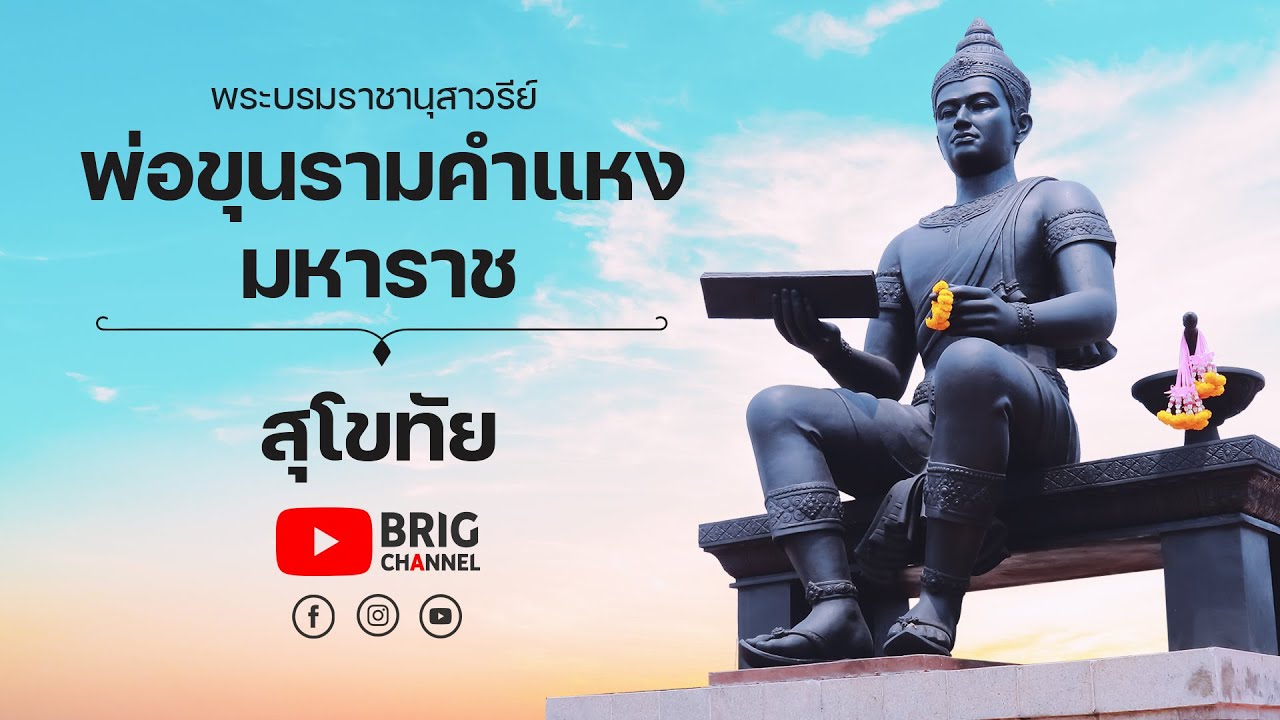
 Click to Access the Navigation Map GPS
The King Ramkhamhaeng Monument Map
Recommend

 Historical Sites and Monuments(4)
Landmarks and Memorials(5)
Historical Sites and Monuments(4)
Landmarks and Memorials(5)
 Art, Craft Centres, Tradition(11)
 Museums(5)
 Places of Worship
 Temple(40)
 Other Sacred Sites(10)
 Suburban Living
 Village, Community(3)
 Nature and Wildlife
 National Parks and Marine Reserves(3)
 Mountain (Doi)(2)
 Dam, Reservoir, Lake(4)
 Waterfalls(8)
 Caves(4)
 River, Canal(2)
 Entertainment and Agricultural
 Farms, Parks and Ecotourism(3)
 Travel Articles, Recipes
 Travel Review, Food Review(1)


