
lovethailand home >North Travel Attractions >Sukhothai Travel Attractions >Si Sat Chana Lai >Si Sat Chana Lai > Wat Chedi Chet Thaeo
TL;DR: Wat Chedi Chet Thaeo is located at Si Satchanalai Historical Park, Si Satchanalai District, Sukhothai Province, open Daily, hours 08.00 – 17.00.
Wat Chedi Chet Thaeo
Open Days: Daily
Opening Hours: 08.00 – 17.00
Wat Chedi Chet Thaeo is one of the most important ancient monuments inside the walled city of Si Satchanalai Historical Park in Sukhothai Province. Located near the center of the ancient city on the same axis as Wat Chang Lom, the temple is one of the most distinctive religious sites in Si Satchanalai. Its layout, numerous subsidiary stupas, diverse architectural forms, and possible association with the Sukhothai royal family make it a key destination for travelers who want to understand the artistic and spiritual depth of the Sukhothai period.
The temple faces southeast and is arranged with a strong sense of order. This orientation and spatial organization reflect the careful planning of ancient Si Satchanalai, a major city of the Sukhothai kingdom. Wat Chedi Chet Thaeo is not an ordinary ruined temple. It is a sacred complex where architecture, Buddhist cosmology, royal memory, and artistic exchange are expressed through rows of stupas, viharn remains, boundary walls, and ritual spaces.
The name “Wat Chedi Chet Thaeo” was given by local people after they saw many stupas arranged in rows. The name means “the temple of seven rows of chedis.” Later archaeological excavation and restoration by the Fine Arts Department revealed that the temple actually contains as many as 9 rows of stupas, with more than 33 stupas and small structures inside the compound. Even so, the traditional name remains widely used and has become one of the most memorable names in Si Satchanalai Historical Park.
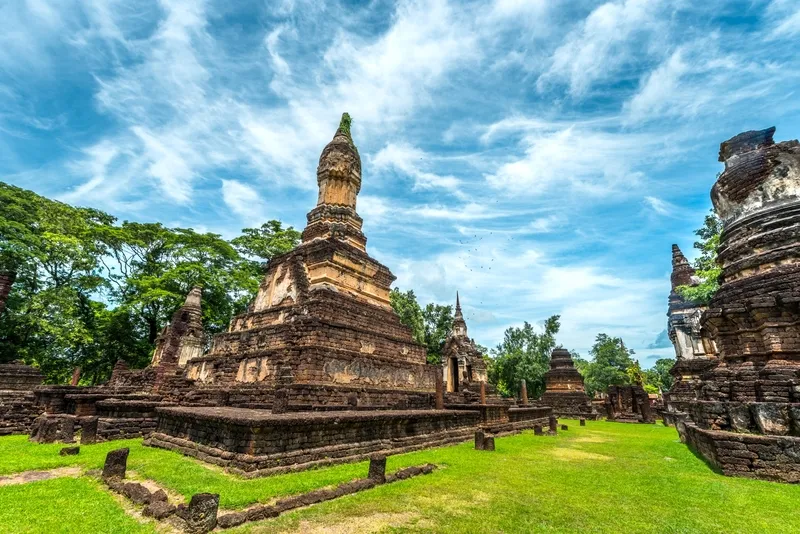
The temple is especially famous for the remarkable variety of stupa forms within one compound. Visitors can see a main lotus-bud or phum khao bin stupa, which is strongly associated with Sukhothai art, alongside Sri Lankan-style stupas, castle-like stupas, Pagan-influenced structures, and small subsidiary monuments. This diversity shows that Si Satchanalai was a place of artistic openness and cultural exchange. It absorbed ideas from Sri Lanka, Pagan, Srivijaya, and other Buddhist traditions, then transformed them into a local Sukhothai expression.
The main stupa stands behind the viharn and takes the form of a lotus-bud stupa, one of the most iconic architectural forms of Sukhothai art. Its shape rises gracefully toward the top, creating a sense of spiritual elevation and calm. The lotus-bud form symbolizes purity and enlightenment, making it an appropriate center for a Buddhist sacred space. This main stupa anchors the temple both visually and ritually.
In front of the main stupa are the remains of the viharn, which once served as the ceremonial hall for worship and religious activities. The arrangement from viharn to main stupa follows a common pattern in Sukhothai Buddhist architecture. As visitors enter from the front, they move through a sequence of sacred space that gradually leads toward the principal monument. This spatial design helps create a sense of religious progression and reverence.
The subsidiary stupas are the most fascinating feature of Wat Chedi Chet Thaeo. They differ in form, size, and artistic detail. Some have square laterite bases with rounded upper sections and arched niches. Others are castle-like structures with high superstructures and mandapa-like niches. Some enshrine or once enshrined stucco Buddha images in walking, standing, or naga-protected postures. Together, these monuments create an open-air gallery of Buddhist architecture from the Sukhothai world.
The beauty of Wat Chedi Chet Thaeo comes not only from individual monuments but also from the way they are arranged together. The stupas stand in ordered rows within a sacred boundary wall, creating a dense but harmonious architectural landscape. Outside the wall are additional features such as an ordination hall and pond, and the temple once had a surrounding moat. These elements suggest that the temple was carefully planned and may have held a special ritual or symbolic status within the ancient city.
One of the most important interpretations of Wat Chedi Chet Thaeo is that it may have functioned as a royal cemetery or memorial site for members of the Sukhothai royal family. Prince Damrong Rajanubhab proposed this interpretation based on the number and arrangement of the subsidiary stupas. If this interpretation is accepted, the temple was not merely a place of worship, but also a site of dynastic memory, funerary ritual, and royal Buddhist merit-making.
King Rama VI also referred to Wat Chedi Chet Thaeo in his royal travel writing “Travel to Mueang Phra Ruang.” He considered the temple significant and associated it with elite or royal patronage. Such historical reflections reinforce the idea that Wat Chedi Chet Thaeo was a high-status temple connected with the political and spiritual life of ancient Si Satchanalai.
The castle-like stupas are among the most impressive architectural elements at the site. Some have mandapa niches, central chambers, and tall superstructures. At the rear of one subsidiary stupa, a niche contains or once contained a stucco Buddha image in the naga-protected posture. This image refers to the episode in Buddhist tradition when the naga king Mucalinda protected the Buddha during meditation. Its presence adds symbolic depth to the temple’s religious program.
Traces of monochrome mural painting have also been found in some niches and interior surfaces. These paintings are associated with Buddhist narratives, celestial worshippers, and royal or elite figures. Although only traces remain, they are valuable evidence that the monuments were once richly decorated, not just plain masonry structures. The original atmosphere would have combined architecture, sculpture, painting, and ritual practice.
Wat Chedi Chet Thaeo is also associated with the concept of a Bodhighara, a structure or sacred space connected with the Bodhi tree. Behind the main stupa outside the boundary wall, there is a square laterite base that has been interpreted in relation to Bodhi-tree worship. This adds another layer to the temple’s meaning, showing that Buddhist devotion at Si Satchanalai included not only stupas and Buddha images, but also sacred botanical symbolism linked to the Buddha’s enlightenment.
When seen within the wider context of Si Satchanalai Historical Park, Wat Chedi Chet Thaeo helps explain the city’s importance in the Sukhothai kingdom. Si Satchanalai was not simply a secondary settlement. It was a major religious, artistic, administrative, and ceramic production center. The architectural richness of Wat Chedi Chet Thaeo confirms the city’s high cultural status and its role in the development of Sukhothai Buddhist art.
A meaningful visit should begin by observing the overall plan of the temple. From the entrance, visitors can see the alignment of the viharn, the main lotus-bud stupa, and the many subsidiary stupas. After that, walk slowly through the compound and compare the different stupa forms. This approach allows visitors to notice the contrast between Sukhothai, Sri Lankan, Pagan, and other artistic influences.
Wat Chedi Chet Thaeo is an abandoned ancient monument under the care of Si Satchanalai Historical Park, Fine Arts Department. It does not have a resident abbot because it is no longer an active monastery. The main caretaker is the historical park authority, which is responsible for conservation, visitor management, interpretation, and protection of the ancient remains. Visitors should not climb the stupas, touch fragile stucco, remove objects, or damage the site in any way.
The best times to visit are early morning and late afternoon. Morning offers a quiet atmosphere and soft light, while late afternoon brings warm tones to the laterite and stupa surfaces. Since the site is mostly open-air, visitors should bring drinking water, a hat, and comfortable walking shoes. Cycling through Si Satchanalai Historical Park is also a pleasant way to explore the nearby temples.
Getting There is easiest by private car. From Sukhothai city, drive north toward Si Satchanalai District, which usually takes about 1 hour. Enter Si Satchanalai Historical Park, then continue to the central zone of the ancient city. Wat Chedi Chet Thaeo is located close to Wat Chang Lom, so the two sites can easily be visited together on foot or by bicycle.
A recommended route is to begin at Wat Chang Lom, then continue to Wat Chedi Chet Thaeo to study the rows of subsidiary stupas. After that, visit Wat Nang Phaya, Wat Suan Kaeo Utthayan Yai, Wat Khao Phanom Phloeng, and, if time allows, Wat Phra Si Rattana Mahathat Ratchaworawihan in the old Chaliang area. Travelers with a full day can also include the Sangkhalok kiln conservation sites to connect religious architecture with the ceramic production heritage of Si Satchanalai.
For photography, Wat Chedi Chet Thaeo offers many impressive angles: the main stupa framed by rows of smaller stupas, the repeating forms of the subsidiary chedis, the mandapa niches, the boundary wall, and views showing several monuments layered together. However, photography should be done responsibly. Visitors should not stand on ancient bases or climb the ruins for a better angle, as this can damage the monument.
Wat Chedi Chet Thaeo rewards slow observation. At first glance, it may appear to be a group of old stupas, but each monument has its own form, meaning, and cultural background. The temple is therefore an excellent learning site for students, travelers, art historians, and anyone interested in the World Heritage landscape of Sukhothai and Si Satchanalai.
In summary, Wat Chedi Chet Thaeo in Sukhothai Province is one of the most important ancient monuments in Si Satchanalai Historical Park. Its highlights include the lotus-bud main stupa, more than 33 subsidiary stupas and small structures, diverse artistic influences from Sri Lanka, Pagan, Srivijaya, and Sukhothai, and the interpretation that it may have served as a royal cemetery of the Sukhothai dynasty. The temple is not only a historical attraction, but also a powerful record of Buddhist belief, royal memory, artistic exchange, and the cultural sophistication of ancient Si Satchanalai.
| Name | Wat Chedi Chet Thaeo |
| Location | Si Satchanalai Historical Park, Si Satchanalai District, Sukhothai Province |
| Address | Si Satchanalai Subdistrict, Si Satchanalai District, Sukhothai 64190, Thailand |
| Coordinates | Approximately 17.4270, 99.7890 |
| Highlights | Lotus-bud main stupa, more than 33 subsidiary stupas and small structures, boundary wall, ordination hall, pond, and artistic influences from Sri Lanka, Pagan, Srivijaya, and Sukhothai |
| History | Believed to have been established during the Sukhothai period around the 19th Buddhist century and associated with the central sacred zone of ancient Si Satchanalai |
| Key Evidence | Main lotus-bud stupa, viharn remains, 33 subsidiary stupas and small structures, boundary wall, ordination hall, pond, naga-protected Buddha image, mural traces, and Bodhighara base |
| Name Origin | The name means “temple of seven rows of chedis,” based on the local impression of many stupas arranged in rows; later excavation revealed as many as 9 rows |
| Distinctive Features | One of the richest stupa complexes in Si Satchanalai and possibly a royal cemetery or memorial site of the Sukhothai dynasty |
| Travel Information | About 1 hour by car from Sukhothai city to Si Satchanalai Historical Park, then walk or cycle within the ancient city zone |
| Current Status | Abandoned ancient monument under the care of Si Satchanalai Historical Park, Fine Arts Department |
| Open Days | Daily |
| Opening Hours | 08.00 – 17.00 |
| Facilities | Walking paths, parking areas, visitor service points, restrooms, and bicycle rental services within Si Satchanalai Historical Park |
| Main Areas / Zones | Main stupa, viharn, subsidiary stupas, boundary wall, ordination hall, pond, mandapa niches, castle-like stupas, and Bodhighara base |
| Caretaker | Si Satchanalai Historical Park, Fine Arts Department |
| Main Contact Number | 055-950-714, 061-268-6383 |
| Official Website / Official Page | Si Satchanalai Historical Park, Fine Arts Department |
| Nearby Tourist Attractions | 1. Wat Chang Lom, about 0.2 km 2. Wat Nang Phaya, about 0.4 km 3. Wat Suan Kaeo Utthayan Yai, about 0.6 km 4. Wat Khao Phanom Phloeng, about 1 km 5. Si Satchanalai Historical Park Visitor Center, about 1 km 6. Wat Phra Si Rattana Mahathat Ratchaworawihan, about 3 km 7. Sangkhalok Kiln Conservation Site No. 61 And 42, about 6 km |
| Nearby Restaurants | 1. ChomPrang, about 3 km, Tel. 063-465-6168, 083-229-9598 2. Thaowali, about 3 km 3. Jeedja Fresh Coffee, about 3 km 4. Kaeng Sak Beer Garden, about 4 km 5. Baan Klang Na Si Satchanalai Restaurant, about 6 km 6. Krua Ton Aoy Si Satchanalai, about 8 km, Tel. 087-208-5526, 098-156-9393 |
| Nearby Accommodations | 1. Sisatchanalai Heritage Resort, about 3 km, Tel. 055-615-423, 086-443-2799, 062-869-6988 2. Resort Ban Phra Ruang Phra Prang Si Satchanalai, about 4 km, Tel. 080-509-7345 3. Nong Or Blue House Resort, about 7 km 4. Downhill Resort, about 10 km 5. Chanalai Resort And Hotel, about 12 km, Tel. 055-672-555 |
Frequently Asked Questions (FAQ)
Q: Where is Wat Chedi Chet Thaeo located?
A: Wat Chedi Chet Thaeo is located inside the walled ancient city of Si Satchanalai Historical Park in Si Satchanalai District, Sukhothai Province, near Wat Chang Lom.
Q: Is Wat Chedi Chet Thaeo still an active monastery?
A: No. It is an abandoned ancient monument under the care of Si Satchanalai Historical Park, Fine Arts Department, and does not have a resident abbot.
Q: Why is it called Wat Chedi Chet Thaeo?
A: The name comes from the local impression of many stupas arranged in rows. Although the name means “seven rows,” later excavation revealed as many as 9 rows of stupas.
Q: What are the main highlights of Wat Chedi Chet Thaeo?
A: The main highlights are the lotus-bud main stupa, more than 33 subsidiary stupas and small structures, diverse architectural styles, and the interpretation that it may have been a royal cemetery of the Sukhothai dynasty.
Q: What are the opening hours?
A: Si Satchanalai Historical Park is open daily from 08.00 to 17.00.
Q: How long should visitors spend at Wat Chedi Chet Thaeo?
A: Allow about 45 minutes to 1 hour for this temple alone, or at least half a day if visiting it together with Wat Chang Lom, Wat Nang Phaya, and other monuments in the historical park.
Q: How can I get there from Sukhothai city?
A: The easiest way is by private car from Sukhothai city to Si Satchanalai District, which usually takes about 1 hour, then walk or cycle inside the historical park.
Q: What nearby attractions can be visited with Wat Chedi Chet Thaeo?
A: Nearby attractions include Wat Chang Lom, Wat Nang Phaya, Wat Suan Kaeo Utthayan Yai, Wat Khao Phanom Phloeng, Wat Phra Si Rattana Mahathat Ratchaworawihan, and the Sangkhalok kiln conservation sites.
 Category: ●Places of Worship
 Group: ●Temple
Last Update : 5 MonthAgo
 Last Update : 5 MonthAgo
 Click to Access the Navigation Map GPS
Wat Chedi Chet Thaeo Map
Recommend

 Art, Culture and Heritage
 Historical Sites and Monuments(4)
 Landmarks and Memorials(5)
 Art, Craft Centres, Tradition(11)
 Museums(5)
Temple(40)
Museums(5)
Temple(40)
 Other Sacred Sites(10)
 Suburban Living
 Village, Community(3)
 Nature and Wildlife
 National Parks and Marine Reserves(3)
 Mountain (Doi)(2)
 Dam, Reservoir, Lake(4)
 Waterfalls(8)
 Caves(4)
 River, Canal(2)
 Entertainment and Agricultural
 Farms, Parks and Ecotourism(3)
 Travel Articles, Recipes
 Travel Review, Food Review(1)


