
lovethailand home >North Travel Attractions >Sukhothai Travel Attractions >Si Sat Chana Lai >Hat Sieow > Wat Hat Siao
TL;DR: Wat Hat Siao is located at Ban Hat Siao, Village No. 2, Hat Siao Subdistrict, Si Satchanalai District, Sukhothai Province, open Daily, hours Open for merit-making and daytime temple visits.
Wat Hat Siao
Open Days: Daily
Opening Hours: Open for merit-making and daytime temple visits
Wat Hat Siao is located at 51/2, Village No. 2, Ban Hat Siao, Hat Siao Subdistrict, Si Satchanalai District, Sukhothai Province. Standing on the eastern bank of the Yom River, it is one of the most important Buddhist temples of the Thai Phuan community in Hat Siao. The temple was formerly known as Wat Pho Sai before it was later renamed Wat Hat Siao. Today, it remains a living religious and cultural center where Buddhist faith, local history, Thai Phuan architecture, and community identity are closely connected.
Wat Hat Siao is especially important because it preserves the story of an old Thai Phuan community along the Yom River. It is not only a place for Buddhist ceremonies, but also a historical landmark that reflects the cooperation between monks and laypeople in earlier generations. For foreign travelers who want to understand Sukhothai beyond the ancient city and the historical parks, Wat Hat Siao provides a valuable window into living local culture, ethnic identity, and rural Buddhist life.
According to the inscription recorded on the wall of the ordination hall, the temple celebration was held on Tuesday, the full moon day of the fifth lunar month in the Year of the Rabbit, corresponding to 2 April 1844. This evidence confirms that Wat Hat Siao had already become an established religious place by the early Rattanakosin period. The temple therefore has a long history of more than 167 years and remains one of the oldest and most meaningful sacred places in the Thai Phuan community of Hat Siao.
The construction of Wat Hat Siao was made possible through cooperation between lay leaders and Buddhist monks. On the lay side, Saen Panya, Saen Chan, and Saen Phon are remembered as important supporters of the temple’s construction. On the monastic side, Chao Hua Ai Somdet of Wat Ban Tat played a leading role. This cooperation shows how temple building in traditional Thai communities was not merely a construction project, but a collective act of faith, social organization, and cultural foundation.
The temple covers an area of 6 rai, 2 ngan, and 48 square wa. Although it is not a very large temple by area, every part of the compound is culturally significant. The temple is closely integrated with the surrounding community, public roads, private land, and the Yom River landscape. This setting shows that Wat Hat Siao is part of the everyday life of the community rather than a separate religious monument isolated from local people.
A major historical event occurred in 1917 when Somdet Phra Maha Samana Chao Krom Phraya Vajirananavarorasa stayed at the temple during an inspection of the monastic community. At that time, the temple, then known as Wat Pho Sai, was renamed Wat Hat Siao in accordance with the district name. This event gave the temple an important place in local religious history and helped connect the identity of the temple with the wider identity of Hat Siao.
In 1918, Phra Khru Uttama, an important abbot of the temple, received the ecclesiastical title Phra Khru Sattha Sophon. This event further reflects the temple’s importance within the local Buddhist community. The recognition of the abbot shows that Wat Hat Siao was not only a village temple, but also a respected religious institution within the wider monastic network of the area.
Wat Hat Siao received its most recent royal boundary for the ordination hall on 16 October 1986. In Thai Buddhism, the royal boundary is important because it defines the sacred space for formal monastic ceremonies such as ordination. This confirms that the temple continues to function as a complete and active Buddhist institution for the local community.
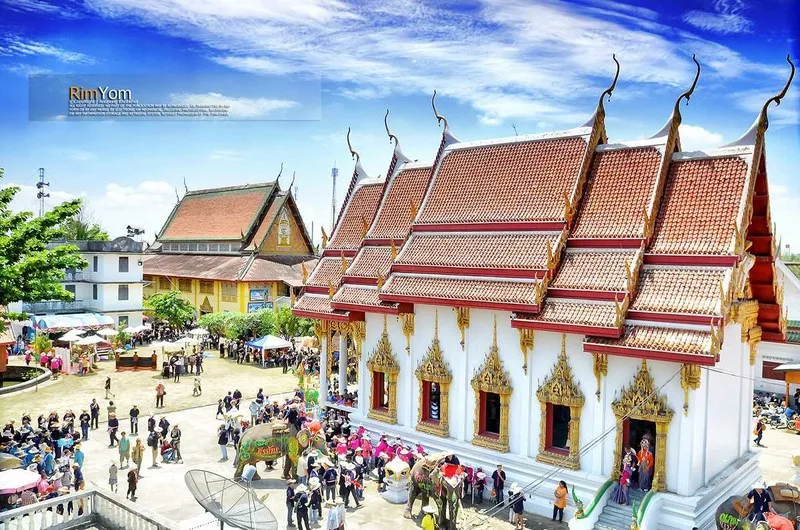
The most distinctive feature of Wat Hat Siao is its Thai Phuan-style ordination hall, one of the most valuable architectural remains of the community. The building reflects the craftsmanship, proportions, materials, and aesthetic taste of Thai Phuan artisans. Its beauty does not come from monumentality alone, but from careful details, local identity, and a sense of sacred simplicity.
Traditional Thai Phuan temple architecture at Wat Hat Siao includes several important elements, such as 8 arched gateways, stupas, a scripture hall built over water, and the shrine known locally as Chao Pho Pu Kue. These elements show that the temple is not only a Buddhist site, but also a cultural space where Buddhism, ancestral belief, and local sacred traditions coexist naturally.
The scripture hall over water is especially meaningful. In Thai temple tradition, a scripture hall is used to preserve Buddhist texts and important manuscripts. Building it over water helped protect the texts from termites, insects, and other damage in the past. At the same time, it also created a beautiful and symbolic landscape within the temple compound. Its presence reflects the importance of Buddhist learning and manuscript preservation in the Thai Phuan community.
The shrine of Chao Pho Pu Kue is another important sacred element of the temple. For local people, it represents respect for ancestral power, protective spirits, and sacred guardians of the community. This belief is not separate from Buddhism in local practice; instead, it exists alongside temple ceremonies and community life. The shrine helps visitors understand how Thai Phuan people integrate Buddhist devotion with local memory and ancestral respect.
Wat Hat Siao is deeply connected with Thai Phuan identity. The Thai Phuan people of Hat Siao are known for their language, textiles, traditional dress, rituals, and community customs. The temple serves as a religious center where these cultural elements continue to be expressed. For travelers, visiting the temple can be combined with learning about Thai Phuan weaving, traditional textiles, and local customs in Ban Hat Siao.
One of the best-known Thai Phuan traditions in the area is the elephant ordination procession of Ban Hat Siao. This tradition reflects Buddhist faith, gratitude to parents, and the distinctive cultural identity of the Thai Phuan community. Although the procession involves many parts of the community, the temple remains important as a sacred setting and religious center connected with the meaning of ordination.
Wat Hat Siao is also a valuable place for local historical learning. Visitors can learn about the former name Wat Pho Sai, the renaming of the temple in 1917, the role of Thai Phuan leaders and monks in its construction, and the relationship between the temple and the Yom River community. These stories help travelers see that a temple can function as a historical archive in built form, preserving memories that are not always visible in museum displays alone.
The temple’s location near the Yom River adds to its cultural meaning. Rivers have always shaped settlement, agriculture, transportation, and community life in Thailand. A temple located near a river often becomes a natural center of both physical and spiritual life. Wat Hat Siao reflects this relationship clearly. It belongs not only to a religious tradition, but also to the riverine landscape that has supported the Hat Siao community for generations.
A visit to Wat Hat Siao should be made slowly and respectfully. Visitors can begin with the Thai Phuan-style ordination hall, then observe the arched gateways, stupas, scripture hall over water, and Chao Pho Pu Kue shrine. Each element has its own meaning, whether architectural, religious, or cultural. Seeing them together gives a fuller understanding of the temple as a living cultural landscape.
The current abbot and caretaker of Wat Hat Siao is Phra Khru Sangharak Khit Sirichanto. Under monastic care, the temple continues to serve as a religious center for Hat Siao, hosting Buddhist ceremonies, merit-making activities, ordinations, and community events. The continued activity of the temple allows the past and present of Hat Siao to remain connected.
For travelers interested in local culture, Wat Hat Siao is best visited together with nearby cultural sites such as Sathorn Gold Textile Museum, Ban Hat Siao Thai Phuan community, Wat Phra Si Rattana Mahathat Chaliang, Si Satchanalai Historical Park, and the Sangkhalok Kiln Conservation and Study Center. This route allows visitors to understand Si Satchanalai through religion, ethnic identity, textiles, ancient monuments, and ceramic heritage.
Getting There is most convenient by private car. Travelers should drive to Si Satchanalai District in Sukhothai Province and continue to Hat Siao Subdistrict. The temple is located in Ban Hat Siao, Village No. 2, close to the local community and the Yom River. Visitors can use navigation by searching for Wat Hat Siao or the former name Wat Pho Sai. The temple can be combined in a one-day cultural route with Sathorn Gold Textile Museum and Si Satchanalai Historical Park.
Visitors should dress modestly, speak respectfully, and behave calmly inside the temple grounds. If taking photos of monks, ceremonies, or local people, it is polite to ask permission first. Visitors should also respect the sacred area of Chao Pho Pu Kue Shrine and the old architectural elements of the temple, as these are important parts of the community’s heritage.
Wat Hat Siao is therefore a temple of many layers. It is an old Mahanikaya Buddhist temple, a center of Thai Phuan culture, a place of architectural heritage, a riverside community landmark, and a living spiritual space. A visit to Wat Hat Siao offers travelers the chance to experience the depth of Sukhothai’s local culture beyond the ancient ruins, and to understand how faith, craftsmanship, history, and community identity continue to shape everyday life in Hat Siao.
| Name | Wat Hat Siao, Formerly Wat Pho Sai |
| Location | Ban Hat Siao, Village No. 2, Hat Siao Subdistrict, Si Satchanalai District, Sukhothai Province |
| Address | 51/2 Village No. 2, Ban Hat Siao, Hat Siao Subdistrict, Si Satchanalai District, Sukhothai 64130, Thailand |
| Highlights | Old Thai Phuan-style ordination hall, scripture hall over water, arched gateways, stupas, Chao Pho Pu Kue Shrine, and the temple celebration record dated 2 April 1844 |
| History | Built before 1844, formerly known as Wat Pho Sai, renamed Wat Hat Siao in 1917, and received its latest royal boundary on 16 October 1986 |
| Name Origin | The temple was formerly called Wat Pho Sai and was later renamed Wat Hat Siao after the district and the Hat Siao riverside community |
| Distinctive Features | A Mahanikaya temple covering 6 rai, 2 ngan, and 48 square wa, reflecting Thai Phuan architecture and culture through its ordination hall, gateways, scripture hall, stupas, and community shrine |
| Travel Information | Travel by private car to Si Satchanalai District, continue to Hat Siao Subdistrict and Ban Hat Siao, Village No. 2. The temple is near the local community and the Yom River and can be combined with Sathorn Gold Textile Museum and Si Satchanalai Historical Park |
| Current Status | An old active Buddhist temple serving as a religious and cultural center of the Thai Phuan community in Hat Siao |
| Open Days | Daily |
| Opening Hours | Open for merit-making and daytime temple visits |
| Fees | No Admission Fee |
| Facilities | Merit-making areas, ordination hall, temple courtyard, ceremonial spaces, parking space within or near the temple, and basic facilities depending on local conditions |
| Main Areas / Zones | Thai Phuan-style ordination hall, arched gateways, stupas, scripture hall over water, Chao Pho Pu Kue Shrine, activity courtyard, and community religious areas |
| Abbot / Caretaker | Phra Khru Sangharak Khit Sirichanto |
| Important Related Tradition | Thai Phuan elephant ordination procession of Ban Hat Siao, Buddhist merit-making days, and cultural activities of the Thai Phuan community |
| Nearby Tourist Attractions | 1. Sathorn Gold Textile Museum, about 1 km 2. Ban Hat Siao Thai Phuan Community, about 1 km 3. Wat Phra Si Rattana Mahathat Chaliang, about 11 km 4. Si Satchanalai Historical Park, about 12 km 5. Sangkhalok Kiln Conservation And Study Center, about 14 km |
| Nearby Restaurants | 1. Sathorn Restaurant, about 1 km, Tel. 055-671129 2. Local Restaurants In Hat Siao Community, about 1 km 3. Sukhothai Noodle Hat Siao, about 2 km 4. Ban Kaeng Restaurant, about 8 km 5. Rim Yom Si Satchanalai Restaurant, about 10 km |
| Nearby Accommodations | 1. Tonpalm Resort, about 1 km, Tel. 089-461-8323, 095-340-9738 2. Smile Loft Resort, about 2 km, Tel. 055-672456 3. Si Satchanalai Heritage, about 4 km, Tel. 055-672555 4. Chanalai Resort And Hotel, about 5 km, Tel. 061-273-4888 5. Resort Ban Phra Ruang Phra Prang Si Satchanalai, about 12 km, Tel. 080-509-7345 |
Frequently Asked Questions (FAQ)
Q: Where is Wat Hat Siao located?
A: Wat Hat Siao is located at 51/2, Village No. 2, Ban Hat Siao, Hat Siao Subdistrict, Si Satchanalai District, Sukhothai Province.
Q: What was the former name of Wat Hat Siao?
A: The temple was formerly known as Wat Pho Sai before it was renamed Wat Hat Siao in 1917.
Q: Why is Wat Hat Siao important?
A: Wat Hat Siao is an old Thai Phuan community temple with a temple celebration record dated 2 April 1844 and remains an important religious, cultural, and historical center of Ban Hat Siao.
Q: What are the main highlights of Wat Hat Siao?
A: The main highlights include the Thai Phuan-style ordination hall, arched gateways, scripture hall over water, stupas, and Chao Pho Pu Kue Shrine.
Q: Who is the abbot of Wat Hat Siao?
A: The abbot of Wat Hat Siao is Phra Khru Sangharak Khit Sirichanto.
Q: What Thai Phuan tradition is associated with Hat Siao?
A: Hat Siao is strongly associated with the Thai Phuan elephant ordination procession, a well-known cultural tradition connected with Buddhist ordination and local identity.
Q: What nearby attractions should travelers visit with Wat Hat Siao?
A: Nearby attractions include Sathorn Gold Textile Museum, Ban Hat Siao Thai Phuan Community, Wat Phra Si Rattana Mahathat Chaliang, Si Satchanalai Historical Park, and the Sangkhalok Kiln Conservation and Study Center.
Q: Is there an admission fee to visit Wat Hat Siao?
A: No. There is no admission fee. Visitors should dress respectfully and behave calmly inside the temple grounds.
 Category: ●Places of Worship
 Group: ●Temple
Last Update : 4 MonthAgo
 Last Update : 4 MonthAgo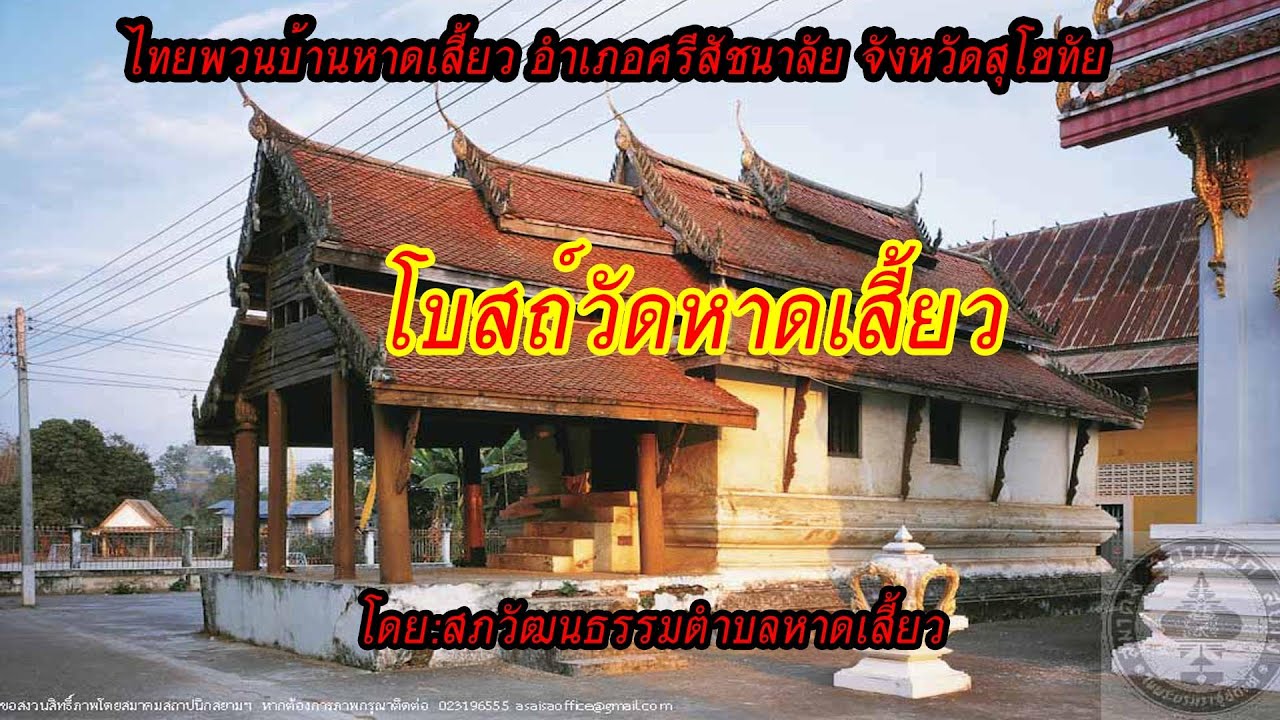
 Click to Access the Navigation Map GPS
Wat Hat Siao Map
Gellery
Recommend

 Art, Culture and Heritage
 Historical Sites and Monuments(4)
 Landmarks and Memorials(5)
 Art, Craft Centres, Tradition(11)
 Museums(5)
Temple(40)
Museums(5)
Temple(40)
 Other Sacred Sites(10)
 Suburban Living
 Village, Community(3)
 Nature and Wildlife
 National Parks and Marine Reserves(3)
 Mountain (Doi)(2)
 Dam, Reservoir, Lake(4)
 Waterfalls(8)
 Caves(4)
 River, Canal(2)
 Entertainment and Agricultural
 Farms, Parks and Ecotourism(3)


