
lovethailand home >North Travel Attractions >Phitsanulok Travel Attractions >Nakhon Thai >Nakhon Thai > Pak Thong Chai Tradition
TL;DR: Pak Thong Chai Tradition, open Held Annually Around The 14th-15th Waxing Moon Days Of The 12th Lunar Month, hours Schedule Varies By Annual Announcement From Nakhon Thai District And Local.
Pak Thong Chai Tradition
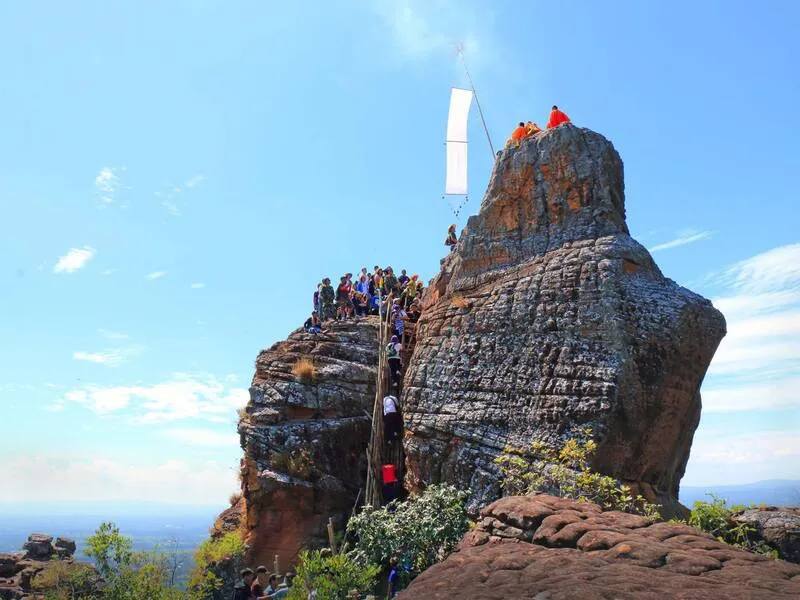
Open Days: Held Annually Around The 14th-15th Waxing Moon Days Of The 12th Lunar Month
Opening Hours: Schedule Varies By Annual Announcement From Nakhon Thai District And Local Organizers
Pak Thong Chai Tradition in Nakhon Thai District, Phitsanulok Province, is one of the most distinctive local traditions of lower northern Thailand. The heart of the ceremony is the carrying of 3 white cloth flags to be planted on the summits of Khao Chan Phen, Khao Yan Hai, and Khao Chang Luang. The tradition is performed for auspiciousness and in memory of Pho Khun Bang Klang Thao, also known locally as Pho Khun Bang Klang Hao and historically associated with Pho Khun Si Inthrathit, the first king of the Sukhothai Kingdom. This tradition brings together history, faith, community unity, sacred mountains, and the identity of the people of Nakhon Thai.
In simple terms, Pak Thong Chai is an annual ceremony held around the 14th-15th waxing moon days of the 12th lunar month, near Loy Krathong. Local people prepare 3 white cloth flags, perform ritual offerings, organize processions, and carry the flags up to 3 sacred mountain points: Khao Chan Phen, Khao Yan Hai, and Khao Chang Luang. The act commemorates the victory and heroic memory of Pho Khun Bang Klang Thao, expresses the community’s wish for protection and prosperity, and strengthens the bond between local people, their ancestors, and the natural landscape.
Nakhon Thai District is historically significant because local memory connects the area with Mueang Bang Yang and the story of Pho Khun Bang Klang Thao. He is remembered as a brave leader who played an important role in the early political formation of the Thai realm. For local people, he is not only a figure from history but also a spiritual and cultural reference point. The Pak Thong Chai tradition allows the community to honor him through action, movement, ritual, and shared participation rather than through words alone.
The timing of the ceremony is closely connected with the full moon of the 12th lunar month. In the past, local people might choose one day between the 1st and 14th waxing moon days of the 12th lunar month to perform the ritual. Today, the tradition is organized more systematically, usually around the 14th-15th waxing moon days. This period coincides with the Loy Krathong season, a time when water, moonlight, merit-making, gratitude, and community gatherings are already important in Thai cultural life.
The central ritual object is the white cloth flag. The white color represents purity, peace, and auspiciousness. The flag is not simply a decorative object. It is a ritual object created through collective effort. From preparing cotton and weaving the cloth to attaching the flag to bamboo poles and carrying it up the mountain, every step reflects the unity of the people. The flags are the visible form of the community’s faith.
In the past, the preparation of the flags began before the main ceremony. At night, a male villager would beat a gong while leading monks to receive white cotton flowers as offerings. Elderly women from villages near Wat Nuea, Wat Klang, and Wat Hua Rong would then invite local people to help dry, press, fluff, spin, and weave the cotton. Once the soft white thread was ready, the community would weave 3 white flags from 3 villages. This process shows that the tradition began long before the mountain ceremony. It began with shared labor, devotion, and preparation within the village.
The role of women in this tradition is especially important. The preparation of cotton and weaving of the flags requires patience, skill, and knowledge of traditional textile work. Elderly women and local weavers therefore act as carriers of cultural wisdom. The flags are not purchased objects but sacred items made by the hands of the community. This gives each flag emotional and cultural depth.
Today, some details of cotton preparation have changed, but the core meaning remains. People from communities near Wat Nuea, Wat Klang, and Wat Hua Rong still prepare 3 white flags, each about 90 centimeters wide and about 4 meters long. The flags are often decorated with beautiful patterns along the edges. This continuation shows that Nakhon Thai does not preserve only the final act of planting the flags; it also preserves the craft, collaboration, and symbolic meaning behind them.
On the morning of the 14th waxing moon day of the 12th lunar month, the flags are taken for ritual offerings at the monument of Pho Khun Bang Klang Thao or another place connected with his memory. In the afternoon, villages may organize processions, and at night there may be festive activities. These activities turn Pak Thong Chai into both a sacred ritual and a community festival. Different villages come together, express their local identity, and celebrate a tradition that belongs to all of Nakhon Thai.
On the morning of the 15th waxing moon day, processions move through the district before participants walk through fields and natural paths toward Khao Chang Luang. The climb requires physical effort, patience, and cooperation. Carrying the flags up the mountain is therefore not merely a practical action. It is a journey of faith that involves body, mind, landscape, and community.
The 3 important flag-planting points are Khao Chan Phen, Khao Yan Hai, and Khao Chang Luang. Each summit carries meaning as a sacred place within the local landscape. The white flags are tied to bamboo poles and planted into natural rock crevices. The act reflects the belief that high mountains are places connected with sacred power. Planting flags on the mountains is a symbolic declaration of victory, blessing, and protection for the community.
In the traditional form of the ceremony, villagers brought sweet and savory food and invited monks to the Khao Chang Luang range. They offered the midday meal to the monks. Local leaders recited the offering of the white flags in Pali, and the monks chanted auspicious verses. After the ritual, villagers planted the flags on the mountain summits in sequence. Once the ceremony was completed, people played traditional music and danced joyfully as they descended the mountain. This combination of sacred ritual and communal joy is one of the most beautiful features of Thai local traditions.
The belief surrounding Pak Thong Chai remains strong. Local people believe that if the tradition is not performed, Nakhon Thai may face misfortune, illness, natural disasters, or fires. This belief gives the tradition deep social and spiritual importance. It is not merely entertainment or a symbolic show. It is a duty of the community to maintain protection, continuity, and confidence in the well-being of the town.
Pak Thong Chai also expresses the relationship between the people of Nakhon Thai and Pho Khun Bang Klang Thao. The community does not remember him only as a historical figure. They remember him through an annual ritual that requires action. The flags, procession, chanting, mountain path, and collective footsteps make history present again every year.
Culturally, the tradition is highly valuable because it strengthens people’s attachment to their hometown. Preparing flags, organizing processions, cooking food, climbing the mountain, and performing the ritual together all require cooperation. The tradition therefore functions as a social mechanism that keeps the people of Nakhon Thai connected across generations.
Geographically, Pak Thong Chai transforms Khao Chang Luang into a sacred cultural landscape. The mountain is not only a natural site; it is a place of memory, ceremony, and identity. Participants who climb the mountain see the surrounding views of Nakhon Thai and feel a direct connection with the land that has shaped local life. The landscape itself becomes part of the ritual.
For travelers, Pak Thong Chai is a rare opportunity to witness a living local tradition. Visitors can see flag processions, community participation, ritual offerings, mountain climbing, and the planting of the flags. The experience is different from visiting a normal tourist attraction because the tradition is still actively practiced by local people. Travelers witness not only a place, but a cultural act in motion.
Visitors should join the event respectfully. Modest but practical clothing is recommended, along with good walking shoes, drinking water, and sun protection. Travelers should follow the instructions of local officials and community leaders. They should not touch or move the ritual flags without permission, should not overtake the procession disrespectfully, and should not climb dangerous rocks or leave the designated route.
At night, the festival atmosphere often continues with celebration and Loy Krathong activities. Nakhon Thai becomes lively with community events, local food, stalls, and cultural gatherings. Travelers who wish to stay overnight should book accommodation early because the number of visitors increases during the festival period.
Getting There is most convenient by private car. Travelers can start from Phitsanulok city and drive toward Nakhon Thai District, then continue to the event areas announced for that year. Important related sites include Wat Klang, the monument of Pho Khun Bang Klang Thao, the procession area, and Khao Chang Luang. A private vehicle also allows visitors to continue to nearby attractions such as Nakhon Thai Town Museum, Phu Hin Rong Kla National Park, and Phu Lom Lo.
Those who plan to climb Khao Chang Luang should prepare physically. The route involves walking and may include steep or uneven sections. Visitors should stay on the designated path, avoid littering, protect the natural environment, and respect local guidance. Khao Chang Luang is not only a scenic mountain; it is a historical and sacred site for the people of Nakhon Thai.
From a conservation perspective, Pak Thong Chai should be preserved in both form and meaning. Keeping only the procession or festive activities is not enough if younger generations no longer understand the story of Pho Khun Bang Klang Thao, the sacred mountains, the white flags, and the community’s belief. Clear transmission of meaning helps ensure that the tradition remains alive rather than becoming only a performance.
The tradition is also valuable for understanding Thai society. It shows how local history can live through annual ritual. The community uses flags, cloth, mountains, chants, and processions as tools for preserving shared memory. When many generations participate in the same ritual, young people see real examples of cooperation, respect for ancestors, and cultural responsibility.
For foreign travelers, Pak Thong Chai is a meaningful example of a Thai local tradition that combines history, sacred landscape, ritual, and community unity. It shows that Thai culture is not limited to temples or large festivals in major cities. Some of the most powerful traditions take place in small communities and mountain landscapes where people continue to honor their ancestors and protect their cultural identity.
In summary, Pak Thong Chai Tradition in Nakhon Thai District, Phitsanulok Province, is a deeply meaningful local tradition held around the 14th-15th waxing moon days of the 12th lunar month. Its central act is the planting of 3 white flags on Khao Chan Phen, Khao Yan Hai, and Khao Chang Luang to bring auspiciousness and honor Pho Khun Bang Klang Thao. The tradition reflects faith, unity, local identity, sacred mountains, and the bond between the people of Nakhon Thai and their homeland. It is a cultural heritage worthy of respect, preservation, and thoughtful visitation.
| Tradition Name | Pak Thong Chai Tradition |
| Venue | Nakhon Thai District, Phitsanulok Province, especially Khao Chang Luang, Khao Chan Phen, Khao Yan Hai, Wat Klang, and community areas in Nakhon Thai |
| Main Area | Khao Chang Luang, Nakhon Thai Subdistrict, Nakhon Thai District, Phitsanulok Province 65120 |
| Reference Coordinates | 17.1000, 100.8350 |
| Festival Period | Around the 14th-15th waxing moon days of the 12th lunar month, with the main flag-planting ceremony on the 15th waxing moon day |
| Importance | A major Nakhon Thai tradition honoring Pho Khun Bang Klang Thao or Pho Khun Si Inthrathit and asking for auspiciousness for the community |
| History / Background | Rooted in local belief and the victory legend of Pho Khun Bang Klang Thao, with villagers carrying 3 white flags to plant on sacred mountain summits |
| Main Rituals | Preparing cotton and weaving white flags, ritual offerings, processions, offering the midday meal to monks, auspicious chanting, and planting flags on Khao Chan Phen, Khao Yan Hai, and Khao Chang Luang |
| Ritual Objects | 3 white cloth flags, each about 90 centimeters wide and about 4 meters long, bamboo poles, sacred mountain summits, and the Nakhon Thai community procession |
| Travel Information | Travel from Phitsanulok city to Nakhon Thai District, then continue to the annual event areas and Khao Chang Luang. Private car is the most convenient option, and visitors should follow annual traffic and parking announcements. |
| Current Status | A major annual local tradition of Nakhon Thai District, Phitsanulok Province, with the flag-planting ceremony still practiced on Khao Chang Luang |
| Facilities | Community event areas, procession assembly points, ritual areas, festival stalls, local authority service points, restaurants, and accommodations in Nakhon Thai District |
| Main Areas / Zones | Wat Klang, Pho Khun Bang Klang Thao Monument, Khao Chan Phen, Khao Yan Hai, Khao Chang Luang, and Loy Krathong event areas in Nakhon Thai |
| Caretaker / Local Authority | Nakhon Thai District Office, Nakhon Thai Subdistrict Municipality, Phitsanulok Province, and related local agencies |
| Main Contact Number | Nakhon Thai District Office Tel. 055-388985, 055-389499, 055-389082 Nakhon Thai Subdistrict Municipality Tel. 0-5538-9987 |
| Official Website / Official Page | Nakhon Thai Subdistrict Municipality, Nakhon Thai District Office, and Phitsanulok Provincial Public Relations Office |
| Nearby Tourist Attractions | 1. Pho Khun Bang Klang Thao Monument At Wat Klang, about 1 km 2. Nakhon Thai Town Museum, about 1 km 3. Royal Monument Of Pho Khun Si Inthrathit At Noen Nong Pu, about 4 km 4. Phu Hin Rong Kla National Park, about 35 km 5. Phu Lom Lo, about 50 km |
| Nearby Restaurants | 1. Local Restaurants In Nakhon Thai Market, about 1 km 2. Krua Chao Khrua, about 1 km 3. Zab Yok Khrok, about 1 km 4. Ngam Sap Food Nakhon Thai Branch, about 2 km, Tel. 094-2149269, 065-8946669 5. De Frong’ce Cafe, about 3 km, Tel. 084-091-6897 |
| Nearby Accommodations | 1. Panya Garden Resort, about 8 km, Tel. 087-998-6896 2. Eve & Amp Resort, about 8 km 3. Ploen Dao Hotel, about 8 km 4. Petch Nakhonthai Homestay, about 8 km 5. Prem’s Place Nakhon Thai, about 8 km |
Frequently Asked Questions (FAQ)
Q: When is the Pak Thong Chai Tradition held?
A: It is held around the 14th-15th waxing moon days of the 12th lunar month, with the main flag-planting ceremony on the 15th waxing moon day, during the Loy Krathong period.
Q: Where is the Pak Thong Chai Tradition held?
A: It is held in Nakhon Thai District, Phitsanulok Province, especially at Khao Chan Phen, Khao Yan Hai, Khao Chang Luang, Wat Klang, and the event areas in Nakhon Thai town.
Q: Why are 3 white flags used in the ceremony?
A: The 3 white flags are sacred ritual objects prepared by the community and planted on 3 important mountain summits to honor Pho Khun Bang Klang Thao and bring auspiciousness to the community.
Q: How is the tradition related to Pho Khun Bang Klang Thao?
A: Local people associate the tradition with the victory legend of Pho Khun Bang Klang Thao, also known as Pho Khun Si Inthrathit. Planting flags on the mountains is a way to remember his bravery and leadership.
Q: Can travelers join the Pak Thong Chai Tradition?
A: Yes. Travelers can observe and join the event respectfully, follow local instructions, dress appropriately, prepare for walking, and avoid touching or moving ritual flags without permission.
Q: What should visitors prepare before climbing Khao Chang Luang?
A: Visitors should wear proper walking shoes, bring drinking water, sun protection, and essential medicine, and follow the designated route without climbing dangerous rocks or leaving the trail.
Q: Why is the tradition important to the people of Nakhon Thai?
A: It strengthens community unity, attachment to the homeland, respect for ancestors, and the shared memory of Pho Khun Bang Klang Thao and the sacred mountains of Nakhon Thai.
Q: What nearby attractions can travelers visit after the ceremony?
A: Travelers can visit the Pho Khun Bang Klang Thao Monument, Nakhon Thai Town Museum, the Royal Monument of Pho Khun Si Inthrathit, Phu Hin Rong Kla National Park, and Phu Lom Lo.
 Category: ●Art, Culture and Heritage
 Group: ●Art, Craft Centres, Tradition
Last Update : 2 MonthAgo
 Last Update : 2 MonthAgo
 Click to Access the Navigation Map GPS
Pak Thong Chai Tradition Map
Recommend

 Historical Sites and Monuments(1)
 Landmarks and Memorials(2)
Art, Craft Centres, Tradition(3)
Landmarks and Memorials(2)
Art, Craft Centres, Tradition(3)
 Museums(3)
 Educational Places
 Educational Gardens, Farm(1)
 Places of Worship
 Temple(29)
 Mosque(1)
 Other Sacred Sites(3)
 Research and Development
 Royal Project(1)
 Suburban Living
 Village, Community(1)
 Nature and Wildlife
 National Parks and Marine Reserves(7)
 Mountain (Doi)(4)
 Dam, Reservoir, Lake(5)
 Waterfalls(19)
 Caves(3)
 River, Canal(9)
 Other natural attractions(1)
 Entertainment and Agricultural
 Farms, Parks and Ecotourism(2)
 Outdoor and Adventure Activities(1)


