
lovethailand home >North Travel Attractions >Phitsanulok Travel Attractions >Muang Phitsanulok >Nai Muang > Wat Nang Phaya
TL;DR: Wat Nang Phaya is located at Cha Kan Bun Road, Nai Mueang Subdistrict, Mueang Phitsanulok District, Phitsanulok Province, open Daily, hours 08.30 – 18.00.
Wat Nang Phaya
Open Days: Daily
Opening Hours: 08.30 – 18.00
Wat Nang Phaya in Phitsanulok Province is an important historic Buddhist temple on the eastern bank of the Nan River. Located in the old city area near Wat Ratchaburana and Wat Phra Si Rattana Mahathat Woramahawihan, the temple is deeply connected with the religious, artistic, and cultural history of Phitsanulok. For many Thai visitors, Wat Nang Phaya is best known as the source of the famous Nang Phaya votive tablets, one of the most respected groups of Thai amulets in the Benjapakee set. For foreign travelers, the temple offers a meaningful introduction to Thai Buddhist devotion, ancient architecture, royal history, and the cultural role of amulets in Thai society.
Wat Nang Phaya is located on Cha Kan Bun Road in Nai Mueang Subdistrict, Mueang Phitsanulok District. The temple stands within a historically rich riverside area where several major religious sites are located close together. Because it is very near Wat Ratchaburana and only a short walk from Wat Phra Si Rattana Mahathat, visitors can easily include Wat Nang Phaya in a cultural walking route through the old city of Phitsanulok. This makes the temple not only a destination for worship but also an important stop for understanding the broader historical landscape of Song Khwae, the old name closely associated with Phitsanulok.
The history of Wat Nang Phaya is commonly linked with Phra Wisut Kasatri, the queen consort of King Maha Thammaracha and the mother of King Naresuan the Great. It is believed that she founded or supported the construction of Wat Nang Phaya during the restoration of Wat Ratchaburana around B.E. 2090–2100. At that time, Phitsanulok was a politically and culturally important royal city. This background gives Wat Nang Phaya a special place in Thai history, especially because it is associated with a royal woman whose life was connected with some of the most significant figures in the Ayutthaya period.
The temple was registered as an ancient monument on 27 September B.E. 2479. The registered structures include the vihara, which now functions as the ubosot, and the twelve-indented-corner chedi. This official recognition reflects the historical and artistic value of the temple. Wat Nang Phaya is not simply a local place of worship; it is an archaeological and cultural site that preserves evidence of religious architecture, community faith, and historical continuity in Phitsanulok.
Architecturally, Wat Nang Phaya is closely related to nearby Wat Ratchaburana. Both temples share stylistic similarities, but Wat Nang Phaya is distinct because it did not originally have a separate ubosot. Instead, its vihara is now used for ordination-hall functions. This feature helps visitors understand how religious buildings can change in use over time while still retaining their historical identity. The temple’s layout, vihara, and chedi together reflect the artistic character of early Ayutthaya-period religious architecture.
The vihara of Wat Nang Phaya is one of the most important structures in the temple compound. It represents a space where art, worship, and community life meet. Inside, visitors come to pay respect to the Buddha image and to experience the calm atmosphere of an old Thai temple. The building is not overly ornate in a modern sense, but its historical weight and quiet dignity make it an important place for cultural travelers. For those interested in Buddhist art, the vihara provides a useful context for understanding how sacred spaces were designed and used in older Thai cities.
The twelve-indented-corner chedi is another significant feature. This architectural form reflects refined craftsmanship and a strong sense of proportion. The indented corners create rhythm, shadow, and depth, giving the chedi a graceful visual presence. In Thai Buddhist architecture, chedis are more than decorative structures; they represent sacred memory, merit, and devotion. The chedi at Wat Nang Phaya therefore deserves careful observation, especially by visitors interested in Ayutthaya-period temple design.
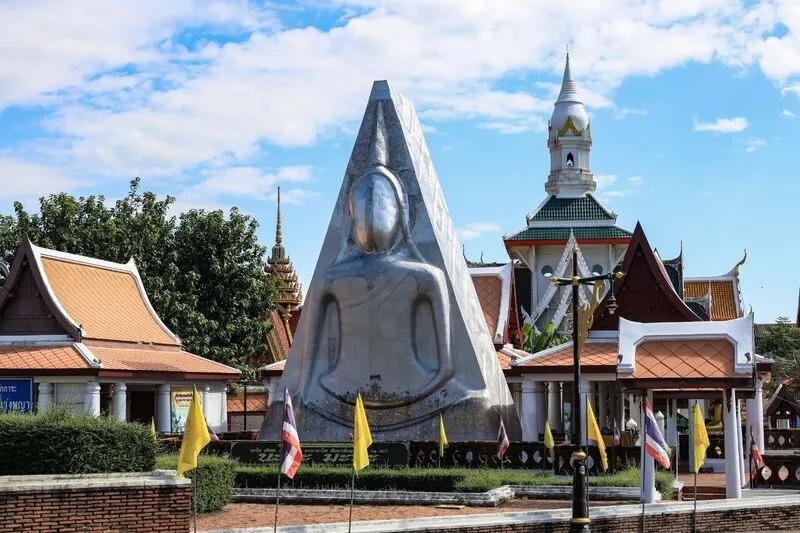
The most famous aspect of Wat Nang Phaya is the Nang Phaya amulet. These clay votive tablets are among the most celebrated Thai Buddhist amulets and are included in the Benjapakee, the five most prestigious groups of Thai amulets. Nang Phaya amulets are known for their distinctive triangular form, seated Buddha image, and strong yet graceful artistic expression. For Thai amulet collectors and devotees, the name Wat Nang Phaya carries exceptional cultural and spiritual importance.
Nang Phaya amulets are especially associated with compassion, charisma, respect, and auspicious influence. The word “Nang Phaya” can be understood as a queenly or powerful feminine figure, and this meaning has shaped the way many devotees understand the amulet. It is often believed to support leadership, dignity, and the ability to receive respect from others. Because of this, the amulet has long been admired not only by collectors but also by people who value its symbolic connection with grace, authority, and benevolence.
The history of the Nang Phaya amulet includes important discoveries in B.E. 2444 and later in B.E. 2497. These discoveries helped make the amulet widely known throughout Thailand. Authentic old Nang Phaya amulets are now extremely rare. Many examples found in the market today are later reproductions or commemorative versions. Visitors who are interested in amulets should treat the subject with care and learn from reliable experts, because the distinction between an original amulet, a later reproduction, and a devotional replica can be highly specialized.
The importance of the Nang Phaya amulet is not only about its rarity or market value. It also shows how Buddhist faith is carried into daily life in Thailand. Small votive tablets and amulets allow people to keep a symbol of the Buddha close to them. For many believers, an amulet is a reminder of protection, mindfulness, merit, and moral conduct. Wat Nang Phaya is therefore an excellent place for foreign travelers to learn how Thai Buddhism can be expressed through objects, belief, art, and personal devotion.
Even visitors who do not know much about Thai amulets can appreciate Wat Nang Phaya. The temple offers a quiet and meaningful atmosphere where people come to worship, learn, and connect with cultural memory. Some visitors come because of the amulet tradition, some come because of the temple’s ancient architecture, and others come simply to explore the historic heart of Phitsanulok. This variety of visitors keeps the temple alive as both a religious site and a cultural landmark.
Wat Nang Phaya also gives travelers an opportunity to think about the role of women in Thai history. The temple’s connection with Phra Wisut Kasatri adds a meaningful dimension to the site. She was not only a royal consort but also the mother of King Naresuan the Great, one of Thailand’s most revered historical kings. The association between the temple, a royal woman, and the name “Nang Phaya” gives the place a unique cultural identity that combines history, dignity, and devotion.
In the wider history of Phitsanulok, Wat Nang Phaya is part of a cluster of important sacred sites that reflect the city’s former status as a major political and religious center. Phitsanulok was once a strategic royal city, a military center, and a cultural hub. The presence of several significant temples along the Nan River shows how religion, royal authority, and urban life were closely connected. Visiting Wat Nang Phaya helps travelers understand this historical landscape in a more complete way.
The atmosphere of the temple is peaceful and accessible. Visitors can begin by paying respect inside the vihara, then walk around the chedi and observe the old structures. Because the temple is an active Buddhist place, visitors should dress respectfully, speak quietly, and avoid touching ancient structures unnecessarily. Such respectful behavior supports both religious practice and heritage conservation.
Getting There is very easy because Wat Nang Phaya is located in central Phitsanulok. Travelers can reach the temple by private car, local taxi, tuk-tuk, songthaew, or ride-hailing service. Those arriving by train can get off at Phitsanulok Railway Station and continue to the temple by local transport. The temple is close to Wat Phra Si Rattana Mahathat and Wat Ratchaburana, so it can be visited as part of a short walking or city sightseeing route.
The best time to visit is in the morning or late afternoon when the weather is more comfortable. The temple is open daily from 08.30 to 18.00. A visit of around 45 minutes to 1 hour is recommended for those who want to worship, see the vihara and chedi, learn about the Nang Phaya amulet, and absorb the atmosphere without rushing. Visitors who are particularly interested in amulet history may want to spend more time in the area.
Wat Nang Phaya is suitable for several types of travelers, including Buddhist pilgrims, cultural tourists, history enthusiasts, amulet collectors, photographers, families, and foreign visitors seeking a deeper understanding of Thai religious culture. For international travelers, the temple is a good place to learn that Thai amulets are not simply collectibles. They are closely connected with faith, identity, memory, merit, and the relationship between people and Buddhism.
A visit to Wat Nang Phaya can be combined with nearby attractions. Wat Phra Si Rattana Mahathat Woramahawihan, home of the revered Phra Buddha Chinnarat, is very close. Wat Ratchaburana stands nearby and has historical links with Wat Nang Phaya. Chan Palace and Sgt. Maj. Thawee Folk Museum can also help visitors understand Phitsanulok’s royal history and local way of life. Together, these sites create a rich cultural route through the old city.
For photography, Wat Nang Phaya offers modest but meaningful scenes: the vihara, the twelve-indented-corner chedi, temple details, and the quiet movement of worshippers. The site is best photographed with respect and sensitivity. Visitors should avoid interrupting ceremonies or photographing people at prayer in a disruptive way. The most meaningful images from Wat Nang Phaya are those that show its calm dignity and historical depth.
Today, Wat Nang Phaya continues to function as a living Buddhist temple. It remains a place for merit-making, worship, and cultural learning, while also preserving the memory of one of Thailand’s most famous amulet traditions. Its caretaker and monastic community help maintain the religious space and welcome visitors who come with respect. The temple’s continuing role shows that heritage in Thailand is not frozen in the past; it lives through worship, memory, and daily practice.
Wat Nang Phaya is therefore one of the most meaningful places to visit in Phitsanulok. It brings together royal history, early Ayutthaya-style architecture, an officially registered ancient monument, the famous Nang Phaya amulet, and the living faith of local people. For travelers who want more than a quick photo stop, this temple offers a deeper cultural experience and a clearer understanding of why Phitsanulok remains one of Thailand’s most historically important cities.
| Name | Wat Nang Phaya |
| Location | Cha Kan Bun Road, Nai Mueang Subdistrict, Mueang Phitsanulok District, Phitsanulok Province |
| Coordinates | Approximately 16.8237, 100.2618 |
| Highlights | Ancient riverside temple, origin of the famous Nang Phaya amulet, and an important historic Buddhist site in Phitsanulok |
| History | Believed to have been founded by Phra Wisut Kasatri during the restoration of Wat Ratchaburana around B.E. 2090–2100, when Phitsanulok was an important royal city. |
| Name Origin | The name is closely associated with the Nang Phaya amulet and the symbolic idea of queenly dignity, compassion, authority, and spiritual charisma. |
| Distinctive Features | Ancient vihara now used as the ubosot, twelve-indented-corner chedi, and architectural relationship with nearby Wat Ratchaburana |
| Key Evidence | Registered ancient vihara, twelve-indented-corner chedi, and the historical discoveries of Nang Phaya amulets in B.E. 2444 and B.E. 2497 |
| Travel Information | Accessible from Phitsanulok Railway Station and the city center by local taxi, songthaew, ride-hailing service, or private car. The temple is close to Wat Phra Si Rattana Mahathat and Wat Ratchaburana. |
| Current Status | Active Buddhist temple and cultural attraction related to history, architecture, and Thai amulet tradition |
| Open Days | Daily |
| Opening Hours | 08.30 – 18.00 |
| Facilities | Worship areas, walking areas around ancient structures, nearby shops and services in the old city area, and nearby parking depending on local conditions |
| Main Areas / Zones | Vihara, twelve-indented-corner chedi, worship area, and areas associated with the Nang Phaya amulet tradition |
| Abbot / Caretaker | Phra Khru Kasem Wapi Phisai, Acting Abbot of Wat Nang Phaya |
| Official Website / Official Page | Wat Nang Phaya, Phitsanulok Province |
| Nearby Tourist Attractions | 1. Wat Ratchaburana, about 0.1 km 2. Wat Phra Si Rattana Mahathat Woramahawihan, about 0.2 km 3. Chan Palace, about 1 km 4. Sgt. Maj. Thawee Folk Museum, about 3 km 5. Wat Chulamani, about 6 km |
| Nearby Restaurants | 1. Khao Niao Pa Yao, about 0.2 km 2. Racha Khao Niao Wat Yai, about 0.2 km 3. Rim Nan Hanging-Leg Noodles, about 0.6 km 4. Dragon River Avenue Restaurant, about 1 km, Tel. 099-374-7447, 055-242-242 5. Amore Restaurant at Topland Hotel, about 1 km |
| Nearby Accommodations | 1. Baan Lek Tee 3 Hotel, about 0.1 km 2. Holatel Phitsanulok, about 0.1 km 3. The Harmony Ville, about 0.7 km 4. Phitsanulok Hotel, about 0.9 km 5. Topland Hotel, about 1 km, Tel. 055-247-800 |
Frequently Asked Questions (FAQ)
Q: Where is Wat Nang Phaya located?
A: Wat Nang Phaya is located on Cha Kan Bun Road in Nai Mueang Subdistrict, Mueang Phitsanulok District, near Wat Ratchaburana and Wat Phra Si Rattana Mahathat Woramahawihan.
Q: Why is Wat Nang Phaya important?
A: Wat Nang Phaya is an ancient temple with registered historic structures and is famous as the origin of the Nang Phaya amulet, one of Thailand’s prestigious Benjapakee amulets.
Q: What is the Nang Phaya amulet?
A: The Nang Phaya amulet is a famous clay Buddhist votive tablet associated with compassion, charisma, auspiciousness, and spiritual protection.
Q: What are the opening hours of Wat Nang Phaya?
A: Wat Nang Phaya is open daily from 08.30 to 18.00.
Q: Who is the current caretaker of Wat Nang Phaya?
A: The current caretaker listed in recent public information is Phra Khru Kasem Wapi Phisai, Acting Abbot of Wat Nang Phaya.
Q: Is Wat Nang Phaya suitable for foreign travelers?
A: Yes. It is suitable for travelers interested in Thai history, Buddhist culture, ancient architecture, amulet traditions, and the old city area of Phitsanulok.
Q: What nearby attractions can be visited with Wat Nang Phaya?
A: Nearby attractions include Wat Ratchaburana, Wat Phra Si Rattana Mahathat Woramahawihan, Chan Palace, Sgt. Maj. Thawee Folk Museum, and Wat Chulamani.
Q: How long should visitors spend at Wat Nang Phaya?
A: A visit of around 45 minutes to 1 hour is recommended for worship, viewing the vihara and chedi, and learning about the Nang Phaya amulet tradition.
Tel : 0552527423
 Tel : 0552527423
 Category: ●Places of Worship
 Group: ●Temple
Last Update : 5 MonthAgo
 Last Update : 5 MonthAgo
 Click to Access the Navigation Map GPS
Wat Nang Phaya Map
Gellery
Recommend

 Art, Culture and Heritage
 Historical Sites and Monuments(1)
 Landmarks and Memorials(2)
 Art, Craft Centres, Tradition(3)
 Museums(3)
 Educational Places
 Educational Gardens, Farm(1)
Temple(29)
Educational Gardens, Farm(1)
Temple(29)
 Mosque(1)
 Other Sacred Sites(3)
 Research and Development
 Royal Project(1)
 Suburban Living
 Village, Community(1)
 Nature and Wildlife
 National Parks and Marine Reserves(7)
 Mountain (Doi)(4)
 Dam, Reservoir, Lake(5)
 Waterfalls(19)
 Caves(3)
 River, Canal(9)
 Other natural attractions(1)
 Entertainment and Agricultural
 Farms, Parks and Ecotourism(2)
 Outdoor and Adventure Activities(1)
 Travel Articles, Recipes
 Travel Review, Food Review(1)


