
lovethailand home >North Travel Attractions >Phitsanulok Travel Attractions >Muang Phitsanulok >Nai Muang > Ancient City Wall
TL;DR: Ancient City Wall is located at Nai Mueang Subdistrict, Mueang Phitsanulok District, Phitsanulok Province, open Daily, hours Accessible according to public areas and visible historic remains within the.

Ancient City Wall
Open Days: Daily
Opening Hours: Accessible according to public areas and visible historic remains within the city
The Ancient City Wall and Moat of Phitsanulok are important historical remains that help explain the strategic role of Phitsanulok in Thai history. This city was not merely a transit point between northern and central Thailand. It was once a major administrative center, a frontier city, a royal city, and a military base during periods when the kingdom faced pressure from Lanna and Burma. The remaining traces of the city wall and moat therefore tell the story of urban defense, political geography, military planning, and the changing security needs of Thailand across several historical periods.
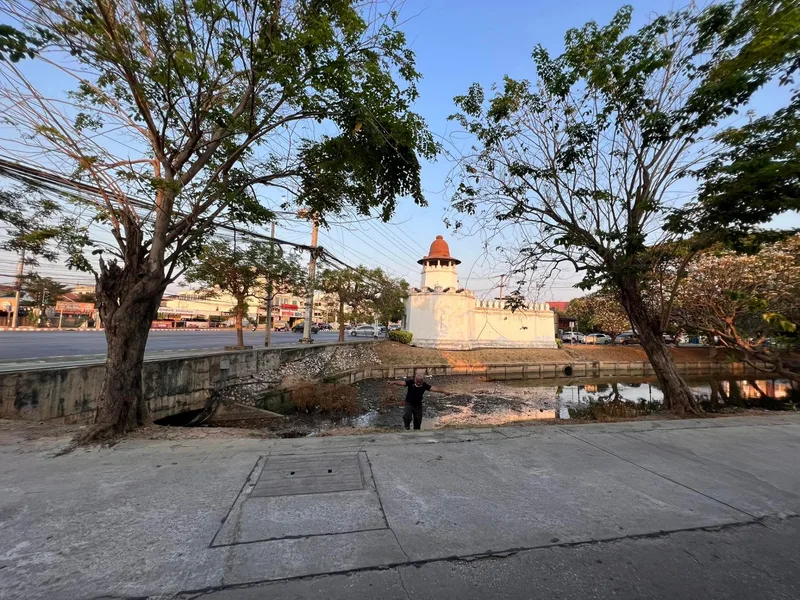
In simple terms, the city wall and moat of Phitsanulok were part of an old defensive system that became especially important during the Ayutthaya period. The original wall was made of earth, accompanied by a moat. Later, the system was repaired and strengthened in different reigns, and during the reign of King Narai the Great, a new brick wall was built to make the city stronger. In the early Rattanakosin period, King Rama I ordered the removal of many city walls and forts so that invading enemies could not use them as defensive strongholds. Today, visible remains can still be seen near Wat Phothiyan, Wat Noi, and the Phitsanulok Provincial Police Station, while parts of the moat are visible along Phra Ruang Road behind Pibulsongkram Rajabhat University.
Phitsanulok occupies a highly significant position in Thailand’s historical geography. It lies between the central plains and the northern region, with the Nan River functioning as a major transportation and economic route. Because of this location, Phitsanulok became important for administration, trade, troop movement, and the control of strategic routes. During wartime, the city often served as a defensive base or a military gathering point before armies moved north or south.
The city wall and moat were therefore not built simply to mark the boundary of the city. They formed a complete defensive system. The moat created an obstacle for enemy troops, while the wall provided a protective line around the city. Together, these elements made Phitsanulok a fortified urban center capable of responding to military threats more effectively than an open settlement.
During the reign of King Borommatrailokkanat, Phitsanulok became especially important because the king resided in the city for a long period while Ayutthaya faced conflict with the Lanna Kingdom under King Tilokaraj. Lanna was a major northern power at that time, and Phitsanulok functioned as a vital defensive city against northern attacks. Strengthening the earth wall and moat was therefore a practical military measure, designed to protect the city and slow the advance of enemy forces before they could move toward the inner territories of Ayutthaya.
The importance of the wall in this period was not only physical. It also had psychological and political meaning. A walled city gave residents a sense of protection and showed the authority of the state. The wall made the city’s boundary visible and symbolized the government’s commitment to defending Phitsanulok as a key frontier city.
Later, during the reign of King Maha Chakkraphat, Phitsanulok remained a vital defensive city against Burmese armies. Repairs to the wall during this period show that the city continued to be militarily important. The threat shifted from Lanna to Burma, but Phitsanulok remained strategically valuable because it controlled routes into the central region. If an enemy could capture Phitsanulok, the road toward Ayutthaya would become easier to access.
The repeated repairs of the city wall show that this historic site was not a static structure. It was a living defensive system that was used, repaired, and adapted according to political and military conditions. As threats changed, the city’s defensive preparation changed as well. The wall and moat therefore serve as evidence of military adaptation in one of Thailand’s most important inland cities.
During the reign of King Narai the Great, the city wall of Phitsanulok was developed further. Historical sources state that a stronger brick wall was constructed, and that French engineers or craftsmen were involved in the work. The transition from an earth wall to a brick wall reflects technological development and the influence of Western engineering during the late Ayutthaya period. Phitsanulok thus became a place where local defensive traditions and foreign construction knowledge were combined.
A brick wall made the city stronger and more permanent. It could better resist attack and represented a greater investment by the state in the defense of Phitsanulok. A city that received such fortification was clearly important to the security of the kingdom. The wall therefore stood as both a military structure and a political statement.
In the early Rattanakosin period, however, King Rama I ordered the removal of many walls and forts, including those at Phitsanulok, for strategic reasons. The concern was that if Burmese forces captured the city, they could use the walls and forts as their own defensive strongholds. The removal of the wall was therefore not a careless destruction of heritage, but a military decision shaped by the realities of war at that time.
Although much of the wall was lost, the remaining traces are now even more valuable. They are physical evidence that survived centuries of political change, warfare, urban expansion, and land use. Earth embankments, moat lines, and fragments of the old defensive layout allow later generations to read the history of Phitsanulok directly from the landscape.
Today, visible remains of the ancient wall can still be found around Wat Phothiyan, which is associated with the northern side of the old wall, around Wat Noi near the railway area, and near the Phitsanulok Provincial Police Station. The moat can be seen along the line parallel to Phra Ruang Road, behind Pibulsongkram Rajabhat University. These places help visitors understand the old city layout through actual urban geography rather than through written history alone.
One of the most interesting aspects of the Phitsanulok wall and moat is that the historic remains are embedded within the modern city. They are not located in a large enclosed historical park. Instead, old and new layers of the city overlap. Roads, houses, temples, schools, government buildings, and urban communities now stand near the old defensive lines. Visiting the wall and moat is therefore a way of reading the city itself, seeing how history remains present within everyday urban life.
The moat is also an important part of the old urban landscape. It was not only a military obstacle but also related to water management, drainage, and the definition of the old city boundary. When visitors walk along Phra Ruang Road and observe the remaining moat line, they can understand that ancient urban planning was closely connected with topography, the Nan River, and settlement patterns.
From a military perspective, the wall and moat are an important lesson in pre-modern urban defense. Before modern weapons and military infrastructure, a secure city required walls, moats, gates, watch points, and carefully chosen terrain. Such planning made it harder for enemies to reach the urban core and gave defenders time to respond, gather forces, or protect civilians. The Phitsanulok city wall was therefore part of a larger system of urban security.
In political history, Phitsanulok reflects the relationship between Ayutthaya and the northern cities. The fact that Phitsanulok served as a major center of power at certain times gives its wall and moat meaning beyond local defense. They were part of the kingdom’s wider security network. When Phitsanulok was secure, the route between the north and the central region was also more secure.
The wall and moat also connect with many other important sites in Phitsanulok, including Wat Phra Si Rattana Mahathat Woramahawihan, Chan Palace, the Shrine of King Naresuan the Great, and the Nan River area. Travelers can create a historical route through the city by beginning at Wat Yai, visiting Chan Palace, and then exploring the old wall and moat to understand Phitsanulok from religious, royal, military, and urban perspectives.
Getting There is easy because the remains are located within Phitsanulok city. Travelers can start from Wat Phra Si Rattana Mahathat Woramahawihan or Phitsanulok Railway Station, then continue to the areas around Wat Phothiyan, Wat Noi, the Phitsanulok Provincial Police Station, and Phra Ruang Road. Private cars, local taxis, and ride-hailing services are convenient options.
For those who enjoy walking through historical urban landscapes, it is best to visit in the morning or late afternoon because many areas are outdoors. Visitors should bring drinking water, a hat or umbrella, and should be careful when walking near roads. Some historic remains are located close to modern traffic, residential areas, and government facilities.
When visiting the wall and moat, travelers should observe the earth levels, water lines, curves in the landscape, and the relationship between the remains and nearby temples or government buildings. Although not all remains survive as high walls, the landscape still preserves the memory of the old city. This makes the site especially rewarding for visitors who enjoy deeper historical interpretation.
Conservation of the Phitsanulok city wall and moat requires cooperation among many groups, including the Fine Arts Department, local authorities, educational institutions, communities, and residents. The historic remains are located within a living city, so conservation must consider both heritage value and the daily life of people who live around the area.
Visitors should help preserve the site by not climbing on remains, not damaging historic surfaces, not littering, and not writing on signs or structures. Respecting the site helps protect the remaining evidence of Phitsanulok’s history for future generations. The wall and moat are not just old structures; they are historical documents written in earth, water, brick, and urban landscape.
For travelers from outside the province, the wall and moat are best visited together with nearby historical attractions. Wat Phra Si Rattana Mahathat Woramahawihan is the most important starting point because it is the spiritual and historical heart of the city. Chan Palace adds the royal dimension of Phitsanulok’s history, while the Nan River area helps explain why the city developed in this location.
The wall and moat are also suitable as an educational site for students and history enthusiasts. They help explain the concepts of frontier cities, urban planning, defensive architecture, military geography, and changing technology. When connected with the reigns of King Borommatrailokkanat, King Maha Chakkraphat, King Narai the Great, and King Rama I, the site reveals the long development of Phitsanulok as a strategic city.
As a cultural travel destination, the Phitsanulok city wall and moat may not appear dramatic at first glance like a grand temple or palace. Their value lies in historical depth. The remaining earthworks, moat lines, and fragments of the old city require visitors to look carefully and connect the landscape with the past. Those who understand the context will see that even modest traces can carry powerful stories of war, defense, survival, and statecraft.
In summary, the Ancient City Wall and Moat of Phitsanulok are essential to understanding Phitsanulok as one of Thailand’s strategic historic cities. They reflect the city’s role in defending against Lanna during the reign of King Borommatrailokkanat, preparing for Burmese threats during the reign of King Maha Chakkraphat, strengthening defenses with brick construction during the reign of King Narai the Great, and being dismantled in the reign of King Rama I for military reasons. The remaining traces stand as a memorial to strategic wisdom, sacrifice, and the long history of defending the Thai realm.
| Name | Ancient City Wall And Moat Of Phitsanulok |
| Location | Nai Mueang Subdistrict, Mueang Phitsanulok District, Phitsanulok Province |
| Address | Old city wall and moat lines within Nai Mueang Subdistrict, Mueang Phitsanulok District, Phitsanulok Province 65000 |
| Reference Coordinates | 16.8246, 100.2597 |
| Highlights | Historic remains of the old city wall and moat of Phitsanulok, a strategic city between northern and central Thailand |
| History | Connected with the reigns of King Borommatrailokkanat, King Maha Chakkraphat, King Narai the Great, and King Rama I |
| Key Evidence | Visible remains near Wat Phothiyan, Wat Noi, the Phitsanulok Provincial Police Station, and the moat line along Phra Ruang Road |
| Distinctive Features | Originally an earth wall and moat, later strengthened with brick construction during the late Ayutthaya period |
| Travel Information | Located within Phitsanulok city. Visitors can combine the route with Wat Phra Si Rattana Mahathat, Chan Palace, and the Nan River area by private car, local taxi, or ride-hailing service. |
| Current Status | An important archaeological site of Phitsanulok, with several visible traces remaining in the modern city |
| Facilities | Located in the city near main roads, restaurants, hotels, temples, the railway station, and local transport services |
| Main Areas / Zones | Wat Phothiyan area, Wat Noi area, Phitsanulok Provincial Police Station area, and Phra Ruang Road moat line |
| Caretaker / Related Authority | The Fine Arts Department through the 6th Regional Office of Fine Arts, Sukhothai, together with local authorities in Phitsanulok |
| Related Authority Contact | 6th Regional Office of Fine Arts, Sukhothai Tel. 0-5569-7364 |
| Nearby Tourist Attractions | 1. Wat Phra Si Rattana Mahathat Woramahawihan, about 1 km 2. Chan Palace, about 2 km 3. Shrine of King Naresuan the Great, about 2 km 4. Sgt. Maj. Thawee Folk Museum, about 4 km 5. Wat Nang Phaya, about 1 km |
| Nearby Restaurants | 1. Ku Mueang A La Carte, about 1 km, Tel. 095-728-0016 2. Khaotom Paknang, about 2 km, Tel. 055-258-681 3. Amore Restaurant At Yodia Heritage, about 2 km, Tel. 055-214-677 4. Guay Tiew Hoi Kha Rim Nan, about 1 km 5. Restaurants And Cafés Around Wat Yai And The Nan River Area, about 1 km |
| Nearby Accommodations | 1. The Harmony Ville, about 1 km, Tel. 097-923-4272, 055-241-188 2. Topland Hotel & Convention Centre, about 1 km, Tel. 055-247-801 3. Yodia Heritage Hotel, about 2 km, Tel. 055-214-677 4. Dragon River Avenue, about 2 km, Tel. 055-242-242, 091-151-7999 5. Fortune D Hotel Phitsanulok, about 2 km, Tel. 055-303-833 |
Frequently Asked Questions (FAQ)
Q: Where are the Ancient City Wall and Moat of Phitsanulok located?
A: They are located within Nai Mueang Subdistrict, Mueang Phitsanulok District. Visible remains can be found near Wat Phothiyan, Wat Noi, the Phitsanulok Provincial Police Station, and along Phra Ruang Road.
Q: Why are the city wall and moat important?
A: They are evidence of Phitsanulok’s role as a strategic frontier city and show how the city defended itself against northern and Burmese threats in different historical periods.
Q: When was the Phitsanulok city wall built?
A: The original earth wall is associated with the reign of King Borommatrailokkanat. It was later repaired in the reign of King Maha Chakkraphat and strengthened with brick construction during the reign of King Narai the Great.
Q: Where can visitors still see the remains today?
A: Visible traces remain near Wat Phothiyan, Wat Noi, and the Phitsanulok Provincial Police Station. The moat line can be seen along Phra Ruang Road behind Pibulsongkram Rajabhat University.
Q: Why were the walls and forts dismantled during the reign of King Rama I?
A: They were dismantled for military reasons so that enemies, especially Burmese forces, could not use the walls and forts as strongholds if they captured the city.
Q: Who should visit this historical site?
A: It is suitable for travelers interested in Thai history, ancient military strategy, old city planning, cultural travel, students, and anyone who wants to understand Phitsanulok more deeply.
Q: What nearby attractions can be combined with this visit?
A: Visitors can combine the route with Wat Phra Si Rattana Mahathat Woramahawihan, Chan Palace, the Shrine of King Naresuan the Great, Wat Nang Phaya, and the Nan River area.
Q: What should travelers prepare before visiting?
A: Visit in the morning or late afternoon, bring drinking water, a hat or umbrella, and be careful when walking near roads because several remains are located within the modern city.
Tel : 0552527423
 Tel : 0552527423
 Category: ●Art, Culture and Heritage
 Group: ●Landmarks and Memorials
Last Update : 4 MonthAgo
 Last Update : 4 MonthAgo
 Click to Access the Navigation Map GPS
 Historical Sites and Monuments(1)
Landmarks and Memorials(2)
Historical Sites and Monuments(1)
Landmarks and Memorials(2)
 Art, Craft Centres, Tradition(3)
 Museums(3)
 Educational Places
 Educational Gardens, Farm(1)
 Places of Worship
 Temple(29)
 Mosque(1)
 Other Sacred Sites(3)
 Research and Development
 Royal Project(1)
 Suburban Living
 Village, Community(1)
 Nature and Wildlife
 National Parks and Marine Reserves(7)
 Mountain (Doi)(4)
 Dam, Reservoir, Lake(5)
 Waterfalls(19)
 Caves(3)
 River, Canal(9)
 Other natural attractions(1)
 Entertainment and Agricultural
 Farms, Parks and Ecotourism(2)
 Outdoor and Adventure Activities(1)


