
lovethailand home >North Travel Attractions >Phitsanulok Travel Attractions >Nakhon Thai >Nong Ka Thao > Thung Salaeng Luang National Park
TL;DR: Thung Salaeng Luang National Park is located at Covering Wang Thong, Nakhon Thai, and Noen Maprang Districts in Phitsanulok Province, and Khao Kho and Wang Pong Districts in Phetchabun, open Daily, hours 08.30 – 16.30.

Thung Salaeng Luang National Park
Open Days: Daily
Opening Hours: 08.30 – 16.30
Thung Salaeng Luang National Park is one of the most important forest landscapes in lower northern Thailand, covering areas of Phitsanulok and Phetchabun Provinces. Often described as Thailand’s savanna-like grassland, the park is famous for its wide open meadows, pine forests, camping grounds, nature trails, birdwatching opportunities, wildlife habitats, seasonal wildflowers, and cool highland atmosphere. It is a major destination for travelers who want to experience nature in a deeper and more meaningful way than a simple scenic stop.
The park’s landscape is unusually diverse. Within one protected area, visitors can encounter open grasslands, two-needle and three-needle pine forests, mixed deciduous forest, dry evergreen forest, streams, waterfalls, and highland viewpoints. This variety makes Thung Salaeng Luang one of the best places in the region for nature study, camping, photography, trekking, and ecological learning. The Nong Mae Na area in Khao Kho District is especially popular because it provides access to camping facilities, visitor services, and scenic grassland landscapes.
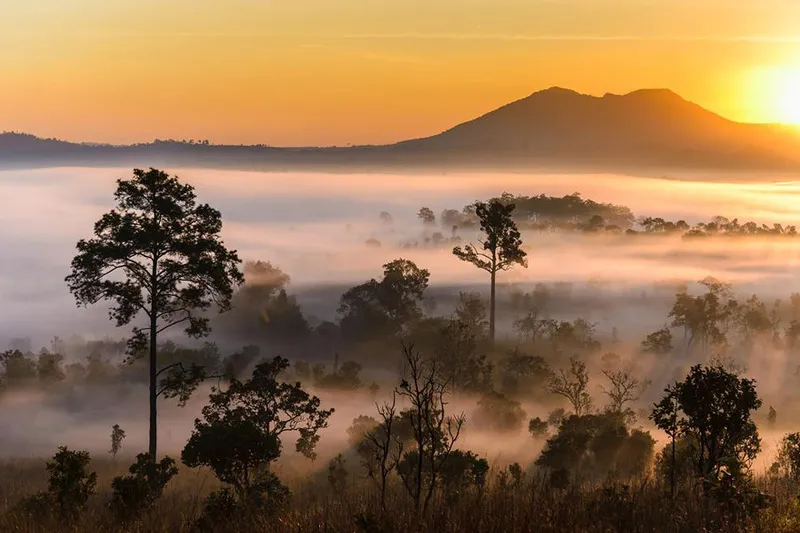
The most iconic image of Thung Salaeng Luang is the broad meadow surrounded by pine trees. During the rainy season and cool season, the grassland becomes green and fresh, often with morning mist drifting softly across the landscape. In the dry season, the meadow turns golden and creates a savanna-like atmosphere that is rare in Thailand. This seasonal transformation makes the park attractive throughout the year, with each period offering a different mood and photographic character.
The pine forests are one of the park’s most distinctive ecological features. Two-needle and three-needle pines can grow more than 15 – 20 meters tall, creating an open and elegant forest structure where sunlight reaches the ground. These pine forests support many bird species, including woodpeckers, quails, sunbirds, bulbuls, and other forest birds. Birds play an important role in seed dispersal, insect control, and ecosystem balance, making birdwatching here both enjoyable and educational.
Beyond the pine forests, the park contains many other native trees and plants, including hardwoods, medicinal plants, ferns, wild mushrooms, and seasonal wildflowers. During the rainy season, the forest floor becomes more active, with small flowering plants and fungi appearing along trails and meadow edges. These plants are not only beautiful but also ecologically important because they provide food for bees, butterflies, and pollinating insects.
Wildlife is another major reason to visit Thung Salaeng Luang. The park is home to many species of mammals, birds, reptiles, amphibians, and insects. Visitors may see signs of deer, wild boar, forest birds, lizards, frogs, and other wildlife depending on the season and area visited. Early morning and late afternoon are the best times for observing animals because many species are more active during these cooler periods. Travelers should observe wildlife quietly and from a safe distance without feeding or disturbing animals.
Nature trails and trekking routes in the park range from easier walks near visitor areas to more demanding routes leading toward deeper grassland and forest zones. Popular natural areas include Thung Salaeng Luang, Thung Nang Phaya, and Thung Non Son. These places allow visitors to experience pine forests, open meadows, seasonal flowers, panoramic views, and quieter parts of the park. Some routes require more preparation, and travelers should contact park staff before entering deeper areas.
Thung Nang Phaya is known for its peaceful meadow and pine forest atmosphere, while Thung Non Son is a favorite among trekkers and photographers. Thung Non Son is especially beautiful in the season when wildflowers appear across the grassland. Because access to some areas may depend on weather, road condition, and park regulations, travelers should check with the park before planning a hike or overnight nature trip.
Camping is one of the most popular activities at Thung Salaeng Luang National Park. The Nong Mae Na camping area is spacious, scenic, and suitable for travelers who want to sleep close to nature. At night, the wide grassland and pine forest create a calm atmosphere filled with the sound of wind, insects, and birds. On clear nights, the open sky makes the area suitable for stargazing and night photography. Visitors should follow park rules, keep food properly stored, avoid loud noise, and use only designated areas for cooking or lighting.
Each season offers a different travel experience. The rainy season from June to October is best for green meadows, full streams, fresh forest scenery, and wildflowers. The cool season from November to February is the most popular period for camping, trekking, misty mornings, and comfortable walking weather. The hot season from March to May gives the grasslands a golden color, creating the park’s well-known savanna-like appearance.
For photographers, Thung Salaeng Luang offers many strong visual subjects: morning mist over the grassland, pine trees in soft light, wildflowers in rainy season, golden grass in summer, camping scenes, and wide open skies. The best light is usually early in the morning and late in the afternoon. Travelers who want the best images should stay overnight, wake early, and allow enough time to explore the landscape slowly.
The park is also an important outdoor classroom for students, researchers, birdwatchers, and nature lovers. Its forest types, grassland ecology, medicinal plants, birds, insects, and seasonal cycles make it valuable for environmental education. A visit here helps travelers understand how plants, animals, soil, water, climate, and human behavior are connected within one protected ecosystem.
Thung Salaeng Luang also reflects the relationship between local communities and forests. In the past, surrounding communities used forest resources for food, herbal medicine, and daily life. Today, the park is protected as a national park, shifting its main role toward conservation, education, and sustainable tourism. Responsible travel is therefore essential. Visitors should not litter, collect plants, feed wildlife, enter restricted areas, or disturb other travelers and animals.
Getting There is most convenient by private car. From the Camp Son area on the Phitsanulok-Lom Sak route, travelers can turn onto Highway 2196 toward Khao Kho, pass Talat Phatthana, then turn right onto Highway 2325 toward Ban Than Tawan and the Nong Mae Na park unit. The distance from Camp Son to Nong Mae Na is about 35 kilometers. Travelers using public transport can take a Phitsanulok-Lom Sak bus, get off at Ban Camp Son, and continue by local songthaew, chartered vehicle, or rental transport to Nong Mae Na.
Preparation is important, especially for camping or trekking. Visitors should bring warm clothing, rain protection, comfortable walking shoes, a flashlight, sleeping gear, personal medicine, a power bank, drinking water, and trash bags. During the rainy season, waterproof equipment and careful driving are important. During the cool season, warm clothing is necessary because temperatures at night can be much lower than in nearby towns.
Thung Salaeng Luang National Park is suitable for many types of travelers, including families, campers, hikers, photographers, birdwatchers, students, and slow travelers seeking a quiet natural atmosphere. Its greatest value lies in the combination of accessibility, scenic beauty, ecological diversity, and conservation meaning. A journey here is not only a nature escape but also a chance to understand why protected forests are essential for biodiversity, climate, water systems, wildlife, and future generations.
In summary, Thung Salaeng Luang National Park is one of the most rewarding nature destinations in lower northern Thailand. With its savanna-like grasslands, pine forests, wildlife habitats, camping areas, walking trails, wildflowers, and misty mornings, the park offers an experience that is both relaxing and educational. Travelers who visit with respect for nature will leave not only with beautiful photographs, but also with a deeper appreciation for Thailand’s protected forests.
| Name | Thung Salaeng Luang National Park |
| Location | Covering Wang Thong, Nakhon Thai, and Noen Maprang Districts in Phitsanulok Province, and Khao Kho and Wang Pong Districts in Phetchabun Province |
| Address | Main visitor area at Nong Mae Na, Khao Kho District, Phetchabun Province, with protected forest areas extending into Phitsanulok Province |
| Highlights | Thailand’s savanna-like grassland, two-needle and three-needle pine forests, Nong Mae Na camping area, Thung Nang Phaya, Thung Non Son, nature trails, birdwatching, and wildlife observation |
| Distinctive Features | Large protected forest with open grasslands, pine forests, dry evergreen forest, mixed deciduous forest, streams, waterfalls, and high biodiversity |
| Important Flora and Fauna | Two-needle pine, three-needle pine, hardwood trees, wildflowers, mushrooms, medicinal plants, woodpeckers, quails, sunbirds, bulbuls, deer, wild boar, and grassland-forest wildlife |
| Recommended Activities | Camping, trekking, nature study, birdwatching, wildlife observation, meadow photography, pine forest photography, wildflower viewing, and morning mist watching |
| Travel Information | From Ban Camp Son on the Phitsanulok-Lom Sak route, turn onto Highway 2196 toward Khao Kho, pass Talat Phatthana, then turn right onto Highway 2325 toward Ban Than Tawan and Nong Mae Na. Total distance is about 35 km. Public transport users can take the Phitsanulok-Lom Sak bus and continue by local vehicle. |
| Current Status | Open as a national park, camping destination, nature tourism site, and ecological learning area in lower northern Thailand |
| Open Days | Daily |
| Opening Hours | 08.30 – 16.30 |
| Fees | Thai visitors: adults 40 baht, children 20 baht / Foreign visitors: adults 500 baht, children 300 baht / Car 30 baht / Motorcycle 20 baht |
| Facilities | Visitor center, camping ground, park accommodation, welfare shop, restrooms, parking area, viewpoints, and nature trails |
| Main Areas / Zones | Nong Mae Na, Thung Salaeng Luang, Thung Nang Phaya, Thung Non Son, pine forests, camping grounds, nature trails, and birdwatching/wildlife observation areas |
| Caretaker / Related Authorities | Department of National Parks, Wildlife and Plant Conservation, through Thung Salaeng Luang National Park |
| Main Contact Number | Thung Salaeng Luang National Park Office Tel. 08-8756-4940 Visitor Center Tel. 08-8771-5056 |
| Official Website / Official Page | Thung Salaeng Luang National Park Official Page |
| Nearby Tourist Attractions | 1. Nong Mae Na Camping Area, about 0 km 2. Thung Salaeng Luang Meadow, about 3 km 3. Thung Nang Phaya, about 14 km 4. Si Dit Waterfall, about 18 km 5. Thung Non Son, about 30 km 6. Khao Kho Viewpoint, about 20 km 7. Khao Kho Sacrificial Memorial, about 24 km |
| Nearby Restaurants | 1. National Park Welfare Shop at Nong Mae Na, about 0 km, Tel. 08-8756-4940 2. 180 Cafe 180 All Day All Season Hostel, about 14 km, Tel. 096-665-2954 3. Boranniyom @ Khao Kho Steak House & Restaurant, about 15 km, Tel. 062-565-0535, 064-353-8897 4. Lap Nuea 2 Restaurant, about 15 km, Tel. 087-556-1245 5. Malai Kitchen Khao Kho, about 14 km, Tel. 091-778-8694, 061-019-4696 |
| Nearby Accommodations | 1. Thung Salaeng Luang National Park Accommodation and Camping Area, about 0 km, Tel. 08-8756-4940 2. Raccoon Camping @ Khao Kho, about 4 km, Tel. 098-668-8150 3. Sky Glamper Khao Kho, about 9 km, Tel. 081-474-9979 4. Cirrus Valley Hill Resort, about 10 km, Tel. 061-123-4235 5. Lazika Khao Kho, about 10 km, Tel. 082-182-1149 6. 180 All Day All Season Hostel, about 14 km, Tel. 096-665-2954 |
Frequently Asked Questions (FAQ)
Q: Where is Thung Salaeng Luang National Park located?
A: The park covers areas of Phitsanulok and Phetchabun Provinces. The Nong Mae Na area in Khao Kho District, Phetchabun, is a popular visitor base for camping and nature trips.
Q: What are the main highlights of Thung Salaeng Luang National Park?
A: Highlights include savanna-like grasslands, two-needle and three-needle pine forests, Nong Mae Na camping area, Thung Nang Phaya, Thung Non Son, seasonal wildflowers, birdwatching, and wildlife observation.
Q: What are the opening hours?
A: The park is open daily from 08.30 to 16.30. Travelers planning to camp or visit deeper trails should contact park staff in advance for current conditions.
Q: How much is the entrance fee?
A: Thai visitors pay 40 baht for adults and 20 baht for children. Foreign visitors pay 500 baht for adults and 300 baht for children. Vehicle fees are 30 baht for cars and 20 baht for motorcycles.
Q: When is the best time to visit?
A: The cool season is best for camping, trekking, mist, and comfortable weather. The rainy season is ideal for green meadows, wildflowers, and waterfalls. The hot season offers golden savanna-like grassland views.
Q: Can visitors camp in the park?
A: Yes. Camping is available, especially around Nong Mae Na, where the park provides a spacious camping ground, restrooms, welfare shop, parking, and park accommodation services.
Q: Can travelers reach the park by public transport?
A: Yes. Travelers can take a Phitsanulok-Lom Sak bus, get off at Ban Camp Son, and continue by local songthaew, chartered vehicle, or rental transport to Nong Mae Na.
Q: What should visitors prepare before traveling?
A: Visitors should bring warm clothing, rain protection, comfortable walking shoes, a flashlight, sleeping gear, personal medicine, trash bags, and check weather and trail conditions before departure.
Tel : 025620760
 Tel : 025620760
 Category: ●Nature and Wildlife
 Group: ●National Parks and Marine Reserves
Last Update : 4 MonthAgo
 Last Update : 4 MonthAgo
 Click to Access the Navigation Map GPS
Thung Salaeng Luang National Park Map
Recommend

 Art, Culture and Heritage
 Historical Sites and Monuments(1)
 Landmarks and Memorials(2)
 Art, Craft Centres, Tradition(3)
 Museums(3)
 Educational Places
 Educational Gardens, Farm(1)
 Places of Worship
 Temple(29)
 Mosque(1)
 Other Sacred Sites(3)
 Research and Development
 Royal Project(1)
 Suburban Living
 Village, Community(1)
National Parks and Marine Reserves(7)
Village, Community(1)
National Parks and Marine Reserves(7)
 Mountain (Doi)(4)
 Dam, Reservoir, Lake(5)
 Waterfalls(19)
 Caves(3)
 River, Canal(9)
 Other natural attractions(1)
 Entertainment and Agricultural
 Farms, Parks and Ecotourism(2)
 Outdoor and Adventure Activities(1)


