
lovethailand home >North Travel Attractions >Phitsanulok Travel Attractions >Bang Krathum >Ban Rai > Wat Sirisutthawat
TL;DR: Wat Sirisutthawat is located at Ban Khwang, Village No. 5, Ban Rai Subdistrict, Bang Krathum District, Phitsanulok Province, open Daily, hours 08.00 – 17.00.
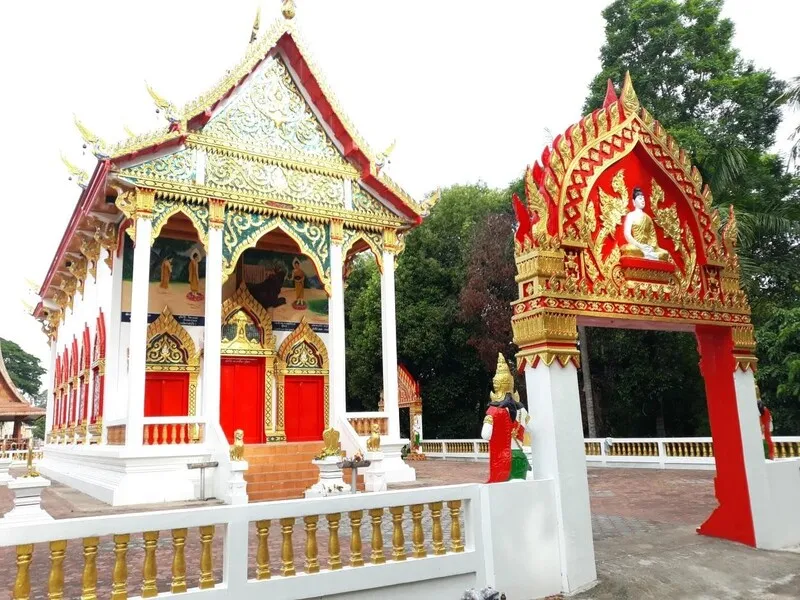
Wat Sirisutthawat
Open Days: Daily
Opening Hours: 08.00 – 17.00
Wat Sirisutthawat, formerly known as Wat Khwang, is located at No. 1, Ban Khwang, Village No. 5, Ban Rai Subdistrict, Bang Krathum District, Phitsanulok Province. It is a public Buddhist temple under the Mahanikaya order and has long served as an important religious and community center for local residents. With a history dating back to around B.E. 2275, the temple reflects the long-standing relationship between Buddhism, education, public service, and village life in lower Phitsanulok. For travelers interested in quiet local temples, Wat Sirisutthawat offers a meaningful glimpse into how a rural Thai temple can function as both a sacred space and a social institution.
The temple covers approximately 31 rai and 79 square wa. Its land is surrounded by private property and public roads. The northern boundary extends 158 wa and adjoins private land, the southern boundary extends slightly over 158 wa and connects with a public road, the eastern boundary extends slightly over 79 wa and adjoins occupied land, and the western boundary extends slightly over 79 wa and connects with a public road. The temple land is documented under Nor Sor 3 No. 8734, and the temple also has one additional monastic land plot covering 1 ngan and 92 square wa under Nor Sor 3 No. 258. These land details show that Wat Sirisutthawat has a clearly established physical foundation for religious and public use.
Most of the temple grounds are flat, making the area suitable for constructing monastic buildings and organizing religious and community activities. This physical setting has allowed Wat Sirisutthawat to develop naturally as a center of the village. The temple has spaces for ceremonies, Dhamma listening, monastic practice, and public gatherings. Its role is therefore broader than that of a simple merit-making place. It has been a shared space where villagers can participate in religious life, education, local meetings, and community services.
One of the most important buildings at Wat Sirisutthawat is the ordination hall, measuring 8 meters wide and 22 meters long. It was built in B.E. 2510 and is the central sacred building for formal monastic ceremonies. In Thai Buddhist tradition, the ordination hall is used for important Sangha activities such as ordination, monastic observances, and ceremonies requiring a consecrated boundary. Inside the ordination hall are 3 principal Buddha images, which form the spiritual focus of the building and provide a place for local Buddhists to pay respect, make merit, and cultivate peace of mind.
The main assembly hall measures 20 meters wide and 32 meters long and was built in B.E. 2497. This hall has played a vital role in community life. It is used for merit-making, Dhamma talks, village meetings, Buddhist ceremonies, and social gatherings. In many Thai villages, the assembly hall is where monks and laypeople meet most often. At Wat Sirisutthawat, this building helps connect the temple with the daily life of the community, especially during annual festivals, Buddhist holy days, memorial rites, and other shared events.
The temple also has 7 monks’ residences for resident monks and novices. These residences support daily monastic life, Buddhist practice, and the continuation of religious activities throughout the year. In addition, the temple contains 2 chedis, which are important Buddhist architectural elements. In Thai Buddhist culture, chedis often symbolize devotion to the Buddha, the Dhamma, and the Sangha, and may also function as memorials or sacred monuments created through the faith of the community.
Wat Sirisutthawat was established as a temple around B.E. 2275 and was originally called Wat Khwang. The original name is connected with Ban Khwang, the local village where the temple stands. Later, the temple came to be known by its present name, Wat Sirisutthawat, a name with auspicious meaning associated with purity, goodness, and spiritual calm. The temple received its later royal grant of ordination boundary on 31 March B.E. 2502, and the consecration of the boundary was performed on 9 May B.E. 2504. These events marked an important stage in the temple’s religious development.
The royal grant of an ordination boundary is highly significant for a Buddhist temple because it establishes the proper consecrated area for formal Sangha ceremonies. After the boundary was consecrated, Wat Sirisutthawat could fully use its ordination hall for important monastic functions according to Buddhist discipline. This shows that the temple is not only old in terms of age, but also has a clear religious structure, important buildings, and a long record of serving the Buddhist community.
Another major role of Wat Sirisutthawat is Buddhist education. The temple began teaching Phra Pariyatti Dhamma, or formal Buddhist studies, in B.E. 2520. This educational role is important because it helps monks, novices, and interested learners study Buddhist teachings and monastic discipline in a systematic way. The temple has therefore functioned not only as a place of ritual, but also as a place of learning, moral training, and the transmission of Buddhist knowledge within the community.
The temple grounds have also been connected with public benefit. Within the temple area there was a government primary school covering more than 5 rai, a subdistrict council area covering slightly more than 1 ngan, and a health station area covering slightly more than 2 rai. This makes Wat Sirisutthawat especially important as a community institution. It shows that the temple once supported education, local administration, and public health, in addition to its religious function. Such a role reflects the traditional importance of temples in rural Thai society.
In many Thai communities, temples have historically served as the main public space of the village. Wat Sirisutthawat is a strong example of this pattern. Local residents could come to the temple to make merit, listen to Dhamma, send children to school, take part in community discussions, and use public services located within or near the temple grounds. This close relationship helped build trust, unity, and shared responsibility among villagers. The temple became a place where religious values and practical community needs met.
Current temple information identifies Phra Wisit Kittisophano as the abbot of Wat Sirisutthawat. Earlier records also mention Phra Khru Sirisutthikhun, a former abbot of Wat Sirisutthawat and former ecclesiastical chief of Ban Rai Subdistrict, who was later appointed as an advisor to the subdistrict ecclesiastical chief. These details show the continuity of monastic leadership and the temple’s importance within the local Sangha structure of Bang Krathum District.
The atmosphere of Wat Sirisutthawat is suitable for visitors who want to make merit, pay respect to Buddha images, and learn about an old village temple in a peaceful setting. The ordination hall, assembly hall, monks’ residences, Buddha images, and chedis all express the continuity of local faith from past to present. The temple is not a commercial tourist site, but it has strong historical and cultural value. It is especially suitable for travelers who are interested in older community temples and the social role of Buddhism in provincial Thailand.
One distinctive feature near the temple is the local cable crossing over the Nan River in front of Wat Sirisutthawat. This small but memorable element reflects the simple way of life in Ban Khwang and Ban Rai Subdistrict. The presence of the Nan River and local crossing routes near the temple helps connect the temple with the riverside landscape and everyday community movement. Visitors can therefore experience not only a Buddhist temple, but also a local cultural scene shaped by the relationship between temple, village, and river.
For travelers exploring Bang Krathum District, Wat Sirisutthawat can be included in a one-day cultural route. Nearby places include the Nan River cable crossing in front of the temple, Ban Rai Phuwasin 159, Wat Huai Kaew, the King Naresuan Shrine of Bang Krathum, Wat Tha Na, and, farther away, Wat Phra Si Rattana Mahathat Woramahawihan in Phitsanulok city. This route is suitable for travelers who prefer a slow itinerary focusing on temples, local food, community scenery, and the quieter side of Phitsanulok.
Getting There is most convenient by private car or rental car. From Phitsanulok city, travel toward Bang Krathum District and continue to Ban Rai Subdistrict, Ban Khwang. The temple is located within a local community area, so drivers should proceed carefully on village roads. Travelers using public transport can first reach Bang Krathum town and then arrange local transport to Ban Rai Subdistrict. Those planning to continue to Phitsanulok city attractions should allow enough time, as the distance from Bang Krathum to the city is moderate.
Visitors to Wat Sirisutthawat should dress modestly, speak quietly, and respect monastic areas, especially around the ordination hall, monks’ residences, and ceremonial spaces. If a religious event or community activity is taking place, visitors should keep a respectful distance and avoid disturbing participants. Photography should be done thoughtfully, especially near worship areas. Respectful conduct helps preserve the peaceful atmosphere of the temple and shows consideration for the local community.
Wat Sirisutthawat is therefore an important historical, religious, educational, and cultural site in Ban Rai Subdistrict, Bang Krathum District, Phitsanulok Province. With its foundation dating back to around B.E. 2275, its important religious buildings, its role in Buddhist education, and its long-standing connection with public service, the temple stands as evidence of community cooperation and local faith. Visitors who come here can experience the calm of an old village temple, appreciate Buddhist architecture, and understand how Thai temples have long served as centers of community life.
| Name | Wat Sirisutthawat, also known as Wat Khwang |
| Location | Ban Khwang, Village No. 5, Ban Rai Subdistrict, Bang Krathum District, Phitsanulok Province |
| Address | No. 1, Ban Khwang, Village No. 5, Ban Rai Subdistrict, Bang Krathum District, Phitsanulok 65110, Thailand |
| Type | Public Buddhist temple under the Mahanikaya order |
| Highlights | An old temple of Ban Rai Subdistrict, formerly called Wat Khwang, with an ordination hall, assembly hall, 2 chedis, 3 principal Buddha images, and a strong role in religion, education, and community life |
| History | Established around B.E. 2275. It received its later royal ordination boundary on 31 March B.E. 2502 and the boundary consecration was performed on 9 May B.E. 2504 |
| Temple Area | About 31 rai and 79 square wa, with one additional monastic land plot of 1 ngan and 92 square wa |
| Name Origin | Originally known as Wat Khwang after Ban Khwang village before later becoming Wat Sirisutthawat |
| Distinctive Features | A flat temple compound used for religious, educational, and community activities, serving as an important center for Ban Khwang and Ban Rai Subdistrict |
| Main Buildings | Ordination hall measuring 8 x 22 meters, built in B.E. 2510; assembly hall measuring 20 x 32 meters, built in B.E. 2497; 7 monks’ residences; 2 chedis; and 3 principal Buddha images inside the ordination hall |
| Education And Public Role | The temple began teaching Phra Pariyatti Dhamma in B.E. 2520 and has been connected with a government primary school, subdistrict council area, and health station area |
| Travel Information | From Phitsanulok city, travel toward Bang Krathum District and continue to Ban Rai Subdistrict, Ban Khwang. Private car, rental car, or local transport from Bang Krathum town is recommended |
| Current Status | An active Buddhist temple, a spiritual center for Ban Khwang community, and a cultural attraction of Ban Rai Subdistrict |
| Open Days | Daily |
| Opening Hours | 08.00 – 17.00 |
| Fees | No admission fee |
| Facilities | Ordination hall, assembly hall, monks’ residences, merit-making area, religious activity areas, and community activity spaces |
| Main Areas / Zones | Ordination hall, assembly hall, monks’ residences, chedis, former school area, former subdistrict council area, and former health station area |
| Abbot / Caretaker | Phra Wisit Kittisophano |
| Official Website / Official Page | Wat Sirisutthawat, Wat Khwang |
| Nearby Tourist Attractions | 1. Nan River cable crossing in front of Wat Sirisutthawat, about 1 km 2. Ban Rai Phuwasin 159, about 2 km 3. Wat Huai Kaew Bang Krathum, about 11 km 4. King Naresuan Shrine Bang Krathum, about 12 km 5. Wat Tha Na, about 14 km 6. Wat Phra Si Rattana Mahathat Woramahawihan, about 33 km |
| Nearby Restaurants | 1. Ban Rai Phuwasin 159, about 2 km, Tel. 097-202-1159 2. Rom Chamchuri Bang Krathum, about 13 km, Tel. 086-927-4222, 091-382-6411, 062-039-9727 3. Krua Na Nin, about 16 km, Tel. 081-675-5519, 081-575-5699 4. Muse Cafe & Studio, about 13 km 5. Pan Cafe, about 13 km 6. Lan Isan, about 13 km |
| Nearby Accommodations | 1. Ban Rai Phuwasin 159, about 2 km, Tel. 097-202-1159 2. Topland Hotel & Convention Centre, about 33 km, Tel. 055-247-800, 086-440-9016 3. Pattara Resort & Spa, about 35 km, Tel. 055-282-966 4. iDUS Hotel, about 34 km, Tel. 094-641-8226 5. B2 Phitsanulok Premier Hotel, about 35 km, Tel. 052-009-161, 088-263-2897 |
Frequently Asked Questions (FAQ)
Q: Where is Wat Sirisutthawat located?
A: Wat Sirisutthawat is located at No. 1, Ban Khwang, Village No. 5, Ban Rai Subdistrict, Bang Krathum District, Phitsanulok Province. It is a public Buddhist temple under the Mahanikaya order.
Q: What was the original name of Wat Sirisutthawat?
A: Wat Sirisutthawat was originally known as Wat Khwang, a name connected with Ban Khwang village in Ban Rai Subdistrict.
Q: When was Wat Sirisutthawat established?
A: Wat Sirisutthawat was established around B.E. 2275 and received its later royal ordination boundary on 31 March B.E. 2502.
Q: What important buildings are found at Wat Sirisutthawat?
A: Important buildings include the ordination hall, assembly hall, 7 monks’ residences, 2 chedis, and 3 principal Buddha images inside the ordination hall.
Q: What is the temple’s educational role?
A: The temple began teaching Phra Pariyatti Dhamma in B.E. 2520 and has been connected with a government primary school, subdistrict council area, and health station area.
Q: Who is the abbot of Wat Sirisutthawat?
A: The abbot of Wat Sirisutthawat is Phra Wisit Kittisophano.
Q: What are the opening hours of Wat Sirisutthawat?
A: Wat Sirisutthawat is open daily from 08.00 to 17.00. Visitors should dress modestly and behave respectfully inside the temple grounds.
Q: What nearby attractions can travelers visit after Wat Sirisutthawat?
A: Nearby attractions include the Nan River cable crossing in front of the temple, Ban Rai Phuwasin 159, Wat Huai Kaew, King Naresuan Shrine Bang Krathum, Wat Tha Na, and Wat Phra Si Rattana Mahathat Woramahawihan.
 Category: ●Places of Worship
 Group: ●Temple
Last Update : 3 MonthAgo
 Last Update : 3 MonthAgo
 Click to Access the Navigation Map GPS
 Art, Culture and Heritage
 Historical Sites and Monuments(1)
 Landmarks and Memorials(2)
 Art, Craft Centres, Tradition(3)
 Museums(3)
 Educational Places
 Educational Gardens, Farm(1)
Temple(29)
Educational Gardens, Farm(1)
Temple(29)
 Mosque(1)
 Other Sacred Sites(3)
 Research and Development
 Royal Project(1)
 Suburban Living
 Village, Community(1)
 Nature and Wildlife
 National Parks and Marine Reserves(7)
 Mountain (Doi)(4)
 Dam, Reservoir, Lake(5)
 Waterfalls(19)
 Caves(3)
 River, Canal(9)
 Other natural attractions(1)
 Entertainment and Agricultural
 Farms, Parks and Ecotourism(2)
 Outdoor and Adventure Activities(1)


