
lovethailand home >North Travel Attractions >Phitsanulok Travel Attractions >Nakhon Thai >Bo Pho > Pha Pratu Mueang
TL;DR: Pha Pratu Mueang is located at Bo Pho Subdistrict, Nakhon Thai District, Phitsanulok Province, open Contact Bo Pho Subdistrict Administrative Organization before traveling, hours Contact Bo Pho Subdistrict Administrative Organization before traveling.
Pha Pratu Mueang
Open Days: Contact Bo Pho Subdistrict Administrative Organization before traveling
Opening Hours: Contact Bo Pho Subdistrict Administrative Organization before traveling
Pha Pratu Mueang in Phitsanulok Province is a cultural, historical, spiritual, and geological landmark in Bo Pho Subdistrict, Nakhon Thai District. The site is known for its natural rock formation that resembles a gateway on a mountain cliff, together with local stories about an ancient frontier town, the hidden city of Lap Lae, the guardian spirit known as Chao Mae Pha Pratu Mueang, and the strategic role of Nakhon Thai in early Thai historical memory. For foreign travelers, this destination offers more than scenery. It is a place where landscape, legend, community belief, and local history are layered together in a deeply meaningful way.
Pha Pratu Mueang is located in Bo Pho Subdistrict, Nakhon Thai District, Phitsanulok Province. The surrounding area is mountainous, forested, and closely connected with the old village landscape of Ban Bo Pho, a community near the boundary area between Phitsanulok and Loei provinces. Because the site stands on high terrain, it has long been understood by local people as a natural lookout point. From such an elevated position, people could observe the surrounding landscape and see movement from a distance. This geographical advantage is one reason why local stories describe the area as an old gateway, a frontier post, or a natural defensive point.
The historical imagination of Pha Pratu Mueang is often connected with Pho Khun Bang Klang Thao, also known in many historical traditions as Pho Khun Bang Klang Hao, a key figure associated with the early formation of Thai political power. According to local belief, the area around Pha Pratu Mueang once served as a place for gathering forces and watching for approaching enemies. Whether one approaches this story as history, legend, or cultural memory, it clearly shows how the local community interprets the mountain landscape as part of a wider story of courage, protection, and the defense of the homeland.
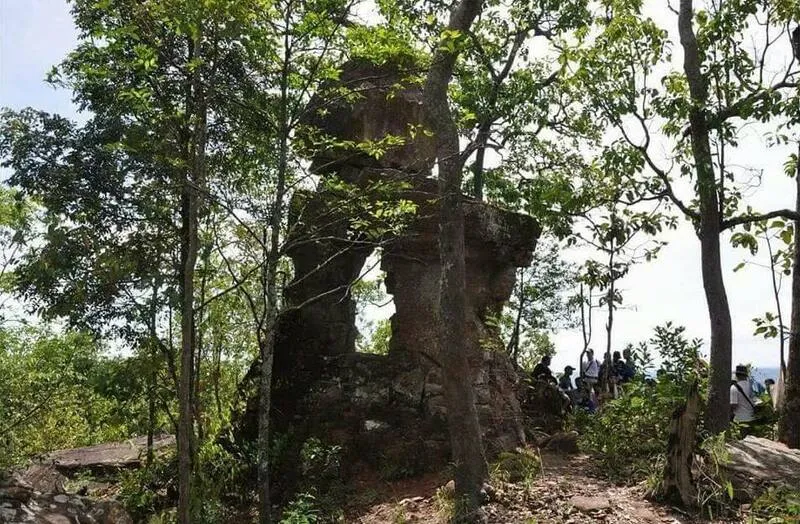
The name Pha Pratu Mueang can be understood from the appearance of the site itself. Large sandstone rocks and a cliffside opening form a shape that resembles a city gate. From certain angles, the stacked rocks create a natural frame, as if the mountain were opening toward the landscape below. This striking form gives the place its identity and makes it memorable for visitors. It is not a constructed monument, but a natural rock formation that local imagination has transformed into a symbolic gateway.
One of the most fascinating stories connected with Pha Pratu Mueang is the legend of a hidden city. Local people tell of a mysterious Lap Lae city once believed to exist beyond the rock gateway. In the past, villagers were said to be able to enter this hidden city and borrow household items such as pots, jars, plates, and bowls. Later, when borrowed objects were not returned completely, the gateway closed forever and people could no longer enter. This legend gives the site a mysterious atmosphere and helps explain why many visitors feel that Pha Pratu Mueang is not merely a scenic place, but a site of spiritual and cultural depth.
The legend of the hidden city also reflects how local communities understand mountains, forests, and cliffs as sacred spaces. Such stories teach respect for nature. They suggest that a mountain is not an empty landscape, but a place with guardians, rules, and unseen forces. The story of the closed gateway can be read as a cultural reminder that people must behave with honesty, gratitude, and restraint when using shared resources. In this sense, the legend functions as both folklore and environmental ethics.
Another important aspect of Pha Pratu Mueang is the belief in Chao Mae Pha Pratu Mueang, the female guardian spirit of the site. Local residents believe that she protects the land, the mountain, the forest, and the community. Each year, villagers continue to hold a ritual offering with savory and sweet foods to honor her, ask for blessings, and pray for safety, prosperity, and protection from danger. This ceremony has become a living cultural tradition that connects present-day villagers with their ancestors, sacred geography, and collective memory.
The annual ritual for Chao Mae Pha Pratu Mueang is more than a religious act. It is also a community gathering and a cultural expression of gratitude. Through the offering, local people show respect to the guardian spirit, to the mountain, and to the historical memory attached to the site. Travelers who have the opportunity to visit during the ritual period may witness a powerful atmosphere of faith, respect, and continuity. The ceremony is not simply performed for tourism; it remains part of the local community’s belief system and annual rhythm.
Pha Pratu Mueang is also associated with a local story about three signal flags used in times of conflict. A white flag represented peace, a blue flag called people to gather, and a red flag warned that enemies were approaching the city gate and that everyone should prepare for defense. This story reinforces the idea that the site once functioned symbolically as a watchpoint and defensive landmark. The high position of the cliff and its wide visibility help visitors understand why such a place could be remembered as a natural fortress.
In the broader local history of Nakhon Thai, Pha Pratu Mueang is linked with the memory of Nakhon Bang Yang, Pho Khun Bang Klang Thao, and the early formation of Thai society. Some details belong to oral tradition rather than written historical records, but the value of the site does not depend only on documents. Places like this function as landscapes of memory. They show how communities interpret their own homeland and how they connect mountains, rocks, and paths with stories of origin, protection, and identity.
Geologically, Pha Pratu Mueang is notable for sandstone formations associated with the Phu Phan Formation and the Phra Wihan Formation within the Khorat Group. These rocks belong to the Jurassic Period of the Mesozoic Era. Their compact texture and varied colors, including grey, pink, red, green, and white, reflect different mineral compositions, sedimentation processes, compression, and long-term erosion. Over time, weathering shaped the sandstone into cliffs, pillars, and gateway-like openings, producing the distinctive appearance that visitors see today.
For travelers interested in earth science, Pha Pratu Mueang is a valuable outdoor classroom. The site allows visitors to observe sandstone layers, rock surfaces, colors, erosion patterns, and the way natural forces shape landforms over immense periods of time. Unlike a museum display, the evidence here is part of the landscape itself. Standing near the rock gateway, visitors can sense the scale of geological time and understand how slow natural processes can create forms that later become culturally meaningful.
The surrounding environment remains largely natural. Much of the area is associated with dry dipterocarp forest and older local woodland adapted to mountain conditions. Dry dipterocarp forest changes noticeably with the seasons. Some trees shed leaves during drier periods, allowing more sunlight to reach the ground and supporting seasonal herbs and smaller plants. This type of forest offers a different atmosphere from dense evergreen forest and gives travelers a chance to experience one of Thailand’s important upland ecosystems.
Wildlife in the surrounding forest, such as wild boar, birds, and smaller animals, forms part of the ecological value of the area. Visitors should travel responsibly by keeping noise low, not feeding wildlife, not collecting plants or stones, and taking all waste out of the site. This is especially important because Pha Pratu Mueang is not only a viewpoint but also a living natural environment connected to local belief and community identity.
The walk toward the rock gateway combines nature, spirituality, and local history. As visitors move from the community area toward the forested slope and higher terrain, the atmosphere gradually changes. At the upper section, the cliff and rock gateway open toward a wide view of Nakhon Thai and the surrounding mountains. This view helps explain why the site has long been remembered as a place of observation and protection. The landscape itself makes the historical and spiritual stories easier to understand.
Pha Pratu Mueang is suitable for several types of travelers. History-minded visitors can learn about Nakhon Thai, Nakhon Bang Yang, and frontier-town traditions. Culture-focused travelers can explore the legend of the hidden city and the ritual of Chao Mae Pha Pratu Mueang. Nature lovers can enjoy the dry dipterocarp forest, mountain scenery, and quiet rural atmosphere. Geology enthusiasts can study sandstone formations and natural erosion. This combination makes the site a distinctive destination that is different from mainstream tourist attractions.
Preparation is important before visiting. Travelers should wear shoes suitable for walking on natural ground and rock surfaces, bring drinking water, a hat, and insect repellent, and avoid visiting during heavy rain when the path may become slippery. Visitors unfamiliar with the area should ask local residents or Bo Pho Subdistrict Administrative Organization for guidance before going, especially because the site is a local natural attraction rather than a fully commercialized tourist facility.
Those who wish to pay respect to Chao Mae Pha Pratu Mueang should dress politely and behave respectfully. If there is a shrine or ritual area, visitors should avoid loud behavior and should not place inappropriate objects in sacred spaces. Respecting the site does not require every visitor to share the same belief, but it does require consideration for the culture and faith of the local community.
Pha Pratu Mueang can be connected with other cultural sites in Bo Pho Subdistrict. One important nearby place is the ancient salt well of Ban Bo Pho, a local heritage site connected with community livelihood, local knowledge, and the history of settlement in the mountain valley. Combining Pha Pratu Mueang with Ban Bo Pho and the salt-well area gives travelers a fuller understanding of the relationship between landscape, resources, belief, and community life.
For a wider travel route, visitors can continue from Pha Pratu Mueang to important sites in Nakhon Thai District, such as the Pho Khun Si Inthrathit Monument and Wat Klang Si Phuttharam, or continue toward Phu Hin Rong Kla National Park and Dan Sai District in Loei Province. This route is suitable for travelers interested in early Thai historical memory, mountain landscapes, and the cultural borderland between lower northern Thailand and the northeastern region.
Getting There from Phitsanulok city, travelers should head toward Nakhon Thai District and continue to Bo Pho Subdistrict. Ban Bo Pho is about 30 kilometers from Nakhon Thai town and lies near the boundary area toward Dan Sai District in Loei Province. A private car is the most practical option because some sections are rural roads and mountain routes. Visitors should check road conditions with local people or Bo Pho Subdistrict Administrative Organization before traveling, especially during the rainy season.
Because Bo Pho is far from Phitsanulok city, travelers should start early and allow enough time for the return journey. Morning travel provides better conditions for walking, photography, and visiting nearby community sites. Those who prefer a slower trip may stay overnight in Nakhon Thai District and continue to nearby attractions the next day.
The charm of Pha Pratu Mueang lies in its authenticity. It is not a heavily developed tourist site with full urban convenience. Instead, it offers a quiet, local, and spiritually rich experience. Visitors should approach the place with patience, respect, and curiosity. Listening to local stories will make the journey far more meaningful than simply taking photographs of the rock formation.
Pha Pratu Mueang also has strong educational potential. It can be used to study how geography relates to defensive strategy, how sacred beliefs help protect forests, how legends function within community life, and how geological formations become cultural landmarks. The site shows that history is not found only in written records; it is also present in mountains, stones, rituals, pathways, and oral traditions.
Overall, Pha Pratu Mueang is a place worth preserving and introducing to a wider audience. It combines local history, the legend of a hidden city, the ritual of Chao Mae Pha Pratu Mueang, a natural defensive landscape, dry dipterocarp forest, wildlife, and distinctive sandstone geology. Visiting with understanding and respect allows travelers to experience more than a viewpoint. It becomes a journey into the historical memory and spiritual landscape of Nakhon Thai.
For foreign travelers seeking a deeper side of Phitsanulok beyond its famous temples and national parks, Pha Pratu Mueang offers a rare and meaningful experience. It reveals how local communities interpret their landscape, how legends preserve moral lessons, and how natural formations can become part of cultural identity. With good preparation and respectful behavior, a visit to Pha Pratu Mueang can become one of the most memorable cultural nature trips in Phitsanulok Province.
| Name | Pha Pratu Mueang |
| Location | Bo Pho Subdistrict, Nakhon Thai District, Phitsanulok Province |
| Address | Bo Pho Subdistrict, Nakhon Thai District, Phitsanulok 65120, Thailand |
| Highlights | Natural rock gateway, hidden-city legend, belief in Chao Mae Pha Pratu Mueang, annual ritual offerings, and wide mountain views over Nakhon Thai |
| History | Associated with local stories about an ancient frontier point, Nakhon Bang Yang, Pho Khun Bang Klang Thao, and the strategic use of high terrain in the past |
| Name Origin | The name comes from the natural rock and cliff opening that resembles a gateway or city gate |
| Distinctive Features | Sandstone formations associated with the Phu Phan Formation and Phra Wihan Formation of the Khorat Group, Jurassic Period, Mesozoic Era, with grey, pink, red, green, and white rock colors |
| Beliefs and Traditions | Local belief in Chao Mae Pha Pratu Mueang and ritual offerings of savory and sweet foods for blessings, safety, and community protection |
| Travel Information | Travel from Phitsanulok city to Nakhon Thai District, then continue to Bo Pho Subdistrict. The area is about 30 km from Nakhon Thai town. A private car is recommended, and visitors should check local route conditions before traveling |
| Current Status | Local natural site and cultural-historical attraction of Bo Pho Subdistrict |
| Facilities | Nearby community area, local sacred area, and natural walking route toward the rock gateway |
| Main Areas / Zones | Rock gateway, cliff area, viewpoint, sacred area of Chao Mae Pha Pratu Mueang, and surrounding dry dipterocarp forest |
| Caretaker | Bo Pho Subdistrict Administrative Organization, Nakhon Thai District, Phitsanulok Province |
| Main Contact Number | 055-009-809, 089-938-8842, Hotline 082-837-7895 |
| Official Website / Official Page | Bo Pho Subdistrict Administrative Organization, Nakhon Thai District, Phitsanulok Province |
| Nearby Tourist Attractions | 1. Ancient Salt Well of Ban Bo Pho, about 5 km 2. Ban Bo Pho and Lam Nam Fia, about 5 km 3. Wat Pa Pha Pratu Mueang, about 6 km 4. Pho Khun Si Inthrathit Monument, Nakhon Thai District, about 30 km 5. Wat Klang Si Phuttharam, Nakhon Thai District, about 31 km 6. Phu Hin Rong Kla National Park, about 55 km |
| Nearby Restaurants | 1. Bo Ngoen Restaurant, Ban Bo Pho, about 5 km 2. Local Community Restaurants in Ban Bo Pho, about 5 km 3. Local Restaurants in Bo Pho Subdistrict, about 6 km 4. Restaurants in Nakhon Thai Town, about 30 km 5. Cafes and Restaurants in Nakhon Thai Town, about 31 km |
| Nearby Accommodations | 1. Panya Garden Resort, about 30 km, Tel. 087-998-6896 2. Phet Resort Nakhonthai, about 31 km, Tel. 081-474-3541 3. Prem's Place Nakhon Thai, about 31 km 4. Eve & Am Resort, about 32 km 5. Petch Nakhonthai Homestay, about 33 km |
Frequently Asked Questions (FAQ)
Q: Where is Pha Pratu Mueang located?
A: Pha Pratu Mueang is located in Bo Pho Subdistrict, Nakhon Thai District, Phitsanulok Province. It is a local natural site known for history, belief, and sandstone geology.
Q: Why is Pha Pratu Mueang important?
A: It is important as a site connected with local stories about an ancient frontier point, a strategic mountain position, the legend of a hidden city, and the guardian spirit Chao Mae Pha Pratu Mueang.
Q: Why is it called Pha Pratu Mueang?
A: The name comes from the natural rock formation and cliff opening that resemble a gateway or city gate.
Q: How is Pha Pratu Mueang connected with Pho Khun Bang Klang Thao?
A: Local stories connect the site with the gathering of forces and the strategic role of Pho Khun Bang Klang Thao, also known as Pho Khun Bang Klang Hao, in the Nakhon Thai area.
Q: Are there any rituals or traditions related to Pha Pratu Mueang?
A: Yes. Local people hold ritual offerings for Chao Mae Pha Pratu Mueang, offering savory and sweet foods to ask for blessings, safety, and community protection.
Q: Who should visit Pha Pratu Mueang?
A: It is suitable for travelers interested in local history, folklore, sacred landscapes, dry dipterocarp forest, sandstone formations, and cultural nature tourism in Nakhon Thai District.
Q: What should visitors prepare before going?
A: Visitors should wear suitable walking shoes, bring drinking water, a hat, and insect repellent, and should check the route with Bo Pho Subdistrict Administrative Organization or local residents before traveling.
Q: What nearby attractions can be combined with Pha Pratu Mueang?
A: Travelers can combine it with the ancient salt well of Ban Bo Pho, Wat Pa Pha Pratu Mueang, Pho Khun Si Inthrathit Monument, Wat Klang Si Phuttharam, and Phu Hin Rong Kla National Park.
 Category: ●Nature and Wildlife
 Group: ●Mountain (Doi)
Last Update : 4 MonthAgo
 Last Update : 4 MonthAgo
 Click to Access the Navigation Map GPS
 Art, Culture and Heritage
 Historical Sites and Monuments(1)
 Landmarks and Memorials(2)
 Art, Craft Centres, Tradition(3)
 Museums(3)
 Educational Places
 Educational Gardens, Farm(1)
 Places of Worship
 Temple(29)
 Mosque(1)
 Other Sacred Sites(3)
 Research and Development
 Royal Project(1)
 Suburban Living
 Village, Community(1)
 National Parks and Marine Reserves(7)
Mountain (Doi)(4)
National Parks and Marine Reserves(7)
Mountain (Doi)(4)
 Dam, Reservoir, Lake(5)
 Waterfalls(19)
 Caves(3)
 River, Canal(9)
 Other natural attractions(1)
 Entertainment and Agricultural
 Farms, Parks and Ecotourism(2)
 Outdoor and Adventure Activities(1)


