
lovethailand home >North Travel Attractions >Phichit Travel Attractions >Taphan Hin >Wang Lum > Wat Phra Phutthabat Khao Ruak
TL;DR: Wat Phra Phutthabat Khao Ruak is located at Moo 5, Wang Lum Subdistrict, Taphan Hin District, Phichit Province, open Daily, hours Daytime.
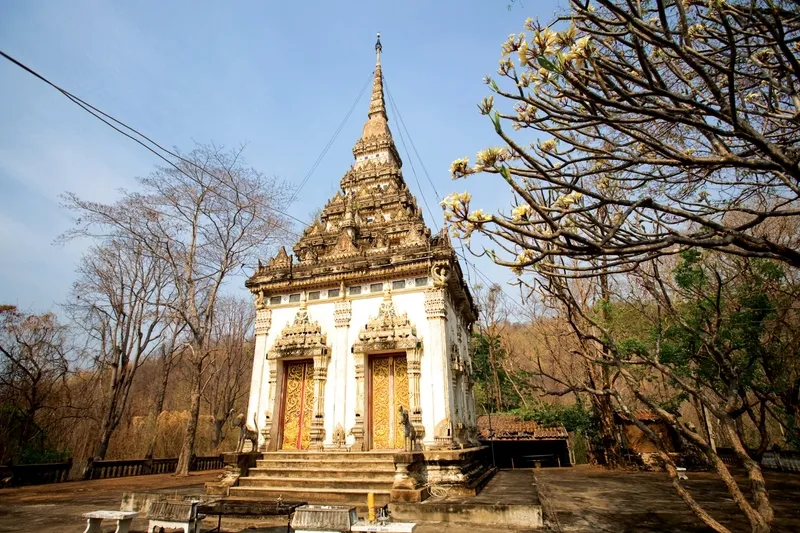
Wat Phra Phutthabat Khao Ruak
Open Days: Daily
Opening Hours: Daytime
Wat Phra Phutthabat Khao Ruak in Phichit Province is an important Buddhist temple in Taphan Hin District, combining religious devotion, local culture, folk wisdom, archaeology, and family-friendly learning in one place. The temple is located at Moo 5, Wang Lum Subdistrict, Taphan Hin District, Phichit Province, about 10 km from Taphan Hin town. Because of its accessible location, it is a popular stop for Buddhist pilgrims, local families, and cultural travelers who wish to pay respect to the replica of the Buddha’s Footprint and learn about the legacy of Luang Pu Ngon Sorayo, a respected Thai Buddhist master associated with the temple.
The temple’s main appeal lies in the wide range of meaningful features found within its grounds. These include a replica of the Buddha’s Footprint modeled after Wat Phra Phutthabat in Saraburi Province, a statue of Luang Pu Ngon Sorayo, a giant pradu-wood drum, an ancient laterite hermit statue estimated to be around 1,000–1,500 years old, and a small zoo inside the temple area. These elements make Wat Phra Phutthabat Khao Ruak more than a place of worship. It is also a learning site for religion, local craftsmanship, archaeology, belief systems, and community culture in Phichit.
For first-time visitors, the most important place to begin is the replica of the Buddha’s Footprint. In Thai Buddhist culture, a Buddha’s Footprint is a sacred symbol that reminds devotees of the Buddha’s presence, teachings, and path of practice. Paying respect to the footprint is a way to cultivate mindfulness, gratitude, and faith. Many visitors come to pray for blessings, family well-being, safe travel, and personal peace.
The replica at Wat Phra Phutthabat Khao Ruak was modeled after the famous Buddha’s Footprint at Wat Phra Phutthabat in Saraburi Province, one of Thailand’s most revered pilgrimage sites. By enshrining a replica in Phichit, local Buddhists and visitors can pay respect to this sacred symbol without having to travel far. At the same time, it connects Phichit with a broader national tradition of reverence for the Buddha’s Footprint.
Wat Phra Phutthabat Khao Ruak is also well known as a place where Luang Pu Ngon Sorayo once stayed during the Buddhist rains retreat. Luang Pu Ngon was a respected Buddhist monk and teacher whose name remains familiar among many Thai devotees. He played an important role in promoting Buddhist values and was known for creating Phra Phuttha Wimok Buddha images in the meditation posture, which he offered to schools across the country. These images served as spiritual anchors and reminders of virtue for students, teachers, and communities.
The connection with Luang Pu Ngon gives the temple a deeper spiritual dimension. Many devotees come to the temple to pay respect to his statue and remember his contribution to Buddhism. His work was not limited to temple communities; by offering Buddha images to schools, he helped bring Buddhist symbolism into educational spaces, encouraging young people to grow with a sense of morality, calmness, and inner discipline.
The story of Phra Phuttha Wimok in the meditation posture reflects Luang Pu Ngon’s vision clearly. A Buddha image is not merely an object of worship. It is a visual reminder of stillness, concentration, and spiritual liberation. When placed in schools, such images encourage students and teachers to reflect on goodness, patience, and mindfulness. This makes Wat Phra Phutthabat Khao Ruak significant not only as a religious site, but also as a place connected with education and moral cultivation.
Another remarkable feature inside the temple is the giant pradu-wood drum, known by its ceremonial name “Klong Nantha Pheri Sri Racha Rukkho Mahorathuek Maruekkhathayawan Banlue Lok.” The drum is made from a giant pradu tree and is regarded as one of the temple’s most distinctive attractions. Its importance is not only in its size, but also in the craftsmanship and local knowledge involved in creating it.
In Thai temple culture, drums are more than musical instruments. Traditionally, they were used to mark time, announce religious activities, call people to gather, and support ritual rhythms. The giant drum at Wat Phra Phutthabat Khao Ruak therefore helps visitors understand the connection between Buddhism, community life, and local wisdom. It is also a memorable point for photography and cultural learning, especially for families and students.
The temple also houses an ancient hermit statue made from laterite. The statue is said to be around 1,000–1,500 years old and was made from laterite associated with the Khuen River basin. The hermit figure reflects older layers of belief in the region. In Southeast Asian culture, hermits are often connected with ascetic practice, knowledge, medicine, spiritual power, and traditional cosmology. Its presence inside the temple adds a cultural and archaeological dimension to the visit.
Laterite is a material often found in archaeological sites across Thailand and nearby regions. Its use in the hermit statue gives visitors a chance to consider the relationship between ancient materials, local belief, and religious spaces. The statue is not simply a curious object; it is a reminder that many Thai temples preserve cultural layers from different periods, bringing together Buddhism, local belief, and historical memory.
For families, another appealing feature of Wat Phra Phutthabat Khao Ruak is the small zoo within the temple grounds. It allows children and visitors to observe various animals and spend time learning in a relaxed environment. This makes the temple experience more diverse. Adults can pay respect to sacred objects and learn about history, while children can enjoy nature and animals in the same visit.
The small zoo also reflects the broader role of Thai temples as community spaces. Temples are not only places for ceremonies and worship; they often function as public spaces for learning, rest, and community life. When families bring children to the temple, children can learn respect for sacred places, kindness toward animals, and basic Buddhist values such as compassion and mindfulness.
The overall atmosphere of Wat Phra Phutthabat Khao Ruak is calm, local, and approachable. Visitors can walk through different areas of the temple, including the Buddha’s Footprint shrine, the statue of Luang Pu Ngon Sorayo, the giant pradu-wood drum, the laterite hermit statue, and the small zoo. Each feature tells a different story. A slower visit allows travelers to appreciate how faith, craftsmanship, archaeology, and community learning come together within one temple compound.
For Buddhist pilgrims, the temple is suitable for merit-making, prayer, and quiet reflection. Visitors can pay respect to the Buddha’s Footprint, remember Luang Pu Ngon, and spend time in a peaceful temple environment away from the busier areas of town. For many Thai visitors, the temple provides a sense of blessing and emotional calm.
For cultural travelers, Wat Phra Phutthabat Khao Ruak offers several layers of interest. It presents the tradition of Buddha’s Footprint worship, the life and work of Luang Pu Ngon Sorayo, the distribution of Phra Phuttha Wimok Buddha images to schools, local craftsmanship represented by the giant drum, older belief reflected in the hermit statue, and family-oriented learning through the small zoo. This variety makes the temple especially useful for educational trips and cultural routes in Taphan Hin District.
The temple also helps visitors understand how Buddhism in local communities often coexists with older beliefs and practical community wisdom. The Buddha’s Footprint represents Buddhist devotion, the hermit statue reflects older spiritual imagery, the drum represents local craftsmanship and communal temple life, and the small zoo connects the temple with natural learning. Together, these features show that Thai temples often function as living cultural centers rather than single-purpose religious sites.
Getting There is most convenient by private car or rental car. From Taphan Hin town, travel toward Wang Lum Subdistrict for about 10 km to reach Wat Phra Phutthabat Khao Ruak at Moo 5. Travelers arriving by train can get off at Taphan Hin Railway Station and continue by local transport or hired vehicle to the temple. The visit can easily be combined with nearby attractions such as Wat Thewaprasat, Wat Khao Rup Chang, Bueng Si Fai, or Wat Tha Luang Royal Monastery.
A half-day route can begin from Taphan Hin town or Taphan Hin Railway Station, then continue to Wat Phra Phutthabat Khao Ruak to pay respect to the Buddha’s Footprint, visit the statue of Luang Pu Ngon, see the giant pradu-wood drum, and walk through the small zoo area. Travelers with a full day can continue to Wat Thewaprasat to pay respect to Luang Pho To Taphan Hin, then visit Wat Khao Rup Chang or Bueng Si Fai depending on their interests.
The best times to visit are in the morning or late afternoon, when the weather is more comfortable for walking through the temple grounds. Morning is suitable for merit-making and prayer, while late afternoon is pleasant for photography and a slower walk. Families traveling with children should prepare drinking water, hats, or umbrellas, and should supervise children closely, especially around the small zoo and areas with many visitors.
Visitors should dress modestly, speak quietly, keep the temple clean, and respect sacred objects and old artifacts. They should avoid climbing on or touching religious objects and cultural items in ways that may cause damage. When visiting the small zoo, visitors should follow the temple’s instructions, avoid feeding animals without permission, and teach children to behave gently and respectfully toward animals.
Wat Phra Phutthabat Khao Ruak is therefore more than a simple temple stop. It brings together devotion to the Buddha’s Footprint, the spiritual legacy of Luang Pu Ngon Sorayo, local craftsmanship through the giant pradu-wood drum, ancient belief through the laterite hermit statue, and family learning through the small zoo. Visitors can gain merit, knowledge, and a more complete understanding of local culture in one visit.
Overall, Wat Phra Phutthabat Khao Ruak is one of the cultural and religious destinations in Phichit that should not be overlooked, especially for travelers visiting Taphan Hin District. The temple reveals another side of Phichit beyond well-known legends and riverside attractions. It preserves stories of Buddhist teachers, sacred footprints, ancient objects, craftsmanship, and community learning. A visit here is both a spiritual experience and a meaningful introduction to the cultural roots of Phichit.
| Name | Wat Phra Phutthabat Khao Ruak, Phichit Province |
| Location | Moo 5, Wang Lum Subdistrict, Taphan Hin District, Phichit Province |
| Address | Moo 5, Wang Lum Subdistrict, Taphan Hin District, Phichit Province 66110, Thailand |
| Highlights | Replica of the Buddha’s Footprint from Wat Phra Phutthabat in Saraburi, statue of Luang Pu Ngon Sorayo, giant pradu-wood drum, ancient laterite hermit statue, and a small zoo within the temple grounds |
| History | An important temple in Wang Lum Subdistrict, known for its Buddha’s Footprint replica and its association with Luang Pu Ngon Sorayo, a respected Buddhist master who once stayed at the temple |
| Name Origin | The name is connected with the Buddha’s Footprint replica enshrined at the temple and the Khao Ruak area in Wang Lum Subdistrict |
| Distinctive Features | A temple combining sacred Buddhist objects, local craftsmanship, ancient cultural artifacts, and a family-friendly learning space |
| Travel Information | About 10 km from Taphan Hin town. Best reached by private car, rental car, or hired local transport from Taphan Hin Railway Station |
| Current Status | An active Buddhist temple open to visitors for worship, cultural learning, and sightseeing |
| Open Days | Daily |
| Opening Hours | Daytime |
| Fees | No admission fee |
| Facilities | Parking area, Buddha’s Footprint worship area, giant drum area, small zoo, and resting areas within the temple grounds |
| Main Areas / Zones | Replica of the Buddha’s Footprint, statue of Luang Pu Ngon Sorayo, Klong Nantha Pheri Sri Racha Rukkho Mahorathuek Maruekkhathayawan Banlue Lok, laterite hermit statue, and small zoo |
| Abbot / Caretaker | Phra Athikan Chatchai Kittitharo |
| Main Contact Number | 086-883-3994 |
| Nearby Tourist Attractions | 1. Wat Thewaprasat and Luang Pho To Taphan Hin, about 12 km 2. Taphan Hin Railway Station, about 11 km 3. Wat Khao Rup Chang, about 14 km 4. Bueng Si Fai, about 35 km 5. Wat Tha Luang Royal Monastery, about 36 km |
| Nearby Restaurants | 1. Khang Ban Taphan Hin Branch, about 8 km, Tel. 083-483-1536 2. Khao Hom Pla Maenam, about 11 km, Tel. 083-165-1169 3. Hua Khao Tom Taphan Hin, about 11 km, Tel. 056-621-696, 062-030-1313 4. PunThai Coffee Taphan Hin, about 11 km, Tel. 062-597-1224 5. 8th, about 12 km, Tel. 095-643-0099 6. Major Sweets Taphan Hin Phichit, about 12 km, Tel. 084-237-7741 |
| Nearby Accommodations | 1. Roseinn Hotel Taphanhin, about 11 km, Tel. 056-621-044, 091-024-5747, 093-140-8168 2. Wela Nxn @ Sleep Time, about 11 km, Tel. 087-730-5991 3. Ruen Rim Nan, about 12 km, Tel. 099-272-2999 4. Ruean Mai Garden Resort, about 14 km, Tel. 091-881-4991, 086-929-3773 5. The Nest Hotel Phichit, about 35 km, Tel. 056-033-662 |
Frequently Asked Questions (FAQ)
Q: Where is Wat Phra Phutthabat Khao Ruak located?
A: Wat Phra Phutthabat Khao Ruak is located at Moo 5, Wang Lum Subdistrict, Taphan Hin District, Phichit Province, about 10 km from Taphan Hin town.
Q: What is the main sacred object at Wat Phra Phutthabat Khao Ruak?
A: The main sacred object is the replica of the Buddha’s Footprint, modeled after Wat Phra Phutthabat in Saraburi Province. The temple also has a statue of Luang Pu Ngon Sorayo.
Q: How is Luang Pu Ngon Sorayo connected with the temple?
A: Luang Pu Ngon Sorayo was a respected Buddhist master who once stayed at Wat Phra Phutthabat Khao Ruak. He was known for creating Phra Phuttha Wimok Buddha images in the meditation posture and offering them to schools across Thailand.
Q: Why is the giant pradu-wood drum important?
A: The giant pradu-wood drum is one of the temple’s distinctive features. It reflects local craftsmanship and the cultural role of drums in Thai temple life.
Q: Is Wat Phra Phutthabat Khao Ruak suitable for families?
A: Yes. In addition to sacred Buddhist sites, the temple has a small zoo that can be educational and enjoyable for children and families.
Q: How can travelers get to Wat Phra Phutthabat Khao Ruak?
A: The temple is best reached by private car or rental car from Taphan Hin town, about 10 km away. Travelers arriving by train can get off at Taphan Hin Railway Station and continue by local transport.
Q: What nearby attractions can be visited with this temple?
A: Nearby places include Wat Thewaprasat, Taphan Hin Railway Station, Wat Khao Rup Chang, Bueng Si Fai, and Wat Tha Luang Royal Monastery.
Q: How should visitors behave at Wat Phra Phutthabat Khao Ruak?
A: Visitors should dress modestly, speak quietly, respect worship areas and old artifacts, keep the temple clean, and follow temple guidance when visiting the small zoo.
 Category: ●Places of Worship
 Group: ●Temple
Last Update : 5 MonthAgo
 Last Update : 5 MonthAgo
 Click to Access the Navigation Map GPS
Wat Phra Phutthabat Khao Ruak Map
Recommend

 Art, Culture and Heritage
 Historical Sites and Monuments(1)
 Art, Craft Centres, Tradition(1)
 Museums(1)
Temple(32)
Museums(1)
Temple(32)
 Other Sacred Sites(4)
 Research and Development
 Royal Project(1)
 Suburban Living
 Floating Market(1)
 Nature and Wildlife
 National Parks and Marine Reserves(1)
 Dam, Reservoir, Lake(3)
 River, Canal(2)
 Other natural attractions(1)
 Entertainment and Agricultural
 Animal camps and shows(1)
 Farms, Parks and Ecotourism(4)
 Travel Articles, Recipes
 Travel Review, Food Review(1)


