
lovethailand home >North Travel Attractions >Phichit Travel Attractions >Bang Mun Nak >Noen Makok > Wat Tha Chang
TL;DR: Wat Tha Chang is located at Noen Makok Subdistrict, Bang Mun Nak District, Phichit Province, open Daily, hours Daytime. Highlights include Luang Pho Hin, an old sandstone Buddha image, and 2 large elephant statues at the front of the temple.
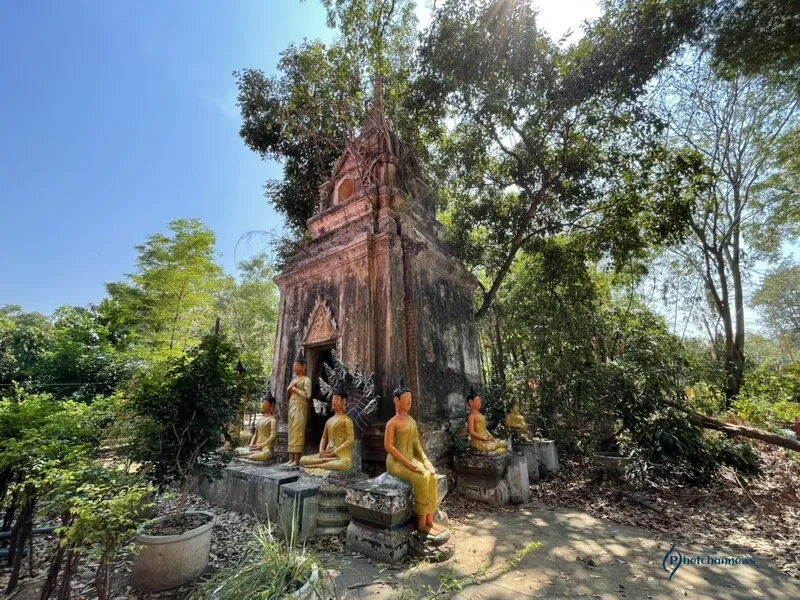
Wat Tha Chang
Open Days: Daily
Opening Hours: Daytime
Wat Tha Chang in Phichit Province is an important local Buddhist temple in Noen Makok Subdistrict, Bang Mun Nak District. Located only about 2 km from Bang Mun Nak town, the temple is easy to reach and is a meaningful stop for visitors who wish to make merit, pay respect to an ancient sandstone Buddha image, and see the temple’s distinctive pair of large elephant statues at the entrance. Wat Tha Chang is not a large commercial tourist attraction, but it is a living community temple that reflects the faith, local identity, and riverside culture of Bang Mun Nak.
The charm of Wat Tha Chang lies in its simplicity and strong local character. The first thing many visitors notice is the pair of large elephant statues in front of the temple. These elephants are closely associated with the name “Tha Chang,” which literally evokes the image of an elephant landing or elephant-related place. The statues make the temple instantly recognizable and have become a popular photo point for travelers and local devotees before they enter the temple grounds to pay respect to the sacred Buddha image.
Wat Tha Chang is situated near the Nan River in Noen Makok Subdistrict, reflecting the traditional pattern of Thai temples being established close to waterways. In earlier times, rivers were essential for travel, trade, farming, and community life. Temples located near rivers often became the heart of the village, serving as places of worship, education, public gathering, and moral support. Wat Tha Chang continues to carry this role as a spiritual and cultural center for the local community.
Local municipal information identifies Wat Tha Chang as a Mahanikaya temple with 18 rai and 2 ngan of temple land. The temple also has 2 plots of monastic land totaling 76 rai. These details show that the temple has a stable physical foundation and a long-standing role in the community. It is not merely a small roadside shrine, but an established Buddhist temple with land, religious buildings, and space for community activities.
The temple has several important monastic buildings, including an ordination hall, sermon hall, chanting hall, and monks’ residences. These are essential components of a Thai Buddhist temple. The ordination hall is used for formal Sangha ceremonies, the sermon hall supports Dhamma listening and community merit-making, and the monks’ residences allow monks to stay and carry out religious duties. Together, these buildings show that Wat Tha Chang continues to function as an active temple throughout the year.
The most important sacred object at Wat Tha Chang is the ancient stone Buddha image, commonly known locally as Luang Pho Hin. This Buddha image was carved from sandstone and has been respected by local residents for a long time. For devotees, Luang Pho Hin is a spiritual anchor of the community. People come to pay respect, pray for blessings, and find peace of mind. For visitors, the image is also valuable as a work of traditional craftsmanship.
A sandstone Buddha image carries both religious and artistic significance. Sandstone requires careful carving, patience, and skill. The image at Wat Tha Chang reflects the work of craftsmen who created a sacred object that could inspire devotion across generations. Its beauty does not come from excessive decoration, but from calmness, simplicity, age, and the sense of stability that old Buddha images often convey.
Paying respect to Luang Pho Hin is therefore not only a routine temple visit. It is a way of connecting with the faith of the people of Noen Makok and Bang Mun Nak. Older residents know the image well, while younger generations continue to inherit respect for the temple and its sacred Buddha image. During merit-making days and local religious activities, Wat Tha Chang remains a place where people gather and reaffirm their connection to Buddhism and community life.
The 2 large elephant statues at the front of the temple are another defining feature. In Thai culture, elephants are associated with strength, stability, dignity, prosperity, and abundance. At Wat Tha Chang, the pair of elephants is more than a decorative feature. It reinforces the temple’s name and gives visitors a clear visual symbol to remember. The elephants also make the entrance feel ceremonial, as if they are welcoming visitors into a sacred space.
Many visitors stop to take photographs with the elephant statues before entering the main temple area. This has become part of the visiting experience. The statues create a transition between the outside road and the temple space, helping visitors feel that they are entering a place of faith and cultural meaning. For cultural travelers, this simple but memorable feature makes Wat Tha Chang stand out among local temples in Phichit.
The atmosphere of Wat Tha Chang is calm, shaded, and approachable. It is the kind of community temple where visitors can walk slowly, pay respect to the Buddha image, sit quietly, and observe local Buddhist life. It is not heavily commercialized, and that is part of its appeal. The temple still functions as a real place of worship and community connection, making it suitable for travelers who appreciate authentic local experiences.
Wat Tha Chang is also associated with Phra Khru Withit Woratham, Charan Worathammo, a former abbot of the temple and former district ecclesiastical chief of Bang Mun Nak. Cultural information records his role in connection with Luang Pho Hin and Wat Tha Chang during his lifetime. More recent Kathin information for 2025 lists the current abbot as Phra Athikan Anurak Thanapanyo. This continuity of monastic care helps the temple maintain its religious and community role from one generation to the next.
For Buddhist travelers, Wat Tha Chang is a good place for a quiet merit-making stop. It is close to Bang Mun Nak town and can be visited without a long detour. Visitors can pay respect to Luang Pho Hin, take photographs of the elephant statues, and walk around the temple grounds in about 30 to 60 minutes. Those who wish to enjoy the atmosphere more slowly may visit in the morning or late afternoon when the weather is more comfortable and the light is suitable for photography.
From a cultural learning perspective, Wat Tha Chang shows that local temples often preserve many layers of meaning. Here, visitors can see an old sandstone Buddha image, elephant symbolism, monastic buildings, and a riverside setting connected with the Nan River. These elements together create a picture of a community temple shaped by art, faith, local identity, and everyday Buddhist life.
For families or student groups, the temple can be a useful informal learning site. Children can learn about the meaning of elephants in Thai culture, the craftsmanship of sandstone Buddha images, and proper behavior at Buddhist temples. They can also learn simple temple etiquette such as dressing modestly, speaking quietly, respecting sacred objects, and not climbing on statues or religious structures. Learning through a real place often makes local culture easier to understand.
Wat Tha Chang can also be included in a cultural route through Bang Mun Nak and nearby areas. Visitors may combine the temple with Bang Mun Nak Railway Station, the Living Museum of Bang Mun Nak, Wat Huai Khen, Wat Khao Rup Chang, and other sites in Phichit Province. Such a route gives travelers a broader view of the province, including religion, riverside community life, local history, and small-town culture.
Getting There is convenient from Bang Mun Nak town. Travelers can take Highway 1118 toward Noen Makok Subdistrict. The temple is about 2 km from the district center. Those arriving by train can get off at Bang Mun Nak Railway Station and continue by local transport or hired vehicle to the temple. Because the distance is short, Wat Tha Chang is suitable for a quick temple stop as well as a slower cultural visit.
A half-day itinerary may begin in Bang Mun Nak town, continue to Wat Tha Chang to pay respect to Luang Pho Hin and photograph the elephant statues, then proceed to the Living Museum of Bang Mun Nak or a local restaurant. Travelers with more time can continue toward Wat Khao Rup Chang or return to Phichit town to visit Bueng Si Fai and Wat Tha Luang. This makes Wat Tha Chang a flexible stop within a wider Phichit travel route.
The best times to visit are in the morning and late afternoon. Morning is suitable for merit-making and prayer, while late afternoon offers softer light for walking around and photographing the elephant statues. Visitors should avoid disturbing monks or local worshippers and should take photographs respectfully within the temple grounds.
Visitors should dress modestly, speak quietly, keep the temple clean, and avoid climbing on the elephant statues or any sacred objects. Respectful conduct is important because Wat Tha Chang remains an active place of worship for the local community. Visiting with consideration helps preserve the temple atmosphere and shows respect for the people who have cared for this temple for generations.
Wat Tha Chang is therefore more than a small temple near Bang Mun Nak town. It brings together the devotion of Noen Makok residents, the artistic value of an old sandstone Buddha image, the memorable symbolism of the elephant statues, and the identity of a riverside community temple. Visitors can gain blessings, take meaningful photographs, and understand how local temples continue to shape Buddhist life in Phichit.
Overall, Wat Tha Chang is a worthwhile stop for travelers who want a quiet and authentic religious-cultural experience in Phichit Province. It is easy to reach, meaningful to the local community, and distinctive because of Luang Pho Hin and the pair of large elephants at the entrance. A visit here offers a simple but valuable glimpse into the faith, culture, and everyday Buddhist life of Bang Mun Nak District.
| Name | Wat Tha Chang, Phichit Province |
| Location | Noen Makok Subdistrict, Bang Mun Nak District, Phichit Province |
| Address | Noen Makok Subdistrict, Bang Mun Nak District, Phichit Province 66120, Thailand |
| Highlights | Luang Pho Hin, an old sandstone Buddha image, and 2 large elephant statues at the front of the temple |
| History | A Mahanikaya community temple located near the Nan River in Noen Makok Subdistrict, with 18 rai and 2 ngan of temple land and a long-standing role in the Bang Mun Nak community |
| Name Origin | The temple name is associated with the elephant symbolism and the local Tha Chang community identity in Noen Makok |
| Distinctive Features | A riverside community temple with an old sandstone Buddha image, a pair of large elephant statues, and a peaceful local atmosphere suitable for merit-making and reflection |
| Travel Information | From Bang Mun Nak town, take Highway 1118 toward Noen Makok Subdistrict. The temple is about 2 km from the district center. Travelers arriving by train can get off at Bang Mun Nak Railway Station and continue by local transport |
| Current Status | An active Buddhist temple open for worship, merit-making, and cultural visits |
| Open Days | Daily |
| Opening Hours | Daytime |
| Facilities | Parking area, worship area for the stone Buddha image, photo area near the elephant statues, sermon hall, and resting areas within the temple grounds |
| Main Areas / Zones | Luang Pho Hin, old sandstone Buddha image, 2 large elephant statues at the entrance, ordination hall, sermon hall, and riverside temple area near the Nan River |
| Abbot / Caretaker | Phra Athikan Anurak Thanapanyo |
| Official Website / Official Page | Noen Makok Municipality website |
| Nearby Tourist Attractions | 1. Bang Mun Nak Railway Station, about 3 km 2. Living Museum of Bang Mun Nak, about 3 km 3. Wat Huai Khen, about 8 km 4. Wat Khao Rup Chang, about 35 km 5. Wat Thewaprasat and Luang Pho To Taphan Hin, about 38 km |
| Nearby Restaurants | 1. Jae Lee Salapao Khanom Jeeb Mantou, about 3 km 2. For-Est Cafe’, about 3 km, Tel. 063-518-4887 3. Lung Ueng Pla Maenam Bang Mun Nak, about 4 km 4. Khanom Jeeb Bang Mun Nak Railway Station, about 3 km 5. Suan Ahan Phuean Mai, about 5 km 6. KFC PTT OR Bang Mun Nak, about 5 km |
| Nearby Accommodations | 1. Weethara Resort Bang Mun Nak, about 1 km, Tel. 081-785-2040 2. Suan Khun Yai Resort, about 3 km, Tel. 056-633-388, 088-282-1152, 086-327-0716 3. Baan Sabaijai Resort, about 4 km, Tel. 082-877-8848 4. Hairhouse Apartment, about 4 km, Tel. 089-707-2582, 080-511-6772 5. Baan Rak Resort, about 5 km, Tel. 083-330-3308, 056-633-336 |
Frequently Asked Questions (FAQ)
Q: Where is Wat Tha Chang located?
A: Wat Tha Chang is located in Noen Makok Subdistrict, Bang Mun Nak District, Phichit Province, about 2 km from Bang Mun Nak town.
Q: What is the main sacred object at Wat Tha Chang?
A: The main sacred object is Luang Pho Hin, an old sandstone Buddha image long respected by the local community.
Q: What makes Wat Tha Chang distinctive?
A: The temple is known for its old sandstone Buddha image and the 2 large elephant statues at the entrance, which have become the temple’s visual symbol.
Q: Is Wat Tha Chang suitable for family visits?
A: Yes. The temple is easy to reach, peaceful, and suitable for merit-making, walking around, and taking photographs of the elephant statues.
Q: Who is the current abbot of Wat Tha Chang?
A: The 2025 Kathin information lists the current abbot as Phra Athikan Anurak Thanapanyo.
Q: How can travelers get to Wat Tha Chang?
A: From Bang Mun Nak town, take Highway 1118 toward Noen Makok Subdistrict for about 2 km. Travelers can also arrive by train at Bang Mun Nak Railway Station and continue by local transport.
Q: What nearby attractions can be visited with Wat Tha Chang?
A: Nearby places include Bang Mun Nak Railway Station, the Living Museum of Bang Mun Nak, Wat Huai Khen, Wat Khao Rup Chang, and Wat Thewaprasat.
Q: How should visitors behave at Wat Tha Chang?
A: Visitors should dress modestly, speak quietly, avoid climbing on the elephant statues or sacred objects, and keep the temple grounds clean.
 Category: ●Places of Worship
 Group: ●Temple
Last Update : 5 MonthAgo
 Last Update : 5 MonthAgo
 Click to Access the Navigation Map GPS
 Art, Culture and Heritage
 Historical Sites and Monuments(1)
 Art, Craft Centres, Tradition(1)
 Museums(1)
Temple(32)
Museums(1)
Temple(32)
 Other Sacred Sites(5)
 Research and Development
 Royal Project(1)
 Suburban Living
 Floating Market(1)
 Nature and Wildlife
 National Parks and Marine Reserves(1)
 Dam, Reservoir, Lake(3)
 River, Canal(2)
 Other natural attractions(1)
 Entertainment and Agricultural
 Animal camps and shows(1)
 Farms, Parks and Ecotourism(4)
 Travel Articles, Recipes
 Travel Review, Food Review(1)


