
lovethailand home >North Travel Attractions >Phichit Travel Attractions >Thao Khlo >Khao Sai > Wat Wang Daeng
TL;DR: Wat Wang Daeng is located at Khao Sai Subdistrict, Thap Khlo District, Phichit Province, open Daily, hours Daytime.
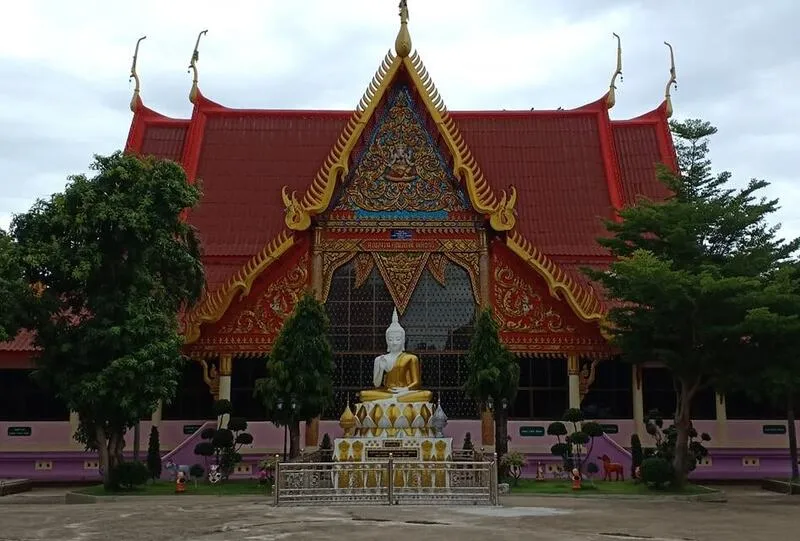
Wat Wang Daeng
Open Days: Daily
Opening Hours: Daytime
Wat Wang Daeng in Phichit Province is a local Buddhist temple in Khao Sai Subdistrict, Thap Khlo District. It is a community temple that reflects the close relationship between Buddhism, local culture, education, and rural life. Located in the Ban Wang Daeng area, the temple serves as a spiritual center for local residents and a peaceful place for visitors who wish to make merit, pay respect to the Buddha, and experience the quiet atmosphere of a traditional Thai village temple. Wat Wang Daeng may not be a large commercial tourist attraction, but its value lies in authenticity, community faith, and the continuing role of a temple in everyday local life.
The temple is situated in Khao Sai Subdistrict, an area of Thap Khlo District known for its calm rural setting and cultural depth. The surroundings of Wat Wang Daeng are peaceful and suitable for visitors who want a slower and more reflective travel experience. The temple grounds are simple, shaded, and connected with the daily rhythm of the community. This atmosphere allows visitors to understand the quieter side of Phichit, away from crowded attractions and large tourist sites.
Wat Wang Daeng is meaningful not only as a religious site but also as part of the broader cultural landscape of Ban Wang Daeng. The Ban Wang Daeng area is associated with important archaeological and historical evidence in Khao Sai Subdistrict. This gives the temple a deeper context. Visitors can view the temple not only as a place of worship but also as part of an old community landscape where Buddhism, local settlement, education, and cultural memory are connected.
The exact founding year of Wat Wang Daeng is not widely published in general public records, but the temple has long served as a community center for religious activities. It remains an active local temple with resident monks, regular merit-making, and Buddhist ceremonies. The temple is also connected with local education through Wat Wang Daeng School and child-development activities in the area. This relationship between temple, school, and village reflects the traditional role of Thai temples as places of learning, morality, and community support.
Inside the temple, visitors can find areas for worship, merit-making, chanting, and religious gatherings. The ordination hall, temple pavilions, monks’ residences, and communal spaces support Buddhist activities throughout the year. The temple does not need grand monuments to be meaningful. Its simplicity is part of its identity. It represents the everyday life of a Thai community temple, where local people come to make offerings, listen to teachings, join ceremonies, and preserve Buddhist customs.
The current abbot of Wat Wang Daeng is Phra Khru Philat Thammawimonpathan (Chattamalo). The temple has around 9 resident monks. This active monastic presence shows that the temple continues to function as a living religious center. The abbot and monks support ceremonies, offer moral guidance, maintain the temple grounds, and help keep the connection between Buddhism and the local community strong.
Wat Wang Daeng plays an important role in preserving Buddhist traditions in the local area. Villagers gather at the temple on important Buddhist days such as Makha Bucha, Visakha Bucha, Asalha Bucha, Buddhist Lent, and the end of Buddhist Lent. Merit-making ceremonies, Kathin, robe-offering events, and local religious activities allow people of different generations to meet, cooperate, and strengthen community bonds. These events keep the temple alive and make it a meaningful social space.
During Songkran and other local festivals, the temple becomes a gathering place for merit-making, paying respect to elders, and continuing Thai traditions. The charm of a rural temple festival lies in its sincerity and simplicity. Local people prepare offerings, food, and ceremonial spaces together. Visitors who come during such periods can observe how Buddhism and community life remain closely linked in rural Thailand.
The temple also has an educational dimension. Its connection with Wat Wang Daeng School and local child-development facilities reflects the long-standing relationship between Thai temples and education. In the past, temples were among the first places where children learned reading, writing, manners, and moral values. In the present, this role continues through school activities, temple events, and community learning. Wat Wang Daeng therefore helps younger generations remain connected with Buddhist values and local culture.
Children and young people who grow up near the temple learn naturally from community participation. They see merit-making, chanting, respect for monks, temple etiquette, and cooperation during festivals. These experiences teach gratitude, responsibility, patience, respect, and kindness. Wat Wang Daeng therefore functions as an informal moral classroom as well as a sacred place.
The atmosphere around Wat Wang Daeng is calm and modest. Visitors can walk around respectfully, make merit, sit quietly, or observe the temple’s connection with the village. This kind of visit is different from sightseeing at a major landmark. It offers an opportunity to understand a living temple that still serves local people. For travelers interested in authentic Thai culture, such a temple can be more meaningful than a highly commercialized destination.
For those interested in local history, Wat Wang Daeng can be a starting point for understanding Khao Sai Subdistrict. Ban Wang Daeng is connected with archaeological evidence that reflects the area’s cultural depth. A visit to the temple can therefore be combined with learning about local settlement, ancient communities, and the historical landscape of lower northern Thailand. This makes the temple suitable for cultural travelers who want to look beyond surface-level tourism.
Wat Wang Daeng can also be included in a wider religious travel route through Thap Khlo District. Nearby places include Wat Phra Phutthabat Khao Sai, Wat Thap Khlo or Suan Bodhisattva, Thap Khlo Railway Station, Thap Khlo Market, Wat Khao Rup Chang, and Wat Thewaprasat in Taphan Hin District. This route allows visitors to experience several types of temples, including a hilltop temple, a meditation temple, a village temple, and a temple with a large Buddha image.
Getting There is convenient by private car, rental car, or local transport. Travelers can head to Thap Khlo District in Phichit Province and continue to Khao Sai Subdistrict and Ban Wang Daeng. Navigation apps can be used by searching for Wat Wang Daeng, Khao Sai Subdistrict, Thap Khlo District, or by using Wat Wang Daeng School as a local reference point. The temple is suitable for a half-day or one-day trip from Thap Khlo, Taphan Hin, or Phichit town.
The best times to visit are in the morning or late afternoon. Morning is suitable for merit-making and quiet reflection, while late afternoon offers a pleasant atmosphere for walking around the temple grounds. Visitors should allow about 30 to 60 minutes for a relaxed visit. Those who plan to combine the temple with nearby attractions may include Wat Phra Phutthabat Khao Sai and Wat Thap Khlo in the same route.
Visitors should dress modestly, speak quietly, keep the temple clean, and avoid disturbing monks or local people who come to make merit. If entering the ordination hall or ceremonial areas, visitors should remove shoes where appropriate and follow temple customs. Photography should be done respectfully. These simple practices help preserve the peaceful atmosphere of a community temple.
Wat Wang Daeng is valuable in several ways. Religiously, it is an active local Buddhist temple with resident monks. Culturally, it supports local ceremonies and traditions. Educationally, it is connected with local learning institutions. Historically, it stands within the Ban Wang Daeng area, which has cultural and archaeological importance. As a travel destination, it offers visitors a chance to experience the sincere and peaceful character of a Thai community temple in Phichit.
Overall, Wat Wang Daeng is a meaningful temple for travelers who want to understand Phichit beyond famous landmarks. Its value lies in community faith, simplicity, continuity, and the living relationship between temple and village. Visitors can make merit, experience a quiet rural temple, and connect the visit with nearby cultural and religious sites in Thap Khlo District. For those who appreciate authentic local temples, Wat Wang Daeng is a worthwhile stop in Khao Sai Subdistrict.
| Name | Wat Wang Daeng, Phichit Province |
| Location | Khao Sai Subdistrict, Thap Khlo District, Phichit Province |
| Address | Ban Wang Daeng, Khao Sai Subdistrict, Thap Khlo District, Phichit Province 66230, Thailand |
| Highlights | A peaceful local Buddhist temple in Khao Sai Subdistrict, connected with Ban Wang Daeng community and the cultural landscape of Thap Khlo District |
| History | A community temple in Ban Wang Daeng that has long served as a spiritual center for local residents. The Ban Wang Daeng area is also associated with important archaeological evidence in Phichit Province |
| Name Origin | The temple name is connected with Ban Wang Daeng, a community in Khao Sai Subdistrict, Thap Khlo District |
| Distinctive Features | A quiet community temple suitable for worship, merit-making, cultural observation, and a religious travel route through Thap Khlo District |
| Travel Information | Travel to Thap Khlo District, continue to Khao Sai Subdistrict and Ban Wang Daeng. Navigation apps can search for Wat Wang Daeng or Wat Wang Daeng School as a local reference point |
| Current Status | An active local Buddhist temple open for worship, merit-making, and community religious activities |
| Open Days | Daily |
| Opening Hours | Daytime |
| Fees | No admission fee |
| Facilities | Parking area, merit-making area, ordination hall, pavilions, resting areas, and community activity spaces |
| Main Areas / Zones | Ordination hall, sermon hall, monks’ residences, merit-making area, ceremonial area, and community spaces around the temple |
| Abbot / Caretaker | Phra Khru Philat Thammawimonpathan (Chattamalo) |
| Resident Monks | About 9 monks |
| Information Sources | DMC temple information, Wat Wang Daeng School information, and Fine Arts Department information on Ban Wang Daeng archaeological site |
| Nearby Tourist Attractions | 1. Ban Wang Daeng Archaeological Site, about 1–3 km 2. Wat Phra Phutthabat Khao Sai, about 8–10 km 3. Thap Khlo Railway Station, about 12 km 4. Thap Khlo Market Area, about 12 km 5. Wat Thap Khlo or Suan Bodhisattva, about 13 km 6. Wat Khao Rup Chang, about 20 km 7. Wat Thewaprasat and Luang Pho To Taphan Hin, about 32 km |
| Nearby Restaurants | 1. Ya Ja Coffee&Food, Thap Khlo District, about 9–11 km, Tel. 064-867-8182, 063-319-7514 2. Restaurants and cafes near Khao Sai Junction, about 8–10 km 3. Restaurants in Thap Khlo Market Area, about 12 km 4. Restaurants near Wat Phra Phutthabat Khao Sai, about 8–10 km 5. Restaurants in Taphan Hin District, about 30–35 km |
| Nearby Accommodations | 1. Baan Suay Resort Thap Khlo Phichit, about 10–12 km, Tel. 089-907-6741, 085-546-1114 2. Accommodations around Khao Sai and Thap Khlo District, about 8–15 km 3. Accommodations in Thap Khlo District, about 12–15 km 4. Roseinn Hotel Taphanhin, about 32 km, Tel. 056-621-044, 091-024-5747, 093-140-8168 5. The Nest Hotel Phichit, about 55 km, Tel. 056-033-662 |
Frequently Asked Questions (FAQ)
Q: Where is Wat Wang Daeng located?
A: Wat Wang Daeng is located in Ban Wang Daeng, Khao Sai Subdistrict, Thap Khlo District, Phichit Province.
Q: What is the main highlight of Wat Wang Daeng?
A: The main highlight is its peaceful character as a local community temple in Khao Sai Subdistrict, connected with Ban Wang Daeng and the cultural landscape of Thap Khlo District.
Q: Who is the abbot of Wat Wang Daeng?
A: The abbot of Wat Wang Daeng is Phra Khru Philat Thammawimonpathan (Chattamalo).
Q: Who should visit Wat Wang Daeng?
A: It is suitable for visitors who want to make merit, experience a quiet village temple, learn about local culture, and combine the visit with nearby temples in Thap Khlo District.
Q: How is Wat Wang Daeng connected with local history?
A: The temple is located in Ban Wang Daeng, a community in Khao Sai Subdistrict associated with important archaeological evidence in Phichit Province.
Q: How can travelers get to Wat Wang Daeng?
A: Travelers can go to Thap Khlo District, continue to Khao Sai Subdistrict and Ban Wang Daeng, and use navigation apps to search for Wat Wang Daeng or Wat Wang Daeng School.
Q: What nearby places can be visited with Wat Wang Daeng?
A: Nearby places include Wat Phra Phutthabat Khao Sai, Wat Thap Khlo or Suan Bodhisattva, Thap Khlo Railway Station, Thap Khlo Market Area, Wat Khao Rup Chang, and Wat Thewaprasat.
Q: How should visitors behave at Wat Wang Daeng?
A: Visitors should dress modestly, speak quietly, keep the temple clean, avoid disturbing monks or local worshippers, and take photographs respectfully.
 Category: ●Places of Worship
 Group: ●Temple
Last Update : 4 WeekAgo
 Last Update : 4 WeekAgo
 Click to Access the Navigation Map GPS
 Art, Culture and Heritage
 Historical Sites and Monuments(1)
 Art, Craft Centres, Tradition(1)
 Museums(1)
Temple(32)
Museums(1)
Temple(32)
 Other Sacred Sites(4)
 Research and Development
 Royal Project(1)
 Suburban Living
 Floating Market(1)
 Nature and Wildlife
 National Parks and Marine Reserves(1)
 Dam, Reservoir, Lake(3)
 River, Canal(2)
 Other natural attractions(1)
 Entertainment and Agricultural
 Animal camps and shows(1)
 Farms, Parks and Ecotourism(4)


