
lovethailand home >North Travel Attractions >Phichit Travel Attractions >Taphan Hin >Huai Ket > Wat Thong Thaiyaram
TL;DR: Wat Thong Thaiyaram is located at Huai Ket Subdistrict, Taphan Hin District, Phichit Province, open Daily, hours Daytime.
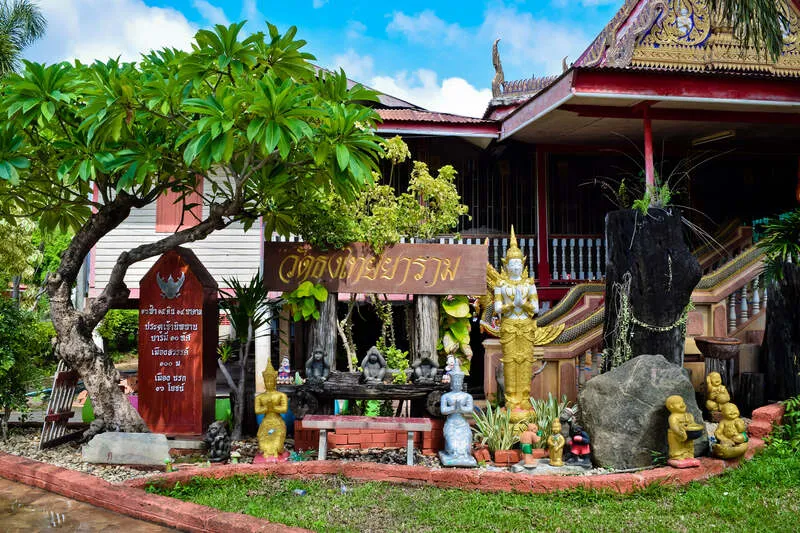
Wat Thong Thaiyaram
Open Days: Daily
Opening Hours: Daytime
Wat Thong Thaiyaram in Phichit Province is an important local Buddhist temple in Huai Ket Subdistrict, Taphan Hin District. It is a temple with a long history and a close relationship with the surrounding community. In the past, local people called it Wat Nam Chon Tai before it was officially established as a temple on 8 March 1925. The temple later received its Wisungkhamsima, the officially designated monastic boundary, on 31 July 1953. This made Wat Thong Thaiyaram a complete Buddhist temple capable of supporting important monastic ceremonies according to the Vinaya. Today, the temple remains a center of worship, community life, Buddhist education, and meditation practice.
The value of Wat Thong Thaiyaram is not limited to its age or formal religious status. Its deeper importance lies in the role it plays as a community temple. Local residents come here to make merit, listen to Dhamma teachings, join Buddhist ceremonies, send children to religious activities, and gather for important communal occasions. The temple reflects the character of a Thai rural monastery that continues to serve many functions at once: religious, educational, moral, and social.
From the perspective of local history, the former name Wat Nam Chon Tai is meaningful. Temple names linked with older village names or geographical features often preserve traces of local settlement and identity. Wat Thong Thaiyaram therefore carries the memory of the community from the time when the area was known locally as Nam Chon Tai to the period when the temple developed into an important religious institution of Huai Ket Subdistrict.
The temple was officially established on 8 March 1925, at a time when local communities needed a stable religious center. In Thai society, a village temple is more than a place for worship. It is connected with the life cycle of the people: ordination, merit-making, funerals, festivals, family ceremonies, and public gatherings. Wat Thong Thaiyaram emerged from the faith and needs of the community, providing a spiritual anchor for everyday life.
Receiving the Wisungkhamsima on 31 July 1953 was another important milestone. A Wisungkhamsima is the boundary that allows monks to perform important ecclesiastical ceremonies properly, especially ordination and formal Sangha acts. This recognition confirmed the temple’s stability and the community’s readiness to support Buddhism in an organized and lasting way.
Inside Wat Thong Thaiyaram are several important monastic buildings that support Buddhist activities. The ordination hall measures 6 meters wide and 18 meters long. It is the sacred space used for formal monastic ceremonies and is central to the temple’s religious identity. An ordination hall is not simply a building; it is the heart of a temple’s formal Buddhist function. With both an ordination hall and a designated boundary, the temple can support essential Sangha ceremonies according to tradition.
The sermon hall measures 20 meters wide and 32 meters long and was built in 1973. It serves as a place for community meetings, Dhamma listening, merit-making ceremonies, and religious activities. In many Thai communities, the sermon hall functions like a large public hall where villagers gather for shared occasions. At Wat Thong Thaiyaram, this building helps connect the temple with the community in a visible and practical way.
The chanting hall measures 10 meters wide and 15 meters long. It is used for chanting, religious ceremonies, meditation, and mental cultivation. This kind of space is especially important for a temple that supports meditation practice. It gives monks and laypeople a quiet area for prayer, reflection, and spiritual training. The temple also has 7 monks’ residences, allowing monks to stay, practice, and carry out religious duties continuously.
The presence of an ordination hall, sermon hall, chanting hall, and monks’ residences shows that Wat Thong Thaiyaram is not active only during festivals. It is a living temple with regular religious functions. Monks can reside and perform their duties, while local people can come for merit-making, Dhamma listening, ceremonies, and meditation. The temple therefore serves as both a sacred place and a public community space.
One of the temple’s important roles is its Sunday Buddhist Study Center. This center gives children, youth, and general members of the public an opportunity to learn the teachings of the Buddha. Such programs are valuable because they cultivate morality within the community. Young people can learn about gratitude, honesty, discipline, compassion, and mindful living alongside their regular school education. In this way, the temple becomes not only a place of worship but also a place of moral learning.
The annual summer novice ordination program is another meaningful activity. Novice ordination is not merely a ritual. It is a period in which children and young people learn discipline, patience, simplicity, and Buddhist principles. They experience life in the saffron robe, learn respect for teachers, live with others, and develop responsibility. These experiences can leave a lasting impression and help shape character.
For families, the summer novice ordination program also strengthens the bond between home and temple. Parents support their children, make merit, and witness their moral development. The temple functions as a teacher of values and a safe learning environment. This makes Wat Thong Thaiyaram an important center for community-based moral education.
Wat Thong Thaiyaram also serves as a meditation center, welcoming Buddhists who are interested in concentration practice, Vipassana, and mental development. Meditation practice in a community temple is meaningful because it gives people a place to step away from daily pressures, observe their own minds, and learn to live with greater awareness. Visitors do not need to be experienced practitioners. Sincere intention and respect for temple guidelines are enough to begin.
The meditation role of the temple makes it more than a ceremonial site. It becomes a place for emotional and spiritual healing. People facing stress, suffering, or confusion can come to chant, listen to Dhamma, meditate, or simply sit quietly. Having such a place within the community is valuable because it provides a familiar and accessible refuge rooted in Thai Buddhist culture.
The temple also contains sacred objects and religious artworks for visitors to pay respect to. Local information describes the temple as having spacious grounds suitable for various activities, along with several sacred points for worship, including carved wooden Buddha images and other Buddhist features. These elements reflect the faith of the local community and its ongoing care for the temple as a place for merit-making, worship, and reflection.
The charm of Wat Thong Thaiyaram lies in its character as a living community temple. It is not a large commercial tourist attraction, but a temple with quiet beauty, practical religious functions, and a close connection to local life. Visitors can see buildings that are actually used, spaces where community activities take place, and the continuing relationship between monks and laypeople. This helps travelers understand that Thai temples are often much more than places to visit; they are part of everyday social and spiritual life.
For cultural travelers, Wat Thong Thaiyaram is suitable as part of a route through Taphan Hin District. It is located in Huai Ket Subdistrict, not far from Taphan Hin town, and can be combined with Wat Thewaprasat, Wat Phra Phutthabat Khao Ruak, Wat Khao Rup Chang, and other sites in Phichit Province. Visiting this temple offers a perspective on Phichit that focuses on community, Buddhist education, and local religious practice rather than only large or widely known attractions.
In terms of cultural preservation, Wat Thong Thaiyaram is important because it continues to pass Buddhist values to younger generations. A temple that maintains a Sunday Buddhist Study Center, annual summer novice ordination, and meditation activities directly transmits cultural and moral knowledge. Children and youth do not learn Buddhism only from books; they learn by entering the temple, meeting monks, listening to teachings, and practicing in a real religious environment.
The participation of local people is essential to the strength of Wat Thong Thaiyaram. A community temple cannot thrive through monks alone. It depends on lay supporters, parents, youth, community leaders, and devoted residents. Helping care for the temple, organizing activities, making merit, and supporting Buddhist education all make the temple a shared responsibility. This relationship is at the heart of Thai temple culture at the community level.
Getting There is convenient by private car or rental car. Travelers can set their route to Rural Road 3017, Huai Ket Subdistrict, Taphan Hin District, Phichit Province. From Taphan Hin town, the route to Huai Ket is not far and is suitable for a half-day visit or a temple route within the district. Travelers arriving by train can get off at Taphan Hin Railway Station and continue by local transport or hired vehicle to the temple.
The best times to visit are in the morning or late afternoon, when the weather is more comfortable for walking around the temple grounds. Morning visits are suitable for merit-making, Dhamma listening, or joining religious activities, while late afternoon is pleasant for a quiet walk through the temple area. Visitors who wish to join meditation practice, novice ordination activities, or special Buddhist events should check the temple’s activity schedule in advance.
Visitors should dress modestly, speak quietly, and respect the temple atmosphere. They should avoid disturbing monks, meditation practitioners, or participants in religious activities. When entering the ordination hall, sermon hall, or chanting hall, shoes should be removed according to Thai custom, and visitors should follow temple guidance. Respectful conduct helps preserve the calm atmosphere and allows travelers to experience the temple more meaningfully.
Wat Thong Thaiyaram is valuable in several ways at once. Historically, it was established in 1925. Ecclesiastically, it received Wisungkhamsima in 1953. Religiously, it remains a place for worship, ceremonies, and meditation. Educationally, it supports a Sunday Buddhist Study Center. Socially, it organizes annual summer novice ordination and other community activities. These roles show how a local temple can support spiritual, moral, and communal life at the same time.
Overall, Wat Thong Thaiyaram is suitable for visitors who wish to make merit, learn about a living community temple, practice meditation, or understand the quieter side of cultural travel in Phichit. Although it is not a large nationally famous tourist temple, it is meaningful because of its continuity of faith, its bond with the local community, and its role in cultivating morality among younger generations. A visit here offers a simple, thoughtful, and authentic view of Buddhist life in Taphan Hin District.
| Name | Wat Thong Thaiyaram, Phichit Province |
| Location | Huai Ket Subdistrict, Taphan Hin District, Phichit Province |
| Address | Rural Road 3017, Huai Ket Subdistrict, Taphan Hin District, Phichit Province 66110, Thailand |
| Highlights | A historic community temple in Huai Ket, formerly known as Wat Nam Chon Tai, with a Sunday Buddhist Study Center, annual summer novice ordination, and meditation activities |
| History | Officially established as a temple on 8 March 1925 and granted Wisungkhamsima on 31 July 1953 |
| Name Origin | The temple was formerly known locally as Wat Nam Chon Tai before later becoming Wat Thong Thaiyaram |
| Distinctive Features | A spacious community temple used for Buddhist ceremonies, education, meditation practice, and local religious activities |
| Travel Information | Accessible by private car or rental car via Rural Road 3017 in Huai Ket Subdistrict. Travelers can also arrive at Taphan Hin Railway Station and continue by local transport |
| Current Status | An active Buddhist temple open for merit-making, meditation practice, and community religious activities |
| Open Days | Daily |
| Opening Hours | Daytime |
| Facilities | Ordination hall, sermon hall, chanting hall, monks’ residences, religious activity areas, meditation areas, and parking space |
| Main Areas / Zones | Ordination hall measuring 6 x 18 meters, sermon hall measuring 20 x 32 meters, chanting hall measuring 10 x 15 meters, 7 monks’ residences, Sunday Buddhist Study Center, and meditation center |
| Abbot / Caretaker | Phra Khru Wiwith Thawatchai, Dr. |
| Nearby Tourist Attractions | 1. Taphan Hin Railway Station, about 8 km 2. Wat Thewaprasat and Luang Pho To Taphan Hin, about 8 km 3. Wat Phra Phutthabat Khao Ruak, about 18 km 4. Wat Khao Rup Chang, about 24 km 5. Bueng Si Fai, about 28 km |
| Nearby Restaurants | 1. Pa Maem Nam Chon Tai, about 1 km, Tel. 081-039-3725 2. Baan Ek Khanek, about 4 km, Tel. 084-224-6144 3. Lung Phan Tom Saep Pla Maenam, about 5 km, Tel. 086-211-4326 4. Khao Hom Pla Maenam, about 8 km, Tel. 083-165-1169 5. Hua Khao Tom Taphan Hin, about 8 km, Tel. 056-621-696, 062-030-1313 6. PunThai Coffee Taphan Hin, about 8 km, Tel. 062-597-1224 |
| Nearby Accommodations | 1. Roseinn Hotel Taphanhin, about 7 km, Tel. 056-621-044 2. Wela Nxn @ Sleep Time, about 8 km 3. Ruen Rim Nan, about 9 km, Tel. 099-272-2999 4. Ruean Mai Garden Resort, about 12 km, Tel. 091-881-4991, 086-929-3773 5. The Nest Hotel Phichit, about 28 km, Tel. 056-033-662 |
Frequently Asked Questions (FAQ)
Q: Where is Wat Thong Thaiyaram located?
A: Wat Thong Thaiyaram is located in Huai Ket Subdistrict, Taphan Hin District, Phichit Province, along Rural Road 3017.
Q: What was Wat Thong Thaiyaram formerly called?
A: Local people formerly called the temple Wat Nam Chon Tai before it later became known as Wat Thong Thaiyaram.
Q: When was Wat Thong Thaiyaram established?
A: The temple was officially established on 8 March 1925 and received Wisungkhamsima on 31 July 1953.
Q: Who is the abbot of Wat Thong Thaiyaram?
A: The most recent information found lists the abbot as Phra Khru Wiwith Thawatchai, Dr.
Q: What are the main facilities inside Wat Thong Thaiyaram?
A: The temple has an ordination hall, sermon hall, chanting hall, monks’ residences, a Sunday Buddhist Study Center, a meditation center, and areas for religious activities.
Q: Is Wat Thong Thaiyaram suitable for meditation practice?
A: Yes. The temple serves as a meditation center and welcomes Buddhists interested in concentration practice, Vipassana, and mental development.
Q: How can travelers get to Wat Thong Thaiyaram?
A: Travelers can drive to Huai Ket Subdistrict via Rural Road 3017. Those arriving by train can get off at Taphan Hin Railway Station and continue by local transport to the temple.
Q: What nearby attractions can be visited with Wat Thong Thaiyaram?
A: Nearby attractions include Taphan Hin Railway Station, Wat Thewaprasat, Wat Phra Phutthabat Khao Ruak, Wat Khao Rup Chang, and Bueng Si Fai.
 Category: ●Places of Worship
 Group: ●Temple
Last Update : 5 MonthAgo
 Last Update : 5 MonthAgo
 Click to Access the Navigation Map GPS
Wat Thong Thaiyaram Map
Recommend

 Art, Culture and Heritage
 Historical Sites and Monuments(1)
 Art, Craft Centres, Tradition(1)
 Museums(1)
Temple(32)
Museums(1)
Temple(32)
 Other Sacred Sites(5)
 Research and Development
 Royal Project(1)
 Suburban Living
 Floating Market(1)
 Nature and Wildlife
 National Parks and Marine Reserves(1)
 Dam, Reservoir, Lake(3)
 River, Canal(2)
 Other natural attractions(1)
 Entertainment and Agricultural
 Animal camps and shows(1)
 Farms, Parks and Ecotourism(4)
 Travel Articles, Recipes
 Travel Review, Food Review(1)


