
lovethailand home >Central Travel Attractions >Pathum Thani Travel Attractions >Thanya Buri >Bueng Yi Tho > Wat Moon Jindaram (Wat Khlong Ha)
TL;DR: Wat Moon Jindaram (Wat Khlong Ha) is located at Khlong Ha, Bueng Yitho Subdistrict, Thanyaburi District, Pathum Thani Province, open Open daily, hours Specific visiting hours are not clearly published.
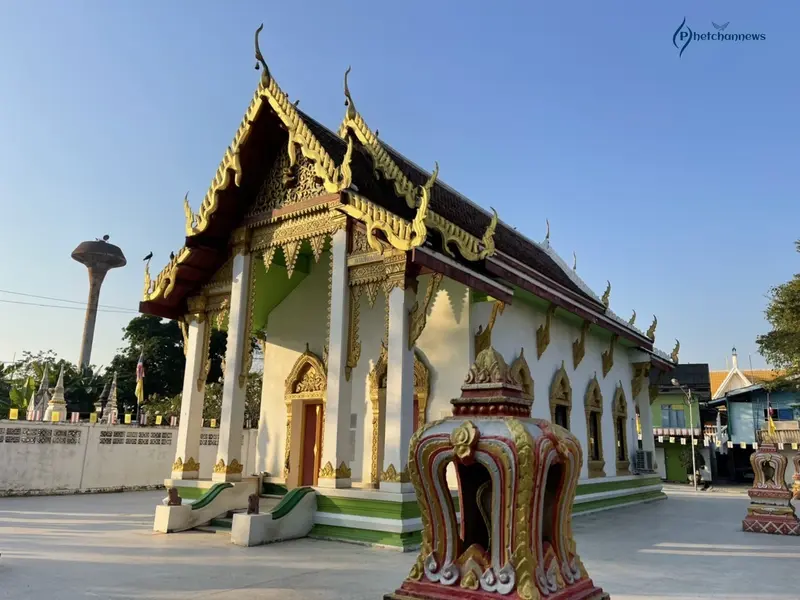
Wat Moon Jindaram (Wat Khlong Ha)
Open Days: Open daily
Opening Hours: Specific visiting hours are not clearly published
Wat Moon Jindaram (Wat Khlong Ha) is an old riverside temple along Khlong Rangsit Prayurasak in Khlong Ha, Pathum Thani. Its history goes back to the reign of King Rama V, and one of its most distinctive features is that it was founded through the shared faith of a European man and a Chinese woman. This gives the temple a rare cross-cultural background that stands out in the history of Thai Buddhist temples. Wat Moon Jindaram is not only a religious site for the local community, but also a historical landmark that reflects the development of the Rangsit canal zone, early settlement along the waterways, and the meeting of different cultural worlds in Siam during the late 19th century.
The temple is located at 98, Moo 3, along Prayurasak Canal, Bueng Yitho Subdistrict, Thanyaburi District, Pathum Thani Province. It stands beside Khlong Rangsit Prayurasak in the Khlong Ha area, about 13 km from Rangsit Market via the Rangsit-Nakhon Nayok Road. Wat Moon Jindaram belongs to the Maha Nikaya order and occupies an area of 79 rai and 65 square wah. Its location is historically significant because the Rangsit canal zone was one of the major development areas created through canal excavation for transportation, agriculture, and settlement. As communities expanded along the canals, the temple became an important spiritual center for people building new lives in the Khlong Ha area.
From a historical perspective, Wat Moon Jindaram has a particularly unusual origin. The person who requested permission to build the monastery was not Thai by birth, but Phra Patibat Ratchaprasong, an Austrian man originally named Muller, together with his Chinese wife. Both were deeply devoted to Buddhism and intended to establish a temple as a residence for monks and novices. This story makes Wat Moon Jindaram different from many other temples in the Central Plains, because it shows that Buddhism in Siam at that time was embraced by people of diverse backgrounds, and that religious faith could bring together individuals from different cultures to create something meaningful for society.
The construction of the temple began on March 18, 1896, and official permission to establish the temple was granted on March 19, 1896. This marked the beginning of Wat Moon Jindaram as a temple built from genuine devotion. It was not simply a matter of constructing religious buildings, but the laying of a spiritual foundation for the people living around Khlong Ha.
Later, the temple received royal boundary consecration on July 10, 1899, during the reign of King Chulalongkorn, Rama V. Receiving royal consecration was a major milestone because it meant that the temple was fully recognized as a proper place for Buddhist ecclesiastical ceremonies in accordance with monastic law. This is another important indication that Wat Moon Jindaram held recognized importance from its early years.
After that, on March 2, 1902, Phra Patibat Ratchaprasong submitted a request toถวาย the temple as a royal monastery in connection with King Chulalongkorn’s royal journey to open Thanyaburi City. However, the King stated that accepting a temple as a royal monastery involved obligations of support, such as regular offerings and annual kathin ceremonies, and that there were already many royal temples under state care. Although the request was not accepted, the event clearly shows that Wat Moon Jindaram was regarded as a temple of notable importance, beyond the status of an ordinary local temple of its time.
One of the most important episodes in the temple’s history took place on March 13, 1902, when King Chulalongkorn traveled to open Thanyaburi City. In the afternoon, as he was returning, his royal boat stopped at the front bridge of Wat Moon Jindaram. Phra Patibat Ratchaprasong came down to welcome the King, who then entered and sat inside the ubosot. After that, Phra Patibat Ratchaprasong delivered words of gratitude for the royal favor of granting the consecrated boundary. Senior monks and monastic officials then performed the formal ceremony of establishing the sacred boundary.
On that occasion, King Chulalongkorn personally performed the merit-making ceremony of gilding the boundary stones and presided over the cutting of the luk nimit with his own hands. This was an exceptional honor, because at that time the King usually took part in such temple ceremonies only at royal monasteries. For that reason, the royal grace shown to Wat Moon Jindaram firmly confirms the temple’s special place in the history of Thanyaburi.
As for the temple’s name, Phra Patibat Ratchaprasong requested that King Chulalongkorn grant it a formal name. The King bestowed the name “Wat Moon Jindaram” so that it would reflect the names of the temple’s founders, Muller and Nang Chin. Since then, the temple’s name has stood as a lasting memorial to the faith of its founders and as a reminder that the devotion of ordinary people can leave a permanent mark on history.
In cultural terms, Wat Moon Jindaram means more than simply being a place of worship. It reflects Thai society during a period of transition toward modernity, the connection between the royal court and newly developing district centers such as Thanyaburi, and the power of faith to bring together people from different ethnic and cultural backgrounds under the shared framework of Buddhism. The temple also helps later generations understand that local history is not shaped only by kings or nobles, but also by ordinary people whose determination to support religion and society created something of lasting value.
Today, the atmosphere at the temple remains calm, shaded, and welcoming, in the character of an old community temple along the Rangsit canals. It is suitable for visitors who wish to make merit, pay respect to the principal Buddha image, pray for blessings, or simply spend time in a peaceful place away from the busier urban center. Even though the surrounding area has continued to develop, the temple still preserves the charm of an old canal-side monastery. Visitors can therefore experience both a sense of history and the simple rhythm of local community life at the same time.
In terms of access, Wat Moon Jindaram is relatively easy to reach for travelers coming from Rangsit or the northern side of Bangkok. Visitors can take the Rangsit-Nakhon Nayok Road toward Khlong Ha and then enter the canal-side road running along Khlong Rangsit Prayurasak. The temple is not far from the main route, making it convenient for those traveling by private car. Public transport users can get off along the Rangsit-Nakhon Nayok line and continue into the Khlong Ha area. This makes the temple suitable both for local visitors from Pathum Thani and for temple-focused travelers planning to explore several religious and cultural sites in the Thanyaburi area in a single day.
Getting There If you are traveling from Rangsit, use the Rangsit-Nakhon Nayok Road heading toward Thanyaburi and Khlong Ha. Once you reach the Khlong Ha community area, continue onto the road along Khlong Rangsit Prayurasak. The temple is located beside the canal and is not difficult to find. Visitors planning a temple trip can also combine it with nearby attractions such as the National Science Museum, Rama IX Museum, Wat Chedi Hoi, local markets in the Khlong Ha zone, and leisure destinations around Thanyaburi. This makes a visit to Wat Moon Jindaram easy to turn into a half-day or full-day local travel route.
| Name | Wat Moon Jindaram (Wat Khlong Ha) |
| Location | Khlong Ha, Bueng Yitho Subdistrict, Thanyaburi District, Pathum Thani Province |
| Address | 98, along Prayurasak Canal, Moo 3, Bueng Yitho Subdistrict, Thanyaburi District, Pathum Thani Province |
| Highlights | An old canal-side temple from the reign of King Rama V, founded by an Austrian man and his Chinese wife |
| History | Construction began on March 18, 1896, official permission was granted on March 19, 1896, and the temple received royal boundary consecration on July 10, 1899 during the reign of King Rama V |
| Name Origin | King Chulalongkorn granted the name “Wat Moon Jindaram” in reference to the founders, Muller and Nang Chin |
| Distinctive Features | A historic community temple linked to the development of Thanyaburi, with a peaceful atmosphere and strong religious and local historical value |
| Travel Information | Take the Rangsit-Nakhon Nayok Road toward Khlong Ha, then continue onto the road along Khlong Rangsit Prayurasak; convenient for private cars and connections from Rangsit |
| Current Status | Still active as a community temple and reachable through its public page |
| Open Days | Open daily |
| Abbot / Caretaker | Luang Ta Saokraw Lorprakhon |
| Main Contact Number | 099-391-1625 |
| Official Website / Official Page | Facebook: วัดมูลจินดาราม Wat Moon Jindaram |
| Nearby Tourist Attractions | 1. National Science Museum, 8 km 2. Rama IX Museum, 8 km 3. Wat Chedi Hoi, 13 km 4. Dream World, 18 km 5. Future Park Rangsit, 20 km |
| Nearby Restaurants | 1. Godang Ahan #Khlong5, about 2 km, Tel. 095-748-1216, 081-113-9841 2. Kin Lom Chom Lao Khlong 5, about 3 km, Tel. 063-326-1591 3. Hiu Jang, Sinthani Village, Khlong 5, about 3 km, Tel. 082-486-3989 4. Khao Tom Ruea Cham Thong, Rangsit Khlong 5, Pa Charoen Market, about 2 km, Tel. 064-517-5544 5. Guay Tiew Rim Suan Khlong 5, about 3 km, Tel. 061-265-9787 |
| Nearby Accommodations | 1. T62 Residence, about 7 km, Tel. 066-118-6262, 065-561-9093 2. The Premium Apartment Khlong 5, about 8 km, Tel. 065-005-5955, 080-001-5150 3. 24 Sleep Resort Branch 2, about 9 km, Tel. 094-616-3889 4. 39 Resort, about 9 km, Tel. 061-459-8989 5. Triple Trees Hotel, about 14 km, Tel. 02-102-4532, 02-102-4533, 064-980-0523 |
Frequently Asked Questions (FAQ)
Q: Where is Wat Moon Jindaram located?
A: The temple is located at 98 Moo 3, Bueng Yitho Subdistrict, Thanyaburi District, Pathum Thani Province, along Prayurasak Canal in the Khlong Ha area.
Q: Why is Wat Moon Jindaram historically important?
A: It is an old temple from the reign of King Rama V and is especially notable because it was founded by an Austrian man and his Chinese wife. King Chulalongkorn also personally visited the temple and presided over the boundary stone ceremony.
Q: Where does the name Wat Moon Jindaram come from?
A: The temple name was royally granted to reflect the names of its founders, Muller and Nang Chin, who devoted themselves to establishing the temple.
Q: How do I get to Wat Khlong Ha?
A: Visitors can take the Rangsit-Nakhon Nayok Road toward Khlong Ha and then continue onto the canal-side road along Khlong Rangsit Prayurasak. The temple is relatively easy to reach from Rangsit and northern Bangkok.
Q: Is Wat Moon Jindaram open every day?
A: The temple remains active as a local community temple and is generally open daily, although clearly published hourly opening times are not available.
Q: Who is the current abbot or caretaker of the temple?
A: The latest publicly available information identifies Luang Ta Saokraw Lorprakhon as the current caretaker associated with Wat Moon Jindaram.
 Category: ●Places of Worship
 Group: ●Temple
Last Update : 5 MonthAgo
 Last Update : 5 MonthAgo
 Click to Access the Navigation Map GPS
Wat Moon Jindaram (Wat Khlong Ha) Map
Recommend

 Art, Culture and Heritage
 Historical Sites and Monuments(2)
 Landmarks and Memorials(1)
 Art, Craft Centres, Tradition(2)
 Museums(11)
 Art Gallery(1)
 Educational Places
 Museum for Study(1)
 Library(1)
 Training Center(1)
Temple(44)
Training Center(1)
Temple(44)
 Mosque(1)
 Other Sacred Sites(1)
 Research and Development
 Royal Project(1)
 Suburban Living
 Local Market(2)
 Floating Market(3)
 Nature and Wildlife
 River, Canal(1)
 Entertainment and Agricultural
 Animal camps and shows(1)
 Stadium(2)
 Amusement Park(1)
 Waterpark(1)


