
lovethailand home >Central Travel Attractions >Lop Buri Travel Attractions >Muang Lop Buri >Tha Khae > Wat Tha Kae Tripitaka Hall
TL;DR: Wat Tha Kae Tripitaka Hall is located at Wat Tha Kae, Ban Mi District, Lopburi Province, hours 07:00 - 18:00. Highlights include Chaturamuk structure, elevated pillars, prang-style roof, Western wood carvings, and Chinese decorative motifs.
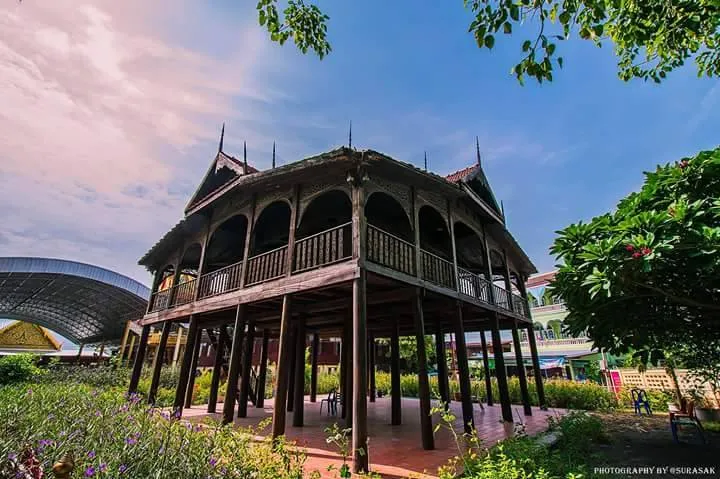
Wat Tha Kae Tripitaka Hall
Open Days: Daily
Opening Hours: 07:00 - 18:00
Wat Tha Kae Tripitaka Hall, Lopburi is a distinctive wooden scripture hall that stands out as one of the most unique structures of its kind in Thailand. Located within Wat Tha Kae in Ban Mi District, Lopburi Province, it serves as a repository for the Tripitaka, the sacred Buddhist scriptures of the “Lao Lom” community, an ethnic group that has played an important role in the area for generations.
Traditionally, Tripitaka halls in Thai temples are built over water or elevated on stilts to protect sacred manuscripts from moisture and pests. However, the Tripitaka hall at Wat Tha Kae is markedly different. It is constructed as a wooden pavilion in a chaturamuk (four-gabled) style, raised on tall pillars. The structure appears light, airy, and elegant, reflecting an advanced level of architectural adaptation and craftsmanship.
One of its most prominent features is the roof, which is covered with kite-shaped tiles and crowned with a central tower-like structure. This design is inspired by palace or prang-style architecture, typically reserved for highly significant buildings such as royal residences or major religious monuments. As a result, this Tripitaka hall appears far more elaborate than typical examples found elsewhere.
The architectural elements of the hall clearly reflect a fusion of multiple cultural influences. The upper structure and surrounding balcony are decorated with intricately carved wooden panels influenced by Western artistic styles, giving the building a delicate and open aesthetic that contrasts with traditional dense Thai carvings.
At the same time, the folding wooden panels (doors and partitions) are carved with auspicious Chinese motifs, including symbols of prosperity, wealth, and good fortune. These elements highlight the long-standing influence of Chinese culture in Lopburi.
Another notable feature is the use of stained glass embedded in parts of the walls. These serve as light channels, allowing natural light to filter into the interior and create dynamic patterns of light and shadow, enhancing the visual atmosphere inside the structure.
Therefore, this Tripitaka hall is not merely a storage space for sacred texts, but also an important architectural record of cultural exchange between Thai, Chinese, and Western traditions. This reflects Lopburi’s historical role as a center of contact and interaction with various cultures.
From a community perspective, the Tripitaka hall holds deep significance for the “Lao Lom” people, who have preserved and utilized this structure. It functions not only as a repository of religious knowledge but also as a spiritual and cultural center for the community.
The surrounding atmosphere of Wat Tha Kae is peaceful and quiet, surrounded by local community life and natural scenery. It is not crowded like the main tourist attractions in central Lopburi, making it ideal for visitors seeking cultural tourism, architectural study, or a calm and relaxing environment.
For photography enthusiasts, the Tripitaka hall offers a variety of interesting angles, from low-angle shots capturing the prang-like roof, to close-up details of wooden carvings, and light filtering through stained glass, all of which create unique and visually appealing compositions.
Getting There to Wat Tha Kae can be done via the irrigation canal road (Bridge 6 – Ban Mi route) until reaching Tha Kae Railway Station. From there, turn right, cross the bridge, and continue for about 1 kilometer. The temple will be on the left-hand side. Public buses on the Lopburi – Wat Tha Kae route are also available between 06:00 and 18:00.
Today, the Tripitaka hall at Wat Tha Kae continues to serve as an important center for religious learning and cultural heritage in Lopburi Province. It is also a valuable destination for those who wish to experience Thai architectural heritage from a perspective that differs from mainstream tourist attractions.
| Place Name | Wat Tha Kae Tripitaka Hall |
| Summary | A historic wooden Tripitaka hall within Wat Tha Kae used to store Buddhist scriptures, featuring a blend of multiple cultural architectural styles. |
| Highlights | Chaturamuk structure, elevated pillars, prang-style roof, Western wood carvings, and Chinese decorative motifs. |
| History / Era | Associated with the Lao Lom community and used as a repository for Buddhist scriptures. |
| Address | Wat Tha Kae, Ban Mi District, Lopburi Province |
| Getting There | Accessible via irrigation canal road or train to Tha Kae Station, then about 1 km further. |
| Open Days | Daily |
| Facilities | Temple grounds, parking area, quiet environment |
| Nearby Attractions | Ban Mi Market, Ban Mi Temple, Ban Mi Railway Station, Khao Wong Phrachan Temple, King Narai Palace |
| Nearby Restaurants | Local restaurants in Ban Mi area with Thai cuisine options |
| Nearby Accommodations | Local resorts and hotels in Ban Mi and Lopburi city |
Frequently Asked Questions (FAQ)
Q: What is the Wat Tha Kae Tripitaka Hall?
A: It is a wooden structure used to store Buddhist scriptures at Wat Tha Kae in Lopburi.
Q: What makes it unique?
A: Its chaturamuk design, elevated structure, and blend of Thai, Chinese, and Western architectural elements.
Q: Where is it located?
A: Inside Wat Tha Kae in Ban Mi District, Lopburi Province.
Q: How can I get there?
A: By car, train to Tha Kae Station, or local bus routes.
Q: What type of travel is it suitable for?
A: Cultural tourism, architectural study, and historical exploration.
Tel : 036427094
 Tel : 036427094
 Category: ●Places of Worship
 Group: ●Other Sacred Sites
Last Update : 6 MonthAgo
 Last Update : 6 MonthAgo
 Click to Access the Navigation Map GPS
Wat Tha Kae Tripitaka Hall Map
Recommend

 Art, Culture and Heritage
 Historical Sites and Monuments(5)
 Landmarks and Memorials(3)
 Royal Palace(1)
 Art, Craft Centres, Tradition(7)
 Museums(11)
 Historic Homes and Cities(1)
 Temple(25)
Other Sacred Sites(3)
Temple(25)
Other Sacred Sites(3)
 Suburban Living
 Village, Community(4)
 Floating Market(1)
 Nature and Wildlife
 National Parks and Marine Reserves(2)
 Mountain (Doi)(3)
 Dam, Reservoir, Lake(4)
 Waterfalls(5)
 Hot Springs(1)
 Caves(2)
 Flower Field(1)
 Entertainment and Agricultural
 Zoos and Aquariums(2)
 Farms, Parks and Ecotourism(4)
 Outdoor and Adventure Activities(1)


