
lovethailand home >Central Travel Attractions >Lop Buri Travel Attractions >Ban Mi >Sanam Chaeng > Wat Khao Wongkot
TL;DR: Wat Khao Wongkot is located at Moo 9, Sanam Chaeng Subdistrict, Ban Mi District, Lopburi Province 15110, open Daily, hours 09:00 - 17:00.
Wat Khao Wongkot
Open Days: Daily
Opening Hours: 09:00 - 17:00
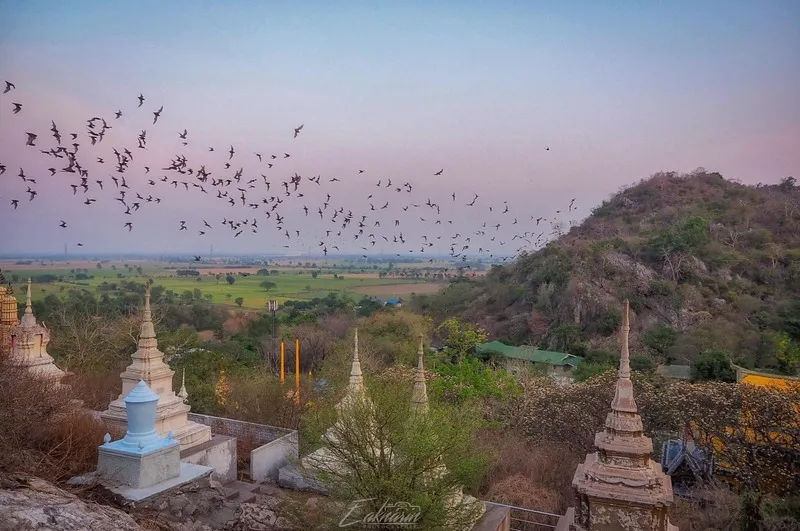
Wat Khao Wongkot in Lopburi Province is a temple with a highly distinctive identity in terms of landscape, devotion, and religious architecture. The temple is located at the foot of Khao Sanam Chaeng in Sanam Chaeng Subdistrict, Ban Mi District, and is enclosed by mountains on 3 sides. This setting gives the temple a calm, secluded atmosphere, clearly separated from the bustle of the surrounding communities. Visitors often feel immediately that this temple is attractive not only as a place of worship, but also because the surrounding natural landscape adds a sense of peace and reverence to the visit.
A key highlight of Wat Khao Wongkot is the relationship between its geography and its identity. The name “Khao Wongkot” reflects the character of the area, where mountains surround the site in a way that resembles a natural labyrinth. Physically, the temple grounds cover about 30 rai and include flat land at the foot of the mountain, religious structures at the lower level, and sacred sites extending up along the hillside and to the summit. This gives a visit to the temple a very different dimension from that of an ordinary temple, because visitors do not simply see religious buildings arranged around a courtyard, but instead experience sacred architecture that is harmoniously integrated with the natural terrain.
Historically, Wat Khao Wongkot was originally an abandoned monastic site. Later, Luang Pho Phao Phutthasaro saw that this area was peaceful and well suited for meditation practice, so he began restoring it and established the temple around 1917. The temple later received its royal boundary charter on July 19, 1928. This event is an important piece of evidence confirming the temple’s official status in Buddhism, and it also shows that Wat Khao Wongkot did not grow from the faith of one individual alone, but gradually developed into a religious center for the surrounding community.
Luang Pho Phao Phutthasaro is therefore a figure who cannot be separated from the history of the temple, because he was the one who first established Wat Khao Wongkot and laid the foundation for the temple’s continuing role in the local community. Inside the temple, a statue of Luang Pho Phao is enshrined in a pavilion so that visitors can pay respect to his contributions. At the front of the temple stands a chedi built on a Chinese junk boat, which serves as a memorial associated with Luang Pho Phao and is one of the clearest visual symbols of Wat Khao Wongkot.
The junk-boat chedi at the entrance of the temple is a very distinctive symbolic feature. The form of the junk evokes the idea of a journey, crossing over, and guiding life toward a secure destination. In a Buddhist context, the image of a boat can also be linked with the idea of crossing the ocean of suffering from the worldly shore to the shore of Dhamma. The chedi on the junk boat is therefore not merely decorative religious art, but also gives the temple entrance a unique appearance filled with spiritual meaning.
Another feature that has made Wat Khao Wongkot widely known is Luang Pho Charoen Dissavanno, a former abbot of the temple, who passed away in 1963, yet whose body did not decay. This belief has led many people to hold him in deep reverence, and he has become one of the main spiritual centers for those who come to Wat Khao Wongkot. People travel here not only to see the site, but also with the intention of paying respect, seeking blessings, and experiencing the atmosphere of a sacred place whose devotion has been passed down through generations.
The body of Luang Pho Charoen has been preserved in the Trimuk Pavilion, or funeral pavilion, within the temple grounds. This method of preservation has made the area an important devotional point and a unique feature of the temple. Many visitors stop here to pay respect in silence and composure, because it is not merely about seeing something considered extraordinary, but also about honoring a monk who played an important role in the temple and the community. The sacred reputation of Luang Pho Charoen therefore adds another layer of meaning to this place.
Among the temple’s most striking sacred structures is the large reclining Buddha enshrined at the western foot of the hill. The statue is positioned beautifully in relation to the mountain ridge, creating a feeling of serenity and awe at the same time for those who look up from below. The reclining Buddha serves as both a destination for worship and an important element that adds depth and grandeur to the temple landscape beyond what is normally seen at a typical community temple.
In addition to the reclining Buddha, the temple also features a replica Buddha footprint, Somdet Luang Pho Metta, or the Mara-Victory Buddha modeled after an image from India, as well as Phra Nak Prok Thipyamuni Kiri Wongkot on the mountaintop. These elements make Wat Khao Wongkot more than a temple with only one notable feature. Instead, it is a devotional site with multiple layers, from the entrance area, to the central grounds, and up into the mountain zone. Visitors can therefore spend time exploring and understanding the meaning of each point throughout the temple grounds.
Another aspect that should not be overlooked is the natural environment around the temple, especially the bat cave near the ordination hall, which is said to be the largest bat cave in Lopburi Province. It is home to millions of bats, while macaques also live around the temple grounds and in front of the temple. These natural features give Wat Khao Wongkot the character of both a temple and a natural site at the same time. Those interested in cultural tourism often feel that this place offers more to learn than an ordinary temple, because it combines devotion, environment, and ecosystem in one location.
Looking at the overall atmosphere, Wat Khao Wongkot is a temple that feels peaceful, shady, and emotionally profound. The mountain setting creates natural shade and a strong sense of being in nature, while the religious structures are positioned in ways that harmonize with the terrain. A visit here is therefore not simply a matter of entering a temple and seeing a few buildings, but an experience of slowly walking, observing, and absorbing the sacred and peaceful atmosphere of the place.
In terms of the temple’s role in the community, Wat Khao Wongkot continues to be a center of devotion and an important social space for local people. Whether for merit-making, religious ceremonies, or welcoming visitors who come to pay respect to Luang Pho Charoen and the sacred sites within the temple, the temple remains alive as a spiritual center for the people, not merely as a tourist attraction known for its unusual character or physical appeal.
Getting There Wat Khao Wongkot can be reached via Highway 311, the Lopburi-Sing Buri route. The temple is located about 4 kilometers before Ban Mi District in Sanam Chaeng Subdistrict. Traveling by private car is the most convenient option, because the temple is located in a foothill area and has several points of interest within the grounds, making it suitable for a longer visit on foot. Those traveling by bus can take a Lopburi-Ban Mi route and get off in Ban Mi District before continuing to the temple. Morning is ideal for worship and exploring the sacred sites, while the late afternoon is well suited for enjoying the natural surroundings, especially for those interested in the mountain scenery around the temple.
Visitors should dress modestly, behave respectfully, and take care not to feed the monkeys or approach the animals in the area more closely than necessary, since both monkeys and bats are part of the temple’s ecosystem. Those walking up to the sites on the hill should also take care with the pathways and weather conditions, especially on hot days or when the ground is slippery after rain. Taking time slowly will make it easier to see the temple thoroughly and appreciate the atmosphere more deeply.
In summary, Wat Khao Wongkot is a temple of complete value in terms of landscape, devotion, history, and unique identity. The image of a temple enclosed by mountains on 3 sides, the large reclining Buddha, the junk-boat chedi, the undecayed body of Luang Pho Charoen, and the natural bat cave all combine to make this place clearly different from other temples in Lopburi. For those seeking a temple that offers peace, devotion, and cultural depth, Wat Khao Wongkot is one destination that is truly worth seeing in person.
| Summary | Wat Khao Wongkot is a hillside temple in Sanam Chaeng Subdistrict, Ban Mi District, Lopburi Province. Surrounded by mountains on 3 sides, it has a peaceful atmosphere and is ideal for meditation and cultural tourism. |
| Highlights | Large reclining Buddha on the hillside, junk-boat chedi, preserved undecayed body of Luang Pho Charoen, temple enclosed by mountains on 3 sides, peaceful atmosphere |
| History / Period | Established by Luang Pho Phao Phutthasaro around 1917 and granted the royal boundary charter in 1928 |
| Address | Moo 9, Sanam Chaeng Subdistrict, Ban Mi District, Lopburi Province 15110 |
| Coordinates | 15.0527705, 100.5392076 |
| Getting There | Take Highway 311 (Lopburi-Sing Buri) from Lopburi city toward Ban Mi District. The temple is about 4 kilometers before reaching the district center and is most conveniently accessed by private car. |
| Facilities | Parking area, uphill walking paths, several worship points, resting areas within the temple grounds |
| Zones | Junk-boat chedi zone, ordination hall zone, Luang Pho Charoen pavilion, reclining Buddha on the hill, hilltop viewpoint |
| Nearby Attractions | 1. Wat Koen Kathin (about 6 km) 2. Wat Khao Sanam Chaeng (about 5 km) 3. Wat Huai Kaeo, Ban Mi (about 8 km) 4. Wat Khung Tha Lao (about 7 km) 5. Khao Sarika, Lopburi (about 25 km) |
| Nearby Restaurants | 1. Krua Lung Wai (about 5 km) Tel. 036-471-745 2. Wang Coffee & Homestay (about 6 km) Tel. 085-666-9865 3. Ban Mi Riverview Restaurant (about 7 km) Tel. 081-946-2456 4. Ban Mi Boat Noodle Restaurant (about 6 km) Tel. 089-801-2345 5. Krua Khun Pa Restaurant (about 8 km) Tel. 084-112-7789 |
| Nearby Accommodations | 1. Ban Mi Resort (about 6 km) Tel. 036-471-200 2. Lopburi Inn Resort (about 20 km) Tel. 036-412-300 3. Nett Hotel Lopburi (about 22 km) Tel. 036-422-444 4. Windsor Resort Lopburi (about 21 km) Tel. 036-413-555 5. Benjatara Boutique Place (about 23 km) Tel. 036-411-789 |
Frequently Asked Questions (FAQ)
Q: Where is Wat Khao Wongkot located?
A: Wat Khao Wongkot is located in Moo 9, Sanam Chaeng Subdistrict, Ban Mi District, Lopburi Province, in a foothill area that is easily accessible from Ban Mi District.
Q: What is the most distinctive feature of Wat Khao Wongkot?
A: Its most distinctive feature is that the temple is enclosed by mountains on 3 sides and includes a large reclining Buddha, a junk-boat chedi, and the Trimuk Pavilion that preserves the body of Luang Pho Charoen Dissavanno.
Q: Who was Luang Pho Charoen Dissavanno?
A: Luang Pho Charoen Dissavanno was a former abbot of Wat Khao Wongkot who passed away in 1963 and is still deeply revered by local people.
Q: What else is interesting at Wat Khao Wongkot besides the reclining Buddha?
A: The temple also features the junk-boat chedi, a statue of Luang Pho Phao, a replica Buddha footprint, Somdet Luang Pho Metta, Phra Nak Prok on the mountaintop, and a large bat cave near the ordination hall.
Q: How do you get to Wat Khao Wongkot?
A: You can take Highway 311, the Lopburi-Sing Buri route. The temple is about 4 kilometers before Ban Mi District. If traveling by public transport, you can get off in Ban Mi and continue to the temple from there.
Q: What kind of travelers would enjoy Wat Khao Wongkot?
A: It is suitable for those who wish to worship, make merit, enjoy nature, study the history of an old temple, and explore a temple with a distinctive landscape and spiritual significance in Lopburi.
Q: What is the best time to visit Wat Khao Wongkot?
A: The morning is ideal for worship and exploring the sacred sites, while the late afternoon is well suited for enjoying the mountain scenery and natural surroundings. It is best to allow enough time to see the many points of interest throughout the temple grounds.
 Category: ●Places of Worship
 Group: ●Temple
Last Update : 6 MonthAgo
 Last Update : 6 MonthAgo
 Click to Access the Navigation Map GPS
Wat Khao Wongkot Map
Recommend

 Art, Culture and Heritage
 Historical Sites and Monuments(5)
 Landmarks and Memorials(3)
 Royal Palace(1)
 Art, Craft Centres, Tradition(7)
 Museums(11)
 Historic Homes and Cities(1)
Temple(25)
Historic Homes and Cities(1)
Temple(25)
 Other Sacred Sites(3)
 Suburban Living
 Village, Community(4)
 Floating Market(1)
 Nature and Wildlife
 National Parks and Marine Reserves(2)
 Mountain (Doi)(3)
 Dam, Reservoir, Lake(4)
 Waterfalls(5)
 Hot Springs(1)
 Caves(2)
 Flower Field(1)
 Entertainment and Agricultural
 Zoos and Aquariums(2)
 Farms, Parks and Ecotourism(4)
 Outdoor and Adventure Activities(1)


